Betaine Anhydrous: 7 Critical Facts on Dosing
BETAINE ANHYDROUS: 7 CRITICAL FACTS ON DOSING
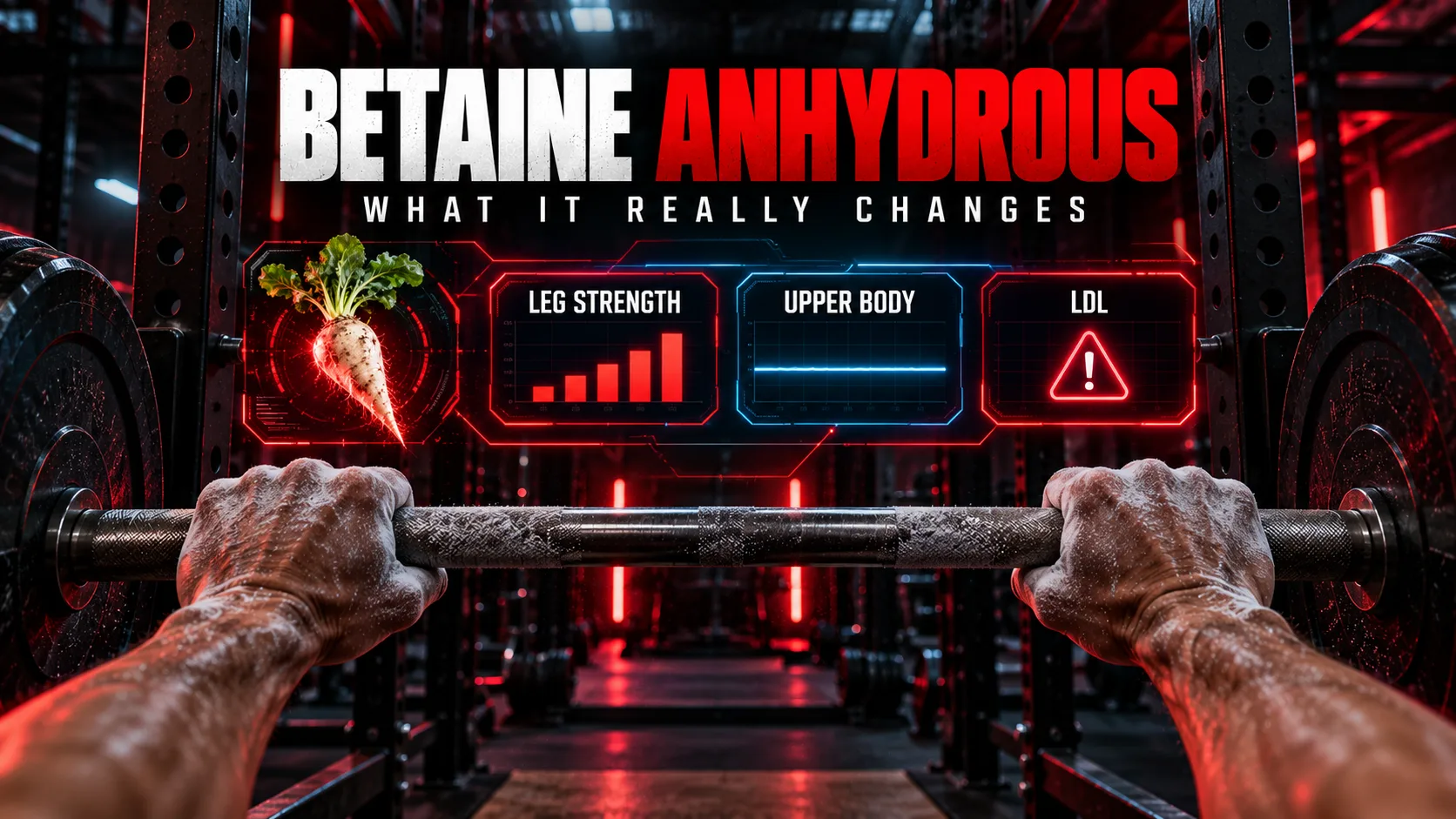
Betaine anhydrous shows up in many pre workouts with promises of more power and less fat. Unlike many ingredients, it has real trials behind it. The honest summary: a small to medium boost in lower body strength, mixed results for everything else, and one side effect worth knowing about.
This guide explains in plain words what betaine anhydrous is, what the trials found for strength, power and body fat, the dose the studies used, and who should be careful. Every figure comes from a PubMed abstract listed at the end. For the best studied strength supplement, see creatine loading.
Betaine anhydrous in brief
Three numbers sum up betaine anhydrous. The size of its effect on strength, the dose most trials used, and the rise in LDL cholesterol at a higher dose.
Effect on maximal strength in a 2024 review of 17 studies
That is a small to medium effect, mostly in lower body strength. Upper body strength and endurance did not clearly change (PMID 39514262).
The dose used in most strength trials of betaine
Several trials gave 2.5 grams a day for 2 to 6 weeks (PMID 22080324, PMID 23967897). Studies overall used 500 to 9,000 mg a day (PMID 24760587).
Rise in LDL cholesterol with 6 grams a day for 6 weeks
In healthy people, 6 grams a day raised LDL cholesterol and blood fats compared with placebo (PMID 15916468).
Every figure on this page comes from a PubMed abstract listed at the end. Effect size labels like small and medium are a rule of thumb. Doses are reported as study facts.
What this guide covers
What betaine anhydrous is and what it does in the body.
Betaine anhydrous benefits for strength, power, jumping and body fat, trial by trial.
The dose in the studies, side effects, and how to check a label.
Not covered
Betaine HCl, a different product sold for stomach acid. It is not the form used in the strength trials.
Brand rankings. We do not rank pre workouts.
What is betaine anhydrous and what does it do?
Betaine, also called trimethylglycine or TMG, is a natural compound first found in sugar beets. Anhydrous just means the dry form without water. You already eat some: seafood and wheat germ or bran are about 1 percent betaine, and spinach about 0.7 percent (PMID 15321791).
Betaine has two main jobs in the body. It helps cells hold water and cope with stress like heat or dehydration. It also donates methyl groups in the liver, which helps keep a compound called homocysteine in check (PMID 15321791).
How it might help training is less clear. Ideas include more creatine made in the body, better cell hydration, and less sense of fatigue. A 2014 review called the mechanisms poorly understood (PMID 24760587).
Betaine anhydrous benefits for strength: the pooled data
The best evidence is a 2024 review of 17 placebo controlled studies with 317 people. They were aged 15 to 60 and took betaine for at least 7 days. The chart shows what changed.
Betaine improved maximal strength with an effect size of 0.47, mostly in the lower body. Vertical jump improved after one low quality study was removed. There was no clear effect on upper body strength, cycling sprints, bench press throws or muscular endurance (PMID 39514262).
A 2026 network review of supplements for jumping found betaine added about 3.72 cm to the countermovement jump compared with placebo. The authors warned that some results were not robust in their sensitivity checks (PMID 42821324).
The individual betaine trials, in plain words
Looking at single trials shows why the results feel mixed. Some found clear gains, others found nothing.
| Trial | People and length | What they found |
|---|---|---|
| Hoffman 2009 | 24 active men, about 2 weeks | More squat reps and better quality reps; no change in power tests (PMID 19250531) |
| Lee 2010 | 12 trained men, 14 days | More bench throw power and isometric force; reps did not change (PMID 20642826) |
| Trepanowski 2011 | Trained men, 2.5 g a day, 14 days | No significant change in performance (PMID 22080324) |
| del Favero 2012 | Untrained people, 2 g a day, 10 days | No change in muscle phosphocreatine or strength; creatine worked (PMID 21744011) |
| Cholewa 2013 | 23 trained men, 2.5 g a day, 6 weeks | Better body composition, arm size and bench volume; no change in 1RM (PMID 23967897) |
A 2017 review of 7 good quality trials summed it up. Only 2 found gains in strength or power, of up to 24.61 percent. The other 5 found no change (PMID 28426517).

Does a betaine supplement change body fat?
Here the two main reviews disagree.
A 2019 review pooled 6 trials with 195 people. Betaine lowered fat mass by about 2.53 kg and body fat percentage by about 2.44 points. Body weight did not change (PMID 31623137).
A larger 2022 review found no effect on body weight, fat mass, body fat percentage or fat free mass. That held across age, sex, dose and trial length (PMID 34743773).
In one 6 week trial of trained men, body fat improved with 2.5 grams a day, while the placebo group did not change (PMID 23967897). Single trials like this are what make the early review look positive.
Betaine anhydrous dosage in the studies
There is no official dose. Studies on betaine for sport and health used 500 to 9,000 mg a day (PMID 24760587). Here is what the strength trials used.
| Dose | How long | Study |
|---|---|---|
| 2 g a day | 10 days | del Favero 2012 (PMID 21744011) |
| 2.5 g a day | 14 days | Trepanowski 2011 (PMID 22080324) |
| 2.5 g a day | 6 weeks | Cholewa 2013 (PMID 23967897) |
| 6 g a day | 6 weeks | LDL study, not a strength trial (PMID 15916468) |
The pooled strength benefit came from taking betaine for at least 7 days (PMID 39514262). Timing around the workout matters less than taking it every day.
Betaine anhydrous side effects and the LDL catch
Betaine is a normal part of food, and the short sport trials did not flag safety problems in their abstracts. But one finding matters for anyone watching their heart health.
Three placebo controlled studies in 151 healthy people gave 6 grams a day of betaine for 6 weeks. LDL cholesterol rose by 0.36 mmol/L and blood triglycerides by 0.14 mmol/L compared with placebo. The ratio of total to HDL cholesterol also rose (PMID 15916468).
That was at 6 grams a day, more than double the usual sport dose. Whether 2.5 grams a day raises LDL in the same way was not tested in these abstracts.
How to check a label for a real betaine anhydrous dose
Betaine anhydrous is often hidden inside a pre workout blend. Here is a quick checklist. It is a rule of thumb built from the trials above.
| Check | What to look for | Why |
|---|---|---|
| Form | Betaine anhydrous or trimethylglycine (TMG) | The form used in the strength trials |
| Amount | About 2 to 2.5 g per day, listed on its own | The dose most trials used (PMID 22080324) |
| Not HCl | Betaine HCl is a different product | Sold for stomach acid, not tested for strength here |
| No blend | Each ingredient with its own amount | A blend can hide a tiny dose |
Seven critical facts about betaine anhydrous
1. It is a food compound, also called TMG. Found in beets, seafood, wheat bran and spinach (PMID 15321791).
2. It gives a small to medium boost in maximal strength. Effect size 0.47, mostly in the legs (PMID 39514262).
3. Upper body strength and endurance did not clearly improve. (PMID 39514262).
4. Single trials are mixed. Only 2 of 7 good trials found gains in a 2017 review (PMID 28426517).
5. It is not a proven fat burner. The 2022 review found no change in body fat (PMID 34743773).
6. Most strength trials used 2.5 grams a day. (PMID 22080324, PMID 23967897).
7. At 6 grams a day it raised LDL cholesterol. (PMID 15916468).
So, is betaine anhydrous worth taking?
For strength, maybe. The pooled data show a small to medium gain in maximal strength, mostly in the lower body (PMID 39514262). Individual trials are mixed, and some found nothing (PMID 28426517, PMID 22080324).
For fat loss, no. The broadest review found no change in body composition (PMID 34743773). And at higher doses, betaine raised LDL cholesterol (PMID 15916468).
Our take: if your pre workout already has 2 to 2.5 grams of betaine, fine. If not, put your money into creatine first. More guides sit on the supplements hub and in evidence based supplements.
Betaine anhydrous: frequently asked questions
What is betaine anhydrous?
It is the dry form of betaine, also called trimethylglycine or TMG. It is found in sugar beets, seafood, wheat bran and spinach. It helps cells hold water and donates methyl groups in the liver (PMID 15321791).
What are betaine anhydrous benefits?
In a 2024 review of 17 studies, betaine improved maximal strength with an effect size of 0.47, mostly in the lower body. Upper body strength and endurance did not clearly change (PMID 39514262).
What does betaine anhydrous do for workouts?
It may give a small boost to leg strength and jumping after at least 7 days of use (PMID 39514262). It is not a stimulant, so you will not feel an instant effect.
How much betaine anhydrous should I take?
Most strength trials used 2.5 grams a day for 2 to 6 weeks (PMID 22080324, PMID 23967897). This is the research dose, not personal advice.
What are betaine anhydrous side effects?
At 6 grams a day for 6 weeks, betaine raised LDL cholesterol by 0.36 mmol/L and triglycerides by 0.14 mmol/L in healthy people (PMID 15916468). People with high cholesterol should ask a doctor first.
Does betaine help you lose fat?
Probably not. A 2019 review found less fat mass (PMID 31623137), but a broader 2022 review found no effect on body fat or weight (PMID 34743773).
Betaine anhydrous vs betaine HCl: what is the difference?
Betaine anhydrous is the form used in the strength trials on this page. Betaine HCl is a different product sold for stomach acid and was not part of these trials.
Is betaine as good as creatine?
No. In one trial, creatine raised muscle phosphocreatine and strength, while 2 grams a day of betaine did not (PMID 21744011).
Sources and further reading
Every figure on this page comes from one of the 13 papers below, checked against their PubMed abstracts on 26 October 2026. Effect size labels and the label checklist are rules of thumb and are marked as such. Reference links are dofollow to support open science.
Verified
Verified
Verified
Verified
Verified
Verified
Verified
Verified
Verified
Verified
Verified
Verified
Verified
More on strength ingredients
Four pages on what actually moves strength, and what to check in a pre workout.
Final Educational Note
This article is educational and is not medical advice. It reports what trials and reviews found about betaine anhydrous. Doses are reported as study facts, not as recommendations. If you have high cholesterol, heart, liver or kidney disease, are pregnant or are under 18, talk to your doctor before taking betaine. More guides sit on the supplements hub.
Read more about how this site works on the about page and in the full disclaimer.