Water Retention on TRT: Timeline, Red Flags & 7 Fixes
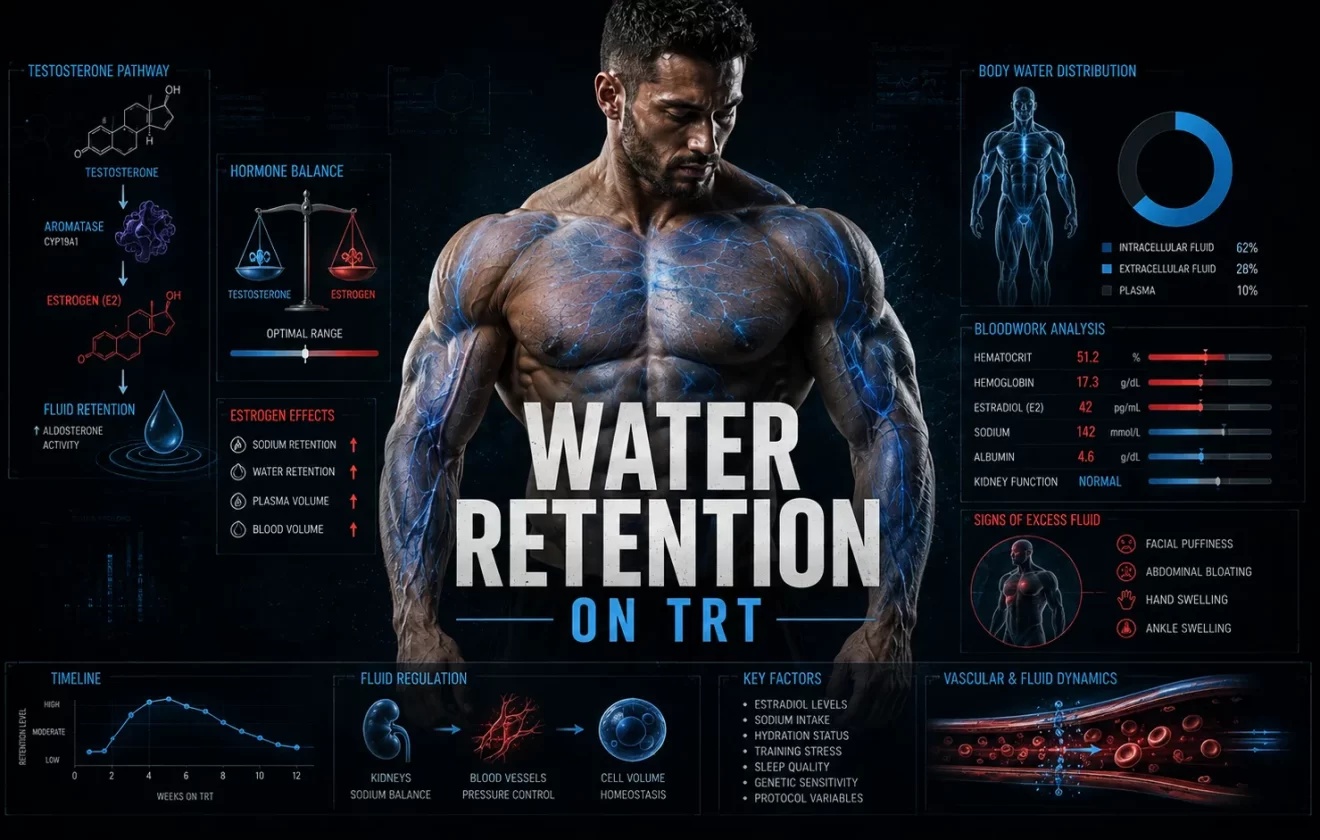
Water retention on TRT, explained
Many men start testosterone, feel better within weeks, and then notice the scale jump, a puffier face or slightly swollen ankles. Water retention on TRT is one of the most common early complaints, and it is usually mild, temporary and manageable. But it is also widely mishandled - most pages either dismiss it or push an aromatase inhibitor you probably do not need. This guide explains the two ways testosterone makes you hold fluid, how to tell ordinary water retention on TRT from swelling that needs a doctor today, and the graded fixes that actually work.
What water retention on TRT means in one screen
Testosterone holds sodium at the kidney, and some converts to estradiol - both pull water into your tissues.
Usually about one to two kilos of fluid, worst in weeks 3-6, easing by 8-12 weeks as levels stabilise.
Split or lower the dose, cut excess salt, keep moving - and never reach straight for an aromatase inhibitor.
The reassuring headline: for most men, early water retention on TRT is your body adjusting to a higher androgen level, not a warning sign. A few pounds that appear in days are fluid, not fat - you cannot gain real fat that fast. The job is to keep it mild and to recognise the small number of cases where swelling means something else.
This page is written for men on therapeutic testosterone. As with hematocrit, TRT and high-dose anabolic cycles are different worlds: gram-level cycles cause far more dramatic fluid shifts and need a different approach. If you are on TRT, do not assume blast-cycle bloat - but do not ignore swelling that ticks the red-flag boxes below. For the estrogen side of this, see our guide to estradiol on TRT.
Why testosterone makes you retain water - two pathways

There are two mechanisms, and confusing them is why so much advice is wrong. The first is direct: testosterone acts on the kidney tubules to reabsorb more sodium, and water follows the salt, so the volume of fluid outside your cells rises. In hypogonadal men given testosterone, extracellular water measurably increased even when the classic salt-regulating hormones (renin and atrial natriuretic peptide) did not change - evidence that testosterone itself, not only estrogen, drives water retention on TRT.
The second pathway is estradiol. A fraction of your testosterone aromatizes to estradiol, and estradiol also influences sodium handling, vasopressin and fluid balance. This is the pathway everyone blames - but estradiol is essential in men for bone, joints, libido and mood, so the goal is a healthy level, not the lowest possible one. Both pathways scale with dose and with peaks: a big once-weekly injection produces a supraphysiologic spike that drives more retention than the same weekly dose split into smaller, more frequent shots.
How long does water retention on TRT last?

For most men the pattern is predictable. Fluid climbs over the first couple of weeks, peaks somewhere around weeks three to six, and then eases as your body adapts and hormone levels reach a steady state - usually much improved by eight to twelve weeks and stable by three to six months. The typical magnitude is modest, on the order of one to two kilograms of water, which is why the early "weight gain" alarms so many men who assume it is fat.
If your water retention on TRT is still worsening after about twelve weeks, or it appeared suddenly and dramatically rather than building gradually, that is no longer simple "settling in" and deserves a closer look. Track it with a morning weight and how your rings, shoes and face feel - trends matter more than a single reading, and comparing the mirror and a tape measure to the scale helps separate water from real tissue change.
Why some men retain a lot of water on TRT and others barely notice
Two men on the same protocol can have completely different experiences, and knowing the drivers helps you predict and manage yours. The biggest factors are dose and peak (higher and spikier means more fluid), delivery method (large weekly injections versus steady daily gels or split shots), baseline body fat (more adipose tissue means more aromatase, so more estradiol), and salt intake and genetics of sodium handling. Leaner men on modest, well-split doses often barely register any water retention on TRT at all, while a heavier man starting a big once-weekly injection may feel it strongly for a month.
It also helps to understand where the water sits. Early on, most of it is extracellular - fluid held in the tissue spaces that shows up as puffiness and a higher morning weight. Some scale weight in men who also start training is intracellular and benign: every gram of stored muscle glycogen binds roughly three grams of water, so filling out with training adds "water" that is actually a sign of recovery, not a problem. Separating these from real fat gain is straightforward once you know the tells.
How to tell what your new weight actually is
The panic around water retention on TRT usually comes from misreading the scale. Use three simple signals to decode it. Rate: fluid appears in days and swings day to day; fat accrues slowly over weeks and does not fluctuate; muscle is slower still. Distribution: water shows as all-over puffiness, softer face, fuller ankles and fingers; fat concentrates at the waist; muscle shows in the trained areas. Method: track a morning weight trend, a waist tape measure and the mirror together - if the scale is up but the tape and mirror are stable, you are holding water, not gaining fat.
This matters because the wrong diagnosis drives the wrong action. Men who mistake early water retention on TRT for fat often slash calories or add stimulants; men who mistake it for a hormone emergency often demand an aromatase inhibitor. Both overreact to a normal, self-limiting adjustment. Give the fluid a few weeks, apply the graded fixes, and re-measure before making any big change.
When swelling is an emergency, not just water weight
This is the section most articles skip, and it is the most important. Ordinary water retention on TRT is soft, mild, roughly symmetrical and stable or improving. A small number of presentations are not benign and need urgent attention - do not wait to "adjust your dose."
| Picture | What it suggests | What to do |
|---|---|---|
| Mild, even puffiness in face/hands/ankles; a few pounds; improving over weeks | Ordinary early fluid retention | Use the fixes below; monitor |
| Swelling of one leg, calf pain, warmth or redness | Possible deep-vein blood clot (DVT) | Urgent medical care the same day |
| Breathlessness, chest pain, cannot lie flat, sudden severe swelling | Possible pulmonary embolism or heart strain | Emergency services now |
| Rapid gain (for example 5+ lb in days), pitting edema, known heart/kidney disease | Fluid overload needing evaluation | Contact your clinician promptly |
The large TRAVERSE safety trial recorded events such as pulmonary embolism among men on testosterone, which is exactly why one-sided leg swelling or new breathlessness should never be written off as "just water." When in doubt, get it checked - the downside of an unnecessary review is small; the downside of a missed clot is not.
Should you take an aromatase inhibitor for TRT bloating?
Here is the single biggest mistake in this space: reaching for an aromatase inhibitor (anastrozole/Arimidex) to dry out water retention on TRT. It is tempting because estradiol contributes to fluid - but crushing estradiol trades a cosmetic problem for real harm. Major guidelines do not recommend routine aromatase inhibitors in standard testosterone therapy; they are reserved for confirmed, symptomatic estradiol elevation measured on a sensitive assay.
When estradiol is driven too low, men get joint pain, low libido and erectile problems, flat mood or depression, worse cholesterol, and - proven in controlled studies - accelerated bone loss, because estradiol is what protects male bone. In other words, the drug people take to look less puffy can quietly weaken their skeleton and their sex drive. The correct first moves for water retention on TRT are dose, frequency and lifestyle, not a hormone-blocker. If estradiol genuinely is high and symptomatic, that is a conversation to have with your prescriber with real labs in hand - see estradiol on TRT.
How to reduce water retention on TRT, in order
Work these from the top. Most men never need to go far down the list, and none of the durable fixes involve a diuretic drug.
- Give it time. Early fluid usually settles by 8-12 weeks. If you just started, adaptation alone fixes most water retention on TRT.
- Split or lower the dose. Smaller, more frequent injections (or a daily gel) blunt the peaks that drive retention, without changing your weekly total.
- Cut excess sodium. Trim processed and restaurant food; you are managing salt, not starving yourself of it.
- Hydrate properly. Under-drinking can worsen sodium retention, so steady water intake helps rather than hurts.
- Get potassium from food. Fruit and vegetables help balance sodium - but avoid potassium supplements or salt-substitutes if you have kidney disease or take an ACE inhibitor, ARB or spironolactone.
- Move and lose excess fat. Activity and a leaner body composition both reduce fluid retention over time.
- Monitor blood pressure. Sodium and fluid raise it; a home cuff catches problems the mirror misses.
Notice what is not on the list: pharmacologic diuretics and herbal "water pills." Using a diuretic to chase cosmetic water weight is inappropriate, can disturb electrolytes, and - worst of all - can mask the very swelling that signals a clot or heart problem. Fix the cause, do not paper over the signal.
Water retention, sodium and your blood pressure
Because water retention on TRT is fundamentally about holding sodium and fluid, it is tied to blood pressure, and testosterone products carry labelled warnings about blood-pressure increases. Sex-hormone effects on sodium and water handling feed directly into blood-pressure regulation, so the same habits that reduce puffiness - less salt, steady hydration, activity, sensible dosing - also protect your numbers.
Practically: buy a home blood-pressure monitor, take readings at consistent times, and share the trend with your clinician alongside your TRT bloodwork. Do not confuse fluid weight with the separate issue of thicker blood from a rising hematocrit on TRT - both deserve monitoring, but they are different problems with different fixes.
Water retention on TRT: FAQ
How long does water retention on TRT last?
Does TRT cause a puffy face or moon face?
When is swelling on TRT an emergency?
Should I take an aromatase inhibitor for water retention on TRT?
Is my TRT weight gain fat or water?
Does the type of testosterone affect water retention?
Will drinking more water help TRT bloating?
Sources & further reading
The bottom line on water retention and TRT
Water retention on TRT is common, usually mild, and almost always a passing part of adjusting to therapy. Give it a few weeks, keep your dose steady and split, watch your salt and your blood pressure, and skip the aromatase inhibitor unless real labs and symptoms justify it. Reserve urgency for the red flags - one-sided leg swelling, breathlessness, rapid pitting edema - and manage the rest calmly with your prescriber and your TRT bloodwork in view.
This article is published for educational purposes only. It explains why fluid retention can occur on testosterone replacement therapy, drawing on publicly available clinical guidelines and peer-reviewed physiology research. Nothing here is medical advice, a treatment recommendation, or a substitute for care from a licensed clinician. MuscleScience.org does not sell, supply, prescribe, or affiliate with any testosterone product, medication, pharmacy, or clinic.
Fluid balance varies by dose, ester, delivery method, salt intake, body composition, medications, and underlying heart, kidney and liver health. Do not start, stop, change, or add any medication - including an aromatase inhibitor or a diuretic - without the clinician who manages your treatment, and treat one-sided leg swelling, chest pain or breathlessness as an emergency rather than a side effect. Related blood markers and blood-pressure monitoring are covered at the bloodwork hub.
This contributor writes under a pseudonym. The photograph above is a stylized portrait, not a real image of the writer. See our About page for details on our editorial team and anonymity policy. Water retention and blood pressure travel together; see blood pressure on TRT.