High Hematocrit on TRT: Safe Levels & 6 Ways to Lower It
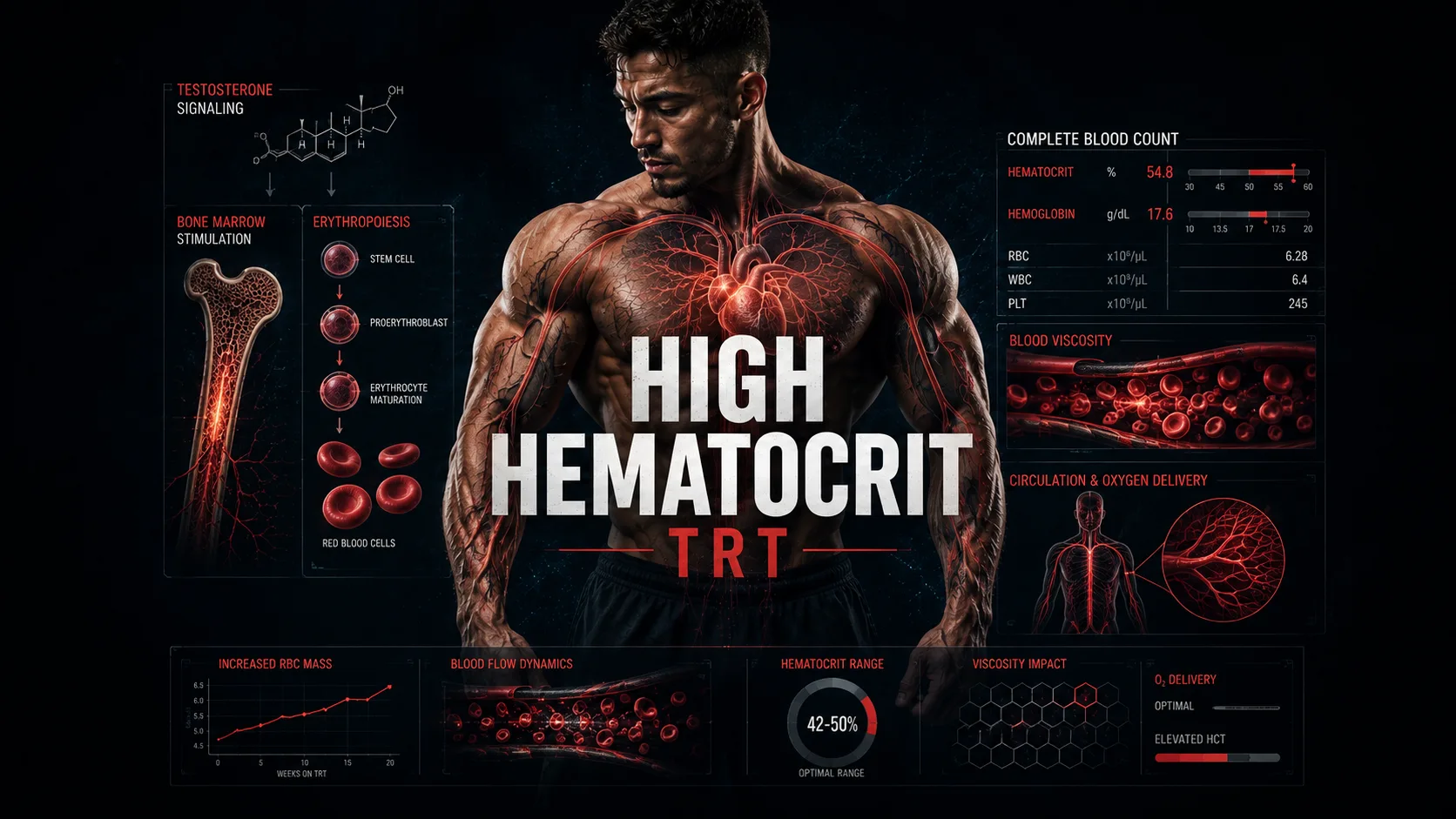
HIGH HEMATOCRIT ON TRT: SAFE LEVELS & 6 WAYS TO LOWER IT
High hematocrit on TRT is the most common lab change testosterone causes. It is also the one most likely to get your dose cut or therapy paused. The fixes are graded, and most men never need to jump straight to having blood drawn off.
This guide covers the safe range for hematocrit on TRT and why injections push it up most. It also shows how to lower hematocrit on TRT step by step, and what the clot evidence really shows. Every figure comes from a PubMed abstract, the guideline or the gel label, listed at the end. Testing is covered in TRT bloodwork.
High hematocrit on TRT in three numbers
Three numbers frame high hematocrit on TRT. The action line, how much injections raise it, and how often heart and clot events showed up above 52 percent.
Where guidance says reduce or stop testosterone
A urology consultation guide says to decrease or stop therapy above 54 percent until hematocrit normalizes (PMID 36335038).
Hematocrit rise on weekly injections in 16 weeks
In matched men, injections raised hematocrit 4.4 points, pellets 1.7, and nasal gel lowered it 0.8 (PMID 37068153).
Heart or clot events with hematocrit 52% or more
In the first year of TRT, men who reached 52 percent had more heart and clot events than matched men who did not (PMID 35050717).
Every figure here comes from a PubMed abstract, the Endocrine Society guideline or the AndroGel label, listed at the end. Lines marked rule of thumb are common practice, not study results. This page is education, not medical advice.
What this hematocrit on TRT guide covers
Safe levels: the 52 and 54 percent lines and why they are fuzzier than they look.
How to lower hematocrit on TRT: 6 steps, from a retest to phlebotomy.
Risk: what the clot and heart data do and do not show.
Not covered
Steroid cycles. See do steroids cause high hematocrit.
The marker basics. See hematocrit and hemoglobin explained.
What is a safe hematocrit on TRT?
Hematocrit is the share of your blood volume taken up by red cells. Hematocrit on TRT is checked on a schedule for that reason. Testosterone raises it in most men, and the labels and guidelines set lines for when to act.
The gel label checks hematocrit before starting, at 3 to 6 months, then yearly. If it becomes elevated, therapy stops until it falls to an acceptable level (AndroGel label).
The Endocrine Society defines erythrocytosis as hematocrit above 54 percent (Endocrine Society guideline, PMID 29562364). A 2023 consultation guide says to decrease or stop testosterone above 54 percent until it normalizes (PMID 36335038).
Here is the honest part. A 2022 review found little evidence that hematocrit itself causes harm on TRT, and called the guideline cutoffs arbitrarily chosen (PMID 34987178).
Why TRT raises hematocrit, and why injections raise it most
The rise in hematocrit on TRT has a clear mechanism. In older men on testosterone gel, hemoglobin and hematocrit rose 7 to 10 percent in 6 months. Erythropoietin, the hormone that drives red cell production, went up (PMID 24158761).
Hepcidin, the hormone that locks iron away, went down. That frees iron for new red cells. The authors described a new, higher set point for red cells (PMID 24158761).
The rise is dose dependent and larger in older men (PMID 18160461). Short acting injections carry the highest risk of any form (PMID 28526632).
| Study | What was compared | Result |
|---|---|---|
| Reddy 2023 | Matched men, 16 weeks | Injections +4.4 points, pellets +1.7, nasal gel minus 0.8 (PMID 37068153) |
| Pastuszak 2015 | Hematocrit over 50 percent, up to 3 years | Injections 66.7%, pellets 35.1%, gels 12.8% (PMID 26468380) |
| Dobs 1999 | Shots every 2 weeks vs patch | Abnormal rises 43.8% vs 15.4% (PMID 10522982) |
| Calof 2005 | 19 trials, men over 45 | Odds of hematocrit over 50 percent 3.69 times placebo (PMID 16339333) |
The pattern is the same in every study: steady low dose forms raise hematocrit less than a big weekly or two weekly spike. Timing is covered in TRT injection frequency.
Why some men get high hematocrit on TRT and others do not
Two men on the same plan can land far apart on hematocrit on TRT. A 20 year study of 1,073 transgender men on testosterone found clear risk factors for hematocrit over 50 percent (PMID 33599731).
| Factor | Odds ratio |
|---|---|
| Smoking | 2.2 |
| Long acting undecanoate injections | 2.9 |
| Higher BMI | 3.7 |
| Lung conditions linked to erythrocytosis | 2.5 |
Most of the rise came in the first year, from 0.39 to 0.45. Yet the chance of erythrocytosis kept climbing, from 10 percent at 1 year to 38 percent at 10 years (PMID 33599731).
Untreated severe sleep apnea is a reason not to start TRT (Endocrine Society guideline, PMID 29562364). Rule of thumb: if you snore or wake unrefreshed, ask about a sleep study early.

Dehydration and draw timing can fake a high reading
Hematocrit on TRT is a concentration. Anything that lowers the water in your blood raises the percentage without adding a single red cell.
Rule of thumb: before acting on one high result, repeat it under steady conditions.
| Step | Why |
|---|---|
| Drink normally the day before and that morning | Low plasma volume inflates the number |
| Skip hard training and sauna for a day | Fluid loss shifts the reading |
| Same point in the injection cycle each time | Peaks drive red cell production |
| Mention any recent blood donation | Donation lowers the reading for a while |
How to lower hematocrit on TRT: 6 ways, in order
How to lower hematocrit on TRT is a ladder. You climb only as far as you need, with your prescriber.
1. Recheck under steady conditions. Rule of thumb: rule out a dehydration artefact first.
2. Split the dose. This is often the first real step in how to lower hematocrit on TRT. Peaks drive red cell production, and short acting injections carry the highest risk (PMID 28526632). Smaller, more frequent shots lower the peak.
3. Lower the total dose. The hematocrit rise is dose dependent (PMID 18160461). The gel label stops therapy until hematocrit settles (AndroGel label).
4. Switch to a gel or another form. Gels caused the least erythrocytosis in one comparison (PMID 26468380), and nasal gel lowered hematocrit in another (PMID 37068153).
5. Fix what you can. Smoking and higher BMI raised the odds (PMID 33599731). The authors advised quitting smoking, going transdermal and losing weight as a first step.
6. Phlebotomy, as a last resort. Evidence that it is effective or safe for testosterone induced erythrocytosis is lacking (PMID 39212549). More below.

Phlebotomy and blood donation are not a free fix
Removing blood lowers high hematocrit on TRT fast. But a 2024 review found no solid evidence that phlebotomy is effective or safe for testosterone induced erythrocytosis (PMID 39212549).
The same review warned that phlebotomy lowers tissue oxygen and drains iron, which could switch on pathways that raise clot risk (PMID 39212549).
Donation alone did not keep hematocrit under 54 percent in men on TRT. In 44 percent of repeat donors it stayed high (PMID 28150363).
In a trial of 20,757 donors, shorter gaps between donations lowered ferritin, the iron store marker. In men it fell 6.5 percent per week shorter (PMID 31383583).
Does high hematocrit on TRT raise clot and heart risk?
The evidence on high hematocrit on TRT points in more than one direction, so here it is straight.
A database study matched 5,842 men on TRT who reached hematocrit of 52 percent or more with men who did not. The high group had more heart and clot events in year one, odds ratio 1.35 (PMID 35050717).
In the same study, men on testosterone without polycythemia had no more events than untreated men (PMID 35050717).
TRAVERSE, the large randomized trial, found no rise in major heart events on testosterone. It did find more atrial fibrillation, acute kidney injury and pulmonary embolism (PMID 37326322).
A 2025 review concluded that the route of delivery strongly shapes the hematocrit rise and can be chosen to limit it (PMID 40126900).
Monitoring hematocrit on TRT, and when to pause testosterone
| When | What | Source |
|---|---|---|
| Before starting | Check hematocrit | AndroGel label |
| 3 to 6 months | Recheck hematocrit | AndroGel label |
| Yearly | Recheck hematocrit | AndroGel label |
| Above 54 percent | Reduce or stop testosterone until it normalizes | PMID 36335038 |
| After any change | Rule of thumb: retest a few weeks later, not months | Rule of thumb |
Rule of thumb: if hematocrit is very high for your dose, ask your doctor to rule out a primary blood disorder. The same goes if platelets and white cells are also up. Experimental drugs are covered in rusfertide.
Keep hematocrit on TRT in the context of the whole plan in TRT bloodwork, and blood pressure in blood pressure on TRT.
High hematocrit on TRT: frequently asked questions
At what hematocrit should testosterone be stopped?
Guidance says to reduce or stop testosterone above 54 percent until hematocrit normalizes (PMID 36335038). The gel label stops therapy until it falls to an acceptable level (AndroGel label).
Is a hematocrit of 52 dangerous on TRT?
Not by itself. A review called the cutoffs arbitrary (PMID 34987178). Men at 52 percent or more did have more heart and clot events in year one, odds ratio 1.35 (PMID 35050717).
Does gel raise hematocrit less than injections?
Yes in comparisons. Hematocrit over 50 percent occurred in 66.7 percent on injections and 12.8 percent on gels (PMID 26468380).
How do I lower hematocrit on TRT without phlebotomy?
Split or lower the dose, switch to a steadier form, stop smoking and lose weight if needed (PMID 33599731, PMID 26468380). Do it with your prescriber.
How often should hematocrit be checked on TRT?
Before starting, at 3 to 6 months, then yearly (AndroGel label).
Can dehydration cause a high hematocrit?
Rule of thumb: yes. Hematocrit is a concentration, so low plasma volume raises it. Recheck under steady conditions before acting.
Does blood donation fix high hematocrit on TRT?
Not reliably. In 44 percent of repeat donors on TRT it stayed high (PMID 28150363), and frequent donation lowers ferritin (PMID 31383583).
Why does testosterone raise hematocrit?
It raises erythropoietin and lowers hepcidin, which frees iron for red cells (PMID 24158761).
Sources and further reading
Every figure on this page comes from one of the 18 sources below. That is 17 papers checked against PubMed on 27 October 2026, plus the AndroGel 1.62% label on DailyMed. The 20 year risk factor study was done in transgender men. Lines marked rule of thumb are common practice. Reference links are dofollow to support open science.
Verified
Verified
Verified
Verified
Verified
Verified
Verified
Verified
Verified
Verified
Verified
Verified
Verified
Verified
Verified
Verified
Verified
Verified
More from the TRT series
Four pages that sit next to hematocrit on TRT.
Final Educational Note
This article is educational and is not medical advice. It reports what studies, the guideline and the gel label say about hematocrit on testosterone therapy. Any change to dose, form or phlebotomy belongs to your prescriber.
Persistent headache, blurred vision, chest pain, sudden breathlessness or one sided leg swelling on testosterone need a doctor at once. More guides sit on the TRT and hormones hub. Read more on the about page and in the full disclaimer.