Do Steroids Cause High Hematocrit? 7 Critical Facts
DO STEROIDS CAUSE HIGH HEMATOCRIT? 7 CRITICAL FACTS
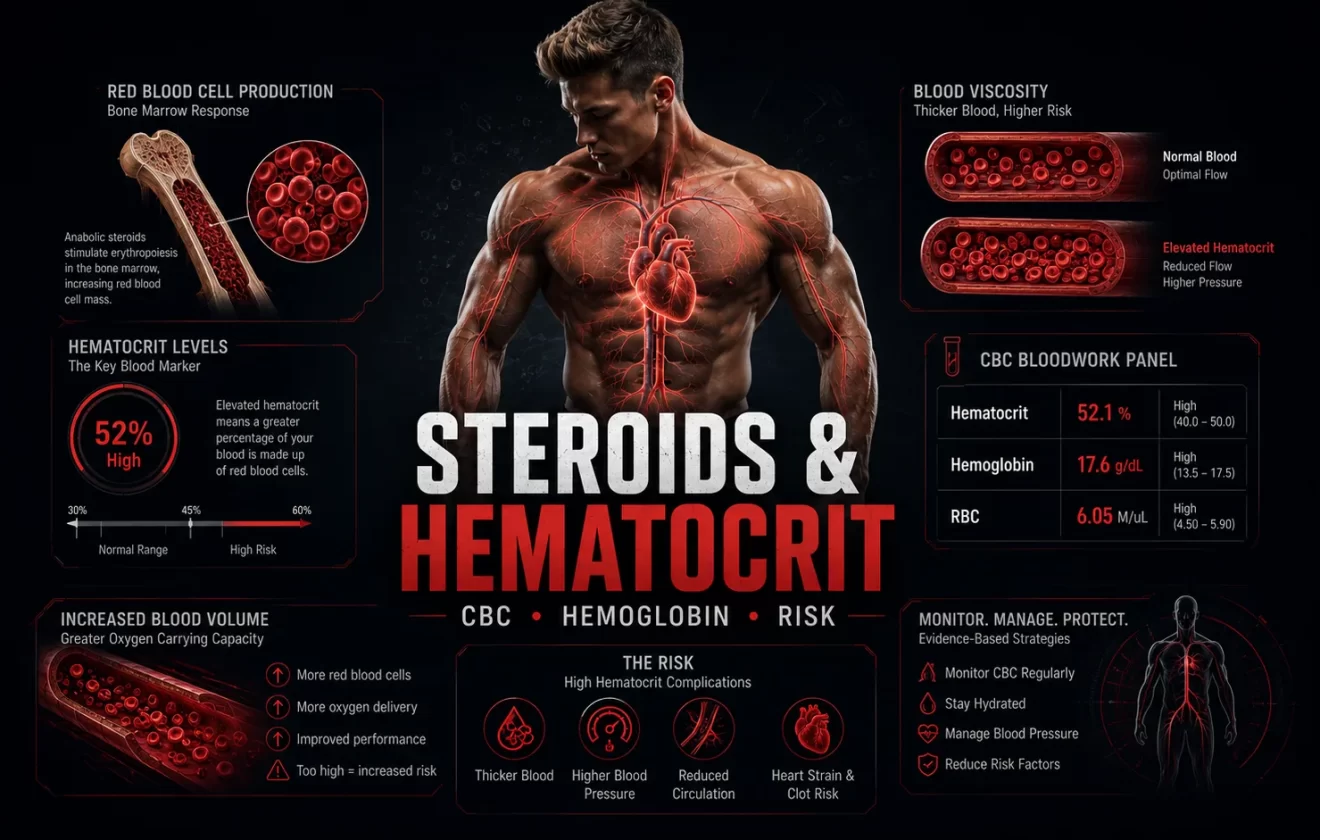
Yes, and more reliably than almost any other change they produce. Androgens raise red cell production in a dose dependent way, and in men on prescription testosterone the reported rates of erythrocytosis run as high as two thirds. What is far less settled is where the danger line sits, because the trial everyone quotes for it was run in a blood disorder rather than in lifters. This guide covers the cause, the size and the evidence behind the threshold; managing a high reading on TRT is a separate page.
Data in brief
Three figures frame the whole question: how much androgens move red cells, how often it crosses into a diagnosis, and where the number that everyone quotes as the danger line actually comes from.
In a randomized trial of testosterone gel in older men with mobility limitation, hemoglobin rose about 7 per cent and hematocrit about 10 per cent, alongside a rise in erythropoietin and a fall in hepcidin and ferritin (PMID 24158761).
A 2025 systematic review of drug induced erythrocytosis found rates of up to 66.7 per cent in men on prescription testosterone, with intramuscular formulations, higher doses and older age carrying more risk, and thromboembolic events in up to 2.7 per cent (PMID 39913688).
The trial behind the 45 per cent target randomized 365 patients with polycythemia vera. Cardiovascular death or major thrombosis occurred in 2.7 per cent below that target against 9.8 per cent at 45 to 50 per cent, hazard ratio 3.91 (PMID 23216616). Those were not steroid users.
What this guide covers
The size of the effect and what drives it. Dose, route, age and the other variables that changed the numbers in controlled work.
The mechanism, including the part that is disputed. Erythropoietin, hepcidin, and two trials that disagree about which one is doing the work.
Where the threshold evidence comes from, and why importing it into this population is an assumption rather than a finding.
What else raises the hematocrit reading when the compounds are not to blame.
Not covered
What to do about a raised hematocrit. Thresholds on therapy, donation, iron and monitoring belong to the page on managing it.
Reading the two markers against each other. Hematocrit against hemoglobin is covered by the CBC markers guide.
Any protocol. No compound, dose or treatment is recommended here.
Do steroids cause high hematocrit? The direct answer
Yes, and the relationship is dose dependent rather than incidental. In a dose response study, men received a monthly GnRH agonist plus one of five weekly doses of testosterone enanthate, 25, 50, 125, 300 or 600 mg intramuscularly, for 20 weeks. Hemoglobin and hematocrit rose in a linear, dose dependent fashion in both the 61 young men and the 60 older men, and the rise was significantly greater in the older group (PMID 18160461).
At a therapeutic dose the change is moderate. Testosterone gel for six months in older men raised hemoglobin by about 7 per cent and hematocrit by about 10 per cent (PMID 24158761). At the doses used outside medicine there is no equivalent controlled trial, which is worth saying plainly: the dose response line above stops at 600 mg a week, and nobody has run the experiment beyond it.
How often that rise crosses into a diagnosis of erythrocytosis depends heavily on the preparation. The 2025 systematic review reports rates up to 66.7 per cent in cisgender and transgender men on prescription testosterone, and names intramuscular formulations, higher doses and older age as the risk factors (PMID 39913688).
What actually drives the rise, and what only gets repeated
Four of the rows below rest on controlled data. Three of them are things this audience says constantly and nobody has measured.
| Variable | Direction | What the evidence actually says | Source |
|---|---|---|---|
| Dose | Higher dose, bigger rise | Linear and dose dependent across 25 to 600 mg a week of testosterone enanthate in 121 men | PMID 18160461 |
| Route and preparation | Intramuscular more than transdermal | Named as a risk factor in a systematic review of 45 studies on drug induced erythrocytosis | PMID 39913688 |
| Age | Older men rise more | The increase in hemoglobin and hematocrit was significantly greater in men aged 60 to 75 than in men aged 19 to 35 on the same doses | PMID 18160461 |
| Time on drug | Fast at first, then a new set point | Erythropoietin and hepcidin moved at one and three months, then returned toward baseline by six months while hemoglobin stayed elevated | PMID 24158761 |
| Which compound | Widely claimed, thinly evidenced | Reviews of androgen use in athletes describe effects on erythropoiesis as a class effect. No controlled trial has compared specific compounds head to head for this outcome | PMID 15248788 |
| Injection frequency | Commonly asserted | No controlled trial has tested whether splitting the same weekly dose changes the red cell response | Not established |
| Untreated sleep apnea | Plausible, and a guideline concern | Severe untreated obstructive sleep apnea is listed as a condition against starting testosterone therapy, though the interaction with red cell counts has not been quantified in this population | PMID 29562364 |
Why it happens, and the part that is still disputed
The accepted outline is that androgens push red cell production two ways at once: erythropoietin rises, and hepcidin, the protein that restricts iron availability, falls, which frees more iron for the marrow. In the testosterone gel trial, erythropoietin rose while ferritin and hepcidin fell at one and three months. By six months both had drifted back toward baseline even though hemoglobin and hematocrit stayed high, which the authors read as a new set point rather than a continuing push (PMID 24158761).
Here is the part most pages skip. In the dose response study, there was no significant difference in the percent change in erythropoietin across the five dose groups, and changes in erythropoietin did not correlate with changes in total or free testosterone (PMID 18160461). Two well conducted studies, two different pictures of the same mechanism. A 2024 review sets out the fuller version, with an initial erythropoietin rise, a new set point, a parallel fall in hepcidin, and several other candidate mechanisms alongside them (PMID 39212549).
What follows from that honestly is narrow: the direction is certain, the size is dose related, and the exact pathway is not settled. Anyone explaining this in one sentence is overstating what has been shown.
Where the danger line actually comes from
Ask why 45, or 50, or 54 per cent is the number that matters and the answer almost always traces back to one trial. It is worth looking at directly, because what it shows is strong and what it does not cover is important.

CYTO-PV randomized 365 adults with JAK2 positive polycythemia vera to a target below 45 per cent or a target of 45 to 50 per cent. Over a median of 31 months, death from cardiovascular causes or major thrombosis occurred in 5 of 182 patients in the tighter group, 2.7 per cent, against 18 of 183, 9.8 per cent, in the looser one, a hazard ratio of 3.91 with a confidence interval of 1.45 to 10.53 (PMID 23216616).
That is a real result, and it is the reason clinicians take a rising hematocrit seriously rather than shrugging at it. It is also a trial in a myeloproliferative disease, in patients being treated with phlebotomy or hydroxyurea, at a median age far above that of most people reading this. No trial has randomized androgen users to a hematocrit target. Treating the 45 per cent figure as a proven line for a lifter on cycle is an extrapolation, and the honest framing is that it is the best available anchor rather than a measured threshold for this group.
What has been observed directly in this population is narrower and still serious: thromboembolic events in up to 2.7 per cent of men on testosterone therapy across the studies reviewed in 2025 (PMID 39913688), and a documented case literature of testosterone use producing erythrocytosis (PMID 29038321). The Endocrine Society guideline lists elevated hematocrit among the conditions against starting testosterone therapy at all, and puts hematocrit in the standard monitoring plan for the first year (PMID 29562364).
When it is not the steroids
A high hematocrit on a report is a ratio of cells to plasma, which means half the ways of raising it do not involve making a single extra red cell. Before anyone concludes that a compound did it, these belong on the list.
| Cause | What it does | What the evidence says | Source |
|---|---|---|---|
| A hard session or a hot day before the draw | Plasma volume falls, so the hematocrit rises without a single extra red cell | Blood and plasma volume adapt to training and to heat and dehydration, and the percentage is a ratio | PMID 10694114 |
| Endurance training over months | Total hemoglobin mass genuinely rises, but plasma volume expands too | Trained athletes carry more hemoglobin in absolute terms while their percentage often looks ordinary | PMID 20335738 |
| A marathon or similar effort | Several blood parameters shift acutely around the event | Measured directly in runners before and after a marathon | PMID 12472278 |
| Living or training at altitude | Red cell mass rises as a normal adaptation | Well established in the exercise physiology literature | PMID 24273518 |
| Untreated obstructive sleep apnea | Chronic low oxygen drives red cell production | Named in the Endocrine Society guideline as a condition against starting therapy; the size of the interaction is not quantified here | PMID 29562364 |
| Smoking | Raises the hematocrit through carbon monoxide exposure | Long recognised clinically, but not measured in androgen users as a combined effect | Not quantified here |
| A primary blood disorder | Polycythemia vera is a distinct disease, not a side effect | This is why a persistently high reading is a question for a physician rather than a forum | PMID 23216616 |
The practical consequence is that a single high reading taken the morning after a hard session in the heat is a weak basis for any decision, and a repeat draw under ordinary conditions settles more than an argument about compounds does.
Androgens against every other drug that does this
A different dataset from the chart above: reported rates of erythrocytosis by drug class across 45 studies and 2,036 screened articles. Androgens sit at the top of the list by a wide margin. Liu 2025, PMID 39913688.
The same review recorded thromboembolic events in up to 2.7 per cent of men on testosterone therapy, and in up to 10 per cent of the patients taking SGLT-2 inhibitors, which is a reminder that the rate of the finding and the rate of harm are two different numbers.
One more thing that review settled, at least for a neighbouring drug class: patients who stopped the SGLT-2 inhibitor showed improvement or resolution of the erythrocytosis. For androgens the equivalent question, how completely and how fast the hematocrit comes down, is handled on the management page, where the honest answer includes that the evidence supporting therapeutic phlebotomy in this setting is described as lacking (PMID 39212549).
Six claims about high hematocrit that do not survive
Each of these is standard gym advice. Each one is either contradicted or simply unmeasured.
It is only a problem above 54 per cent
No trial has tested any threshold in androgen users. The number people quote traces to a trial in polycythemia vera where the comparison was below 45 against 45 to 50 per cent, and the looser target carried nearly four times the event rate (PMID 23216616).
Splitting the dose fixes it
Nothing has tested whether the same weekly dose split across more injections changes the red cell response. What has been tested is the dose itself, which mattered a great deal (PMID 18160461).
Donating blood solves it
A 2024 review states directly that evidence supporting the efficacy or safety of therapeutic phlebotomy for lowering hematocrit in this setting is lacking (PMID 39212549). That is not the same as saying it does not work; it means it has not been shown.
It is just dehydration
Sometimes it is, and that is worth ruling out with a repeat draw under ordinary conditions (PMID 10694114). But rates of genuine erythrocytosis up to 66.7 per cent on prescription testosterone are not a hydration artefact (PMID 39913688).
Only certain compounds do it
Reviews describe effects on erythropoiesis as a class property of androgens (PMID 15248788). No controlled trial has ranked specific compounds against each other for this outcome, so confident rankings are folklore with numbers attached.
Feeling fine means it is fine
The finding is silent. Thromboembolic events were reported in up to 2.7 per cent of men on testosterone therapy, and the case literature exists precisely because nobody felt it coming (PMID 39913688, PMID 29038321).
Where people go wrong reading this
- Treating a percentage as a count. Hematocrit is the share of blood volume made of red cells, so plasma volume moves it without any change in red cell production (PMID 10694114).
- Acting on one draw. A repeat under ordinary conditions, not after a hard session or a hot day, settles more than any argument about compounds.
- Importing a threshold without saying where it came from. The evidence behind it is strong in the disease it was tested in, and absent in this one.
- Ignoring the rest of the panel. Pressure and lipids move in this population too. See the blood pressure page and the cholesterol page.
- Skipping the baseline. Without a pre-cycle reading there is nothing to compare against, which is the argument made in the baseline guide.
British spellings of these markers, haematocrit and haemoglobin, refer to exactly the same measurements and appear on reports outside the United States.
Frequently asked questions
Do steroids cause high hematocrit?
Yes, dose dependently. Across five weekly doses of testosterone enanthate from 25 to 600 mg in 121 men, hemoglobin and hematocrit rose in a linear fashion, and more in older men than younger ones (PMID 18160461). On prescription testosterone, reported rates of erythrocytosis run as high as 66.7 per cent (PMID 39913688).
How high does it usually go?
At a therapeutic dose, about a tenth. Six months of testosterone gel in older men raised hemoglobin by roughly 7 per cent and hematocrit by roughly 10 per cent (PMID 24158761). At supraphysiological doses no controlled trial exists, so any specific figure quoted for a cycle is an estimate rather than a measurement.
What hematocrit is dangerous?
No trial has tested a threshold in androgen users, which is the honest answer. The number everyone quotes comes from CYTO-PV, where 365 patients with polycythemia vera were randomized to a target below 45 per cent or 45 to 50 per cent: events occurred in 2.7 against 9.8 per cent, hazard ratio 3.91 (PMID 23216616). A persistently raised reading is a question for a physician.
Why does testosterone raise hematocrit?
Erythropoietin rises and hepcidin falls, freeing iron for the marrow, after which a new set point appears to establish itself (PMID 24158761, PMID 39212549). The mechanism is not fully settled: a dose response study found no significant change in erythropoietin across doses and no correlation with testosterone levels (PMID 18160461).
Which steroid raises hematocrit the most?
Nobody has measured it. Reviews treat the effect on erythropoiesis as a class property of androgens (PMID 15248788), and no controlled trial has compared specific compounds head to head for this outcome. Confident rankings circulating in forums are not based on published comparisons.
Can dehydration make a reading look high?
Yes, because the hematocrit figure is a ratio. Plasma volume falls with dehydration, heat and hard exercise, which raises the percentage without adding a single red cell (PMID 10694114). A repeat draw taken under ordinary conditions is the way to separate the two.
Does it come down after stopping?
For a neighbouring drug class the 2025 review recorded improvement or resolution after discontinuation (PMID 39913688). For androgens the recovery question, and what the evidence does and does not support for lowering a reading, is covered on the management page; notably, support for therapeutic phlebotomy in this setting is described as lacking (PMID 39212549).
Is a high hematocrit on steroids actually dangerous?
The mechanism concern is thrombosis, and it is not theoretical: thromboembolic events were reported in up to 2.7 per cent of men on testosterone therapy in a systematic review, alongside a case literature of testosterone induced erythrocytosis (PMID 39913688, PMID 29038321). Guidelines list elevated hematocrit among the reasons not to start testosterone therapy at all (PMID 29562364).
Sources and further reading
Every figure on this page comes from one of the twelve papers below, each checked against its PubMed record while the guide was written.
Verified
Verified
Verified
Verified
Verified
Verified
Verified
Verified
Verified
Verified
Verified
Verified
Keep reading
Four pages that carry this further: what to do about a raised hematocrit, how the two red cell markers differ, the baseline draw, and the pressure side of the same picture.
Final Educational Note
This article is educational and is not medical advice. It reports what trials, reviews and guidelines measured about androgens and red cell production, including where the threshold evidence comes from and where it does not apply. It does not recommend any compound, dose or treatment, and it does not tell anyone how to manage a result. More marker guides sit on the bloodwork and health hub.
A raised red cell count is a clinical question for a physician, who can look for the other causes and decide what, if anything, to do about it. Read more about how this site works on the about page and in the full disclaimer.