Do Steroids Raise Blood Pressure? 6 Facts & How to Lower It
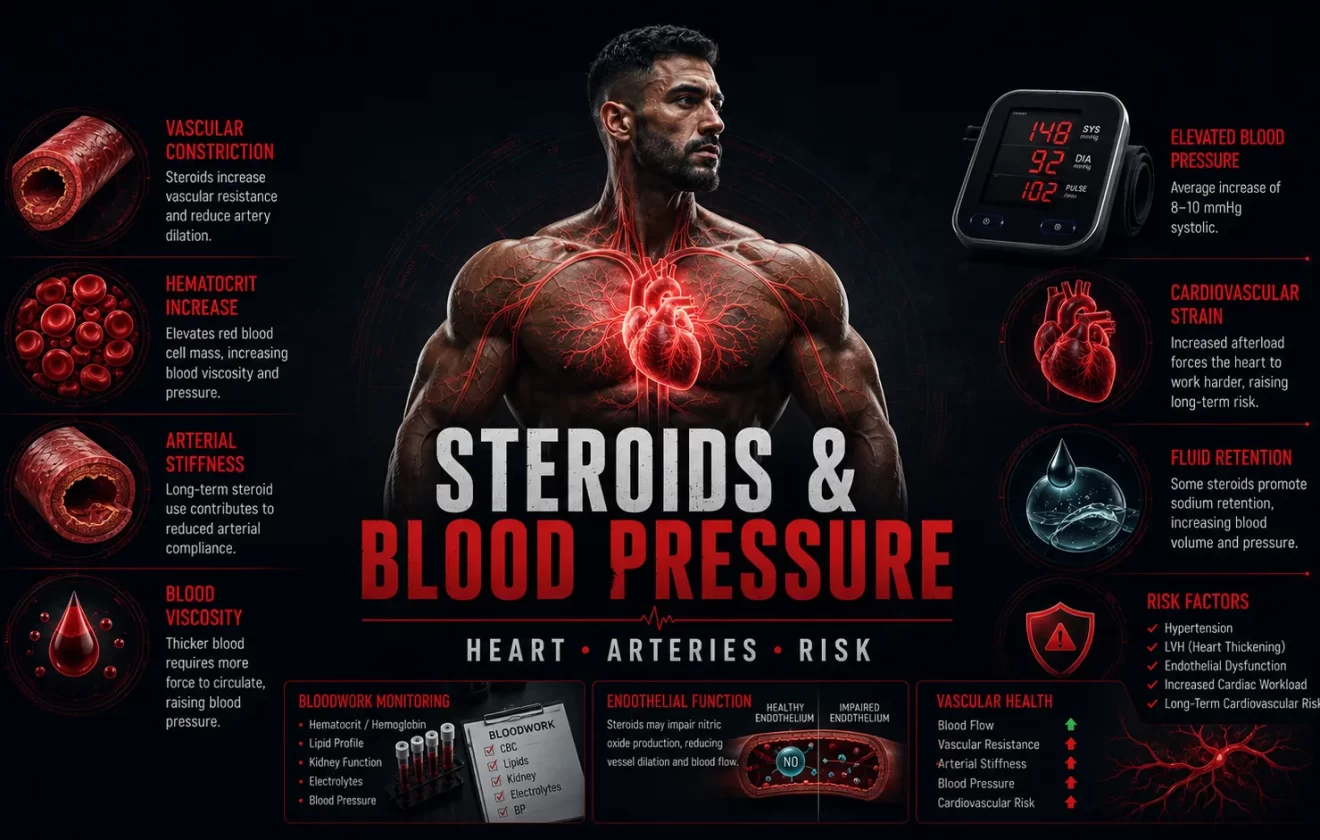
Short answer: yes. Anabolic steroids raise blood pressure in most users - in controlled studies, active users ran roughly 8-10 mmHg higher than non-users, and most had hypertension overnight. Here's how much, why it happens, which compounds are worst, and what actually lowers it.
Do steroids raise blood pressure?
Short version: yes, steroids raise blood pressure in the large majority of users - the only real questions are by how much and what you do about it.
Yes - for the large majority of people, anabolic-androgenic steroids (AAS) push blood pressure up, and it's one of the most consistent cardiovascular effects in the research. It isn't a rare side effect you might avoid; it's closer to a default that varies in size depending on the compound, the dose, and your own physiology.
The rise is usually silent. Blood pressure has no symptoms until it's very high, which is exactly why it's dangerous over a multi-week cycle - the damage to arteries, heart and kidneys accumulates while you feel fine. The only way to know your number is to measure it.
How much, and how common?
Exactly how much steroids raise blood pressure depends on the person, dose and compound, but the pooled averages are consistent.
The clearest data comes from a Copenhagen study that put 24-hour blood-pressure monitors on current AAS users, former users, and drug-free strength trainers. Compared with the former users and controls, the ongoing users averaged roughly 8-10 mmHg higher blood pressure across the day and night - and most of them were hypertensive overnight, when pressure should normally dip.
Two details matter. First, a single clinic reading badly underestimates the problem - the elevation showed up most at night, which a daytime cuff check misses entirely. Second, it's dose-dependent: higher doses and longer cycles push the number further, and the heaviest users show the biggest changes.
%3C%2Ftext%3E%3Ctext%20x%3D%2230%22%20y%3D%22132%22%20fill%3D%22%23cbd5e1%22%20font-family%3D%22Arial%22%20font-size%3D%2215%22%3ENon-users%3C%2Ftext%3E%3Crect%20x%3D%22170%22%20y%3D%22114%22%20width%3D%22300%22%20height%3D%2226%22%20rx%3D%224%22%20fill%3D%22%233b82f6%22%2F%3E%3Ctext%20x%3D%22480%22%20y%3D%22133%22%20fill%3D%22%23ffffff%22%20font-family%3D%22Arial%22%20font-size%3D%2214%22%3E~120%20mmHg%3C%2Ftext%3E%3Ctext%20x%3D%2230%22%20y%3D%22187%22%20fill%3D%22%23cbd5e1%22%20font-family%3D%22Arial%22%20font-size%3D%2215%22%3EOn%20steroids%3C%2Ftext%3E%3Crect%20x%3D%22170%22%20y%3D%22169%22%20width%3D%22360%22%20height%3D%2226%22%20rx%3D%224%22%20fill%3D%22%23ef4444%22%2F%3E%3Ctext%20x%3D%22540%22%20y%3D%22188%22%20fill%3D%22%23ffffff%22%20font-family%3D%22Arial%22%20font-size%3D%2214%22%3E%2B8%20to%2010%3C%2Ftext%3E%3Ctext%20x%3D%2230%22%20y%3D%22250%22%20fill%3D%22%23f87171%22%20font-family%3D%22Arial%22%20font-size%3D%2215%22%20font-weight%3D%22700%22%3EAbout%208%20to%2010%20mmHg%20higher%20systolic%20on%20average%3C%2Ftext%3E%3Ctext%20x%3D%2230%22%20y%3D%22278%22%20fill%3D%22%2364748b%22%20font-family%3D%22Arial%22%20font-size%3D%2212%22%3ESource%3A%20pooled%20data%20on%20anabolic-steroid%20users%20(e.g.%2C%20Rasmussen%20et%20al.)%3C%2Ftext%3E%3C%2Fsvg%3E)
In short: yes, steroids raise blood pressure for most users. How much steroids raise blood pressure depends on the compound, the dose, and how long you run it.
Why steroids raise blood pressure
Several overlapping mechanisms explain why steroids raise blood pressure, and they rarely act alone.
It's rarely one thing. AAS hit blood pressure through several channels at once, which is why the effect is so reliable:
Sodium & water retention
Higher hematocrit (thicker blood)
Mineralocorticoid (aldosterone-like) activity
Stiffer, less responsive arteries
Suppressed HDL and vascular strain
Blunted post-exercise recovery
Which steroids are worst for blood pressure?
Not all steroids raise blood pressure to the same degree - the compound you run matters as much as the dose.
All of them can raise it, but not equally. The heaviest hitters combine fluid retention and a strong rise in hematocrit or mineralocorticoid activity. Rough, illustrative guide:
| Compound / class | BP tendency | Main driver |
|---|---|---|
| Trenbolone (19-nor) | High | Aldosterone-like activity + big hematocrit rise, even without much water |
| Oral 17-aa (dianabol, anadrol) | High | Heavy water & sodium retention, sharp HDL crash |
| High-dose testosterone | Moderate | Aromatization → estrogen → fluid; dose-dependent hematocrit |
| Nandrolone (deca) | Moderate | Water retention + mild mineralocorticoid effect |
| "Dry" compounds (masteron, primo, anavar) | Lower | Less water, but hematocrit and HDL effects still add up over time |
| TRT-dose testosterone | Lower | Physiological doses have a modest effect for most; watch hematocrit |
"Lower" is not "none" - even dry compounds and TRT can raise hematocrit enough to matter, especially over long-term use. The point is that a high-dose testosterone-plus-trenbolone stack and a modest TRT protocol are not the same conversation.
Where does a reading land?
Once you know steroids raise blood pressure, the next question is where your own numbers actually sit on the clinical scale.
Blood pressure is graded on both numbers - the higher of the two decides the category. Set a reading to see where it sits (ACC/AHA categories):
On cycle, don't judge off one reading. Take several resting measurements on different days, ideally morning and evening, and watch the trend.
Illustrative ACC/AHA categories, not a diagnosis. For a full breakdown and how to measure properly, see the blood pressure guide.
Does it go back to normal after stopping?
For most users the way steroids raise blood pressure is largely reversible once the cycle ends and estrogen and fluid balance normalise.
Largely, yes - and that's one of the more encouraging findings. In the monitoring data, former users sat much closer to drug-free controls than to active users, so a lot of the pressure rise comes back down once the compounds and the water clear. Hematocrit also normalises over the weeks after a cycle.
The caveat: not everything reverses cleanly. Increased arterial stiffness and any left-ventricular changes from long, heavy, repeated use can linger, and years of poorly-managed cycles do leave a mark. The reversible part is a reason to manage it now, not a reason to ignore it.
What actually lowers it
If steroids raise blood pressure during your cycle, these are the levers that actually bring the numbers back down.
If you've decided to use, the harm-reduction priorities are straightforward and mostly measurable:
- Measure properly. A home cuff and several resting readings beat a single clinic check - remember the elevation is worst at night. A baseline before you start is what makes any later number meaningful.
- Control estrogen and water on aromatizing compounds - a lot of "cycle hypertension" is fluid that tracks with estradiol.
- Watch hematocrit. If it climbs too high, blood viscosity rises; donating blood (where appropriate) and dose adjustments help. Track it on a CBC.
- Do real cardio. Zone-2 conditioning directly opposes the pressure and stiffness effects - most "just lift" users skip it.
- Respect dose and compound choice. Trenbolone and high-dose orals are the usual culprits; lower doses and "wetter" drugs handled with an eye on estrogen behave better.
- Don't self-treat a high number. Persistent readings in Stage 2 or above are a doctor conversation, not a forum one.
How to measure it properly (most people get this wrong)
A single reading at the doctor’s office tells you almost nothing. If steroids raise blood pressure mainly at night and under load, a rushed daytime check in a waiting room will routinely miss it. To track what is really happening you need home readings with a validated upper-arm cuff - wrist monitors are far less reliable.
Get the conditions right or the number is just noise: sit quietly for five minutes first, back supported, feet flat on the floor, arm resting at heart height, and no caffeine, training or nicotine in the 30 minutes before. Take two readings a minute apart, once in the morning and once in the evening, and log the average rather than cherry-picking the lowest one. A week of that gives you a real baseline; two weeks of it on cycle shows you the true trend instead of a lucky snapshot.
If your home averages sit consistently above 130/80, treat that as a signal to act rather than something to explain away, and read our baseline bloodwork guide so blood pressure is tracked alongside the other markers that shift on cycle.
Why a few extra mmHg is a bigger deal than it sounds
It is easy to shrug off a reading of 138/88. The problem is that the heart is a muscle, and like any muscle it adapts to load. When steroids raise blood pressure and keep it elevated for months, the left ventricle thickens - left ventricular hypertrophy - to push against the higher resistance. That remodelling is the single most consistent cardiac finding in long-term anabolic-steroid users, and it does not fully reverse in everyone.
Sustained pressure also grinds on the kidneys and the fine vessels of the eyes and brain. Epidemiologically, every 20/10 mmHg above 115/75 roughly doubles cardiovascular risk, so the "small" 8 to 10 mmHg that steroids raise blood pressure by is not cosmetic - it is a measurable shift up the risk curve. The reason steroids raise blood pressure quietly is exactly what makes it dangerous: there are no symptoms until the damage is already done.
Blood pressure never travels alone
The compounds and doses that make steroids raise blood pressure tend to move three other markers in the same direction: hematocrit climbs as red-blood-cell production ramps up, HDL cholesterol falls while LDL rises, and kidney markers can drift under the extra filtration load. None of these is visible in the mirror, and none of them hurts until it is well advanced.
This is why the way steroids raise blood pressure is best treated as one dial on a dashboard rather than a standalone check. If you are tracking pressure, track the rest at the same cadence - start from our pre-cycle bloodwork guide, then repeat the key markers mid-cycle so you can see how far each has moved before any of them becomes a real problem.
Common questions
Does testosterone raise blood pressure?
Does trenbolone raise blood pressure?
Is steroid-induced high blood pressure permanent?
How high can blood pressure get on a cycle?
Do steroids thin or thicken the blood?
Can I take blood pressure medication while on cycle?
How soon after starting a cycle does blood pressure rise?
Can I stay on cycle if my blood pressure is high?
Does drinking more water lower blood pressure on a cycle?
Do steroids raise blood pressure permanently?
Does cardio cancel out the rise?
Do all steroids raise blood pressure, or only some?
If I feel fine, do steroids raise blood pressure enough to worry about?
- Rasmussen JJ et al. - Endocrine Society (2016). Ambulatory 24-hour blood pressure in current, former, and non-users of anabolic-androgenic steroids - current users ~8-10 mmHg higher, frequent nocturnal hypertension.
- Rasmussen JJ et al. (2018). Increased blood pressure and aortic stiffness among abusers of anabolic androgenic steroids: potential role of suppressed natriuretic peptides. Journal of Hypertension.
- Baggish AL et al. Cardiovascular effects of long-term anabolic-androgenic steroid use - left-ventricular and vascular changes.
The takeaway
The fact that steroids raise blood pressure is not a reason to panic - it is a reason to measure, because a number you track is a number you can manage.
Anabolic steroids raise blood pressure for most users - on the order of 8-10 mmHg on average, more with trenbolone and high-dose orals, and often worst at night when you'd never catch it with a random daytime check. The good news is that it's largely reversible and, more importantly, completely trackable. Measure a baseline before you start, keep a cuff on hand, watch your hematocrit and estrogen, and treat a persistently high number as the medical issue it is.
Educational information only, written for harm reduction - not medical advice and not an encouragement to use anabolic steroids, which carry serious health and legal risks. Blood pressure and cardiovascular decisions should be made with a qualified clinician.