Blood Pressure Before Steroids: 6 Critical Baseline Checks
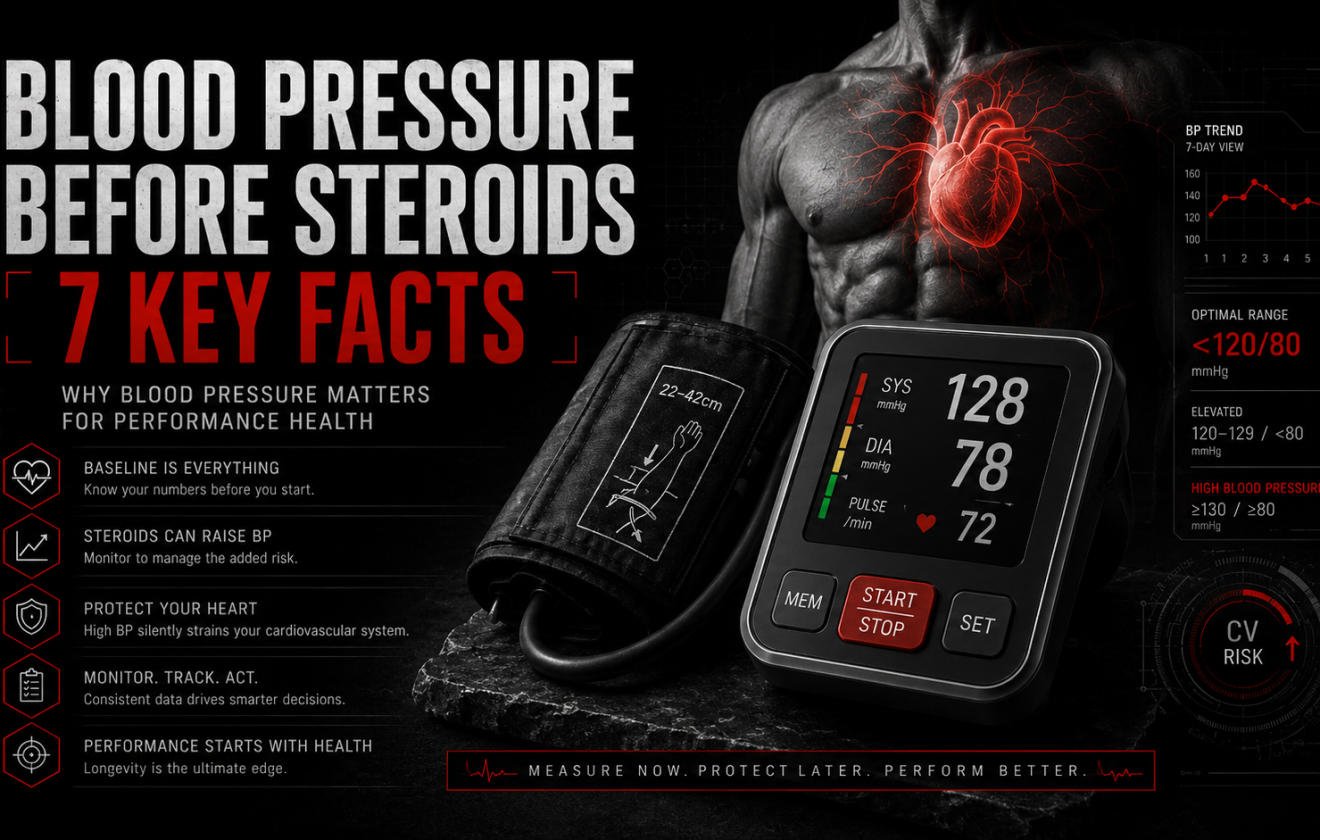
Blood Pressure Before Steroids: 6 Critical Baseline Checks
Blood pressure is the cheapest and least forgiving number in any pre cycle screen. It takes two minutes to measure, it predicts more hard cardiovascular outcomes than anything else on a routine panel, and anabolic androgenic steroids push it upward long before anyone feels a symptom. This guide covers how to build a real baseline, what each category means for somebody who is considering a cycle, and which findings say do not start yet. For the mechanism and the size of the effect, see do steroids raise blood pressure.
Blood Pressure Before Steroids: 3 Findings That Set The Baseline
Most people who plan a cycle screen their hormones and their liver and skip the one blood pressure measurement that carries the clearest outcome data. Three published findings explain why that order is backwards. The first says that a clinic reading is not the reading that matters. The second says the equipment decides the number more than the artery does. The third says risk starts far below the point at which anyone gets a diagnosis.
Rasmussen and colleagues put 37 current steroid users, 33 former users and 30 controls through 24 hour ambulatory monitoring. Mean 24 hour systolic blood pressure was 132 mmHg in current users against 124 mmHg in controls, and systolic hypertension was present in 51 percent of current users against 17 percent of controls.
In a randomised crossover trial of 195 adults, using a regular cuff on an arm that needed an extra large cuff raised the systolic blood pressure reading by 19.5 mmHg. On an arm needing a large cuff the error was 4.8 mmHg. Muscular arms are exactly the population this hits.
Across 61 prospective studies and one million adults with 12.7 million person years of follow up, vascular mortality rose in a straight line down to a usual systolic of 115 mmHg. Every 20 mmHg systolic or 10 mmHg diastolic above that roughly doubled the death rate.
Categories and thresholds quoted throughout follow the 2017 ACC/AHA adult hypertension guideline. A category is never assigned from one reading, and nothing on this page replaces assessment by a clinician who can see your history, your medication and your examination.
What This Guide To Baseline Blood Pressure Covers
Measuring a real blood pressure baseline. Cuff size, posture, rest interval, how many readings across how many days, and why a single clinic figure is the weakest evidence you can collect.
What the categories mean before you start. The five ACC/AHA bands, translated into what each one implies for somebody weighing up anabolic androgenic steroids rather than for a patient already in treatment.
Screening findings that say stop. The combinations of blood pressure readings, bloodwork and symptoms that make starting a cycle a materially worse idea, and what to do with each of them.
Why androgens move the number. Sodium and water handling, mineralocorticoid activity, haematocrit, and the difference between oral 17 alpha alkylated compounds and injectable esters.
Treatment. No antihypertensive, supplement, dose or protocol is recommended here. Medication decisions belong to a prescribing clinician who has examined you.
Cycle design. Nothing on this page explains how to obtain, dose or run any compound. The framing throughout is risk screening and education.
Diagnosis. A blood pressure category is not a diagnosis. Secondary hypertension, sleep apnoea and kidney disease all require investigation that no article can perform.
The effect size itself. How far pressure climbs on cycle, which compounds are worst and how much reverses afterwards are covered in the companion guide linked above.
The 5 Blood Pressure Categories And What Each Means Before You Start
The 2017 ACC/AHA guideline replaced the older prehypertension language with five bands, and it lowered the diagnostic threshold from 140/90 to 130/80 mmHg. That single change matters more to lifters than to almost any other group, because a very large number of young, heavy, well trained men sit in the 130s and were told for years that they were fine.
Two rules govern how the blood pressure table below is read. A category is decided by whichever of the two numbers is worse, so 128/84 mmHg is stage 1 on the diastolic figure alone. And a category is assigned from an average of several readings on separate days, never from the number on the machine in front of you right now.
| Category | Systolic and diastolic | What it means before starting | Status |
|---|---|---|---|
| Normal | Below 120 and below 80 mmHg | The cleanest starting point there is, and the only one that leaves real headroom. It does not mean blood pressure will stay there, which is why the baseline series is worth keeping. | ● Clear |
| Elevated | 120 to 129 and below 80 mmHg | Not a diagnosis, but the arrow is already pointing the wrong way. An eight point rise of the kind measured in current users lands this group in stage 1 or stage 2. | ● Watch |
| Stage 1 hypertension | 130 to 139 or 80 to 89 mmHg | A diagnosis under current guidance. Most people here are told to change diet, sodium, alcohol, weight and activity first. Adding an androgen at this point works directly against every one of those measures. | ● Investigate |
| Stage 2 hypertension | 140 or higher, or 90 or higher | Treatment territory. Untreated stage 2 is the clearest single reason on this page not to start anything, and the reason to book an appointment instead. | ● Stop |
| Hypertensive crisis | Above 180 or above 120 mmHg | Urgent medical territory rather than a screening finding. Repeat once after five minutes of rest, and if it holds, this is a same day clinical problem. | ● Emergency |
| White coat effect | High in clinic, normal at home | Common and easy to misread in both directions. It is the main argument for home or ambulatory measurement rather than one reading in a waiting room. | ● Context |
Notice what the third column is doing. None of these bands were written for somebody about to add a drug that raises plasma volume, sympathetic tone and haematocrit at the same time. Read that way, a blood pressure category that looks merely untidy on a clinic printout becomes a decision point, because the intervention under consideration moves the number in the wrong direction.
Steroids Effect On Blood Pressure: What Measured Data Shows
Where does a typical enhanced lifter actually sit? The best measurement in this population is ambulatory rather than clinic based. Rasmussen and colleagues fitted 24 hour monitors to 37 current users, 33 former users and 30 controls, all recreational strength trainers, and also measured aortic distensibility by magnetic resonance imaging. Mean 24 hour systolic blood pressure was 132 mmHg in current users against 124 mmHg in controls.
Eight millimetres of mercury sounds trivial until it is placed on the scale below. A control group sitting at 124 mmHg is in the elevated band. The same group plus eight points sits in stage 1, and half of the current users in that study met the definition of systolic hypertension against one in six of the controls. The chart shows the fixed blood pressure thresholds that decide those labels.

The animation below shows something different from the chart: not thresholds, but measured outcomes in people. Two of these figures come from the ambulatory study above, and two come from imaging work on long term users. Every bar is a percentage, and every one of them describes a group rather than an individual.
A different view: measured group findings in steroid users and non using weightlifters, all expressed as percentages. Left ventricular ejection fraction below about 55 percent is considered reduced.
The last three bars are the reason a baseline is worth the trouble. Baggish and colleagues scanned 140 experienced weightlifters aged 34 to 54, of whom 86 reported at least two years of cumulative use. Ejection fraction averaged 52 percent in users against 63 percent in non users, and early relaxation velocity was lower as well. Aortic stiffening in the Rasmussen cohort was present in former users too, at the same 21 percent deficit, which is the part that does not simply wash out when a cycle ends.
6 Baseline Findings That Mean Do Not Start Yet
Can steroids make your blood pressure go up from a starting point that was already poor? That is the wrong question, because the interesting part is what the starting point itself rules out. The six findings below are the ones that turn a screening blood pressure measurement into a decision, and each of them has a sensible next step that is not a cycle.
Averaged readings at 140/90 mmHg or above
Untreated stage 2 hypertension is the single clearest stop signal in a pre cycle screen. It already sits in treatment territory under the ACC/AHA guideline, and the measured group effect of androgen use adds to it rather than replacing it. The next step is a clinician, not a compound.
Stage 1 readings alongside a second risk factor
Blood pressure readings in the 130s carry a different weight when they arrive with a raised haematocrit, a poor lipid ratio, obstructive sleep apnoea, heavy stimulant use or a family history of early cardiac events. Fuchs and Whelton describe hypertension as the most common modifiable contributor to cardiovascular disease precisely because it rarely travels alone.
A diagnosis that is not currently controlled
Somebody already diagnosed, on medication, and still averaging above target has no headroom at all. Adding sodium retention and increased plasma volume to an antihypertensive regimen that is not yet working is a reliable way to make it work even less well.
Rising blood pressure with a rising haematocrit
Thicker blood and higher blood pressure compound each other. If the baseline haematocrit is already near the top of the reference range, review it alongside the readings rather than separately. The haematocrit and haemoglobin guide explains how far that marker can legitimately move.
Symptoms that suggest the heart is already loaded
Breathlessness out of proportion to conditioning, chest tightness on exertion, palpitations, or unexplained exercise intolerance are clinical findings, not training feedback. D’Andrea and colleagues found measurable left ventricular myocardial dysfunction in long term users by Doppler imaging while standard echocardiography still looked acceptable.
No baseline series at all
The most common finding of the six. Without blood pressure readings taken before anything changed, every future number is uninterpretable: there is no way to separate a pre existing pattern from a new one. Collecting a week of measurements costs nothing and is the entire point of screening early.
How To Measure Blood Pressure Properly Before A Cycle
How do you get a blood pressure baseline that means something? The technique is not complicated, but almost every step of it is commonly skipped, and the errors are large enough to move somebody a whole category in either direction. The American Heart Association scientific statement on measurement in humans is unusually blunt about how routinely this is done badly in practice.
Start with the cuff, because it is the largest single source of error and the one that hits lifters hardest. Ishigami and colleagues randomised 195 adults to blood pressure readings with a correctly sized cuff and with a regular cuff. In people who needed an extra large cuff, the regular one read 19.5 mmHg too high. In people who needed a large cuff it read 4.8 mmHg too high. A developed upper arm with a standard cuff will manufacture hypertension that is not there.
Then fix the posture and the timing. Sit quietly for five minutes with the back supported, both feet flat, legs uncrossed, the cuff on bare skin, and the mid arm supported at heart level. Do not talk during the measurement. Take two or three blood pressure readings a minute apart and record the average rather than the friendliest one.
Do not measure blood pressure after training, after a pre workout, after nicotine, after caffeine, or after a bad night. Those readings are real, but they describe a stressed state rather than a resting one, and a baseline is meant to capture the resting state. If you want to know what stimulants do to your own numbers, measure that deliberately and label it separately.
Collect enough of them. The European Society of Hypertension practice guidance for out of office measurement asks for blood pressure readings in the morning and the evening across several consecutive days, discarding the first day, then averaging the rest. A week of duplicate morning and evening readings gives roughly 24 numbers, which is a baseline. One number from a pharmacy machine is an anecdote.
Home beats clinic for prediction. Out of office blood pressure readings correlate better with organ damage and with outcomes than office readings do, which is why guidance now leans on home and ambulatory monitoring for both diagnosis and follow up.
Validate the device. An upper arm monitor that has passed an independent validation protocol is the baseline standard. Wrist devices are far more sensitive to arm position and are a poor choice for somebody with a large arm.
Keep the log, not the last reading. A man whose average ran at 118/72 mmHg for two years and now averages 134/86 mmHg has changed a great deal, and no single reading shows it. The series is the evidence.
Will Steroids Raise Your Blood Pressure? Which Classes Do Most
Will steroids increase blood pressure in everybody? No, and the honest answer is that response varies widely between people and between compounds. What the literature does support is a ranking by mechanism, and the mechanisms are the ones a baseline is designed to expose: sodium and water retention, mineralocorticoid receptor activity, haematocrit, and the lipid and hepatic effects unique to the 17 alpha alkylated orals.
Hartgens and Kuipers reviewed the human evidence and described modest average rises in systolic pressure with androgen administration alongside the far larger and more consistent lipid changes. Achar and colleagues, pooling 49 studies covering 1,467 athletes, reached the same shape of conclusion: elevated systolic and diastolic blood pressure and left ventricular hypertrophy appear repeatedly, the studies are small, and the effect is real but variable. Read the table below as relative risk of pushing a borderline baseline over a line, not as a dose response chart.
| Compound class or situation | Dominant mechanism | What it does to a borderline baseline | Status |
|---|---|---|---|
| 19 nortestosterone derivatives with mineralocorticoid activity | Renal sodium and water retention through mineralocorticoid receptor cross reactivity | The class most often linked in clinical reports to rapid, large rises in a person who started in the elevated band | ● Highest |
| Oral 17 alpha alkylated compounds | Hepatic first pass effects, sharp fall in HDL, fluid shifts | Adds vascular risk on top of any blood pressure change, so a poor baseline and an oral is the worst combination on this table | ● High |
| High dose injectable testosterone esters | Aromatisation, plasma volume expansion, rising haematocrit | Dose dependent. The ambulatory data showing 132 against 124 mmHg came from cohorts using this kind of exposure | ● Moderate |
| Non aromatising injectables | Less water retention, but haematocrit and lipid effects remain | Often assumed to be neutral. Lower water retention is not the same as a neutral cardiovascular profile | ● Moderate |
| Testosterone replacement at physiological doses | Haematocrit is the main monitored pathway; see blood pressure on TRT | Usually small, but it is monitored precisely because it is not always zero | ● Lower |
| Stimulants, rapid weight gain and sleep loss | Sympathetic drive, plasma volume, untreated sleep apnoea | Not a drug effect at all, and frequently the real cause of a baseline that looks worse than the person expected | ● Confounder |
The practical use of this table at the screening stage is narrow and specific. It does not tell anybody what to run. It tells somebody whose averaged blood pressure already sits in the 130s that the classes near the top of the table remove what little margin remains, and that the honest options are to fix the baseline first or to not proceed.
5 Mistakes People Make Setting A Baseline
1. Using one clinic reading. A single office blood pressure measurement is the weakest evidence available, and it misses both white coat readings and the opposite problem of masked hypertension that only shows outside the clinic. Ambulatory monitoring found nocturnal and daytime elevation in users whose clinic numbers had never raised a concern.
2. Using the wrong cuff. The 19.5 mmHg error measured in people who needed an extra large cuff is larger than the entire difference between users and controls in the ambulatory study. Anybody with a developed upper arm who has never checked cuff size does not yet know their own numbers.
3. Measuring in the wrong state. Readings taken after a session, after a pre workout, after nicotine or after four hours of sleep describe a stressed cardiovascular system. They belong in the log, labelled as such, and they do not belong in the baseline average.
4. Treating the elevated band as normal. A reading of 126/78 mmHg is not hypertension, and it is also not the same as 112/70 mmHg. In the pooled mortality data the relationship stayed linear down to 115 mmHg systolic, so there is no flat zone in which a few extra points are free.
5. Measuring after starting instead of before. A number collected six weeks into a cycle answers nothing, because there is no comparator. This is the mistake the entire page exists to prevent, and it is the only one on the list that cannot be corrected later.
Baseline Readings Before A Cycle: Common Questions
Can steroids increase blood pressure?
Yes, and it has been measured rather than assumed. In 24 hour ambulatory monitoring of recreational strength trainers, current users averaged 132 mmHg systolic against 124 mmHg in controls, and systolic hypertension was present in 51 percent of current users against 17 percent of controls. The size of the shift varies by compound, dose and person, but the direction is consistent across the literature.
Will steroids raise your blood pressure in everyone?
No. Group averages hide wide individual blood pressure variation, and some users show very little change while others move a full category. That variability is the argument for measuring rather than predicting. Somebody who never established a baseline has no way to know which of those two groups they belong to, which is why the screening series matters more than any average from a study.
Can steroids make your blood pressure go up quickly?
Blood pressure can move within weeks when sodium and water retention, rapid weight gain, rising haematocrit and stimulant use all arrive together. That is the usual pattern reported clinically rather than a slow drift over years. It is also why a pre use series and then repeat readings every few weeks catch a change while it is still small and reversible.
What reading should I have before considering a cycle?
There is no reading that makes anabolic steroid use safe, and this page does not offer a green light. What the blood pressure categories do say is that anything averaging 140/90 mmHg or above is treatment territory, anything in the 130s is already a diagnosis under current guidance, and only readings below 120/80 mmHg leave any margin at all. The decision itself belongs with a clinician who can see the whole picture.
How many readings make a real baseline?
European practice guidance for out of office measurement asks for duplicate readings morning and evening across several consecutive days, discarding the first day and averaging the rest. In practice that is a week of measurement and roughly 24 numbers. One blood pressure reading in a clinic or a pharmacy is not a baseline and should not be used as one.
Does a muscular arm change the reading?
Substantially. In a randomised crossover trial of 195 adults, people who needed an extra large cuff read 19.5 mmHg higher when a regular cuff was used, and people needing a large cuff read 4.8 mmHg higher. That error alone can move a lifter from normal into stage 1, or from stage 1 into stage 2, without anything happening to the artery.
Should I start if I am already in stage 1?
Stage 1 is the point at which guidelines ask for weight, sodium, alcohol, sleep and activity to be addressed first. Every one of those levers is pushed the wrong way by the combination of an androgen, a caloric surplus and a stimulant heavy training routine. A baseline in the 130s is a reason to fix the baseline and speak to a clinician, not a reason to proceed carefully.
Does the effect on the heart reverse after stopping?
Partly. Blood pressure itself tends to fall back toward the control range in former users, but aortic distensibility was reduced by about 21 percent in former users as well as current ones in the same cohort, and imaging studies of long term users have found reduced ejection fraction and impaired relaxation. Structural change is far less forgiving than a number on a cuff.
Sources And Further Reading
All citations are peer reviewed studies and clinical guidelines verified via PubMed, and reference links are dofollow to support open science. Every threshold, millimetre of mercury and percentage quoted above is taken directly from the primary publication listed below.
More From The Bloodwork Series
All guides are evidence-based, PMID-verified, and written for lifters who want to read their own blood pressure properly before anything changes.
Final Educational Note
This article is for educational purposes and does not constitute medical advice. Categories, thresholds and averages are interpreted by a clinician alongside your history, medication, examination and other results, and no page can tell an individual whether a given reading is safe for them. Persistently raised readings are common, silent and treatable, and they deserve a proper assessment rather than a forum opinion.
MuscleScience does not prescribe, sell or supply any medication or anabolic compound, and nothing here explains how to obtain or use one. Do not start, continue or stop any drug on the basis of a number read from a website, including this one. For the wider series see the bloodwork hub, our editorial standards and the full medical disclaimer. Related panels are covered in the kidney marker guide, the lipid guide and the liver enzyme guide, and monitoring intervals are in how often to test on a cycle.