Lipid Panel: 7 Critical Facts About HDL and LDL
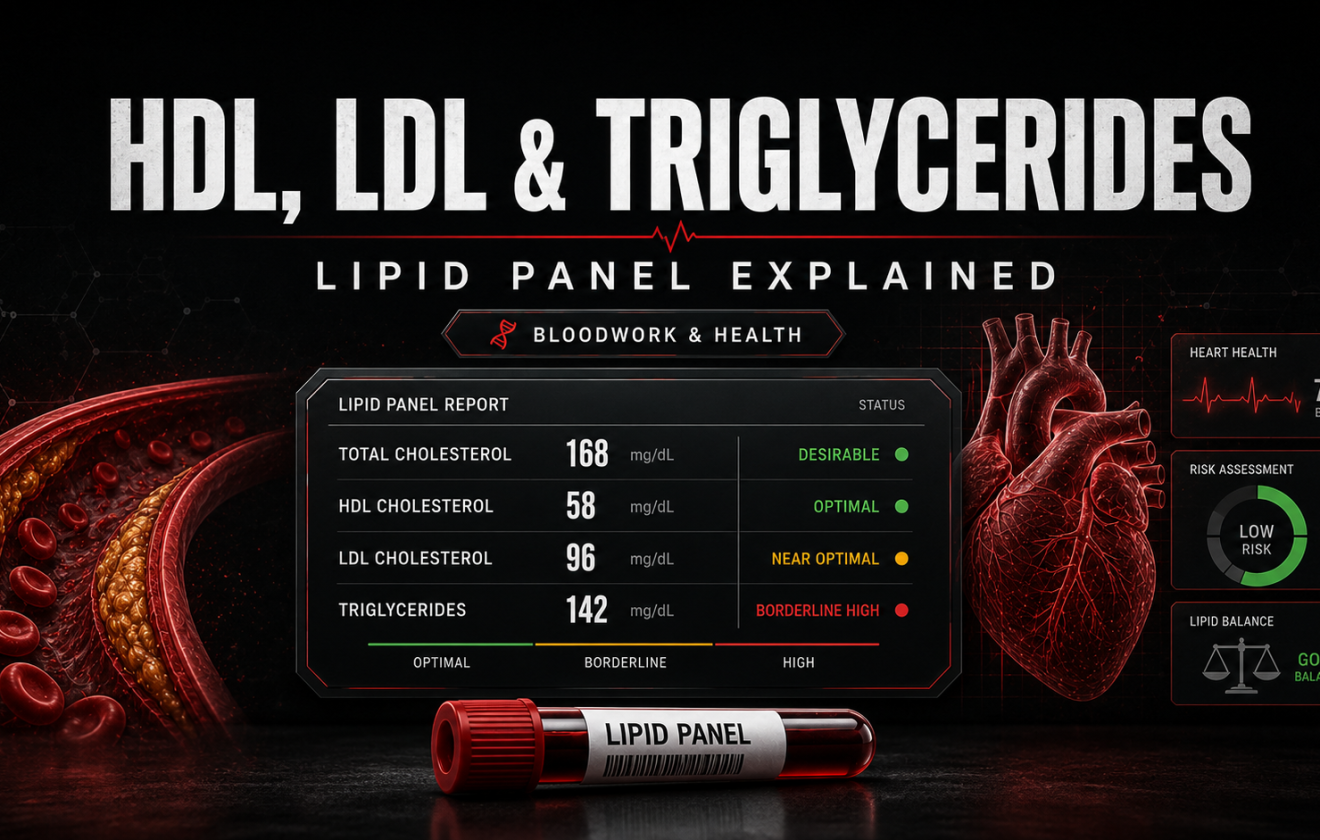
LIPID PANEL: 7 CRITICAL FACTS ABOUT HDL AND LDL
A lipid panel is the blood test that reports total cholesterol, HDL cholesterol, LDL cholesterol and triglycerides. It is also the panel that moves fastest once a lifter starts an oral compound, and the one most often misread, because the LDL figure on the printout is usually calculated rather than measured. This guide reads each number the way a trained man on hormones has to read it, and the steroids and cholesterol guide covers compound specific effects in detail.
Data in brief
Three numbers frame everything else on this page. All three come from controlled work in weight trained men, not from general population screening.
Eleven male weight lifters took oral stanozolol at 6 mg a day for six weeks. HDL cholesterol fell 33 per cent, the HDL2 subfraction fell 71 per cent, apolipoprotein A-I fell 40 per cent and LDL cholesterol rose 29 per cent (PMID 2915439).
In the crossover arm of that trial, intramuscular testosterone enanthate at 200 mg a week moved HDL cholesterol by only 9 per cent, and the loss sat in the HDL3 subfraction instead. Route of administration, not androgenic strength, drove the damage.
Across 25 controlled trials of aerobic training, the mean net gain in HDL cholesterol was 2.53 mg/dL (PMID 17533202). That is the honest size of the lever people expect to fix a wrecked panel with.
What this guide covers
Every line on the report. Total cholesterol, HDL, LDL, triglycerides, non-HDL cholesterol, apolipoprotein B and lipoprotein(a): what each one is, which are measured and which are arithmetic.
How the numbers behave in trained men. What an oral does, what an injectable does, what a hard session or a recent meal does, and how much of a change is just laboratory and biological noise.
The primary studies by name and number. Thompson 1989, Zmuda 1993, Hartgens 2004, Baggish 2017, Martin 2013 and the European non-fasting consensus, with journals, volumes, pages and PubMed identifiers on the page.
Not covered
Compound by compound cholesterol effects. Which drugs are worst and how fast they act belongs to the steroids and cholesterol guide.
Treatment. No drug, dose, supplement or diet is recommended here. What food fat does to hormones is handled in the dietary fat and testosterone guide.
The rest of the panel. Enzymes, kidney figures and blood counts are covered by the seven marker baseline guide.
What a lipid panel measures, and what it only estimates
A standard lipid panel is four assays and two calculations. Total cholesterol, HDL cholesterol and triglycerides are measured directly in the sample. The LDL cholesterol figure printed underneath them is, in most laboratories, not measured at all: it is derived from the other three. Non-HDL cholesterol is also arithmetic, and it is free.
The classic derivation is the Friedewald equation, which assumes a fixed ratio between triglycerides and the cholesterol carried in very low density lipoprotein. That assumption drifts at high triglycerides and at low LDL. A 2013 analysis of more than 1.3 million samples built a ratio that varies by triglyceride and non-HDL stratum instead of a fixed one, and it agreed with directly measured LDL in 91.7 per cent of cases against 85.4 per cent for Friedewald, with the largest gain in people whose LDL sat below 70 mg/dL (PMID 24240933).
Two consequences matter for anyone reading their own report. A single LDL value carries more uncertainty than its two decimal places suggest, especially when triglycerides are high. And above 400 mg/dL of triglycerides most laboratories will not report a calculated LDL at all, which is why a panel sometimes comes back with that line blank.
The rarer lines, apolipoprotein B and lipoprotein(a), are measured directly and are not part of the standard order. They have to be asked for.
Line by line: HDL, LDL and triglycerides on the report
The table below is the whole report in one view. The fourth column is the part general medical pages leave out: what actually moves each marker in a man who trains hard and may be on hormones.
| Marker | Measured or derived | Commonly used adult band | What moves it in a lifter | Source |
|---|---|---|---|---|
| Total cholesterol | Measured | Commonly quoted as desirable below 200 mg/dL (5.2 mmol/L) | Often the last number to move. In 19 strength athletes self administering steroids it did not change significantly at all while HDL collapsed | PMID 15155420 |
| HDL cholesterol | Measured | Low is commonly flagged below 40 mg/dL (1.0 mmol/L) in men | The most reactive line on the report. Oral 17-alpha-alkylated compounds cut it by a third or more within weeks; injectable testosterone moves it far less | PMID 2915439 |
| LDL cholesterol | Calculated in most laboratories | Below 100 mg/dL (2.6 mmol/L) is the usual desirable band | Rises on orals. The calculated value is least reliable exactly where it matters most, at low LDL and high triglycerides | PMID 24240933 |
| Triglycerides | Measured | Below 150 mg/dL (1.7 mmol/L) is the usual normal band | Moves with the last meal, alcohol and recent training more than with any hormone. Above 400 mg/dL the calculated LDL is usually suppressed | PMID 27122601 |
| Non-HDL cholesterol | Calculated, total minus HDL | Usually read as roughly 30 mg/dL above the LDL target | Costs nothing, needs no extra draw, and tracked risk better than LDL in a cohort of more than 90,000 adults | PMID 33736827 |
| Apolipoprotein B | Measured, ordered separately | Interpreted against population percentiles rather than one cut-off | Counts atherogenic particles instead of the cholesterol inside them. Rose from 0.96 to 1.32 g/L in steroid using strength athletes | PMID 15155420 |
| Lipoprotein(a) | Measured, ordered separately | Largely genetic, usually measured once in a lifetime | Fell from 189 to 32 U/L under steroid administration. A lower number here is a drug effect, not a repaired risk profile | PMID 15155420 |
Reference bands differ between laboratories and between countries, and a band is not a personal target. Anyone deciding what to do about a result needs a physician who can see the whole picture, including family history and blood pressure.
The split that decides the panel: oral versus injectable
The single most useful experiment on this subject is nearly forty years old and was done in weight lifters. Eleven men took oral stanozolol at 6 mg a day for six weeks, then, after a washout, intramuscular testosterone enanthate at 200 mg a week, so each man served as his own control.

The oral cut HDL cholesterol by 33 per cent and the HDL2 subfraction by 71 per cent, dropped apolipoprotein A-I by 40 per cent, and pushed LDL cholesterol up 29 per cent. The injectable moved HDL cholesterol by 9 per cent, and what it took came out of HDL3 rather than HDL2. Weight gain was similar on both. The authors concluded that the route of administration, not androgenic potency, produces the lipoprotein damage (PMID 2915439).
Field data agree on the size of the effect. In 19 strength athletes self administering steroids for eight or 14 weeks, HDL cholesterol fell from 1.08 to 0.43 mmol/L, apolipoprotein A-I from 1.41 to 0.71 g/L, and apolipoprotein B rose from 0.96 to 1.32 g/L (PMID 15155420). Total cholesterol and triglycerides did not change significantly in that study, which is the trap this whole page exists to flag: a report can look untouched on the two lines people check first while the particles underneath have been rearranged.
Why an oral does this, and why an aromatase inhibitor makes it worse
The mechanism named in the same trial is hepatic lipase. Stanozolol raised post-heparin hepatic triglyceride lipase activity by 123 per cent; testosterone raised it 25 per cent, which was not significant (PMID 2915439). Hepatic lipase strips lipid from HDL particles, and the larger HDL2 particles are its preferred substrate, which is why the HDL2 fraction took the deepest cut.
The follow up study is the one most people on hormones have never seen. Fourteen weight lifters received intramuscular testosterone at 200 mg a week, the aromatase inhibitor testolactone, or both together. Testosterone alone lowered HDL cholesterol by 16 per cent and apolipoprotein A-I by 12 per cent. Blocking aromatisation did not protect the panel: with the inhibitor added, HDL cholesterol fell 20 per cent, HDL2 fell 30 per cent, apolipoprotein A-I fell 15 per cent, and hepatic lipase activity rose 38 per cent instead of 21 per cent (PMID 8487666).
That result cuts against a common assumption. Oestradiol produced from testosterone is doing part of the work of holding HDL up, so suppressing it hard removes a brake rather than a problem. This page takes no position on whether anyone should use such a drug; it records what happened to the lipids when aromatisation was blocked in a controlled crossover.
The number that tracks risk better than LDL
LDL cholesterol measures the cholesterol carried inside low density particles. It does not count the particles. When those two disagree, which is common in people with high triglycerides or low HDL, the particle count is the one that follows the outcome.
In more than 90,000 adults from the Copenhagen General Population Study, a high apolipoprotein B with a low LDL cholesterol carried a hazard ratio of 1.49 for myocardial infarction and 1.21 for all cause mortality against concordant low values. High non-HDL cholesterol with low LDL gave 1.78 and 1.18. The reverse pattern, high LDL with low apolipoprotein B, carried no excess risk at all (PMID 33736827). A 2022 review sets out the physiological reason: one particle carries one apolipoprotein B molecule, whatever it is loaded with (PMID 36216435).
The practical version needs no new blood draw. Non-HDL cholesterol is total cholesterol minus HDL cholesterol, it is already on every lipid panel, and it is not disturbed by a recent meal. Apolipoprotein B has to be requested, and for a lifter whose HDL has been flattened by a compound it is the line most likely to change the conversation with a physician.
When the panel is telling you about something other than your health
Before anyone reacts to a bad line, it is worth ruling out the reasons a lipid panel moves that have nothing to do with the arteries. Two of the rows below are large enough to change a decision, and three of them are routinely blamed for changes nobody has actually measured.
| Situation | Which line moves | What was actually measured | Evidence |
|---|---|---|---|
| You ate in the last one to six hours | Triglycerides, and slightly total and LDL cholesterol | Triglycerides up by about 0.3 mmol/L (26 mg/dL); total, LDL and non-HDL down by about 0.2 mmol/L (8 mg/dL). HDL, apolipoprotein A-I, apolipoprotein B and lipoprotein(a) are not affected at all | PMID 27122601 |
| Triglycerides came back above 400 mg/dL | The calculated LDL line | Most laboratories suppress it, and the estimate is least accurate in exactly this range | PMID 24240933 |
| Nothing changed, you simply tested twice | Every line, HDL least of all | Within-subject variation for HDL cholesterol was 11.1 per cent, the lowest of the markers tested; a shift smaller than that is noise | PMID 23648634 |
| The draw landed in the middle of a cycle | HDL, apolipoprotein A-I, apolipoprotein B, lipoprotein(a) | HDL cholesterol 1.08 down to 0.43 mmol/L, apolipoprotein B 0.96 up to 1.32 g/L, lipoprotein(a) 189 down to 32 U/L, with total cholesterol and triglycerides barely moving | PMID 15155420 |
| Six weeks have passed since the last dose | HDL, apolipoprotein A-I, apolipoprotein B, lipoprotein(a) | Still not back to baseline at six weeks after cessation, and 14 weeks of use recovered more slowly than eight | PMID 15155420 |
| You trained hard or drank the evening before | Triglycerides above all | Direction is predictable, but the size of the shift has not been quantified in trained men in a controlled trial | Not quantified |
| You are deep in a cut and dropping weight fast | Triglycerides and HDL | Active weight loss moves lipids while it is happening; a panel taken mid-cut is not a stable reading of anything | Not established here |
| You were dehydrated at the draw | Potentially every concentration on the report | Frequently claimed, but no controlled measurement in lifters supports a specific figure | Not established here |
The European consensus behind the first row is worth stating plainly, because it changed practice: for routine screening, fasting is not required, and the laboratory should flag results against non-fasting cut-points instead (PMID 27122601). If a doctor asks for a fasting sample for a specific reason, that instruction wins over a web page.
The two lines people check are the two that did not move
A different dataset from the chart above: percentage change from baseline in 19 strength athletes who self administered steroids for eight or 14 weeks, against 16 non-using volunteers. Bar length is the size of the change. Red marks a change in the adverse direction, amber a fall that looks favourable but is drug driven, green a marker that did not shift. Hartgens 2004, PMID 15155420.
Read the bottom two bars first. Total cholesterol and triglycerides, the numbers a man glances at on his report, came through unchanged while HDL cholesterol lost sixty per cent of its value and the particle count went up by more than a third.
The lipoprotein(a) bar deserves its own warning. That marker is largely inherited and is normally measured once in a lifetime, so a large fall under drug administration is not a risk factor that has been fixed. It is a number that has stopped meaning what it usually means.
Claims about the lipid panel that do not survive the data
Each of these is common in gym conversation. Each is contradicted by a study named on this page.
My total cholesterol is normal, so the panel is fine
In 19 strength athletes on steroids, total cholesterol and triglycerides did not change significantly while HDL cholesterol fell from 1.08 to 0.43 mmol/L and apolipoprotein B rose 38 per cent (PMID 15155420). Total cholesterol is the least sensitive line on the report for this population.
Cardio will bring the HDL back up
Across 25 controlled trials, aerobic training raised HDL cholesterol by a mean of 2.53 mg/dL, and at least 120 minutes a week was needed to see it (PMID 17533202). Set that against a third of the HDL value removed by a single oral compound (PMID 2915439).
Injectables are harmless for lipids
The same eleven men lost 9 per cent of HDL cholesterol on intramuscular testosterone, and a separate crossover measured a 16 per cent fall (PMID 2915439, PMID 8487666). Smaller than an oral is not the same as nothing.
An aromatase inhibitor protects the panel
When testolactone was added to testosterone, HDL cholesterol fell 20 per cent rather than 16, HDL2 fell 30 per cent rather than 23, and hepatic lipase rose further (PMID 8487666). Blocking the conversion made the lipid picture worse in that trial.
A low lipoprotein(a) result means the risk is handled
Lipoprotein(a) fell from 189 to 32 U/L under steroid administration (PMID 15155420). The marker is largely genetic; a drug driven collapse in it is a distorted measurement, not an improved genome.
Lipids reset as soon as the cycle ends
Six weeks after cessation, HDL cholesterol, HDL2, apolipoprotein A-I, apolipoprotein B and lipoprotein(a) had all failed to return to pretreatment values, and 14 weeks of use recovered more slowly than eight weeks (PMID 15155420).
Where people get the lipid panel wrong
- Reacting to one draw. Within-subject variation for HDL cholesterol alone was 11.1 per cent between draws in people whose health had not changed (PMID 23648634). A small move between two reports is usually the assay and the day, not the artery.
- Treating the calculated LDL as a measurement. It agreed with directly measured LDL in 85.4 per cent of cases under the old equation, with the worst disagreement below 70 mg/dL and at high triglycerides (PMID 24240933).
- Fasting for 12 hours and calling the result more accurate. The maximum mean shift after a habitual meal is about 26 mg/dL on triglycerides and 8 mg/dL on the cholesterol lines, and HDL, apolipoprotein B and lipoprotein(a) do not move at all (PMID 27122601).
- Never asking for the two extra lines. Non-HDL cholesterol is already in the numbers you have. Apolipoprotein B costs one added request and, when it disagrees with LDL, it is the one that tracked infarction (PMID 33736827).
- Reading lipids in isolation. Blood pressure, haematocrit, liver enzymes and kidney figures move together in this population. The bloodwork frequency guide covers when to draw, and the red cell markers and kidney figures have their own pages.
Long term users are the group with outcome data rather than marker data. In 86 weight lifters assessed by imaging, steroid users showed lower left ventricular ejection fraction, 52 per cent against 63, and higher coronary plaque volume than non-users, with lifetime dose tracking plaque burden (PMID 28533317).
Frequently asked questions
What do HDL, LDL and triglycerides mean on a lipid panel?
HDL cholesterol is the cholesterol carried in high density particles, LDL cholesterol is the cholesterol carried in low density particles, and triglycerides are circulating fat, largely reflecting what you last ate and how your body clears it. Total cholesterol is the sum of what those carriers hold. Of the four, HDL cholesterol is the one that reacts hardest to an oral androgen, falling 33 per cent in six weeks in weight lifters taking stanozolol (PMID 2915439).
What is another name for a lipid panel?
It is also called a lipid profile, a cholesterol panel, a cholesterol test or a fasting lipid profile. All describe the same order: total cholesterol, HDL cholesterol, triglycerides and a derived LDL value. European guidance has recommended for years that the sample does not need to be a fasting one for routine screening (PMID 27122601).
Which lipid markers should a lifter track?
HDL cholesterol, because it moves first and furthest; non-HDL cholesterol, because it is free arithmetic on the same report; and apolipoprotein B, which has to be requested separately. In a Copenhagen cohort of more than 90,000 adults, a high apolipoprotein B alongside a low LDL cholesterol carried a hazard ratio of 1.49 for myocardial infarction, while the reverse pattern carried no excess risk (PMID 33736827).
Is the LDL number on my report measured or calculated?
In most laboratories it is calculated from the other three values, not measured. A 2013 comparison against directly measured LDL in a very large sample found 85.4 per cent agreement for the classic Friedewald calculation and 91.7 per cent for a newer method, with the largest errors below 70 mg/dL and when triglycerides were high (PMID 24240933). Above roughly 400 mg/dL of triglycerides, the calculated line is usually not reported at all.
Do I have to fast before a lipid panel?
For routine screening, no. A joint European consensus reported that the largest average post-meal shifts are about 26 mg/dL on triglycerides and 8 mg/dL on total, LDL and non-HDL cholesterol, while HDL cholesterol, apolipoprotein A-I, apolipoprotein B and lipoprotein(a) are unaffected by fasting status (PMID 27122601). If your own doctor has asked for a fasting sample for a specific reason, follow that instruction.
How much does an oral compound change HDL cholesterol?
In the cleanest trial available, oral stanozolol at 6 mg a day for six weeks cut HDL cholesterol by 33 per cent and the HDL2 subfraction by 71 per cent in 11 weight lifters, while the same men on 200 mg of injectable testosterone a week lost 9 per cent (PMID 2915439). Field data in self administering athletes recorded a fall from 1.08 to 0.43 mmol/L (PMID 15155420).
How long do lipids take to recover after stopping?
Longer than most people expect. Six weeks after cessation, HDL cholesterol, HDL2, apolipoprotein A-I, apolipoprotein B and lipoprotein(a) had still not returned to pretreatment values, and a 14 week course recovered more slowly than an eight week one (PMID 15155420). A panel drawn two weeks after the last injection is not a recovered panel.
Should I ask for apolipoprotein B instead of LDL cholesterol?
Ask for it in addition. Apolipoprotein B counts atherogenic particles rather than the cholesterol inside them, one molecule per particle, which is why it holds up when the two measures disagree (PMID 36216435). Whether it changes anything about your care is a decision for your physician, not for a web page.
Sources and further reading
Every figure quoted on this page comes from one of the twelve papers below. Each was checked against its PubMed record while this guide was written, and the identifier is printed so anyone can pull the abstract themselves.
Verified
Verified
Verified
Verified
Verified
Verified
Verified
Verified
Verified
Verified
Verified
Verified
Keep reading
Four pages that pick up where this one stops: the compounds behind a wrecked panel, the baseline draw, how often to repeat it, and what a therapeutic dose looks like on paper.
Final Educational Note
This article is educational and is not medical advice. It explains what a lipid panel measures, what published studies recorded about these markers in trained men and in anabolic steroid users, and where the evidence is thin or absent. It does not diagnose anything, does not set a target number for any individual, and does not tell anyone how to run a compound. More marker guides sit on the bloodwork and health hub.
An abnormal result is a clinical question for a physician who can see the whole person, the family history and the rest of the bloodwork, not a number to be argued about on a forum. Read more about how this site works on the about page and in the full disclaimer.