Creatinine, eGFR & BUN Explained
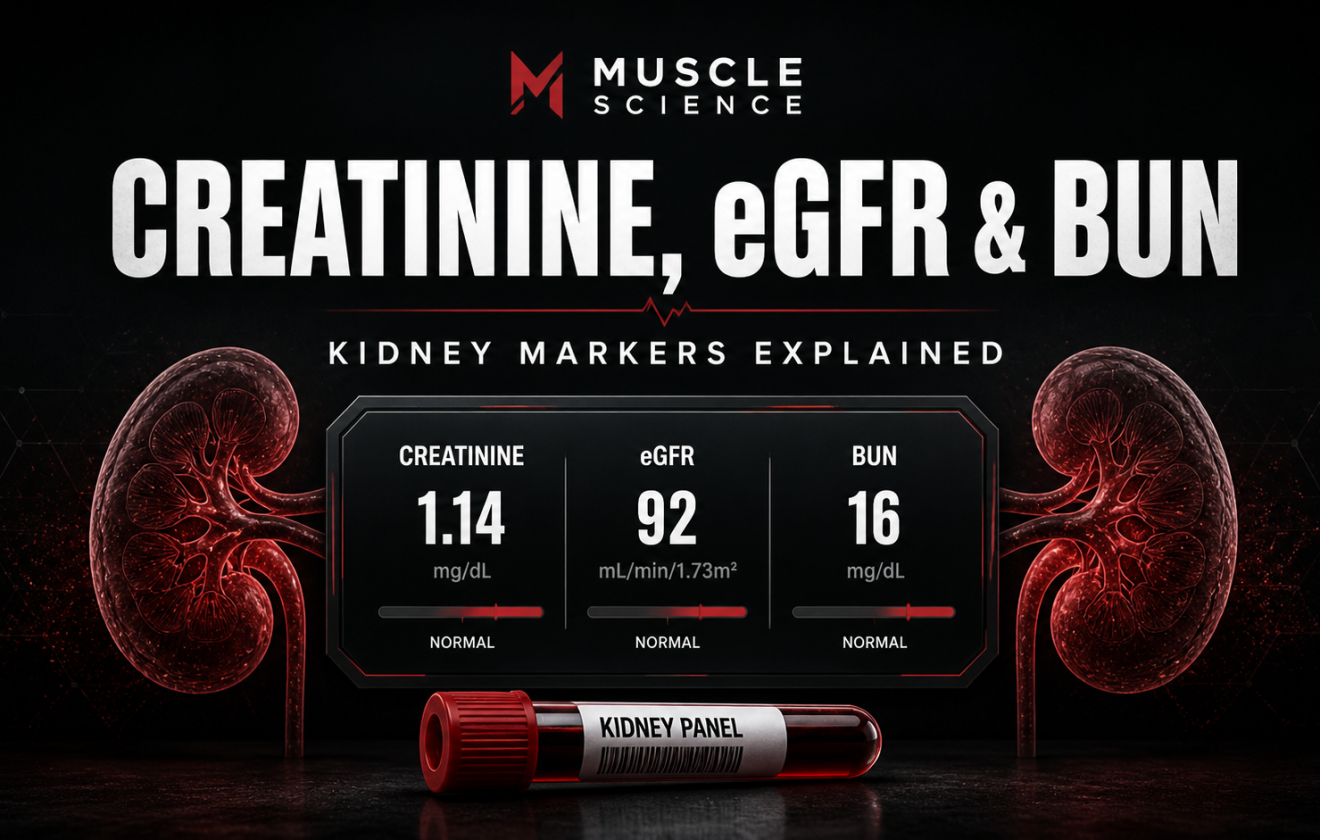
Reading your kidney markers
Kidney markers like creatinine, eGFR, and BUN help explain filtration context, hydration status, protein metabolism, muscle-mass influence, medication pressure, and performance-health monitoring. They are important bloodwork signals, but they need more context in muscular lifters than many people realize.
Kidney Markers in Plain Language
Creatinine, eGFR, and BUN are commonly used to understand kidney-related bloodwork, but they do not all measure the same thing. Creatinine is a waste product connected to muscle metabolism. eGFR is an estimated filtration calculation. BUN reflects urea nitrogen, which is linked to protein metabolism, hydration, and kidney handling of waste.
For bodybuilders, powerlifters, enhanced lifters, and high-protein eaters, these kidney markers can be more complicated than a standard lab interpretation suggests. More muscle mass can raise baseline creatinine. Heavy training, dehydration, creatine use, high protein intake, NSAIDs, illness, and blood pressure can all change the conversation around the same numbers.
The point is not to ignore abnormal kidney markers. The point is to read them intelligently. A single creatinine value without context can mislead in both directions: it may overstate risk in a very muscular person, or it may understate a real problem if other markers are ignored.
Creatinine comes from muscle metabolism and is used in many kidney-function estimates — context matters in muscular lifters.
eGFR estimates filtration, but creatinine-based formulas can need extra context in very muscular people.
BUN reflects urea nitrogen and can shift with protein intake, hydration, kidney function, and catabolic stress.
Contents
What This Kidney Marker Guide Covers
This guide explains creatinine, eGFR, and BUN in the context of training, body composition, hydration, protein intake, TRT, PED education, and general health monitoring. It is written for readers who want practical interpretation without internet panic or careless reassurance.
It does not tell a reader how to diagnose kidney disease, how to treat abnormal labs, whether a supplement or drug is safe, or how to make personal medical decisions. Kidney-related bloodwork can become serious quickly when values are abnormal, persistent, worsening, or paired with symptoms.
- Covered: creatinine, eGFR, BUN, cystatin C context, urine testing, hydration, muscle mass, protein intake, training timing, PED context, and common mistakes.
- Not covered: personal diagnosis, medical treatment, drug protocols, kidney-disease management, or individualized supplement safety advice.
- Best use: read this after the Blood Tests Before Steroids guide and the Liver Markers guide so kidney markers become part of a complete monitoring picture inside the Bloodwork & Health hub.
What Kidney Bloodwork Is Trying to Show
The kidneys filter blood, help remove waste products, regulate fluid and electrolytes, and play a role in blood pressure and red blood cell signaling. Kidney bloodwork is trying to give a partial view of how filtration and waste handling look at the time of testing — not a complete picture on its own.
The problem is that kidney function is not captured perfectly by one number. Creatinine can be affected by muscle mass and creatine intake. BUN can be affected by protein intake and hydration. eGFR is a calculation in most routine bloodwork, not a direct measurement — and all calculations carry assumptions that may not fit a very muscular person.
That is why kidney markers should be read with the larger picture: urinalysis, urine albumin-to-creatinine ratio when appropriate, blood pressure, hydration status, medication use, recent training, body size, symptoms, and previous lab trends.
Blood Tests and Urine Tests
Blood tests are useful, but urine testing often adds information that blood tests cannot capture. A person can have a normal or near-normal eGFR while still showing abnormal urine protein. That is one reason urine albumin, urinalysis, and follow-up testing may matter when kidney risk is being evaluated — especially in the context of high training loads or PED use.
Trends Matter More Than One Snapshot
One lab result is a snapshot. Repeated values show direction. If creatinine, eGFR, BUN, urine markers, or blood pressure are changing over time, the trend can matter far more than a single result taken after a hard training week or dehydration period.
What Creatinine Means
Creatinine is a waste product made from normal muscle metabolism. Because it is filtered by the kidneys, it is commonly used as part of kidney-function assessment and eGFR calculation.
For lifters, creatinine is tricky. A muscular person may naturally produce more creatinine than a smaller sedentary person simply because of greater muscle mass. Creatine supplementation, recent meat intake, hard training, dehydration, and significant muscle damage can also influence the result on any given day. This is the same reason that hematocrit and hemoglobin need training and androgen context to be interpreted correctly — bloodwork markers in active, muscular people rarely sit in the same zone as the general population.
This does not mean a high creatinine should be dismissed. It means the question should be more precise: is creatinine high compared with this person’s own baseline, is eGFR also low, is cystatin C different, are urine markers abnormal, is blood pressure elevated, and are there symptoms or risk factors that change the picture?
What eGFR Means
eGFR stands for estimated glomerular filtration rate. It estimates how well the kidneys are filtering blood. Most routine eGFR values are calculated from serum creatinine along with factors such as age and sex, depending on the equation used by the lab.
eGFR is useful because it translates creatinine into a filtration estimate. But in very muscular people, creatinine-based eGFR can be harder to interpret. A large bodybuilder may produce more creatinine because of muscle mass, which can make creatinine-based eGFR appear lower than actual kidney function would suggest.
This is where cystatin C can become useful. Cystatin C is another biomarker used to estimate kidney function and may provide extra context when creatinine is hard to interpret because of extremes of muscle mass, diet, or body composition. Some clinicians may order a combined creatinine and cystatin C equation to get a more complete picture in muscular patients.
A lower eGFR should not be ignored, but it should be interpreted correctly. One low estimate after dehydration or heavy training is not the same as repeated low eGFR with abnormal urine markers, high blood pressure, or a worsening trend over several tests.
What BUN Means
BUN stands for blood urea nitrogen. Urea is produced when the body breaks down protein. The kidneys help remove urea from the blood, so BUN can give useful context about kidney handling of nitrogen waste — particularly when read alongside creatinine and eGFR.
For lifters, BUN can rise for reasons that are not automatically kidney disease. High protein intake, dehydration, hard training, catabolic stress, illness, gastrointestinal bleeding, and some medications can all affect BUN independently. A lifter eating 250 grams of protein per day while mildly dehydrated may see a higher BUN for dietary reasons alone.
BUN becomes more meaningful when compared with creatinine, eGFR, hydration status, diet history, symptoms, and previous labs. A high BUN after a high-protein diet and dehydration does not carry the same weight as high BUN alongside worsening creatinine, low eGFR, abnormal urine findings, or signs of illness.
Where Does a Reading Fall?
Drag each slider to see the zone for a creatinine, eGFR, or BUN value. For eGFR, higher is better, so its colours are reversed. The key caveat: creatinine and the eGFR estimate depend on muscle, so a muscular or creatine-using person can read “high” creatinine and “low” eGFR without any kidney problem. Bands are illustrative, not diagnostic.
Illustrative adult ranges only — not diagnostic and not sex- or lab-specific. Creatinine and the eGFR estimate depend on muscle: high muscle mass and creatine supplementation raise creatinine (and lower estimated eGFR) without kidney disease. A cystatin C estimate is less muscle-dependent.
Why Bodybuilders Need Extra Context
Bodybuilders often have more muscle mass, higher protein intake, more intense training stress, and more supplement exposure than the average person on whom lab reference ranges are built. That can make kidney markers harder to interpret from a standard “normal or abnormal” binary view.
Creatinine is the marker most affected by this issue. A muscular person may sit higher in the reference range or slightly above it even when actual filtration is not compromised. But the opposite mistake is also common — assuming every abnormal kidney marker is just muscle mass. That assumption can mask a real problem if eGFR is falling, urine markers are abnormal, or blood pressure is consistently elevated.
The smarter approach is to build a pattern: creatinine, eGFR, cystatin C when appropriate, BUN, urine albumin, blood pressure, hydration, symptoms, medications, PED exposure, and trend over time. No single marker tells the full story.
Hydration, Protein Intake, and Creatine Use
Hydration affects kidney-marker interpretation because dehydration can concentrate blood values and reduce short-term kidney perfusion. A lab taken after sweating, low fluid intake, heat exposure, or a hard training block may look meaningfully different from a stable, well-hydrated baseline.
Protein intake matters because BUN reflects nitrogen from protein breakdown. A high-protein diet can raise BUN in some people without meaning the same thing as kidney failure. But if BUN is high alongside abnormal creatinine, low eGFR, high blood pressure, or urine abnormalities, the combined picture deserves more serious review.
Creatine supplementation can also complicate interpretation because creatine and creatinine are chemically connected. Creatine supplementation does not automatically equal kidney damage, but it can make creatinine-based values harder to interpret for both the person and the clinician. Context matters more than reflexively blaming or defending the supplement.
Why PED Use Changes the Kidney Conversation
PED discussions usually focus on hormones, strength, muscle gain, estrogen, lipids, and blood pressure. Kidney markers often get less attention until a lab result looks off. That is a mistake — kidney health is closely connected to blood pressure, hydration, medication exposure, bodyweight, and cardiovascular strain, all of which can be affected by PED use. The PED Side Effects section covers how these risks connect.
Anabolic-androgenic steroid use has been discussed in medical literature in connection with kidney injury risk in some cases, especially when combined with high body mass, elevated blood pressure, intense training, other drugs, or additional stressors. Growth hormone abuse and extreme bodybuilding practices may also complicate the picture in their own ways.
The point is not that every enhanced lifter has kidney damage. The point is that abnormal kidney markers should be taken seriously, especially when they are persistent, worsening, paired with high blood pressure, or supported by abnormal urine findings. Blood pressure is one of the most consistently undermonitored risk factors in this population.
TRT is different from unsupervised PED use, but the monitoring logic still applies. Anyone using hormones medically or non-medically should understand how blood pressure, hematocrit, lipids, kidney markers, and overall risk context connect into a complete health picture.
Blood Pressure, Painkillers, and Kidney Stress
Blood pressure belongs in every serious kidney-marker conversation. The kidneys help regulate blood pressure, and high blood pressure can damage the kidneys over time. At the same time, kidney problems can worsen blood pressure control. This two-way relationship is especially important for larger lifters and enhanced athletes — for a full breakdown of why blood pressure monitoring matters before any PED use, read the Blood Pressure Before Steroids guide.
Painkillers are another overlooked issue. Nonsteroidal anti-inflammatory drugs — commonly called NSAIDs — can increase kidney stress in certain situations, especially with dehydration, illness, heavy training stress, or other risk factors stacked together. Lifters who use painkillers regularly to train through joint pain should not ignore this connection.
The boring details are the ones that matter most: blood pressure readings, hydration habits, medication use, NSAID frequency, alcohol, recent illness, training load, and whether lab changes are repeated. Kidney interpretation is rarely as simple as one number on a screen.
Why Urine Markers Can Matter
Urine testing can add another layer of context that blood markers alone cannot provide. Creatinine and eGFR are blood-based tools, but urine can show signs that bloodwork may miss or understate. Protein, albumin, blood, casts, or abnormal urine concentration can change the seriousness of the picture significantly.
Urine albumin-to-creatinine ratio — often called UACR — may be used to look for albumin leakage in the urine. Albumin in urine can be an early sign of kidney stress or damage in some contexts, even when eGFR is not dramatically low. This is why urine testing and blood testing are more useful together than either is alone.
For performance-focused readers, urine testing is not as exciting as hormone panels or lipid panels, but it can be equally important for kidney health monitoring. If kidney markers are a concern, urine context often makes the conversation complete enough to be useful rather than just anxiety-inducing.
Timing, Repeat Testing, and When the Pattern Matters
Timing matters significantly. Bloodwork taken after a brutal training block, dehydration, heat exposure, high-protein meals, poor sleep, illness, NSAID use, or new supplements may not reflect the same picture as a controlled, rested baseline. The same principle applies to every marker in the pre-cycle baseline panel — conditions at the time of testing shape what the numbers actually mean.
Repeat testing can be useful when a result is unexpected or when a trend needs confirmation. A single creatinine spike is not the same as repeated worsening creatinine, falling eGFR, high BUN, abnormal urine markers, or consistently high blood pressure across multiple visits.
The pattern matters more than any single value. Is creatinine elevated but cystatin C normal? Is eGFR low on multiple tests? Is BUN high mainly with dehydration and high protein? Is urine albumin present? Is blood pressure high? These questions shape the real clinical conversation.
- Creatinine alone: useful, but harder to interpret correctly in very muscular lifters without baseline and context.
- eGFR trend: more useful when compared over time under similar testing conditions rather than one reading after a hard week.
- BUN context: protein intake, hydration, catabolic stress, and illness can all affect BUN independent of kidney function.
- Urine markers: albumin, protein, or blood in urine can change the seriousness of the bloodwork picture significantly.
- Blood pressure: kidney markers should never be interpreted in isolation from blood pressure readings.
Where People Usually Get Kidney Markers Wrong
The first mistake is treating creatinine as a perfect kidney-damage marker. Creatinine matters, but it is influenced by muscle mass, diet, creatine use, hydration, and training timing. In muscular lifters, creatinine consistently needs more context than the number alone provides.
The second mistake is dismissing abnormal labs because “bodybuilders always have high creatinine.” That attitude can miss real problems. If eGFR is falling across multiple tests, urine markers are abnormal, blood pressure is persistently elevated, or values are worsening over months, it deserves medical review — not a forum explanation.
The third mistake is ignoring blood pressure and NSAID use. A lifter may obsess over supplement panels while overlooking the more important kidney stressors: high blood pressure, chronic dehydration, frequent painkiller use, and repeated abnormal labs going unaddressed.
- Only looking at creatinine: eGFR, BUN, cystatin C, urine markers, and blood pressure may add context that changes the interpretation.
- Testing after dehydration: low fluids, heat, sweat loss, and hard training sessions can distort the interpretation of kidney markers.
- Ignoring urine testing: bloodwork alone may not show the full kidney-health picture — urine can catch what blood tests miss.
- Assuming high protein explains everything: diet can influence BUN, but it does not explain every abnormal marker or remove the need for follow-up.
- Self-managing abnormal labs: persistent, worsening, or significant changes need qualified medical evaluation — not gym advice.
Frequently Asked Questions
Does muscle or creatine raise creatinine?
Is a high creatinine kidney damage?
What is eGFR and why does it move with creatinine?
Do hydration and protein affect these markers?
Should I stop creatine before testing?
How does this fit the rest of my bloodwork?
How to Use Kidney Markers Without Guesswork
Kidney markers are not there to scare lifters, but they should not be dismissed. Creatinine, eGFR, and BUN can help show whether filtration context, hydration, protein metabolism, training stress, blood pressure, or medication pressure needs closer attention — but only when read with the right context around them.
For muscular readers, the best approach is to build a fuller picture rather than staring at one number. Compare against personal baseline, consider testing conditions, review blood pressure, check urine when appropriate, ask about cystatin C if creatinine-based eGFR seems misleading for the body composition, and avoid making big conclusions from one result taken after a hard week.
If kidney markers are meaningfully abnormal, persistent, worsening, or paired with symptoms, high blood pressure, or abnormal urine findings, the responsible move is medical review. Bloodwork reduces guessing — but interpretation still needs clinical context, not forum shortcuts.
Continue with the Bloodwork & Health hub for all monitoring marker guides. Review the Blood Tests Before Steroids guide for the full pre-exposure baseline picture. Read the Hematocrit and Hemoglobin guide, the Lipid Panel guide, and the Liver Markers guide as companion monitoring articles. Use the Start Here page to find the right reading path.
Clinical and Research Resources on Kidney Markers
The following sources provide additional clinical background on creatinine, BUN, eGFR calculation, cystatin C, and kidney-risk context in bodybuilding and anabolic steroid use for readers who want to go deeper into the evidence base.
Final Educational Note
Muscle Science is an educational resource. This article is for general information only and does not replace medical advice, diagnosis, treatment, or care from a qualified healthcare professional.