Liver Markers: 6 Critical Signals in AST, ALT and GGT
Liver Markers: 6 Critical Signals in AST, ALT and GGT
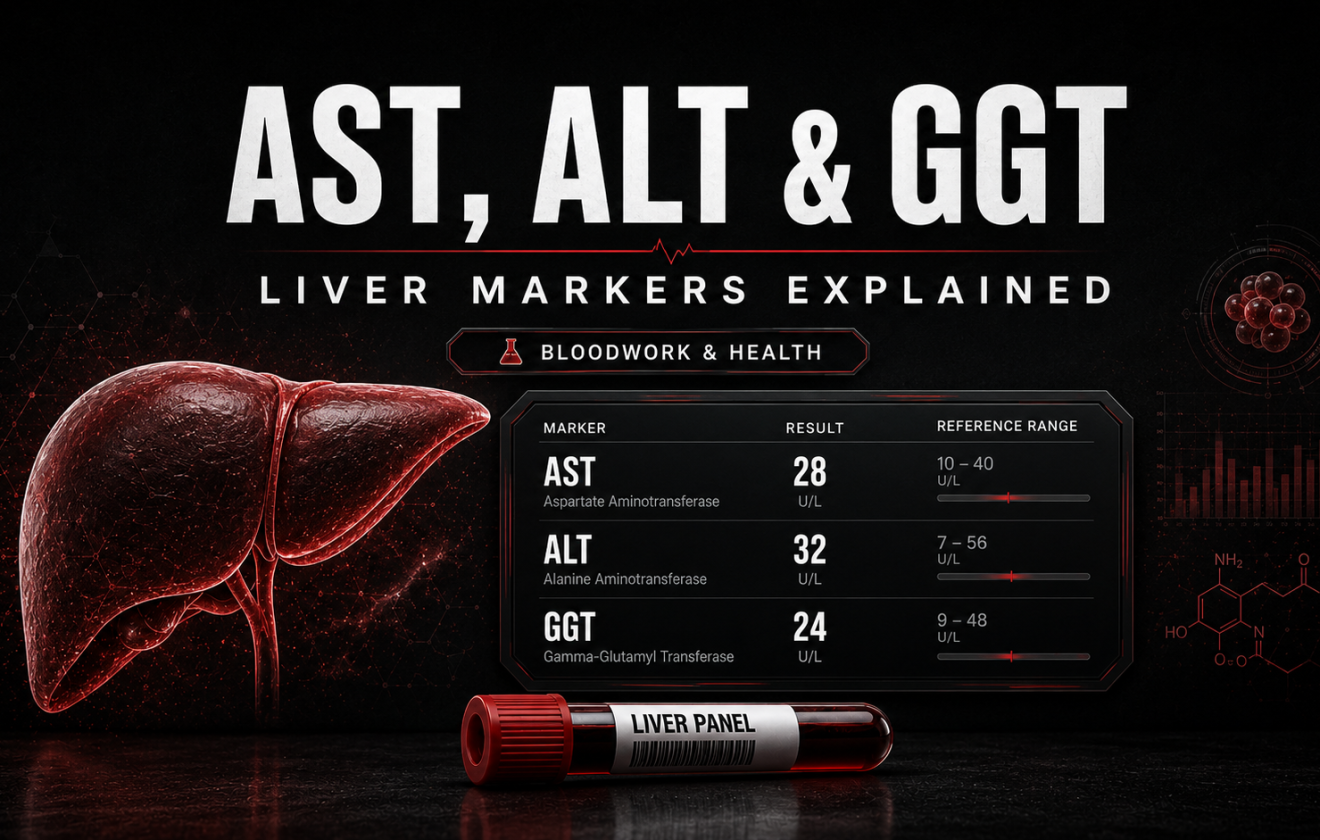
Liver markers are the blood tests that report on liver cells, bile flow and liver protein synthesis: ALT, AST, GGT, alkaline phosphatase, bilirubin and albumin. Lifters and men on hormone therapy have to read them differently, because heavy training leaks AST and ALT out of skeletal muscle while the liver itself stays healthy. This guide separates the harmless pattern from the one that needs a doctor, and the steroid liver damage guide covers compound specific injury in detail.
Liver Markers: 3 Findings That Change How You Read the Panel
Most explanations of liver markers are written for a sedentary patient in a hepatology clinic, not for someone who trained legs three days before the draw or who runs a compound designed to survive first pass metabolism. For lifters and men on testosterone, the same six numbers carry different information, and reading liver markers with the general population script produces two opposite errors: panic over a harmless muscle signal, and calm over a genuinely dangerous one.
Three published findings do most of the work: exercise alone moves the transaminases for a week, one enzyme refuses to move with muscle damage, and only some liver markers predict dying. Together they explain why the enzyme everybody watches is often the least informative on the panel.
In healthy untrained men given a single bout of heavy eccentric exercise, AST, ALT, LDH, CK and myoglobin all rose significantly and stayed elevated for at least seven days. Bilirubin, GGT and alkaline phosphatase never left the normal range (Pettersson 2008).
In elite bodybuilders, CK, AST and ALT were elevated while GGT stayed normal. In hepatitis patients all three enzymes rose together, and only that group showed a correlation between the transaminases and GGT (Dickerman 1999).
Across 19 cohorts and 9.24 million people, the top third of GGT carried a relative risk of 1.60 for all cause mortality and alkaline phosphatase 1.38. AST showed no clear association at 1.23, with a confidence interval crossing one (Kunutsor 2014).
Reference ranges for liver markers vary between laboratories and assay methods. Always interpret your result against the range printed on your own report, and against your own previous results rather than a number from an article.
What This Guide to Liver Markers Covers
The six liver markers on a standard panel. What each one is, where in the body it comes from, what a typical adult range looks like and which conditions push it up.
Muscle versus liver. How to tell training induced transaminase rises from real hepatic injury using GGT, creatine kinase and the AST to ALT relationship.
Anabolic compounds. Why 17 alpha alkylated oral steroids produce a cholestatic pattern, and why the enzyme that moves first is not the one that matters most.
Testing practice. How long to rest before a draw, what to repeat, and which combinations of liver markers justify seeing a clinician.
Diagnosis. This page explains what liver markers measure. It does not diagnose hepatitis, fatty liver disease, gallstones or drug induced liver injury, all of which require imaging, history and a clinician.
Treatment protocols. No supplement, dose or cycle recommendation appears here. Liver support products are discussed only where published evidence exists.
Paediatric and pregnancy ranges. Liver markers behave differently in growing adolescents and in pregnancy, and those ranges are outside this guide.
The 6 Liver Markers, What Each One Actually Measures
A standard liver panel is not one test. It is three different kinds of information printed in one column. ALT and AST are leakage enzymes: they sit inside cells and appear in blood when cells are damaged or made leaky. GGT and alkaline phosphatase are cholestatic enzymes: they rise when bile flow is obstructed or when the cells lining the bile ducts are induced. Bilirubin and albumin are function tests: they measure whether the liver is still doing its job of clearing waste and manufacturing protein.
That three way split is the most useful thing to know about liver markers, because it tells you which question a raised number answers. Leakage enzymes answer whether cells are losing their contents, and muscle cells qualify. Cholestatic enzymes answer whether bile is moving. Function tests answer whether the organ still works, and only that group speaks to how sick someone is.
| MARKER | TYPICAL ADULT MALE RANGE | WHERE IT COMES FROM | WHAT RAISES IT | STATUS |
|---|---|---|---|---|
| ALT (alanine aminotransferase) | About 7 to 40 U/L on most lab reports. A true healthy normal is 29 to 33 U/L for men and 19 to 25 U/L for women (ACG 2017) | Mostly liver, but also skeletal muscle, heart and kidney | Fatty liver disease, viral hepatitis, alcohol, medication, heavy resistance training | ● Leakage |
| AST (aspartate aminotransferase) | About 10 to 40 U/L | Liver, skeletal muscle, heart, red blood cells, kidney, brain | Everything that raises ALT, plus muscle injury, haemolysis and cardiac events | ● Least specific |
| GGT (gamma glutamyl transferase) | About 8 to 61 U/L | Liver, bile ducts, pancreas, kidney. Not skeletal muscle | Alcohol, bile duct obstruction, alkylated oral steroids, enzyme inducing drugs | ● Tie breaker |
| ALP (alkaline phosphatase) | About 40 to 130 U/L | Bile ducts and bone, with smaller contributions from intestine and placenta | Cholestasis, gallstones, and separately bone growth and bone disease | ● Cholestatic |
| Total bilirubin | About 0.2 to 1.2 mg/dL | Breakdown product of haemoglobin, conjugated and excreted by the liver | Cholestasis, liver failure, haemolysis, and harmlessly by Gilbert syndrome | ● Function |
| Albumin | About 3.5 to 5.0 g/dL | Manufactured only by the liver, half life about 20 days | Falls in chronic liver failure, inflammation, kidney loss and malnutrition | ● Slow signal |
Notice what the third column does to the popular reading of liver markers. AST appears in six tissues and ALT in four. Only GGT is absent from skeletal muscle entirely, and that single fact decides most arguments about a lifter's panel. An elevated ALT in someone who squatted heavy on Saturday and tested on Monday is a muscle result until GGT says otherwise.
Why Liver Markers Look High on a Standard Lab Range
Why do liver markers so often look normal when they are not? Because of how the upper limit on your report was produced. Most laboratory ranges came from populations that included undiagnosed fatty liver disease, which drags the limit upward. When Prati and colleagues screened blood donors and excluded everyone with viral markers, raised BMI or abnormal lipids or glucose, the healthy upper limit for ALT fell to 30 U/L in men and 19 U/L in women, against the 40 and 30 then in routine use.
The American College of Gastroenterology adopted the same logic in 2017, putting a true healthy normal ALT at 29 to 33 U/L for men and 19 to 25 U/L for women, and stating that values above this should be assessed. So the chart below is the uncomfortable part of reading liver markers: a result of 38 U/L that your lab prints in black is above the evidence based healthy limit, while a result of 90 U/L two days after a heavy session may mean nothing at all.

The animated bars below show something different: not thresholds, but outcomes. Kunutsor and colleagues pooled 19 prospective cohorts covering 9.24 million participants and 242,953 deaths, and compared the top third of each enzyme against the bottom third for all cause mortality. The ranking is not the one most people expect from liver markers.
A different view: all cause mortality, top third versus bottom third of each enzyme, 19 cohorts, 9.24 million people (Kunutsor 2014). The track runs from 0 to 2.0 times risk; the midpoint is "same risk".
GGT and alkaline phosphatase, the two cholestatic liver markers, were the ones that tracked mortality. AST, the enzyme most likely to be raised by your training, carried no clear signal. ALT went in opposite directions in different populations, which is itself a warning against reading one transaminase as a health score. Among the liver markers on a routine panel, the quiet ones carry the prognosis.
How Training Fakes Bad Liver Markers
Why do liver markers go bad after a heavy week? Pettersson and colleagues put healthy men with no strength training history through a single heavy weightlifting session and followed eight clinical chemistry parameters for a week. Five rose significantly: AST, ALT, LDH, CK and myoglobin, all still elevated seven days later. Bilirubin, GGT and alkaline phosphatase stayed inside the normal range throughout.
Read that report cold and those men had hepatitis. Read the liver markers alongside the muscle markers and the picture is obvious: the enzymes that leak from muscle rose, the enzymes that only liver and bile ducts produce did not. The authors concluded that muscular exercise can cause highly pathological liver function tests in healthy men, and that CK and myoglobin identify the source.
Dickerman and colleagues ran the mirror image study in people who actually lift, comparing liver markers in elite bodybuilders, including steroid users, against hepatitis patients and controls. In both bodybuilder groups CK, AST and ALT were elevated while GGT stayed normal. In the hepatitis group all three rose together, and only there did the transaminases correlate with GGT. Their conclusion was blunt: earlier reports of steroid induced liver dysfunction based on transaminases alone had misattributed muscle damage to the liver.
The scale of the muscle contribution is easy to underestimate. Mougios established creatine kinase reference intervals in athletes of 82 to 1083 U/L in men and 47 to 513 U/L in women, roughly twice the limit for moderately active people and up to six times the limit quoted for inactive individuals. If CK can legitimately sit near 1000 U/L in a trained man, the liver markers that leak alongside it will not look tidy either.
AST and ALT up, GGT normal, CK high
The training pattern, produced in untrained men by Pettersson and found in bodybuilders by Dickerman. It is not evidence of liver disease. Rest 72 hours and repeat rather than starting a supplement. Our guide on high creatine kinase explains how far CK can legitimately climb.
GGT and ALP rising together, with or without bilirubin
The cholestatic pattern, and the one that matters. Alkaline phosphatase raised disproportionately to the transaminases defines cholestatic injury in the ACG framework. Muscle produces neither enzyme, so training does not explain it. On an alkylated oral this combination is the signal to stop and get assessed.
Transaminases above three times normal with a rising bilirubin
Hepatocellular injury severe enough to impair clearance is the classic high risk combination in drug induced liver injury. Bilirubin is a function test, so it only moves when the liver cannot keep up. Among all liver markers, a rising bilirubin with jaundice requires same week medical attention.
AST roughly twice ALT, with a high GGT
The alcohol associated pattern. In muscle driven elevations AST and ALT move together and GGT stays flat; when AST runs at about double ALT with a clearly raised GGT, alcohol is the first thing a clinician will ask about. Honest answers here save a lot of unnecessary imaging.
A mildly high ALT that never comes down
Persistent mild elevation after genuine rest, with a normal CK, points away from muscle. Metabolic fatty liver disease is now the most common explanation for abnormal liver markers worldwide; the largest meta analysis pooled 92 population studies covering over 9.3 million people. Body composition, blood sugar and alcohol matter more here than any supplement.
Normal enzymes, falling albumin, rising INR
The pattern nobody watches for, because the enzymes look fine. Albumin has a half life of about 20 days and falls only when synthesis has been impaired for weeks. Enzyme liver markers describe damage; albumin, bilirubin and clotting time describe function, and function determines outcome.
Which Compounds Actually Move Liver Markers
Which compounds actually move liver markers? Hepatotoxicity among anabolic androgenic steroids is a chemistry effect, not a class effect. Bond and colleagues set out the mechanism: the 17 alpha alkyl substitution that lets an oral steroid survive first pass metabolism is also what makes it hepatotoxic, while non alkylated compounds appear not to share that property. The documented injuries are cholestatic jaundice and, with prolonged use, peliosis hepatis and hepatic tumours.
The case literature shows which liver markers move. Stepien and colleagues reported a 19 year old taking 50 mg of stanozolol every other day for two months. His enzymes were essentially normal, only ALT slightly elevated, while bilirubin reached 44.34 mg/dL and biopsy showed intrahepatic cholestasis with periportal fibrosis. Anyone watching ALT alone would have seen a reassuring report while the patient went into liver failure.
| COMPOUND OR SITUATION | PATTERN IN LIVER MARKERS | WHAT DRIVES IT | STATUS |
|---|---|---|---|
| Oral 17 alpha alkylated steroids (methandrostenolone, oxymetholone, stanozolol, turinabol) | GGT, ALP and bilirubin rise; transaminases may be modest or near normal | 17 alpha alkylation impairs bile flow and injures hepatocytes on first pass | ● Documented |
| Oral oxandrolone | Milder in reports, but still alkylated and still capable of cholestasis | Same chemistry, lower reported incidence, not a free pass | ● Real risk |
| Injectable stanozolol and injectable methandrostenolone | Same cholestatic risk as the oral form | The alkyl group travels with the molecule; the route does not remove it | ● Not spared |
| Injectable testosterone esters and nandrolone | No characteristic hepatic pattern; AST and ALT may rise from training | Not alkylated, so first pass toxicity does not apply | ● Low direct signal |
| Testosterone replacement therapy at physiological doses | Liver markers usually unchanged; see TRT bloodwork for the panel that is actually monitored | Haematocrit, lipids and blood pressure are the monitored risks, not the liver | ● Not the concern |
| Selective androgen receptor modulators | Cholestatic and hepatocellular injury reported in the case literature | Unregulated products of unknown content | ● Reported injury |
This is the practical difference between the two halves of the panel. On an injectable cycle, raised transaminases with a clean GGT are usually a training artefact. On an oral cycle, a clean ALT is not reassurance, because the compounds most likely to hurt you announce themselves through bile flow, and the liver markers reporting bile flow are GGT, alkaline phosphatase and bilirubin.
How to Get Liver Markers That Mean Something
How do you get liver markers that mean something? A blood test is a snapshot of the previous week, not of this morning. Because AST and ALT stayed elevated for seven full days after one session in the Pettersson study, the timing of the draw changes the result more than anything else you control. Most confusion around liver markers in lifters is created at the phlebotomy chair, not in the liver.
The minimum useful preparation for reading liver markers is 48 to 72 hours without heavy or novel resistance training, no alcohol in the same period, and no new supplement in the previous fortnight. If you have just begun a programme or trained an unfamiliar movement, extend that to a week. Testing the day after a personal best is testing your muscles.
Ask for creatine kinase alongside the panel. It is the highest value addition to liver markers for anyone who trains, because it turns an ambiguous transaminase into an answer. Nathwani and colleagues reviewed 16 patients with muscle necrosis and no liver disease, across extreme exercise, polymyositis and seizures, and all showed markedly elevated CK and LDH alongside the raised ALT. If CK is high and GGT is normal, the muscle explanation is live.
Repeat before you react. One abnormal result in an asymptomatic person is a reason to retest under better conditions, not a diagnosis. If the same liver markers are still abnormal after a properly prepared repeat draw, imaging, viral serology and a clinical history become worthwhile. Our guide to bloodwork frequency on a cycle covers sensible intervals.
Keep the trend, not the last number. Liver markers are far more informative as a series than as a single point, because each person sits somewhere different inside the population range. A man whose ALT ran at 22 U/L for three years and now reads 39 U/L has changed considerably, though both print as normal. That is invisible unless you keep your reports.
It is inducible, not just leaked. Whitfield's review describes an enzyme that rises both with bile duct injury and with enzyme induction from alcohol and various drugs, which is why it is sensitive but not specific.
It is absent from skeletal muscle. That absence makes it the tie breaker among liver markers in people who train, and it is how Dickerman separated bodybuilders from hepatitis patients.
It carries prognosis. Of the liver markers examined by Kunutsor across 9.24 million people, GGT showed the strongest and most consistent link with all cause mortality.
5 Mistakes People Make Reading Liver Markers
1. Testing the day after training. This is the most common error and the easiest to fix. AST and ALT remain elevated for at least a week after unaccustomed heavy lifting, so a Monday draw after a Saturday session is measuring your quadriceps. Rest, repeat, and compare like with like.
2. Watching only ALT. ALT is the enzyme everyone recognises, so it is the one everyone over interprets. The Stepien case had a near normal enzyme profile with a bilirubin above 44 mg/dL. Among liver markers, ALT is the noisiest and least prognostic in trained populations.
3. Treating the lab upper limit as healthy. Routine reference ranges were built from populations that included undiagnosed fatty liver. A true healthy ALT sits at 29 to 33 U/L for men, so a result of 38 U/L printed in black is already above the evidence based limit and deserves attention rather than relief.
4. Assuming injectable means liver safe. Injectable stanozolol is still 17 alpha alkylated. The alkyl group, not the needle, determines hepatotoxicity, and the same compound carries the same cholestatic risk whichever way it enters the body.
5. Buying a supplement instead of a repeat test. Marketing thrives on abnormal liver markers, but no product substitutes for finding the cause. The useful sequence is rest, retest with creatine kinase, review alcohol and medication, then see a clinician if GGT, alkaline phosphatase or bilirubin are involved.
Liver Markers: Common Questions Answered
Can lifting weights raise AST and ALT?
Yes, and by a lot. In healthy untrained men given one heavy weightlifting session, AST, ALT, LDH, CK and myoglobin all rose significantly and were still elevated seven days later, while bilirubin, GGT and alkaline phosphatase stayed normal throughout. Both enzymes exist in skeletal muscle, so muscle damage releases them exactly as liver damage does. A result taken soon after training tells you little about the liver itself.
Is GGT a better test than ALT?
For separating muscle from liver, yes. GGT is not produced by skeletal muscle, so training does not raise it. For prognosis it also performs better: across 19 cohorts and 9.24 million people, the highest third of GGT carried a 1.60 times relative risk of all cause mortality, while AST showed no clear association. It is not specific to one disease, since alcohol, bile duct problems and enzyme inducing drugs all raise it, but it answers the question that matters most for a lifter.
What AST to ALT ratio should worry me?
An AST sitting at roughly twice ALT, particularly with a raised GGT, is the pattern classically associated with alcohol related liver disease and warrants an honest conversation with a clinician. Muscle driven elevations usually move both enzymes together with a high creatine kinase and a normal GGT. The ratio is a hint, not a diagnosis, and it is unreliable on its own without CK, GGT and a history.
How long should I rest before a blood test?
At least 48 to 72 hours without heavy or unfamiliar resistance training, and ideally a full week after a programme change or a new movement. Avoid alcohol for the same period and start no new supplement in the fortnight before. Because transaminases were still elevated at day seven in controlled testing, longer is genuinely better for a clean baseline.
Do injectable steroids damage the liver?
Non alkylated injectables such as testosterone esters and nandrolone do not show the characteristic hepatotoxic pattern. The determining factor is 17 alpha alkylation, the modification that lets a steroid survive first pass metabolism, and that substitution rather than the route causes cholestatic injury. Injectable stanozolol is still alkylated and still carries the risk, so the needle changes nothing.
What does a high alkaline phosphatase mean?
Alkaline phosphatase comes from both bile ducts and bone, so it is read in context. Raised disproportionately to AST and ALT it defines a cholestatic pattern, the injury type associated with alkylated oral steroids. Raised alone in a young or recently injured person, a bone source is common. GGT settles it: a raised GGT alongside points to the biliary tree, a normal GGT points to bone.
Is a mildly high ALT dangerous?
One mildly raised value in someone who trains is usually a timing artefact and should be repeated after proper rest, with creatine kinase included. A mild elevation that persists after a well prepared repeat draw is worth investigating, because metabolic fatty liver disease is now the leading cause of chronic enzyme elevation worldwide and it is largely silent. Danger is signalled by the company an enzyme keeps: a rising bilirubin, a falling albumin or a climbing GGT.
Does testosterone replacement therapy raise liver enzymes?
Testosterone replacement at physiological doses, whether by injection, gel or pellet, is not associated with the hepatotoxic pattern seen with alkylated orals, and the liver is not what monitoring focuses on. Haematocrit, lipids, blood pressure and prostate markers are the routine checks. Transaminases can still drift up in men who train hard or gain muscle mass, which is a muscle effect rather than a drug effect.
Sources and Further Reading
All citations are peer reviewed studies and clinical guidelines verified via PubMed, and reference links are dofollow to support open science. Every threshold, relative risk and case detail quoted above for these liver markers is taken directly from the primary publication listed below.
More From the Bloodwork Series
All guides are evidence-based, PMID-verified, and written for lifters and men on hormone therapy who need to read their own blood panel properly.
Final Educational Note
This article is for educational purposes and does not constitute medical advice. Liver markers are interpreted by a clinician alongside your history, medication, alcohol intake, imaging and physical examination, and reference ranges differ between laboratories and assay methods. Nothing here is a substitute for a proper assessment of an abnormal result.
MuscleScience does not prescribe, sell or supply any medication or anabolic compound. Do not start, continue or stop any drug on the basis of a blood result read from a website, including this one. For the wider series see the bloodwork hub, our editorial standards and the full medical disclaimer. Related panels are covered in the kidney markers guide and the lipid panel guide, and the liver stress index calculator puts your own numbers into the same framework.