Libido on Steroids: 6 Reasons Your Drive Crashes
Libido on steroids
A crashed libido on steroids is one of the most common complaints in the enhanced world, and it catches people completely off guard. You raise testosterone far above natural levels, you assume your sex drive will follow, and instead it flatlines. The truth is that raw testosterone is only one lever. Drive depends on the whole hormonal environment around it — estradiol, prolactin, blood pressure and the pathways that control blood flow — and a cycle disturbs every one of those at the same time.
There are six reasons your libido on steroids falls apart, and almost all of them are fixable once you know which one you are dealing with. This guide walks through each cause, how to tell them apart, and what to actually do about it. Wrecked drive on cycle is a signal that something is out of balance, not proof that the gear is not working.
Why more testosterone is not enough
Most people picture libido on steroids as a simple dial wired straight to testosterone: more test, more drive. It does not work that way. Testosterone is the fuel, but a large share of it is aromatised into estradiol, and estradiol is what actually does much of the heavy lifting for male sex drive in the brain. Push testosterone up without managing the conversion and you can end up with sky-high test and a libido on steroids that is worse than when you started.
On top of that, several anabolic compounds bring their own problems that have nothing to do with testosterone at all. Nandrolone and trenbolone raise prolactin. Many orals spike blood pressure, which strangles the blood flow that erections depend on. Every compound stacks another variable on the pile, and drive is the first thing to break when the balance tips.
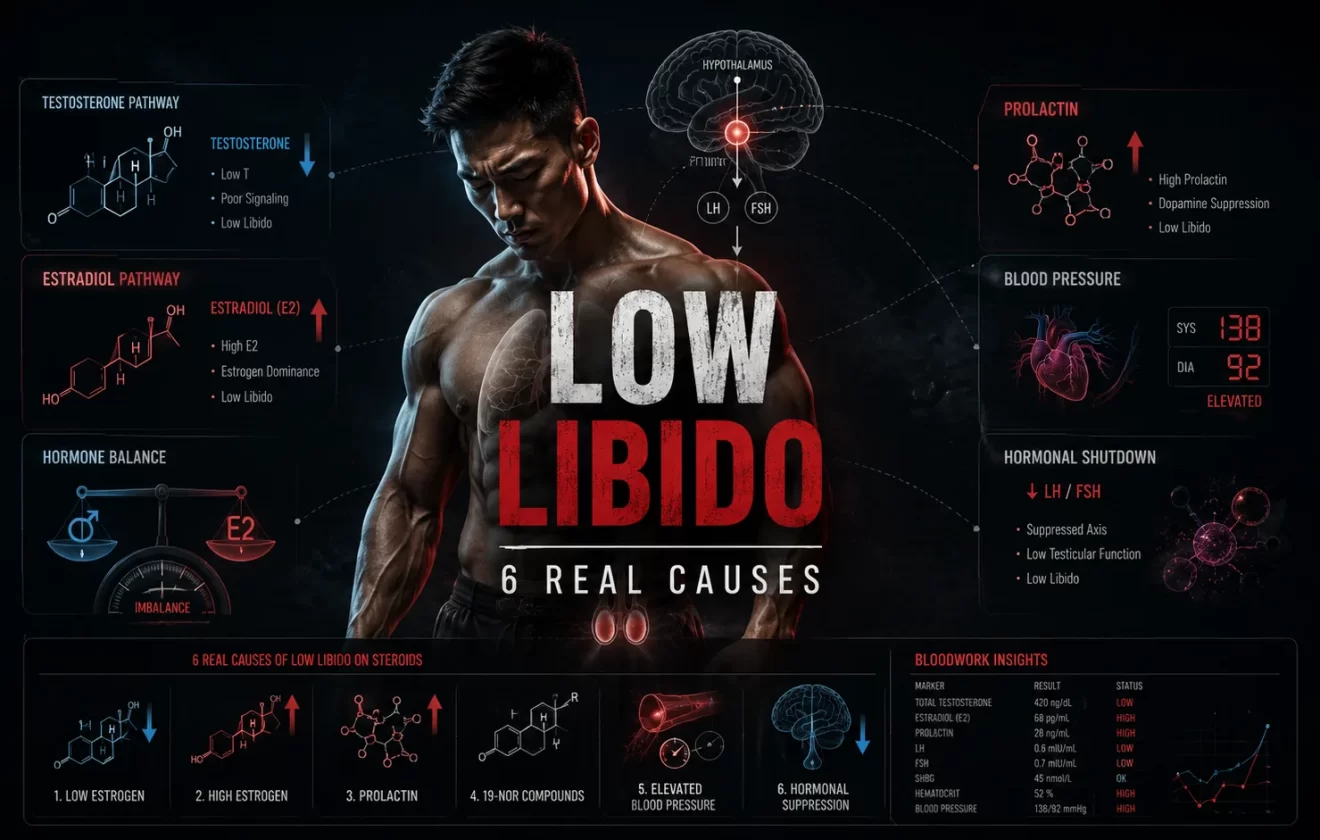
That is why libido on steroids is best understood as six separate failure modes rather than one. The chart below shows roughly how often each one is the real culprit. Identify your cause and the fix is usually straightforward; guess wrong and you can make it dramatically worse, which is exactly what happens when someone blindly adds an aromatase inhibitor to a problem that was never about estrogen.

1. Crashed estrogen from too much AI
This is the number-one reason libido on steroids dies, and it is almost always self-inflicted. Terrified of gyno, people take an aromatase inhibitor like anastrozole or astandrozole on a schedule, or slam a big dose at the first hint of a puffy nipple. Estradiol plummets below the healthy range and drive vanishes overnight. The cruel irony is that the AI meant to protect you is the thing killing your sex life.
Crashed estrogen has a signature you can learn to recognise: aching, dry, clicking joints, a strange flat and joyless mood, dry skin, and a libido on steroids that is not just low but completely absent — no morning wood, no spontaneous interest, nothing. If you started an AI and your drive fell off a cliff a few days later, this is your answer nine times out of ten. The fix is to stop or sharply reduce the AI and let estradiol climb back into range, which usually restores drive within one to two weeks.
The deeper lesson is that aromatase inhibitors are powerful tools that most enhanced lifters simply do not need, or need only in tiny amounts. Estrogen is not the enemy; runaway estrogen is. Unless a blood test or unmistakable gyno symptoms tell you estradiol is genuinely high, the default position should be no AI at all. Countless cases of a wrecked libido on steroids trace back to a preventive dose of anastrozole that was never warranted in the first place.
2. Estrogen too high
The opposite problem also kills drive. When testosterone runs high and nothing controls aromatisation, estradiol can climb far above the healthy window. Moderately elevated estrogen often feels fine or even good, but once it gets high enough it brings water retention, emotional volatility, soft or unreliable erections and a libido on steroids that feels foggy and switched off rather than sharp.
High estrogen is where the classic gyno warning signs live too: itchy or sensitive nipples, a puffy look, and bloating that no amount of dieting shifts. The temptation is to reach straight for a heavy dose of AI, but that is exactly how people over-correct into a crash. The right move is a small, measured reduction confirmed by bloodwork, not a sledgehammer.
Because both too-high and too-low estradiol wreck libido on steroids in overlapping ways, you genuinely cannot tell them apart by feel alone with any confidence. A blood test that puts a number on your estradiol is the only way to know which side of the sweet spot you are on before you touch a single tablet.

3. Prolactin creeping up
Prolactin is the quiet killer, and it is the reason so many people are baffled when their estradiol comes back perfect but their drive is still gone. Certain compounds — especially the 19-nortestosterone family like nandrolone (deca) and trenbolone — push prolactin upward. Elevated prolactin blunts libido on steroids, flattens mood and is the mechanism behind the infamous inability to finish or maintain an erection even when desire is technically present.
The tell is the pattern: good estrogen numbers, plenty of testosterone, and yet erections are unreliable and orgasm feels muted or takes forever. If you are running deca or tren and that describes you, prolactin is the prime suspect. It is confirmed with a simple prolactin blood test.
Management usually means lowering the offending compound and, where appropriate, a dopamine agonist such as cabergoline used carefully under medical guidance. Vitamin B6 helps at the margins. The key point is that no amount of AI, extra test or time will fix a prolactin problem — you have to address prolactin directly, which is why testing matters so much.
It is worth stressing how often this cause is missed. Someone runs a bit of deca for their joints, their estradiol reads perfectly, and they cannot understand why their drive has evaporated. Because the standard advice online is obsessed with estrogen, they crash their estradiol chasing the wrong villain and end up worse off. If you are on a 19-nor and something feels off, put prolactin on the test panel before you touch your aromatase inhibitor.
4. Progestogenic compounds — the deca dilemma
Related to but distinct from prolactin is the progestogenic activity of nandrolone and trenbolone. These compounds interact with the progesterone receptor, and that progestogenic signalling can suppress libido on steroids and erection quality on its own, independent of where your estrogen and prolactin sit. This is a large part of what people are describing when they talk about the notorious drive problems on those drugs.
The frustrating thing is that this cause can coexist with perfectly normal bloodwork. Your estradiol looks fine, your prolactin looks fine, and yet drive is still poor because the compound itself is acting directly on receptors that govern sexual function. No ancillary fully cancels this out.
The practical answer is compound selection and dosing. Many enhanced lifters find they need a healthy ratio of aromatising testosterone alongside any 19-nor to keep drive intact, and that lower doses of the 19-nor are far kinder to libido on steroids than heroic ones. If a compound reliably kills your drive despite clean bloods, the honest fix is to run less of it or not at all.
5. Blood pressure and blood flow
An erection is a plumbing event before it is a hormonal one. It depends on healthy blood vessels dilating and filling on demand, and that process runs on nitric oxide and clean vascular function. Many anabolic compounds — particularly oral steroids — drive blood pressure up and drag down HDL cholesterol, and elevated blood pressure directly impairs the endothelial function that erections rely on.
This is why a person can have textbook hormones and still struggle: desire is there, but the hardware cannot deliver because the vascular system is under strain. High blood pressure on cycle is common, frequently symptomless, and quietly corrosive to both drive and erection quality.
The fix here is cardiovascular, not hormonal. Keep blood pressure in check with cardio, sensible sodium intake, and by not stacking multiple harsh orals; monitor it with a cheap home cuff rather than guessing. Getting blood pressure back into a healthy range often restores erection quality even when nothing about the hormone panel changes.
Hydration, adequate blood volume and healthy blood lipids matter here too. Compounds that dry you out or tank your HDL undermine the same vascular machinery, and dehydration alone can flatten erection quality on a hard cycle. If your drive is intact in your head but your body will not cooperate, the vascular side of libido on steroids deserves a hard look before you blame your hormones.
6. Post-cycle shutdown
The last cause shows up not during the cycle but after it. Exogenous hormones shut down your natural production, and when the cycle ends there is a window where the drugs have cleared but your own testosterone has not yet recovered. Hormones sit in the basement, and libido on steroids goes with them. Without a proper recovery protocol this trough can drag on for months.
This post-cycle crash is one of the strongest arguments for a well-run PCT and for honest, patient recovery rather than blasting straight into the next cycle to escape the low. The drive comes back as natural production climbs, but only if you give the axis a real chance to restart.
It is also worth naming the psychological layer that overlays all six causes. Sleep deprivation, stress, relationship strain and simple burnout suppress libido on steroids powerfully in anyone, enhanced or not. When drive is poor on cycle, the hormonal cause and the lifestyle cause are usually both present, and fixing one without the other leaves you disappointed.
How to fix libido on steroids
Fixing a crashed libido on steroids is a process of elimination. Work through it in order rather than changing five things at once, because the only way to know what worked is to change one variable at a time.
- 1
Test before you touch anything
Get bloodwork covering total and free testosterone, estradiol (sensitive assay) and prolactin. This single step tells you which of the six causes you are dealing with and stops you from crashing your estrogen chasing a problem that was never about estrogen.
- 2
Correct estradiol into the sweet spot, gently
If estrogen is high, make a small AI reduction and re-test. If it is crashed, stop the AI and let it recover. Aim for a balanced mid-range number, never zero — both extremes kill drive.
- 3
Address prolactin and 19-nor load
If prolactin is elevated or you are running deca or tren, lower the offending compound and consider a dopamine agonist under medical guidance. Ensure enough aromatising testosterone sits alongside any 19-nor.
- 4
Fix the plumbing and the lifestyle
Get blood pressure into a healthy range with cardio and by trimming harsh orals, then protect sleep, manage stress and keep body fat reasonable. These recover drive that no ancillary can.

Follow that sequence and most people restore drive without heroics. The mistake that keeps libido on steroids broken for months is impatience — stacking changes, over-dosing an AI, or refusing to test and simply hoping the next tweak fixes it.
Warning signs to watch
No morning erections
A total absence of morning or spontaneous erections points strongly at crashed estrogen or a serious hormonal imbalance, not just stress. It is one of the clearest signals that estradiol or prolactin is off.
Desire present, hardware failing
Wanting sex but being unable to get or keep an erection is the classic prolactin or blood-pressure pattern. Clean estrogen with this symptom means testing prolactin and checking your blood pressure.
Aching, dry joints
Cracking, dry joints alongside dead libido on steroids is the fingerprint of estrogen crashed too low by an aromatase inhibitor. Back off the AI before anything else.
Drive fine on cycle, gone after
A libido on steroids that only collapses once the cycle ends is post-cycle shutdown. This is a recovery-protocol problem, not something to fix with more ancillaries.
Frequently asked questions
Why is my libido on steroids low when my testosterone is so high?
Because drive depends on far more than testosterone. Estradiol, prolactin and blood flow all have to be right, and a cycle disturbs all three. Sky-high testosterone with crashed estrogen or elevated prolactin will still leave you with no drive.
Will an aromatase inhibitor fix my low libido?
Only if your estrogen is genuinely too high, confirmed by a blood test. Taking an AI when estrogen is normal or already low is the single most common way people destroy their libido on steroids. Test first, never guess.
Which steroids are worst for sex drive?
The 19-nortestosterone compounds — nandrolone (deca) and trenbolone — because they raise prolactin and act on the progesterone receptor. Harsh oral steroids also hurt indirectly by spiking blood pressure. Balanced testosterone is usually the kindest to drive.
How long does it take for libido on steroids to come back?
Once you correct the actual cause, most people see drive return within one to four weeks, and largely back to normal by eight. The exception is post-cycle shutdown, which follows your natural testosterone recovery and can take longer.
Can I fix this without bloodwork?
You can try, but you are gambling. Too-high and too-low estrogen feel similar, and prolactin problems mimic both. A blood test covering estradiol, prolactin and free testosterone is cheap and turns guesswork into a targeted fix.
Is low libido on steroids a sign my gear is fake or underdosed?
Not usually. A crashed libido on steroids is far more often a balance problem — estrogen, prolactin or blood pressure — than a dosing problem. Sort those out before you assume the compound is the issue.
References
- Finkelstein JS et al. Gonadal steroids and body composition, strength, and sexual function in men. New England Journal of Medicine, 2013 — shows estradiol, not just testosterone, drives male libido on steroids.
- Schulster M et al. The role of estradiol in male reproductive function. Asian Journal of Andrology — estradiol’s role in erectile and sexual function.
- De Rosa M et al. Hyperprolactinemia in men: clinical and biochemical features and response to treatment. Endocrine — elevated prolactin, low libido on steroids and response to dopamine agonists.
- Corona G et al. Psychobiological correlates of hypoactive sexual desire in men. International Journal of Impotence Research — hormonal and vascular contributors to low drive.
Drive is a balance problem, not a testosterone problem
A crashed libido on steroids almost always comes down to one of six fixable causes: crashed or high estrogen, elevated prolactin, progestogenic compounds, blood pressure, or post-cycle shutdown. The fix starts with a blood test, not another tablet. Get estradiol into the sweet spot, keep prolactin and blood pressure in check, and give recovery real time — drive comes back when balance is restored.