Low Estrogen on Cycle: 8 Crashed Estrogen Warning Signs
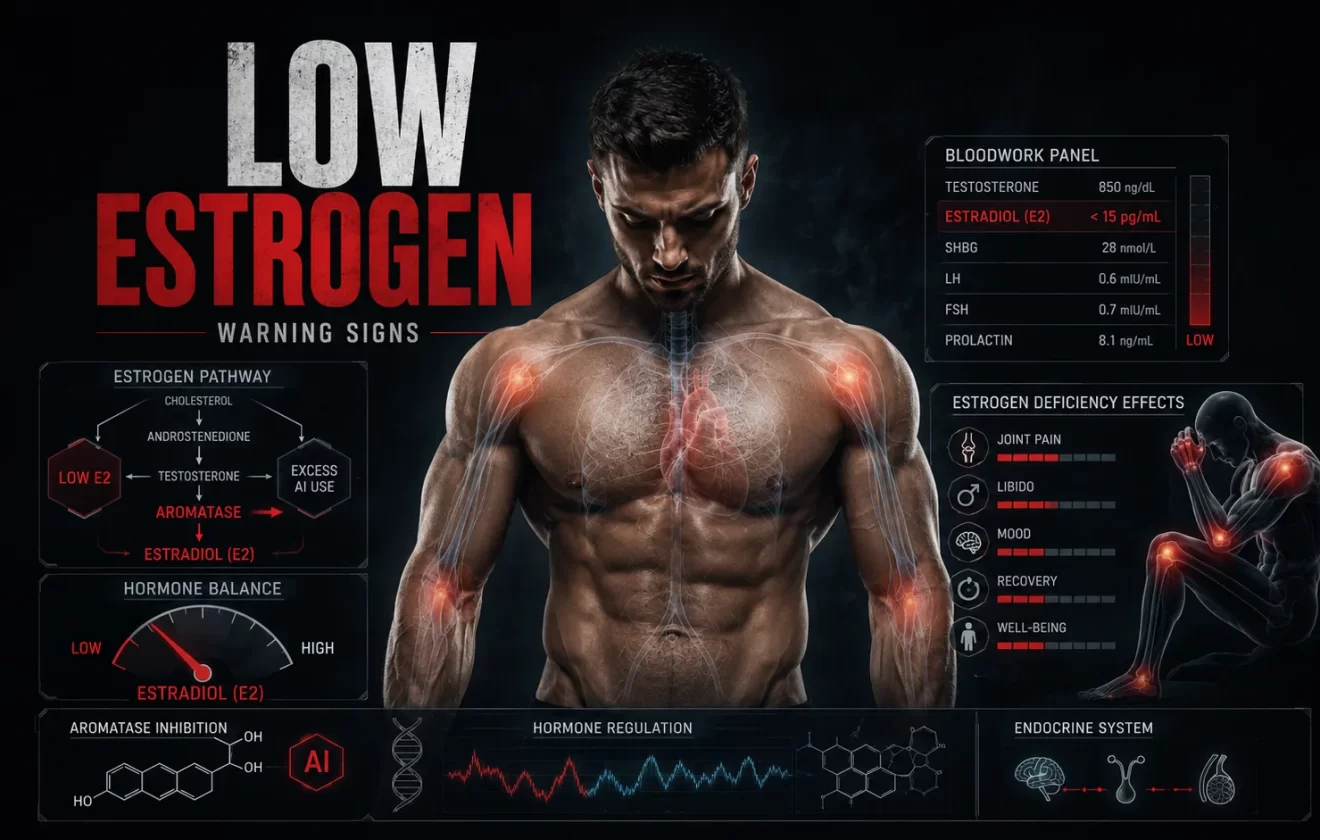
Low Estrogen on Cycle: 8 Crashed Estrogen Warning Signs
Crashed estrogen is what lifters call low estrogen that follows too much aromatase inhibitor: estradiol is driven far below what a male body runs on, and libido, joints, mood and erections go with it. This page explains what an estrogen crash actually is, what it feels like, why the measurement itself is unreliable in men, and why the sensible response is almost never another drug. If your problem points the other way, read high estrogen symptoms on steroids instead.
The data in brief
What twelve weeks of anastrozole 1 mg daily did to estradiol in 37 men, while total testosterone rose from 343 to 572 ng/dL. Testosterone going up is not proof that low estrogen has been avoided.
How weakly a standard immunoassay tracked mass spectrometry for total estradiol across 313 men, against R = 0.90 for testosterone. The male estradiol number is the least trustworthy figure on the panel.
In 198 men whose own hormone production was switched off, estrogen deficiency, not androgen deficiency, primarily accounted for the rise in body fat, and low estrogen and low testosterone both contributed to falling sexual function.
Figures are taken directly from the controlled trials listed in the sources section. They describe what aromatase inhibition and low estrogen do to hormone levels in men, not a dose, a target or a protocol.
What this guide covers
What crashing estrogen means. The physiology behind low estrogen in men, and why aromatase inhibitor overshoot on a cycle or on TRT is the usual cause rather than anything the body does on its own.
What crashed estrogen feels like. The eight warning signs lifters report most, ranked by how specific each one is to low estrogen rather than to low testosterone, poor sleep or simple fatigue.
Why estradiol matters in men. Libido and erectile function, joint comfort, bone density, mood and lipids, with the trial evidence behind each.
Why the number is unreliable. The sensitive assay versus standard immunoassay problem, and why there is no firmly established lower reference limit for estradiol in men.
Doses and protocols. This page names no aromatase inhibitor dose, no titration schedule and no estradiol target. Those are medical decisions and they are outside the scope of an educational site.
The opposite problem. Water retention, nipple sensitivity and estrogenic bloat belong to high estrogen symptoms on steroids, and established breast tissue belongs to how to get rid of gyno.
Therapeutic dose management. Estradiol handling at replacement doses is covered on estradiol on TRT, and baseline interpretation before anything starts is covered on estradiol before steroids.
Individual advice. Nothing here replaces a clinician who can see your bloodwork, your history and your symptoms together.
What crashed estrogen actually means
Men make estradiol out of testosterone. The aromatase enzyme, concentrated in fat tissue but present in bone, brain, liver and the testes, converts part of circulating testosterone into estradiol every day. That conversion is not a leak in the system. It is how the male body gets the estrogen it needs, and the more testosterone circulates, the more substrate aromatase has.
An estrogen crash is what happens when that conversion is blocked harder than intended. Aromatase inhibitors such as anastrozole, exemestane and letrozole were designed to strip estrogen out of women treated for breast cancer, and in a man they work exactly as advertised. Used without a measured reason, they can take estradiol from an ordinary male level down to one the body has no plan for, within days.
This is the single most important thing to understand about low estrogen in men who lift: it is nearly always self-inflicted. Spontaneous low estrogen without a drug involved is rare. What is common is a lifter on a cycle or on testosterone replacement who took an aromatase inhibitor as insurance, took it before any symptom appeared, and ended up with low estrogen instead of the estrogenic complaint he was trying to prevent.
Why testosterone rising does not mean estradiol is safe
When Leder and colleagues gave 37 men aged 62 to 74 anastrozole 1 mg daily for twelve weeks, total testosterone climbed from 343 to 572 ng/dL. Blocking aromatase removes part of the negative feedback on the pituitary, so luteinising hormone rises and the testes make more testosterone. Over the same twelve weeks estradiol fell from 26 to 17 pg/mL. Higher testosterone and low estrogen arrived together, in the same men, from the same tablet.
That pattern is why an estrogen crash so often goes unrecognised. The lifter sees a strong testosterone number, concludes the hormonal side of things is handled, and looks for another explanation for the dead libido and the aching joints. The low estrogen explanation is sitting in the estradiol row that nobody read.
What does crashed estrogen feel like
The reason people search for crashed estrogen rather than a clinical low estrogen term is that the experience is distinctive. It is not a slow slide. Men describe it as arriving over two or three days, shortly after starting or increasing an aromatase inhibitor, and as feeling flat and dry in a way ordinary tiredness does not.
The eight signs below are reported most often. What matters is the right hand column: how much each sign narrows the diagnosis. Fatigue tells you almost nothing about low estrogen. Joints that turn dry and creaky within days of a dose change, in a lifter whose training has not changed, tells you a great deal.
| Warning sign | What men describe | Also caused by | Status |
|---|---|---|---|
| Dry, aching joints | Creaky, unlubricated knees, elbows and shoulders within days of a dose change | Volume spikes, previous injury | ● Strongly suggestive |
| Libido switched off | Not reduced desire but absent desire, arriving abruptly while testosterone looks high | Low testosterone, prolactin, stress | ● Strongly suggestive |
| Weak or unreliable erections | Erections that start and fade, poor fullness, fewer morning erections | Low testosterone, vascular issues | ● Strongly suggestive |
| Flat, joyless mood | Anhedonia rather than sadness, a sense that nothing registers | Low testosterone, poor sleep, deficit | ● Suggestive but shared |
| Dry skin and eyes | Tight skin, gritty eyes, chapped lips, a dehydrated feeling on normal fluid intake | Diuretics, low body fat, climate | ● Suggestive but shared |
| Loss of fullness and pump | Muscles look flat, the training pump disappears, weight drops without fat loss | Low carbohydrate intake, dehydration | ● Suggestive but shared |
| Broken sleep | Falling asleep normally, then waking in the small hours | Stimulants, apnoea, high dose cycles | ● Non-specific |
| Fatigue and low drive | Heavy and unmotivated, routine sessions now feel long | Almost everything | ● Non-specific |
Two things separate low estrogen from the alternatives. The first is timing: the signs cluster after an aromatase inhibitor is started, raised, or continued once the aromatizable compound has cleared. The second is the joint complaint, which is the sign most men name first and the one least explained by low testosterone alone.
Why estradiol matters in men at all
Estradiol is not a female hormone that men tolerate, and low estrogen in a man is not a harmless state. It is a male hormone that happens to be made from testosterone, and several jobs usually credited to testosterone turn out on closer inspection to belong to its estrogenic metabolite.
The cleanest demonstration is the Finkelstein trial. In 198 men, endogenous production was suppressed and testosterone replaced at graded doses, with half also given an aromatase inhibitor so testosterone could be restored while estradiol stayed blocked. Androgen deficiency accounted for losses in lean mass, muscle size and strength. Estrogen deficiency primarily accounted for the rise in body fat. Low estrogen and androgen deficiency each contributed to the decline in sexual function. Split the hormones apart and the estrogen side owns a real share of what men value.

Bone is where the evidence is hardest
Skeletal maintenance in men depends on estradiol more than on testosterone. A landmark case report described a man with aromatase deficiency treated first with testosterone and then with estradiol, and the literature on estrogens as regulators of male bone health has grown steadily since.
When older men were given anastrozole for a full year, testosterone rose from 319 to 524 ng/dL and estradiol fell from 15 to 12 pg/mL, and spine bone mineral density fell in the treated group while it rose slightly on placebo. More recently, giving estradiol to men whose testosterone was deliberately suppressed raised cortical bone density at the radius and estimated failure load at radius and tibia.
Reviews of estrogens in male physiology and of estradiol in male reproductive function set out the rest: estradiol contributes to libido and erectile function, to lipid handling and high density lipoprotein, to fluid balance, to fat distribution, to mood and cognition, and to growth plate closure in adolescence. Strip it out and the consequences of low estrogen are not cosmetic.
How well a standard immunoassay agrees with mass spectrometry in 313 men. Testosterone tracks closely. The estradiol number does not.
How lifters crash their estrogen
Six situations account for most low estrogen cases in lifters. All six involve an aromatase inhibitor, and in five of them the drug was taken without evidence that it was needed.
The inhibitor is taken as insurance
An aromatase inhibitor started on day one of a cycle, before any estrogenic symptom and before any bloodwork, is the commonest route to low estrogen. Nothing has gone wrong yet, so there is no signal to dose against and no way to tell the dose is too much until symptoms arrive.
The dose is chased down to a number
Treating a lab value as a target rather than a context invites overshoot. Because male estradiol measurement is poor at the low end, chasing a number pushes people past the point where symptoms appear and into low estrogen the follow up test may not capture accurately.
The compound does not aromatize
Some compounds are not substrates for aromatase at all. An aromatase inhibitor run alongside them has nothing to block except the small amount of estradiol the body was making from baseline testosterone, so low estrogen arrives quickly and for no benefit whatsoever.
The inhibitor outlives the cycle
Aromatizable compounds clear before the habit of taking the tablet does. Testosterone falls, the substrate for aromatase falls with it, and the same inhibitor dose that was tolerable at peak now drives estradiol into low estrogen territory. This pattern often shows up in the first weeks of recovery.
The wrong test is used to steer
A standard immunoassay reading at male concentrations can disagree substantially with mass spectrometry. Steering an inhibitor dose with a test that correlates at R = 0.63 means a decision that ends in low estrogen is frequently based on a figure that is simply wrong.
More drugs are added to fix it
Low estrogen produces fatigue, flat mood and dead libido, which reads to many people as a testosterone problem. Raising the dose adds substrate but the inhibitor is still blocking conversion, and the real fix, which is removing or reducing the inhibitor, gets buried under a larger stack.
Low estrogen or low testosterone
This is the hardest part of the picture and the reason so many men get it wrong. Fatigue, flat mood, poor libido and weak erections appear on the low estrogen list and the low testosterone list alike, because both hormones feed the same systems. The Finkelstein data showed exactly that overlap: sexual function declined when either hormone was taken away.
Three questions separate them. Is an aromatase inhibitor in the picture, and did symptoms start within days of a change to it? Are the joints dry and sore without a training explanation? Does total testosterone look adequate or high while the complaints persist? Two or three yes answers point at low estrogen rather than androgen deficiency, however good the testosterone number looks.
| Sensitive estradiol | How it is usually read | What men commonly report | Status |
|---|---|---|---|
| Under 10 pg/mL | Below anything a male body normally runs; almost always drug driven | Full crashed estrogen picture: dry joints, absent libido, flat affect, poor erections | ● Symptomatic territory |
| 10 to 19 pg/mL | Low end of the male range; Burnett-Bowie treated men sat near 12 pg/mL | Joint dryness and low drive are common; bone density fell over a year at this level | ● Borderline |
| 20 to 30 pg/mL | Mid male range on a sensitive assay | Few estrogen related complaints in either direction | ● Usually uneventful |
| 31 to 40 pg/mL | Upper male range; common on testosterone replacement | Usually unremarkable, occasional mild fluid retention | ● Usually uneventful |
| Above 40 pg/mL | Above the usual male range, expected on aromatizable cycles | Estrogenic rather than low estrogen complaints, covered on the high estrogen page | ● Other direction |
The band table is a reading aid for low estrogen, not a target list. Two men at the same figure can feel completely different, and one of them may be reading a number that the assay got wrong.
Why the low estrogen number cannot be trusted
Male estradiol concentrations, and low estrogen readings in particular, sit near the bottom of what routine laboratory platforms were built to measure. Standard immunoassays were validated against female concentrations, where estradiol is far higher, and they lose accuracy at the low end through cross reaction with other steroids.
The scale of the problem is measurable. When 313 men aged 22 to 91 had testosterone and estradiol measured by both immunoassay and mass spectrometry, testosterone agreed closely, at R = 0.90 for total and R = 0.95 for bioavailable. Total estradiol agreed at R = 0.63. An Endocrine Society position statement on the challenges of measuring estradiol reached the same conclusion from the laboratory side: the assays in routine use are not fit for the concentrations found in men.
The consequence for anyone worried about low estrogen is uncomfortable. A high reading from a standard platform may be an artefact, and an inhibitor started because of it is started for no reason. A reading taken after the crash may then look acceptable and delay the obvious conclusion. Where a sensitive assay using tandem mass spectrometry is available, it is the only estradiol result worth steering by in a man.
There is no agreed lower limit. Reference intervals for male estradiol are derived from population distributions on varying assays, not from outcome studies, and different laboratories publish different floors. That is why symptoms carry more weight than the figure, and why the absence of a formally low result does not rule low estrogen out.
Timing changes the answer. Estradiol moves with testosterone, so a sample drawn at a different point relative to an injection reads differently. Comparing results taken under different conditions is an easy way to reach a wrong conclusion.
The sensible response is subtraction. Across clinical reviews of aromatase inhibitors in men, the answer to too much inhibition is less inhibition. Stopping or reducing the inhibitor and re measuring later is the step that addresses the cause. Adding a further compound to counter the symptoms does not.
Five low estrogen mistakes that turn a bad week into a bad cycle
1. Treating the inhibitor as routine. The most reliable way to avoid low estrogen is not to take an aromatase inhibitor that no symptom and no reliable test has called for. Prophylactic use is the single biggest driver of low estrogen in lifters, and it is the one entirely under the user's control.
2. Reading a strong testosterone result as reassurance. Aromatase inhibition raises testosterone while lowering estradiol, as both controlled trials above demonstrate. A good testosterone figure alongside dry joints and absent libido is a reason to look at the estradiol row, not a reason to stop looking.
3. Adding compounds to chase low estrogen symptoms. Low libido and flat mood read as androgen problems, so the instinct is to raise the dose. That adds substrate to an enzyme that is still blocked, increases every other risk of the cycle, and leaves the actual cause untouched.
4. Expecting the recovery to be instant. Aromatase inhibitors bind for longer than a single day, and the tissues that produce the symptoms need time once estradiol returns. Days rather than hours is the realistic expectation, and an impatient second intervention on day two is how people end up bouncing between low estrogen and the opposite complaint.
5. Using the wrong test, then trusting it. A standard immunoassay result in a man is a weak signal for low estrogen. Building a dosing decision on it, and then defending that decision against the symptoms, is how a manageable problem becomes a whole ruined cycle. Before any of this starts, a proper baseline blood panel makes every later reading interpretable.
Frequently asked questions
What does crashed estrogen feel like?
Men describe it as flat and dry. Joints feel creaky and unlubricated, libido does not fade but switches off, erections lose fullness, mood goes blank rather than sad, skin and eyes feel dry, and the training pump disappears. The onset is fast, usually within a few days of starting or increasing an aromatase inhibitor, which is what separates low estrogen from the slower drift of a testosterone problem.
How long does it take to recover from an estrogen crash?
Once the inhibitor is stopped or reduced, aromatase activity resumes and estradiol climbs again as testosterone is converted. In practice men report improvement over several days rather than hours, with joints and libido last to return. How much inhibitor was taken, for how long, and how much aromatizable substrate still circulates all matter. Any decision to change medication belongs with a clinician.
Can you crash your estrogen without an aromatase inhibitor?
It is uncommon. Very low body fat reduces aromatase activity, and a cycle built only from compounds that are not aromatase substrates leaves little testosterone for conversion once natural production is suppressed. Both can produce genuinely low estrogen. Even so, the great majority of cases in lifters follow an aromatase inhibitor taken without a clear reason.
Is there a lower limit for estradiol in men?
Not a firmly established one. Published reference intervals come from population distributions measured on assays that disagree with each other, not from studies linking a specific floor to outcomes, and laboratories publish different lower bounds. That is why a result inside the printed range does not rule out low estrogen, and why the symptom picture and the drug history carry more weight than the figure itself.
Why do two estradiol tests disagree so much in men?
Because routine immunoassays were validated at female concentrations and lose specificity at the much lower concentrations found in men. In 313 men measured both ways, testosterone results from immunoassay and mass spectrometry correlated at R = 0.90, while total estradiol correlated at only R = 0.63. A sensitive assay using mass spectrometry is the result worth steering by when it is available.
Do a crashed estrogen and a testosterone problem feel the same?
Low estrogen and low testosterone overlap heavily. Fatigue, poor mood, weak libido and unreliable erections appear on both lists, and controlled work showed sexual function falling when either hormone was removed. The separators are the joints, which are dry and sore in an estrogen crash without a training explanation, and the timing, which follows a change to an aromatase inhibitor rather than drifting in over months.
Does an estrogen crash cause joint pain?
Joint discomfort is the low estrogen sign men name first and the one least explained by androgen deficiency. Estradiol contributes to connective tissue and joint homeostasis in both sexes, and musculoskeletal complaints are among the best documented effects of aromatase inhibition. In lifters the pattern is distinctive: knees, elbows and shoulders feel dry and creaky within days of a dose change, while training volume has not moved.
What is the first thing to do if you think you crashed your estrogen?
Stop adding. The cause of low estrogen in almost every case is the aromatase inhibitor, so the step that addresses it is reducing or removing that drug and re measuring on a sensitive assay after enough time has passed, with a clinician involved in the decision. Raising testosterone, adding another compound or taking something else to counter the symptoms treats the consequence and leaves the cause running.
Sources & further reading
All citations are peer-reviewed studies verified via PubMed. Reference links are dofollow to support open science. The hormone levels, assay correlations and bone outcomes cited in this article are sourced directly from the primary publications below.
Keep reading
All guides are evidence-based, PMID-verified, and written for people managing estrogen on anabolic steroid cycles and on testosterone replacement.
Final educational note
This article is educational and does not prescribe, recommend or endorse anabolic steroids, aromatase inhibitors or any other prescription medication. It names no doses, no schedules and no estradiol targets. Low estrogen in a man is a medical matter, and the trial figures quoted here describe study populations, not you. If you recognise the picture above, the people to involve are a physician and a laboratory, in that order. Further context sits on PED side effects, libido on steroids and post cycle therapy.
Every number on this page is traceable to a peer-reviewed publication listed in the sources section and checked against PubMed at the time of writing. You can read about our editorial standards on the about page, and the full terms are on the disclaimer page.