Do Steroids Raise Cholesterol? 7 Critical Facts on HDL
DO STEROIDS RAISE CHOLESTEROL? 7 CRITICAL FACTS ON HDL
Do steroids raise cholesterol? The measured answer is that they move HDL cholesterol far more than they move the number most men look at, and that an oral compound does something to the panel that an injectable does not. The size of the change runs from a few milligrams per decilitre on a replacement dose of testosterone to two thirds of the HDL value on a self administered cycle. This guide separates the routes, the doses and the compounds, and a separate page covers how to read a lipid panel line by line.
Data in brief
Three measured numbers set the scale of this question. All three come from men, and two of them come from weight lifters.
Eleven male weight lifters on oral stanozolol at 6 mg a day for six weeks lost 33 per cent of HDL cholesterol and 71 per cent of the HDL2 subfraction, while LDL cholesterol rose 29 per cent (PMID 2915439).
Pooling 19 studies and 272 hypogonadal men on intramuscular testosterone esters, HDL cholesterol fell by 4 mg/dL [5 to 2], total cholesterol by 14 and LDL cholesterol by 5 (PMID 11566455). A therapeutic dose is not a cycle.
In 20 strength trained steroid users, cholesterol efflux capacity was 20 per cent against 23 in trained non-users and 24 in sedentary controls, and at least two coronary arteries carried plaque in 25 per cent of the users (PMID 30826541).
What this guide covers
Route, dose and compound. What an oral 17-alpha-alkylated compound does, what an injectable does, what a self administered stack does, and what a replacement dose of testosterone does, each with the study behind it.
The mechanism, in the order it was measured. Hepatic lipase, reverse cholesterol transport, and why blocking oestrogen did not protect the panel.
Recovery and what the evidence says helps. Including the honest size of the training effect.
Not covered
How to read the panel itself. What each line means, why LDL is calculated and when the numbers lie is handled by the lipid panel guide.
Any protocol. No compound, dose, cycle, supplement or drug is recommended here, and nothing on this page describes how to use one.
The rest of the bloodwork. Pressure, red cells and enzymes are covered by the seven marker baseline guide and the testing frequency guide.
Do steroids raise cholesterol? The direct answer
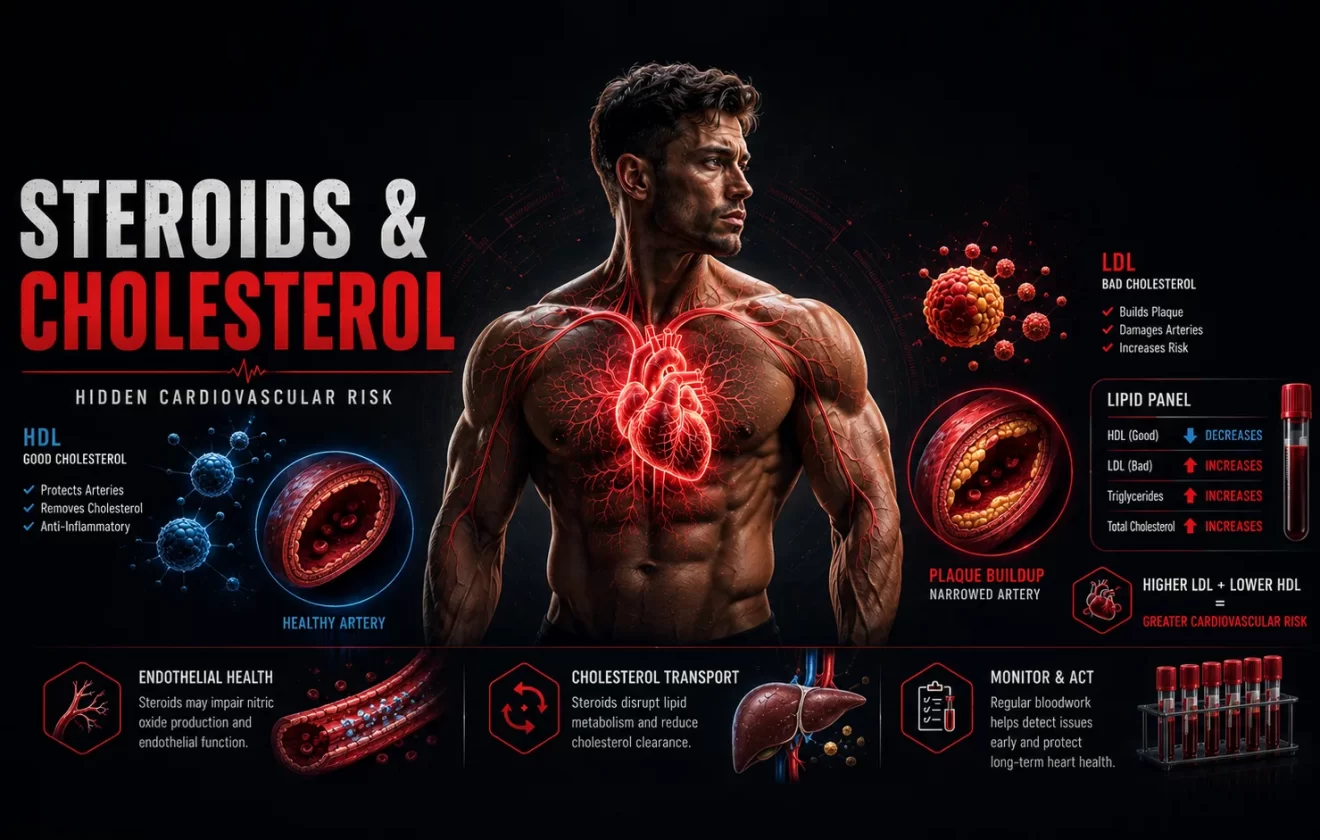
Yes, but the word cholesterol hides what actually happens. Anabolic androgenic steroids raise LDL cholesterol modestly and lower HDL cholesterol severely, and in the studies where both were tracked the HDL side of the panel moved several times further than the LDL side. In 19 strength athletes who self administered for eight or 14 weeks, HDL fell from 1.08 to 0.43 mmol/L and apolipoprotein B rose from 0.96 to 1.32 g/L, while total cholesterol and triglycerides did not change significantly (PMID 15155420).
That last detail is why the question gets answered badly so often. A man looks at his total cholesterol, sees a normal figure, and concludes that nothing happened. The review of 49 studies covering 1,467 athletes describes the same signature: elevated LDL cholesterol and low HDL cholesterol in otherwise healthy young athletes (PMID 20816133).
Three variables decide the size of it: the route the compound takes, whether the dose is replacement or supraphysiological, and how long it runs. The rest of this page takes them one at a time.
Route and dose: the same hormone, three different panels
The table below is every setting in which this has been measured properly, ordered by how hard the panel was hit. Read the second and sixth rows together: the same molecule at two different doses produced a 9 per cent fall and a 4 mg/dL fall.
| Setting | What was given, and to whom | What happened to the lipids | Source |
|---|---|---|---|
| Oral 17-alpha-alkylated compound | Oral stanozolol, 6 mg a day, 6 weeks, 11 weight lifters | HDL cholesterol -33 %, HDL2 -71 %, apolipoprotein A-I -40 %, LDL cholesterol +29 % | PMID 2915439 |
| Injectable testosterone, supraphysiological | Testosterone enanthate, 200 mg a week, same 11 men | HDL cholesterol -9 %, and the loss came out of HDL3 rather than HDL2 | PMID 2915439 |
| Injectable testosterone, second trial | Testosterone enanthate, 200 mg a week, 14 weight lifters | HDL cholesterol -16 %, apolipoprotein A-I -12 %, hepatic lipase +21 % | PMID 8487666 |
| Injectable testosterone plus an aromatase inhibitor | Testosterone with testolactone, same 14 men | HDL cholesterol -20 %, HDL2 -30 %, hepatic lipase +38 %. Worse, not better | PMID 8487666 |
| Self administered stack, field conditions | 19 strength athletes, 8 or 14 weeks, own choice of compounds | HDL cholesterol 1.08 to 0.43 mmol/L, apolipoprotein B +38 %, lipoprotein(a) 189 to 32 U/L | PMID 15155420 |
| Testosterone at a replacement dose | Pooled 19 studies, 272 hypogonadal men, about 179 mg every 16 days for 6 months | HDL cholesterol -4 mg/dL, total cholesterol -14, LDL cholesterol -5, triglycerides unchanged | PMID 11566455 |
| Oral non-steroidal SARM | LGD-4033, ascending doses, healthy men | Dose dependent suppression of HDL cholesterol and triglycerides, returning to baseline after stopping | PMID 22459616 |
None of these studies is a recommendation, and the doses in them are not targets. They are the only controlled numbers that exist for this question.
The ladder, from a replacement dose to a stack
Put the studies on one axis and the pattern is not subtle. The further a protocol sits from replacement, and the more of it arrives by mouth, the less HDL cholesterol survives it.
%3C%2Ftext%3E%3Ctext%20x%3D%22437.8%22%20y%3D%22218%22%20text-anchor%3D%22end%22%20font-family%3D%22Inter%2CArial%2Csans-serif%22%20font-size%3D%2212.5%22%20font-weight%3D%22700%22%20fill%3D%22%23FFFFFF%22%3E-16%25%3C%2Ftext%3E%3Crect%20x%3D%22310%22%20y%3D%22236%22%20width%3D%22560%22%20height%3D%2226%22%20rx%3D%225%22%20fill%3D%22%23151B24%22%2F%3E%3Crect%20x%3D%22310%22%20y%3D%22236%22%20width%3D%2277.5%22%20height%3D%2226%22%20rx%3D%225%22%20fill%3D%22%23FBBF24%22%2F%3E%3Ctext%20x%3D%22300%22%20y%3D%22254%22%20text-anchor%3D%22end%22%20font-family%3D%22Inter%2CArial%2Csans-serif%22%20font-size%3D%2212.5%22%20fill%3D%22%239CA3AF%22%3EInjectable%20testosterone%2C%20200%20mg%20a%20week%20(Thompson)%3C%2Ftext%3E%3Ctext%20x%3D%22377.5%22%20y%3D%22254%22%20text-anchor%3D%22end%22%20font-family%3D%22Inter%2CArial%2Csans-serif%22%20font-size%3D%2212.5%22%20font-weight%3D%22700%22%20fill%3D%22%23FFFFFF%22%3E-9%25%3C%2Ftext%3E%3Cline%20x1%3D%22310%22%20y1%3D%22284%22%20x2%3D%22870%22%20y2%3D%22284%22%20stroke%3D%22%234B5563%22%20stroke-width%3D%221%22%2F%3E%3Ctext%20x%3D%2230%22%20y%3D%22332%22%20font-family%3D%22Inter%2CArial%2Csans-serif%22%20font-size%3D%2212%22%20fill%3D%22%239CA3AF%22%3ESources%3A%20PMID%2015155420%2C%20PMID%202915439%2C%20PMID%208487666.%20Percentage%20fall%20in%20HDL%20cholesterol%20from%20each%20study%20baseline.%3C%2Ftext%3E%3Ctext%20x%3D%2230%22%20y%3D%22354%22%20font-family%3D%22Inter%2CArial%2Csans-serif%22%20font-size%3D%2212%22%20fill%3D%22%239CA3AF%22%3ENot%20shown%20as%20a%20bar%3A%20a%20replacement%20dose%20of%20testosterone%20moved%20HDL%20cholesterol%20by%204%20mg%2FdL%20across%20272%20men%20(PMID%2011566455).%3C%2Ftext%3E%3C%2Fsvg%3E)
The two injectable bars come from different laboratories and different men, which is why they disagree by seven points. Both are far from the oral bar above them, and both are far from the 60 per cent seen when athletes chose their own compounds and stacked them.
Why an oral does it: hepatic lipase, measured in order
The enzyme in the middle of this is hepatic lipase, which strips lipid from HDL particles and prefers the large HDL2 particles. Oral stanozolol raised post-heparin hepatic triglyceride lipase activity by 123 per cent in the crossover trial; the injectable arm raised it 25 per cent, which was not significant (PMID 2915439).
A 1987 study settled the order of events. Hepatic triglyceride lipase activity rose before HDL cholesterol fell, which is the signature of cause rather than coincidence (PMID 3657514). The 17-alpha-alkyl group that lets an oral compound survive first pass through the liver is the same feature that puts it in front of that enzyme at a high concentration.
The oestrogen question has also been tested directly, and the answer surprises most people. Fourteen weight lifters received injectable testosterone, an aromatase inhibitor, or both. Testosterone alone cut HDL cholesterol by 16 per cent. Adding the inhibitor made it 20 per cent, took HDL2 down 30 per cent instead of 23, and pushed hepatic lipase up 38 per cent instead of 21 (PMID 8487666). Oestradiol was holding part of the HDL value up, and removing it removed a brake.
TRT and cholesterol is a different question
Men searching for TRT and cholesterol are usually reading numbers collected from cycles, and the two situations do not belong in the same sentence. The pooled analysis of 19 studies in 272 hypogonadal men on intramuscular testosterone esters found post treatment minus pre treatment differences of 14 mg/dL [17 to 11] for total cholesterol, 5 mg/dL [8 to 1] for LDL cholesterol, 4 mg/dL [5 to 2] for HDL cholesterol and 1 mg/dL [6 down to 4 up] for triglycerides (PMID 11566455). Total and LDL cholesterol fell; HDL fell a little as well.
One finding in that analysis runs against intuition: the falls in HDL cholesterol were larger at lower doses of testosterone ester, and they were not explained by dosing frequency, treatment duration, the rise in total testosterone, or aromatisation to oestradiol. The authors say plainly that the aggregate effect of these changes on cardiovascular risk remains unknown.
Since then the largest trial has reported. TRAVERSE randomised 5,246 men aged 45 to 80 with existing or high cardiovascular risk and symptomatic hypogonadism to testosterone gel or placebo for a mean of 21.7 months. A primary cardiovascular event occurred in 7.0 per cent on testosterone and 7.3 per cent on placebo, hazard ratio 0.96 [0.78 to 1.17], meeting the noninferiority criterion (PMID 37326322). That is a statement about replacement doses in that population, and it is not transferable to supraphysiological use.
What comes back, and what the evidence says helps
The honest version of this section is short, because most of what gets recommended has never been tested in this population. The last two rows are there precisely because they are so often stated as fact.
| Question | What was tracked | What the study found | Evidence |
|---|---|---|---|
| Stopping an oral compound | HDL cholesterol, apolipoprotein A-I | Six weeks after cessation, HDL cholesterol, HDL2, apolipoprotein A-I, apolipoprotein B and lipoprotein(a) had still not returned to pretreatment values. A 14 week course recovered more slowly than an eight week course | PMID 15155420 |
| Stopping a SARM | HDL cholesterol, triglycerides | Hormone levels and lipids returned to baseline within five weeks of discontinuation in an ascending dose trial in healthy men | PMID 22459616 |
| Aerobic training | HDL cholesterol | Mean net gain of 2.53 mg/dL across 25 controlled trials, with at least 900 kcal or 120 minutes a week needed to see it. Every extra 10 minutes per session added about 1.4 mg/dL | PMID 17533202 |
| Switching from oral to injectable | HDL cholesterol | The difference between a 33 per cent fall and a 9 per cent fall in the same 11 men, though this is a comparison between arms, not a study of switching | PMID 2915439 |
| Adding an aromatase inhibitor | HDL cholesterol, HDL2, hepatic lipase | Measured, and the direction is the wrong one: the panel was worse with the inhibitor than without it | PMID 8487666 |
| Diet change during use | HDL cholesterol | No controlled trial has tested a dietary intervention against steroid induced HDL suppression in this population | Not established |
| Fish oil, niacin or other supplements | HDL cholesterol | No controlled trial in steroid users supports any of them for this purpose | Not established |
| Time alone, beyond a few months | HDL cholesterol, coronary plaque | Lifetime dose tracked coronary plaque burden in 86 weight lifters, so some of what accumulates does not reverse with a break | PMID 28533317 |
The number is not the whole injury: HDL also stopped working
Everything above measures how much HDL cholesterol is present. A 2019 study measured what the remaining particles could still do. Twenty strength trained steroid users, 20 age matched strength trained non-users and 10 sedentary controls had cholesterol efflux capacity tested with radiolabelled cholesterol, and had their coronary arteries imaged.
A different measurement from the chart above: cholesterol efflux capacity, the ability of a man’s HDL to pull cholesterol out of cells. Bars are scaled to the axis, not to each other, so the gap looks small; it was significant at p below 0.001. Souza 2019, PMID 30826541.
Two more findings from the same men. The lag time before LDL began to oxidise was 41 minutes in users against 13 in trained non-users and 11 in sedentary controls, and at least two coronary arteries carried plaque in 25 per cent of the users, at a mean age of 29.
This matters for how a result gets read. A man whose HDL cholesterol has partly recovered after a break is not necessarily back to where he started, because the concentration and the function are separate measurements and only one of them appears on a standard report.
Imaging in a larger group points the same way. Among 86 weight lifters, steroid users showed a left ventricular ejection fraction of 52 per cent against 63 in non-users, and higher coronary plaque volume, with lifetime dose tracking plaque burden (PMID 28533317).
Six claims about steroids and cholesterol that do not survive
Each of these is repeated constantly. Each is contradicted by a study named on this page.
My total cholesterol is fine, so my lipids are fine
In 19 strength athletes on cycle, total cholesterol and triglycerides did not change significantly while HDL cholesterol lost sixty per cent of its value and apolipoprotein B rose 38 per cent (PMID 15155420). Total cholesterol is the least sensitive line for this question.
Injectables do not touch cholesterol
Injectable testosterone at 200 mg a week cut HDL cholesterol by 9 per cent in one crossover and 16 per cent in another (PMID 2915439, PMID 8487666). Smaller than an oral is not the same as nothing.
An aromatase inhibitor protects the heart numbers
Adding testolactone to testosterone made HDL cholesterol fall 20 per cent instead of 16, HDL2 30 instead of 23, and pushed hepatic lipase higher (PMID 8487666).
Cardio will offset it
Aerobic training raised HDL cholesterol by a mean of 2.53 mg/dL across 25 controlled trials, and needed at least 120 minutes a week to do it (PMID 17533202). That is the honest size of the lever against a third of the HDL value removed by an oral.
It all resets once the cycle ends
Six weeks after cessation, HDL cholesterol, HDL2, apolipoprotein A-I, apolipoprotein B and lipoprotein(a) had all failed to return to pretreatment values, and longer courses recovered more slowly (PMID 15155420). Coronary plaque burden tracked lifetime dose (PMID 28533317).
TRT wrecks your cholesterol the same way
Pooled across 272 hypogonadal men, replacement doses moved HDL cholesterol by 4 mg/dL while total and LDL cholesterol fell (PMID 11566455), and in 5,246 high risk men a replacement dose was noninferior to placebo for major cardiovascular events (PMID 37326322).
Where people go wrong reading this
- Comparing a cycle study to a TRT study. The two literatures use different doses, different routes and different populations, and the numbers are an order of magnitude apart.
- Treating one draw as a trend. Between-draw variation for HDL cholesterol alone is about 11 per cent in people whose health has not changed (PMID 23648634).
- Waiting for symptoms. None of the changes on this page produce symptoms. They are visible only on a panel, which is the argument for having a baseline before anything starts, covered in the baseline guide.
- Reading lipids alone. Pressure and red cell counts move in the same direction in this population, and the combination is what a clinician reads. See the blood pressure page and the red cell markers.
- Assuming SARMs are exempt. An ascending dose trial of LGD-4033 in healthy men recorded dose dependent suppression of HDL cholesterol and triglycerides alongside testosterone suppression (PMID 22459616).
What none of this establishes is an individual risk figure. The pooled analysis of replacement doses says outright that the aggregate effect of the lipid changes on cardiovascular risk remains unknown (PMID 11566455), and that honesty applies with more force to doses nobody has run a trial on.
Frequently asked questions
Do steroids raise cholesterol?
Yes, and unevenly. LDL cholesterol rises modestly while HDL cholesterol falls sharply. In 11 weight lifters on oral stanozolol, LDL cholesterol rose 29 per cent while HDL fell 33 per cent (PMID 2915439), and in 19 athletes using their own compounds HDL fell from 1.08 to 0.43 mmol/L while total cholesterol did not change significantly (PMID 15155420).
Does testosterone raise cholesterol at a replacement dose?
Not in the way a cycle does. Pooling 19 studies in 272 hypogonadal men on intramuscular esters, total cholesterol fell 14 mg/dL, LDL cholesterol fell 5 and HDL cholesterol fell 4, with triglycerides unchanged (PMID 11566455). In 5,246 men with high cardiovascular risk, a replacement dose was noninferior to placebo for major cardiac events (PMID 37326322).
Which route is worst for cholesterol?
The oral one. In a crossover in the same 11 men, oral stanozolol cut HDL cholesterol by 33 per cent and the HDL2 subfraction by 71, while injectable testosterone cut it by 9 per cent and took the loss from HDL3 instead (PMID 2915439). The authors attributed the difference to the route of administration rather than to androgenic strength.
How low can HDL cholesterol go on a cycle?
The lowest properly measured figure comes from field conditions: HDL cholesterol at 0.43 mmol/L in strength athletes who had been using for eight to 14 weeks, against 1.08 before, with apolipoprotein A-I halved (PMID 15155420). That is roughly a sixty per cent loss.
How long does it take for cholesterol to recover?
Longer than a few weeks. Six weeks after stopping, HDL cholesterol, HDL2, apolipoprotein A-I, apolipoprotein B and lipoprotein(a) had all failed to return to pretreatment values, and a 14 week course recovered more slowly than an eight week one (PMID 15155420).
Can training and diet fix it?
Training helps a little and has been quantified: aerobic exercise raised HDL cholesterol by a mean of 2.53 mg/dL across 25 controlled trials (PMID 17533202). No controlled trial has tested a diet or a supplement against steroid induced HDL suppression, so any claim in that direction is untested rather than proven.
Do SARMs affect cholesterol too?
Yes. An ascending dose trial of LGD-4033 in healthy men recorded dose dependent suppression of HDL cholesterol and triglycerides alongside suppression of total testosterone, with values returning to baseline after the drug was stopped (PMID 22459616).
Is a low HDL number the whole problem?
No, and this is the part a standard report cannot show. In 20 strength trained users the remaining HDL particles also worked less well: cholesterol efflux capacity was 20 per cent against 24 in sedentary controls, and at least two coronary arteries carried plaque in a quarter of the users at a mean age of 29 (PMID 30826541).
Sources and further reading
Every figure on this page comes from one of the twelve papers below. Each was checked against its PubMed record while the guide was written, and the identifier is printed so the abstract can be pulled directly.
Verified
Verified
Verified
Verified
Verified
Verified
Verified
Verified
Verified
Verified
Verified
Verified
Keep reading
Four pages that carry this further: reading the panel itself, the baseline draw before anything starts, the pressure side of the same picture, and what a therapeutic dose looks like on paper.
Final Educational Note
This article is educational and is not medical advice. It reports what controlled trials and observational studies measured about anabolic androgenic steroids, testosterone replacement doses and blood lipids, including where the evidence is weak or missing. It does not recommend, plan or describe how to use any compound, and it does not tell anyone how to treat an abnormal result. More marker guides sit on the bloodwork and health hub.
A lipid result outside the reference range is a clinical question for a physician who can see the whole person, the family history and the rest of the bloodwork. Read more about how this site works on the about page and in the full disclaimer.