TRT and Fertility: 4 Ways to Protect It on Testosterone
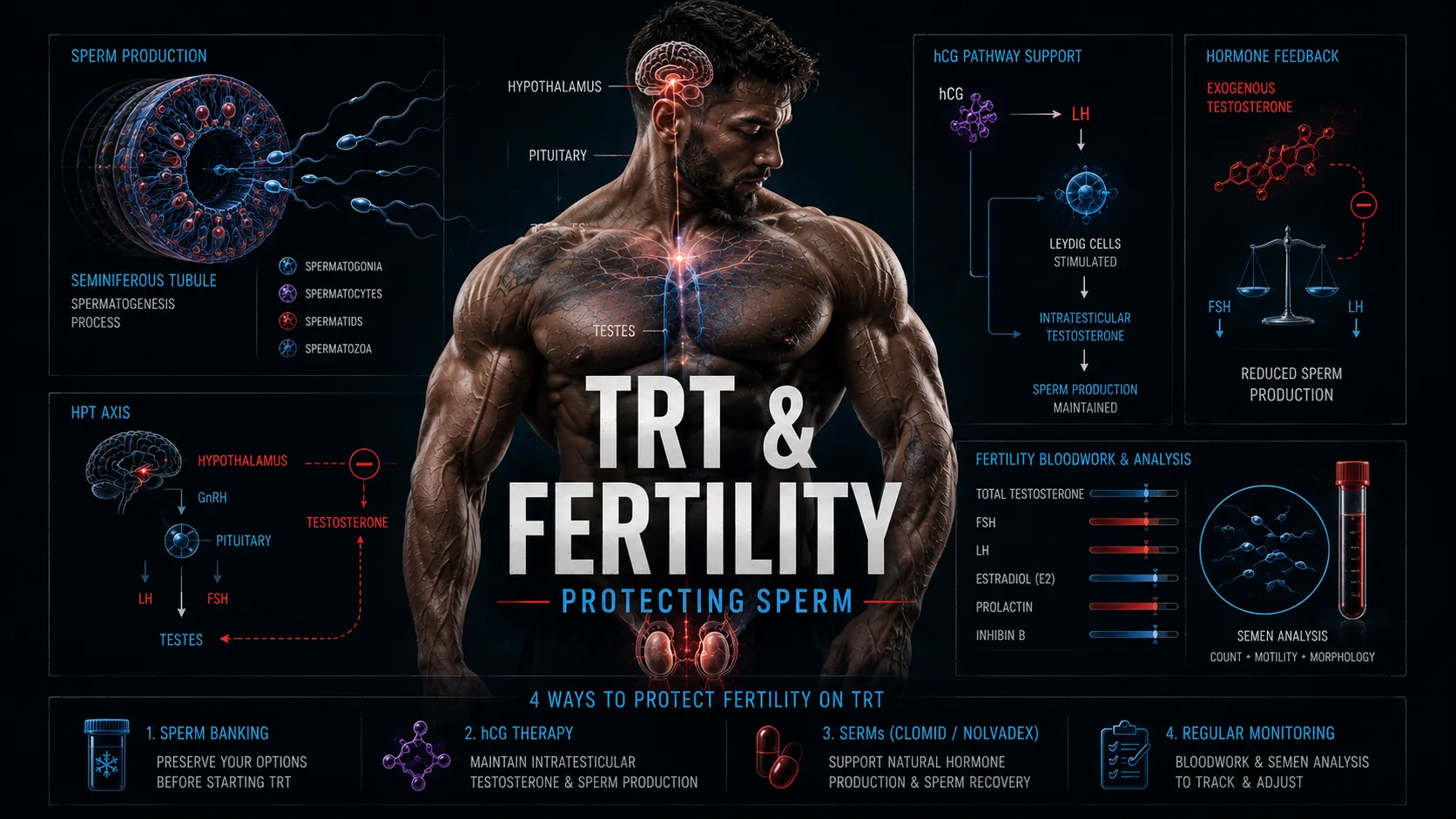
TRT AND FERTILITY: 4 WAYS TO PROTECT IT ON TESTOSTERONE
TRT and fertility pull in opposite directions. Testosterone from outside switches off the signals that tell your testes to make sperm. The World Health Organization tested this exact effect as a male contraceptive.
This guide answers does TRT make you infertile, how fast it happens, how often it reverses, and 4 ways to protect fertility. Every figure comes from a PubMed abstract or the Endocrine Society guideline, listed at the end. Related: TRT bloodwork.
TRT and fertility in three numbers
Three numbers from the research frame TRT and fertility: how often sperm disappears, how long it takes, and how often it comes back.
Infertile men on testosterone at a fertility clinic
While on testosterone, 88.4 percent had no sperm in their semen (PMID 24094422).
Average time to zero sperm on weekly shots
Healthy men on 200 mg testosterone enanthate weekly, WHO trial (PMID 1977002).
Median time to recovery after stopping
Recovery to 20 million per mL in 1,549 healthy men (PMID 16650651).
Figures come from PubMed abstracts and the Endocrine Society guideline. Several key numbers come from contraception trials in healthy men, and we say so where it matters.
What this TRT and fertility guide covers
Does TRT make you infertile? How and how fast sperm production drops.
Recovery: how often and how quickly fertility returns after stopping.
4 ways to protect TRT fertility, including what the hCG studies found.
Not covered
Doses for fertility drugs. Study doses are reported as data. Your prescriber or a fertility specialist sets any treatment.
Why TRT and fertility conflict
Sperm production needs two pituitary signals, LH and FSH, and very high testosterone inside the testes.
Testosterone injections shut those signals down. In 29 healthy men on 200 mg testosterone enanthate weekly, LH fell to 5 percent and FSH to 3 percent of baseline (PMID 15713727).
Testosterone inside the testes fell by 94 percent in the same study (PMID 15713727). Blood testosterone can look great while the testes go quiet.
A 2019 review put it plainly: testosterone is a contraceptive and should not be used in men who want fertility (PMID 30350483).
Does TRT make you infertile, and how fast?
For most men, TRT lowers sperm count sharply, and many reach zero. The best timing data comes from the WHO male contraception trials.
In 271 healthy men given 200 mg testosterone enanthate weekly, 65 percent had no sperm by 6 months. The average time to zero was 120 days (PMID 1977002).
At a fertility clinic, 88.4 percent of men taking testosterone had no sperm while on it (PMID 24094422).
| Study | Who | Finding |
|---|---|---|
| WHO 1990 | 271 healthy men, weekly injections | 65 percent had no sperm by 6 months; average 120 days (PMID 1977002) |
| Samplaski 2014 | 59 men at a fertility clinic on testosterone | 88.4 percent had no sperm while on it (PMID 24094422) |
| Hsieh 2013 | Background figure cited by the authors | TRT leads to no sperm in about 40 percent of patients (PMID 23260550) |
Not every man reaches zero, and some take longer. That is why TRT is not reliable birth control, covered below.
Is TRT infertility reversible?
Is TRT infertility reversible? Usually yes, but it takes months, and the best data comes from healthy volunteers.
Across 30 studies and 1,549 men, median recovery to 20 million per mL took 3.4 months. Recovery reached 90 percent within 12 months and 100 percent within 24 (PMID 16650651).
Recovery was faster with shorter treatment, shorter acting testosterone, older age and higher sperm counts at baseline (PMID 16650651).
Real TRT patients may differ. At the fertility clinic, 65 percent of men without other causes recovered sperm within 6 months of stopping (PMID 24094422).

4 ways to protect TRT and fertility
These are the four options the evidence supports for TRT and fertility. Each one is a decision for you and your prescriber.
1. Do not start TRT if you want children soon. The Endocrine Society recommends against starting testosterone in men planning fertility in the near term (Endocrine Society guideline, PMID 29562364).
2. Ask about a treatment that keeps your own signals on. A review found enclomiphene raised testosterone by raising LH and FSH, without harming semen in early results (PMID 27337642).
3. Ask about hCG alongside TRT. In 26 men on TRT with hCG, none lost all sperm over about 6 months of follow up (PMID 23260550).
4. Bank sperm and get a baseline semen analysis first. Rule of thumb: a frozen sample and a starting count protect your options if recovery is slow.
| Way | Evidence | Strength |
|---|---|---|
| Delay TRT | Endocrine Society recommendation (PMID 29562364) | Guideline |
| Enclomiphene or similar | Review of early studies (PMID 27337642) | Early data |
| hCG with TRT | 26 men, retrospective (PMID 23260550) | Small study |
| Sperm banking | No trial needed; standard practice | Rule of thumb |
hCG on TRT: what the studies show
hCG is the most studied tool for TRT fertility. It acts like LH on the testes and keeps them working while outside testosterone suppresses the pituitary.
In healthy men on weekly testosterone, testosterone inside the testes rose in step with the hCG dose given every other day. 500 IU kept it 26 percent above baseline (PMID 15713727).
In 26 men on TRT with 500 IU hCG every other day, semen did not change over more than a year of follow up. Nine men contributed to a pregnancy (PMID 23260550).
For men already without sperm after testosterone, hCG based combination therapy brought sperm back in 47 of 49 men. Average time to return was 4.6 months (PMID 25904023).
These are small, mostly retrospective studies. Doses above are study data, not instructions; a fertility specialist sets any protocol.
TRT fertility if you are already on testosterone
Many men only ask does TRT make you infertile after they have started. The options are different at that point.
Step one is a semen analysis on your current treatment. It tells you whether you are at zero, low or near normal, and it is your new baseline.
Stopping alone works for most men, but slowly. Median recovery was 3.4 months in healthy volunteers, and 100 percent recovered within 24 months (PMID 16650651).
Some factors predicted faster recovery: shorter treatment, shorter acting testosterone, older age and a higher sperm count before treatment (PMID 16650651).
For men with no sperm after testosterone, a fertility clinic series used hCG based combination therapy. Sperm returned in 47 of 49 men, on average in 4.6 months (PMID 25904023).
| Option | What the study found | Caveat |
|---|---|---|
| Stop and wait | Median 3.4 months to 20 million per mL (PMID 16650651) | Healthy volunteers, not TRT patients |
| Stop with hCG based therapy | 47 of 49 men regained sperm, average 4.6 months (PMID 25904023) | Small retrospective series |
| Stay on TRT and add hCG | No man lost all sperm in 26 men followed (PMID 23260550) | For men who still had sperm |
Rule of thumb: stopping TRT brings back low testosterone symptoms for a while. Plan that period with your prescriber rather than stopping abruptly on your own.
TRT is not reliable birth control
TRT lowers fertility, but that does not make it contraception you can count on. Many TRT fertility myths start here, in both directions.
In the WHO trial, only 65 percent of men reached zero sperm by 6 months (PMID 1977002). The rest still had some sperm.
In a second WHO trial, men whose counts fell low but not to zero had 8.1 pregnancies per 100 person years. Men at zero had none (PMID 8654646).

What to check for TRT and fertility
Before any decision about TRT and fertility, these checks replace guesses with real numbers. Most are simple blood or semen tests.
| Check | When | Why |
|---|---|---|
| Semen analysis | Before starting | Your baseline; low counts recover more slowly (PMID 16650651) |
| LH and FSH | Before starting | Separates testicular from pituitary causes (Endocrine Society guideline, PMID 29562364) |
| Morning testosterone, twice | Before starting | Confirms the diagnosis (Endocrine Society guideline, PMID 29562364) |
| Semen analysis | On TRT with fertility protection | Shows whether protection is working (PMID 23260550) |
| Semen analysis | After stopping | Tracks recovery (PMID 16650651) |
The Endocrine Society also recommends additional evaluation to find the cause of low testosterone before treating (Endocrine Society guideline, PMID 29562364).
TRT and fertility: frequently asked questions
Does TRT make you infertile?
Usually it lowers sperm count sharply. At a fertility clinic, 88.4 percent of men on testosterone had no sperm while on it (PMID 24094422).
How fast does TRT lower sperm count?
In the WHO trial of weekly 200 mg injections, 65 percent of men had no sperm by 6 months. The average time to zero was 120 days (PMID 1977002).
Is TRT infertility permanent?
Usually not. In 1,549 healthy men, recovery to 20 million per mL reached 90 percent within 12 months and 100 percent within 24 months (PMID 16650651).
How long does fertility take to come back after TRT?
Median recovery was 3.4 months in contraception studies (PMID 16650651). At a fertility clinic, 65 percent of men recovered within 6 months (PMID 24094422).
Can you have kids on TRT?
It is harder. With hCG alongside TRT, 9 of 26 men contributed to a pregnancy in one study (PMID 23260550). The Endocrine Society advises against starting TRT when planning fertility soon (PMID 29562364).
Does hCG protect fertility on TRT?
In a small study, no man on TRT with hCG lost all sperm during follow up (PMID 23260550).
Is TRT a reliable contraceptive?
No. Men whose counts fell low but not to zero had 8.1 pregnancies per 100 person years in a WHO trial (PMID 8654646).
What are alternatives to TRT if I want children?
A review found enclomiphene raised testosterone by raising LH and FSH without harming semen in early studies (PMID 27337642).
Sources and further reading
Every figure on this page comes from one of the 10 papers below, checked against PubMed on 27 October 2026. Advice marked rule of thumb is practical guidance without a study behind the number. Reference links are dofollow to support open science.
Verified
Verified
Verified
Verified
Verified
Verified
Verified
Verified
Verified
Verified
More from the TRT series
Four pages that sit next to TRT and fertility.
Final Educational Note
This article is educational and is not medical advice. It reports what trials and the Endocrine Society guideline say about testosterone and fertility. Study doses are reported as data, not instructions; any fertility treatment belongs to your prescriber or a fertility specialist.
More guides sit on the TRT and hormones hub. Read more on the about page and in the full disclaimer.