TRT and Sleep: Apnea, Insomnia & Night Sweats in 2026
TRT and sleep, in both directions
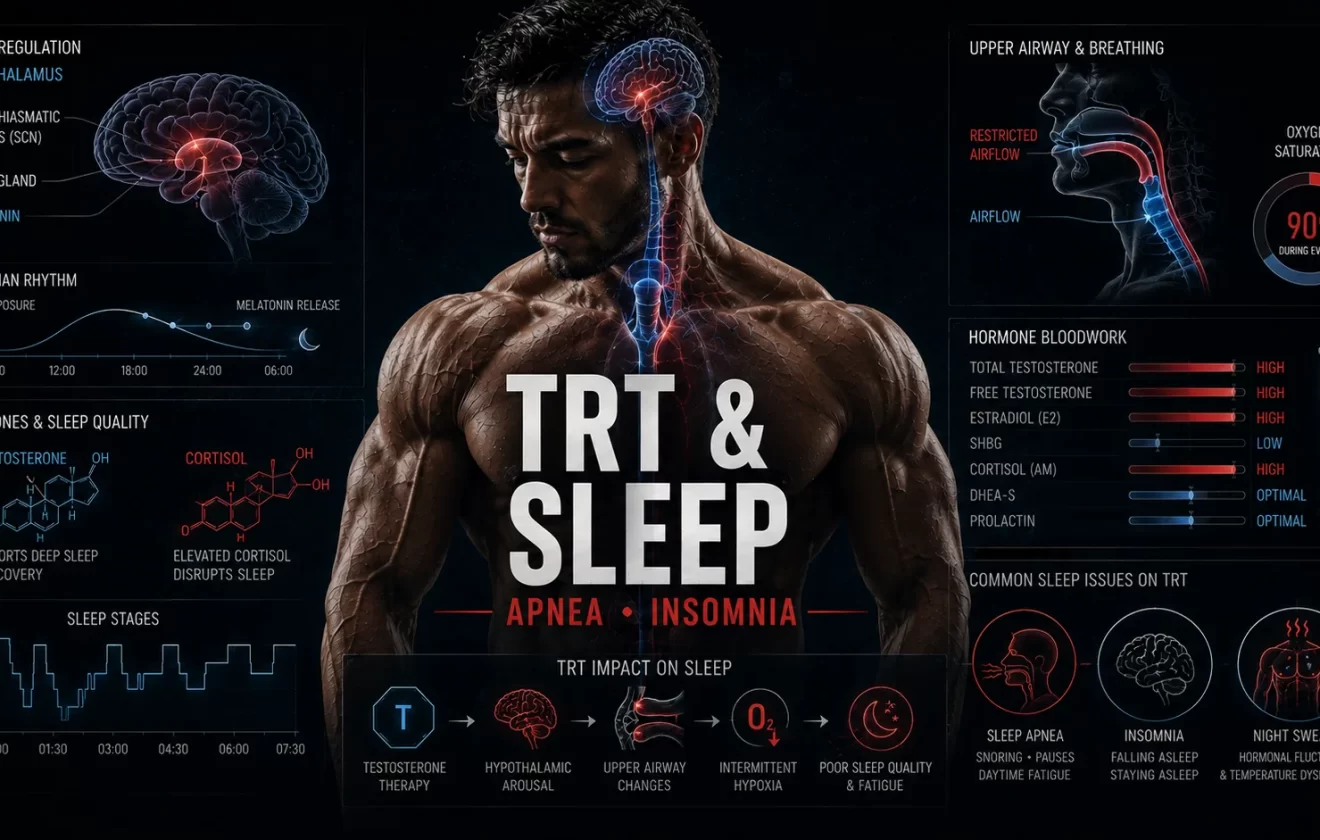
Sleep and testosterone are wired together: your body makes most of its testosterone while you sleep, and skimping on sleep drops your levels within days. So when men ask about TRT and sleep, the honest answer is that it cuts both ways. For a genuinely low man without sleep apnea, replacing testosterone often improves rest. For a man with untreated apnea or a dose that is too high, it can wreck it. This guide covers the two-way link, the real caution around sleep apnea, why some men get insomnia or night sweats on therapy, and how to fix TRT and sleep problems without abandoning treatment.
TRT and sleep in one screen
Poor sleep lowers testosterone by 10-15% in a week; low testosterone worsens sleep. TRT can break that loop.
TRT can worsen obstructive sleep apnea, so untreated severe apnea should be handled before starting.
Big dose peaks, crashed estradiol and poor timing drive most TRT sleep trouble - and all are adjustable.
The single most useful frame for TRT and sleep: testosterone is not a sleep aid and not a sleep poison - it amplifies whatever your underlying situation is. Correct a real deficiency in the right person and sleep tends to improve; add testosterone on top of untreated apnea, a too-high dose or a crashed estradiol and sleep gets worse. The whole game is knowing which situation you are in.
This page is about therapeutic TRT. For the broader picture start with what is TRT, and keep your TRT bloodwork - including hematocrit - in view, because it ties directly into the sleep story below.
How sleep and testosterone feed each other

Testosterone follows a daily rhythm, rising through the night and peaking in the early morning, and that rise depends on getting enough quality sleep. In a well-known study, one week of sleeping only about five hours a night cut daytime testosterone in healthy young men by roughly ten to fifteen percent - as much as aging a decade. Short, broken or shift-work sleep does the same thing, which is why chasing higher testosterone while sleeping badly is self-defeating.
The loop runs the other way too: low testosterone contributes to fatigue, low mood and fragmented sleep, which further lowers testosterone. This is the part of TRT and sleep that gives therapy its upside - in a genuinely deficient man, breaking the loop by restoring testosterone can improve sleep quality and reduce the night-time waking and bathroom trips that fragment it. The catch is that this only holds when sleep apnea is not lurking underneath.
TRT and sleep apnea - the one that matters most

Obstructive sleep apnea (OSA) is the most important safety issue in the whole TRT and sleep conversation. Testosterone can worsen or unmask OSA, and the Endocrine Society guideline explicitly lists untreated severe OSA as a condition that should be addressed before starting testosterone, not after. If you snore heavily, wake gasping, feel unrefreshed or have been told you stop breathing at night, that needs a sleep evaluation first - a quick STOP-BANG questionnaire from your clinician is the usual screen, and a positive screen points to a sleep study.
The reassuring nuance most pages miss: the effect is often dose-dependent and partly transient. Short-term high-dose testosterone worsened night-time oxygen levels and breathing in studies, and in obese men with severe OSA testosterone worsened nocturnal oxygenation at around seven weeks but the effect faded by eighteen weeks. The practical reading for TRT and sleep is that modest, well-managed replacement in a treated or apnea-free man is very different from a big dose piled onto untreated apnea. Treat the apnea (often with CPAP), keep the dose sensible, and the risk falls sharply.
The hematocrit and sleep-apnea loop
There is a vicious circle worth naming. Testosterone raises hematocrit, and OSA independently raises it too through low overnight oxygen - so a man with both can see his blood thicken faster than either alone. In one group of testosterone-treated men who developed polycythemia, more than half also had obstructive sleep apnea, with body weight the dominant shared risk factor. Thick blood plus apnea is a genuine cardiovascular concern, not just a sleep-quality one.
That is why TRT and sleep should be managed together, not in separate lanes. If your hematocrit is climbing, screening and treating sleep apnea can bring it down without touching your dose; and if you have apnea, watching hematocrit closely matters more. Weight loss helps both. Keep both numbers on the same monitoring sheet.
Why TRT can cause insomnia - and how to fix it
Plenty of men sleep worse in the first weeks of therapy without having apnea at all. The usual culprits in TRT and sleep insomnia are the shape of your dose and your estradiol, not the testosterone itself - and each has a fix.
| Problem | Likely cause | Fix |
|---|---|---|
| Restless, wired sleep after an injection | Supraphysiologic peak from a large weekly shot | Split into smaller, more frequent injections |
| Insomnia, anxiety, joint aches | Estradiol crashed too low (often from an AI) | Stop over-suppressing; let estradiol recover |
| Puffiness, poor sleep, high blood pressure | Estradiol too high / fluid retention | Adjust dose and frequency, not an AI reflex |
| Early waking, unrefreshed, snoring | Undiagnosed sleep apnea | Screen and treat OSA before anything else |
Two practical levers cover most cases. First, dose and timing: smaller, more frequent injections flatten the peaks that drive restlessness, and gels or creams are usually taken in the morning to mimic your natural rhythm. Second, estradiol: a crashed estradiol from over-using an aromatase inhibitor is a classic, under-recognised cause of insomnia and anxiety on TRT, so protect it rather than crush it - see estradiol on TRT. Most first-weeks insomnia settles within eight to twelve weeks as levels stabilise.
Night sweats on TRT - normal or a red flag?
Night sweats confuse men because they cut both ways in the TRT and sleep story. Low testosterone itself can cause night sweats, so some men find they stop once a real deficiency is corrected. But sweats can also be a side effect of therapy - usually a sign of supraphysiologic peaks or swinging, high or unstable levels, which is again a cue to move to smaller, more frequent dosing and to check estradiol. In that context, occasional mild night sweats early on are common and usually settle.
- Likely dose-related: mild, intermittent sweats that track with injection timing and ease as you split the dose.
- See a doctor promptly: drenching sweats with fever, unexplained weight loss, swollen lymph nodes, or a persistent cough - these point away from TRT toward infection or other illness and need evaluation.
The rule of thumb: sweats that fit your dosing pattern and improve with adjustment are a TRT and sleep tuning problem; sweats with systemic red-flag symptoms are not something to manage through your testosterone dose at all.
Timing and shaping your dose for better sleep
How you take testosterone, not just how much, shapes its effect on sleep. The goal in TRT and sleep is steady levels that echo your natural rhythm rather than sharp swings. For gels and creams, that usually means applying in the morning, since your body naturally runs testosterone highest early in the day; an evening application can leave levels elevated at the wrong time for some men.
For injections, frequency beats size. A single large weekly shot produces a peak a day or two later that some men experience as restlessness, a racing mind or lighter sleep, followed by a low-feeling trough before the next dose. Splitting the same weekly amount into two, three or more smaller injections - or moving to a daily subcutaneous protocol - flattens those peaks and, for many men, quietly resolves both the mid-week insomnia and the peak-driven night sweats. None of this changes your total dose; it just removes the spikes that disturb sleep. If you have adjusted timing and frequency and still sleep badly, that is a signal to look harder at estradiol and at sleep apnea rather than to keep changing the injection schedule.
Sleep habits that protect your testosterone
Because the TRT and sleep relationship runs both ways, the habits that improve your sleep also defend your hormone levels - and undermining sleep undercuts everything TRT is trying to do. A few have outsized effects.
- Alcohol is a double hit. It suppresses night-time testosterone production and worsens obstructive sleep apnea by relaxing the airway, so heavy evening drinking sabotages both sides of the loop.
- Keep a consistent schedule. Testosterone rises on a nightly rhythm; irregular bed and wake times and shift work blunt that rise as surely as short sleep does.
- Aim for seven to nine hours. The measured 10-15% drop came from cutting sleep to about five hours - you do not have to be sleep-deprived for long to pay for it hormonally.
- Mind caffeine timing. Late-day caffeine fragments the deep sleep during which most testosterone is produced.
- Lose excess weight. It improves both sleep apnea and your own testosterone, and it lowers the hematocrit-and-apnea risk described above.
None of this is exotic, but on TRT it is not optional: therapy sets a higher baseline, and good sleep is what lets you actually feel it. Treat sleep as part of the protocol, not an afterthought, and the rest of your TRT and sleep plan works better.
TRT and sleep: FAQ
Can TRT cause insomnia?
Does TRT make sleep apnea worse?
Should I take testosterone in the morning or evening?
How long do sleep problems last after starting TRT?
Does TRT cause night sweats?
Can poor sleep lower my testosterone?
Can I take TRT if I have sleep apnea?
Sources & further reading
The bottom line on TRT and sleep
TRT and sleep amplify each other in both directions. Protect your sleep and you protect your testosterone; correct a real deficiency in the right man and sleep often improves. But screen for and treat sleep apnea before starting, keep the dose modest and split to avoid peaks, protect estradiol rather than crushing it, and watch hematocrit - especially if apnea is in the picture. Manage the two together, with your clinician and your TRT bloodwork in view, and most TRT and sleep problems are preventable or fixable.
This article is published for educational purposes only. It explains how testosterone replacement therapy interacts with sleep, sleep apnea and related symptoms, drawing on publicly available clinical guidelines and peer-reviewed research. Nothing here is medical advice, a treatment recommendation, or a substitute for care from a licensed clinician or sleep specialist. MuscleScience.org does not sell, supply, prescribe, or affiliate with any testosterone product, medication, pharmacy, or clinic.
Sleep is affected by hormones, dose, medications, body weight, breathing disorders and mental health. Do not start, stop, change, or add any medication - including a change to your testosterone dose or an aromatase inhibitor - without the clinician who manages your treatment, seek a sleep evaluation if you may have sleep apnea, and treat drenching night sweats with systemic symptoms as a reason to see a doctor. Related markers, including hematocrit, are covered at the bloodwork hub.
This contributor writes under a pseudonym. The photograph above is a stylized portrait, not a real image of the writer. See our About page for details on our editorial team and anonymity policy.