Shilajit Resin: 7 Critical Facts on Dose and Purity
Shilajit Resin: 7 Critical Facts on Dose and Purity
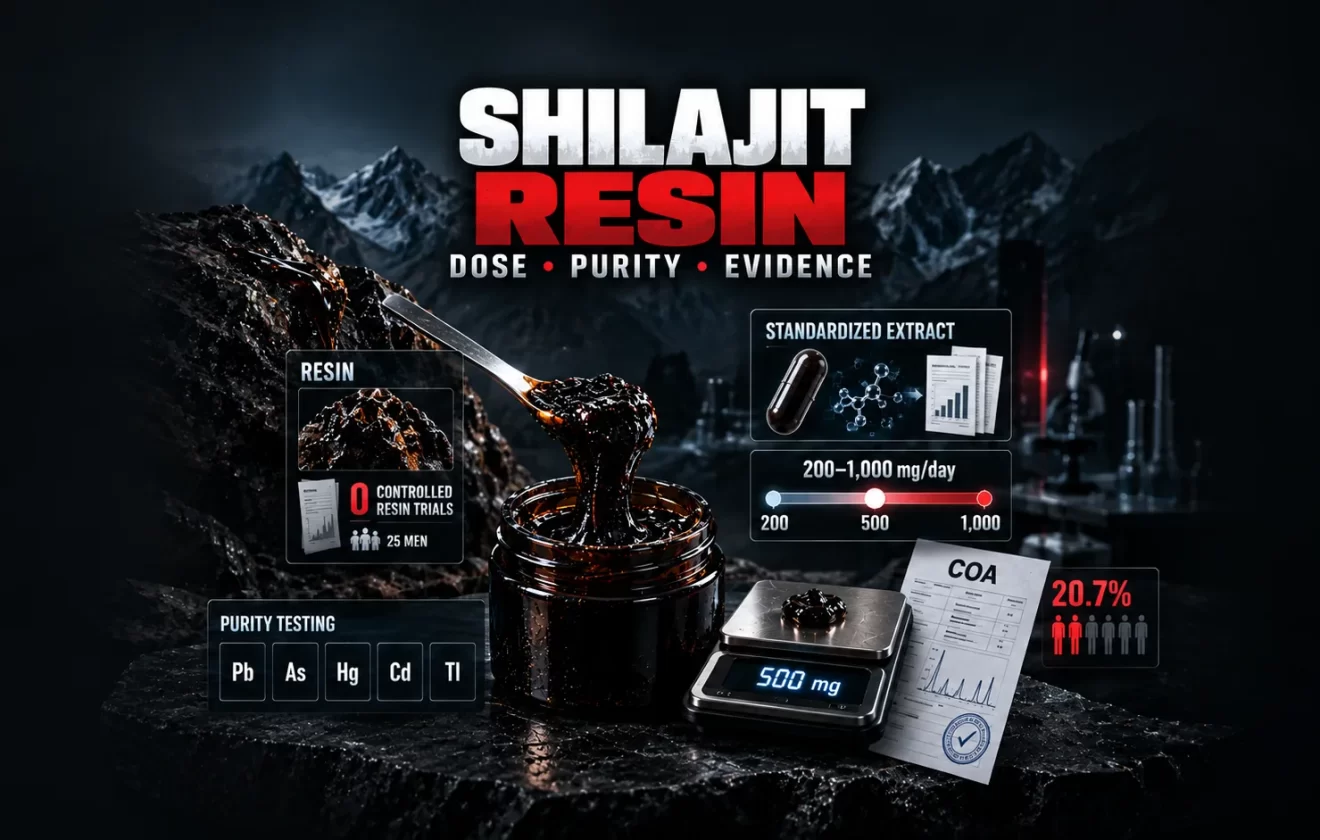
Shilajit resin is the traditional tar like form of shilajit, and almost none of the published human research was done with it. The trials that sellers quote, on testosterone, fatigue and collagen markers, used a purified and standardised shilajit supplement in capsules at 200 to 1,000 mg a day. The one study of resin itself was a 28 day pilot in 25 men with no placebo group. Raw Himalayan shilajit is a mineral pitch that can carry lead, arsenic and thallium, and a fulvic acid percentage on a label depends on which test method the brand chose. This guide covers dose, measuring, purity and how to read a certificate of analysis.
Educational content only. This page summarises published research on an ingredient. It is not medical advice. Avoid shilajit during pregnancy, and speak with a clinician first if you have kidney disease or take prescription medication.
Supplements Editor · Updated September 2026
Three numbers that frame shilajit resin
Every randomised trial we found used a purified, standardised extract in capsules. Resin has one open label pilot.
Testosterone, fatigue and collagen studies used 250 mg twice daily. One collagen study also tested 1,000 mg.
In a JAMA analysis of 193 Ayurvedic medicines bought online, one in five contained detectable lead, mercury or arsenic.
Study figures come from the published abstracts, retrieved in September 2026.
What this guide covers
What shilajit resin is. Where it comes from, what is in it and what purification is supposed to remove.
Resin against capsules and gummies. Which form the research used and what that means for a jar of resin.
Dose and measuring. Trial doses, how to portion a sticky resin and what it costs per day.
Fulvic acid claims and purity. Why percentages are not comparable between brands, and the heavy metal evidence.
What shilajit resin is
Shilajit is a dark, sticky exudate that seeps from rock faces in the Himalaya, Altai and other high mountain ranges. It forms over long periods from decomposed plant material and minerals. The review by Carrasco-Gallardo and colleagues describes it as a phytocomplex made mostly of humic substances, with fulvic acid as the main active fraction, along with dibenzo alpha pyrones and dozens of minerals. Stohs adds that these two groups of compounds are thought to account for most of the reported effects.
Shilajit resin is the least processed commercial form. Sellers describe the process as dissolving raw shilajit in water, filtering out rock, sand and plant debris, and drying it down to a paste. That description comes from brand pages, since no published paper documents the commercial process. Sellers present this as the authentic form of Himalayan shilajit. It is also the hardest form to standardise and the one that carries the most of whatever was in the rock, good and bad.
How we weigh tradition against trials is set out in our guide to evidence based supplements.
Shilajit resin vs capsules and gummies
Buyers usually assume resin is the potent original and capsules are a diluted convenience product. The research points the other way, because the purified extract is what was tested.
| Question | Resin | Purified extract capsules | Gummies |
|---|---|---|---|
| Processing | Water extraction and filtering | Purified and standardised | Extract or powder in a sugar base |
| Used in controlled trials | No | Yes, all of them | No |
| Dose accuracy | Poor, portioned by eye | Exact per capsule | Exact, but often low |
| Standardised fulvic acid | Varies by batch | Stated on label | Rarely stated |
| Heavy metal risk | Depends entirely on purification and testing | Lower if purified as in the trials | Depends on the source extract |
Keller and colleagues name the product in their trial as PrimaVie, a purified shilajit extract. Das and colleagues describe theirs as a purified and standardised extract, Pandit and colleagues as purified shilajit, and Pingali and Nutalapati as a standardised aqueous extract. None of those papers tested a jar of shilajit resin. A resin seller who cites them is borrowing evidence from a different product.
That does not make shilajit resin useless. A well purified resin may deliver the same compounds. It means the claim has to be supported by that brand's own testing, since the published trials cannot do it for them.
What the human trials of a shilajit supplement found
Six published studies make up most of the evidence, all with a purified shilajit supplement and four of them placebo controlled, plus one recent pilot with resin.
| Study | Who and dose | Length | Result |
|---|---|---|---|
| Biswas 2010 | 35 men with low sperm count, 200 mg a day | 90 days | Testosterone up 23.5% and better semen measures against baseline. No placebo comparison in the abstract |
| Pandit 2016 | Healthy men, 500 mg a day, placebo controlled | 90 days | Higher total and free testosterone and DHEAS than placebo |
| Das 2016 | Adults, 500 mg a day, then with exercise | 12 weeks | Changes in muscle gene expression related to collagen. Well tolerated |
| Keller 2019 | 63 active men, 250 or 500 mg a day | 8 weeks | Less strength loss after fatigue at 500 mg in stronger subjects only. 250 mg no different from placebo |
| Neltner 2024 | Adults, 500 or 1,000 mg a day | 8 weeks | More subjects with a meaningful rise in a collagen synthesis marker at 1,000 mg |
| Pingali 2022 | 60 postmenopausal women, 250 or 500 mg a day | 48 weeks | Dose dependent preservation of bone mineral density |
| Yadav 2026, resin | 25 men, 500 mg a day, no placebo | 28 days | Lean mass up 1.5%, body fat down. Open label, single arm |
Two cautions. The testosterone finding comes from one placebo controlled trial and one uncontrolled study, both from Indian groups, and has not been replicated elsewhere. And the only resin study had no control group, so its changes in lean mass and body fat over four weeks cannot be separated from training, diet or expectation. Stohs concluded in his safety review that more well controlled studies with standardised products are needed, and that remains true.
How much shilajit resin per day, and how to measure it
Published trials used between 200 and 1,000 mg a day of purified extract, most often 250 mg twice daily. Shilajit resin sellers usually suggest a portion the size of a grain of rice or a pea. Shilajit Life and Cymbiotika, for example, put a rice grain at about 100 mg and a pea at about 300 mg on their pages in September 2026. That is where the trouble starts, because a sticky paste cannot be portioned accurately by eye and a pea sized lump can weigh several times more than a rice sized one.
Daily dose in each published study, milligrams
Use the supplied spoon and a scale once. Weigh a typical portion on a jewellery scale that reads to 0.01 g, so you know what your usual scoop really is.
Dissolve it. Sellers state that genuine resin dissolves fully in warm water, tea or milk. That is a seller claim and a common home check, not a validated purity test, but a residue of grit is still a bad sign.
Stay inside the studied range. Nothing above 1,000 mg a day has been tested, and with a mineral pitch more is not a safer direction.
Give it eight weeks. Trials measured outcomes after 8 to 12 weeks. There is no evidence for an acute effect.
How long a jar lasts and what it costs per day
The bar shows your daily amount against the trial range, with the marker at 500 mg. Assumes accurate portioning. Educational estimate only, not a dosing recommendation.
Why fulvic acid percentages cannot be compared between brands
Fulvic acid is the headline number on most Himalayan shilajit labels, with claims that commonly run from 60 to more than 80 percent. Trace Minerals, for example, states 75 percent fulvic acid on its resin, read from the brand page in September 2026. The number depends heavily on how it was measured. Fulvic acid is not a single molecule but a fraction defined by the procedure used to isolate it, so different procedures give different answers for the same jar.
Lamar and colleagues published a standardised method for humic and fulvic acids through AOAC International, based on alkaline extraction, acidification and a resin column step that separates true fulvic acid from other acid soluble material. Other methods skip that separation and count more of the acid soluble material, so figures produced by different methods are not comparable, and a label rarely says which method was used.
ConsumerLab, in the public summary of its shilajit testing, reported that fulvic acid per serving ranged from 6.9 mg to 2,206 mg across the products it tested, and that one product could not be approved because the amount found did not match its label. We found no peer reviewed study comparing shilajit label claims with measured fulvic content.
Which method? The label or certificate should name it. A percentage with no method is not informative.
Which laboratory? An independent, named laboratory is worth more than an in house figure.
Which batch? A certificate should carry a batch or lot number that matches your jar.
What else was tested? Fulvic acid content says nothing about heavy metals, which is the more important test.
The practical point is that fulvic acid percentage is a weak basis for choosing between products. Verified purity is a stronger one.
Heavy metals in Himalayan shilajit: what testing has found
Shilajit is scraped from rock, so it concentrates whatever the rock contains. That is the source of its minerals and of its main risk.
Saper and colleagues bought 193 Ayurvedic medicines online and tested them for lead, mercury and arsenic. One in five, 20.7 percent, contained detectable metals, with no meaningful difference between products made in the United States and in India. Among the products with metals, 75 percent claimed good manufacturing practices. The study covered Ayurvedic medicines in general, not shilajit alone, and it shows why a manufacturing claim on a label is not evidence of purity.
Kamgar and colleagues looked at shilajit specifically and measured thallium, a highly toxic metal. They found it in natural shilajit at up to 0.226 micrograms per gram and in commercial supplements at up to 0.5, and warned about long term consumption. The amounts per serving were small, but thallium accumulates, and it is rarely included in the standard heavy metal panel that brands publish.
A credible product publishes a recent certificate of analysis from an independent laboratory, for the batch you are buying, covering lead, arsenic, mercury and cadmium at minimum, with results in numbers against a stated limit. Our guide on how to read supplement labels covers what a genuine certificate looks like.
Seven critical facts about shilajit resin
The trials did not use resin
0 of 6All six extract studies used a purified, standardised shilajit supplement in capsules.
The one resin study had no placebo
25 menA 28 day open label pilot. Its body composition changes cannot be attributed to the resin.
The common trial dose was 500 mg a day
250 mg x 2The full range was 200 to 1,000 mg, for 8 to 48 weeks.
The testosterone result is unreplicated
1 trialOne placebo controlled study in healthy men found higher testosterone after 90 days. No independent group has repeated it.
Fulvic acid percentages depend on the method
60 to 80%The same material can test very differently. A percentage without a named method means little.
Heavy metals are a documented problem in the category
20.7%One in five Ayurvedic medicines bought online contained lead, mercury or arsenic.
Thallium has been found in shilajit supplements
0.5 µg/gIt is rarely part of the heavy metal panel that brands publish.
So, is shilajit resin worth buying?
The evidence for shilajit is modest and belongs to a purified extract. Shilajit resin is the form with the least research, the least dose accuracy and the most exposure to whatever contaminants were in the source rock. Its appeal is authenticity, which is not the same as quality.
- The brand publishes a batch specific certificate from an independent laboratory
- The heavy metal results are numbers, not the word pass
- You weigh your portion and stay at or under 500 mg a day
- You treat it as an eight week trial with a clear goal
- You want the form used in the published trials
- No certificate of analysis is available for your batch
- You are pregnant, have kidney disease or take regular medication
- You expect a testosterone boost comparable to medical treatment
If you want to try shilajit, a standardised extract capsule matches the research and removes most of the guesswork. If you prefer shilajit resin, buy the paperwork before the product. Questions about low testosterone belong with a clinician, as our overview of what is TRT explains.
Common questions
Is shilajit resin better than capsules?
Not on current evidence. Every controlled trial used a purified, standardised extract in capsules. Shilajit resin is less processed and harder to dose, and it has only one small study without a placebo group.
How much shilajit resin should I take per day?
Published trials of purified extract used 200 to 1,000 mg a day, most often 500 mg. Resin has not been dose tested in controlled studies. Weigh your portion instead of estimating it by eye.
How do I know my shilajit is pure?
Ask for a batch specific certificate of analysis from an independent laboratory showing numerical results for lead, arsenic, mercury and cadmium. Home tests such as dissolving or burning do not detect heavy metals.
Does Himalayan shilajit increase testosterone?
One placebo controlled trial found higher total and free testosterone after 90 days of 500 mg a day of purified shilajit in healthy men. It has not been independently replicated, and it did not use resin.
What does the fulvic acid percentage mean?
It is the share of the product that falls into the fulvic acid fraction under a given test. Different methods give very different results, so percentages from different brands are not comparable.
Is shilajit resin safe?
Purified extract was well tolerated in trials lasting up to 48 weeks. The main risk with shilajit resin is contamination with heavy metals. Avoid it during pregnancy and ask a clinician if you have kidney disease or take medication. Those two cautions are standard precautions for an unregulated mineral rich product with a heavy metal contamination risk. No study has tested shilajit in either group.
How long does shilajit take to work?
Trials measured outcomes after 8 to 12 weeks, and the bone study ran for 48 weeks. There is no evidence of an immediate effect.
Is a shilajit supplement better as resin, capsule or gummy?
A standardised extract capsule is the form that matches the research. Gummies often contain small, unstated amounts, and resin varies by batch.
References
More on supplements and evidence
Final Educational Note
This article is for educational purposes and does not constitute medical advice. Shilajit products vary widely in composition and purity, and nothing on this page is a recommendation to use one or a statement of a safe dose. Do not start or change supplementation based solely on general guidance from any website, including this one. If you are pregnant, have kidney disease or take prescription medication, a clinician should make the call.
MuscleScience does not sell shilajit, supplements or medical services. We have no financial relationship with any brand, extract manufacturer or laboratory named on this page. The goal of this article is to set out what the published research does and does not show so you can decide for yourself. For more breakdowns, see the supplements hub.