KSM 66 Ashwagandha: 7 Proven Facts and Doses
KSM 66 Ashwagandha: 7 Proven Facts and Doses
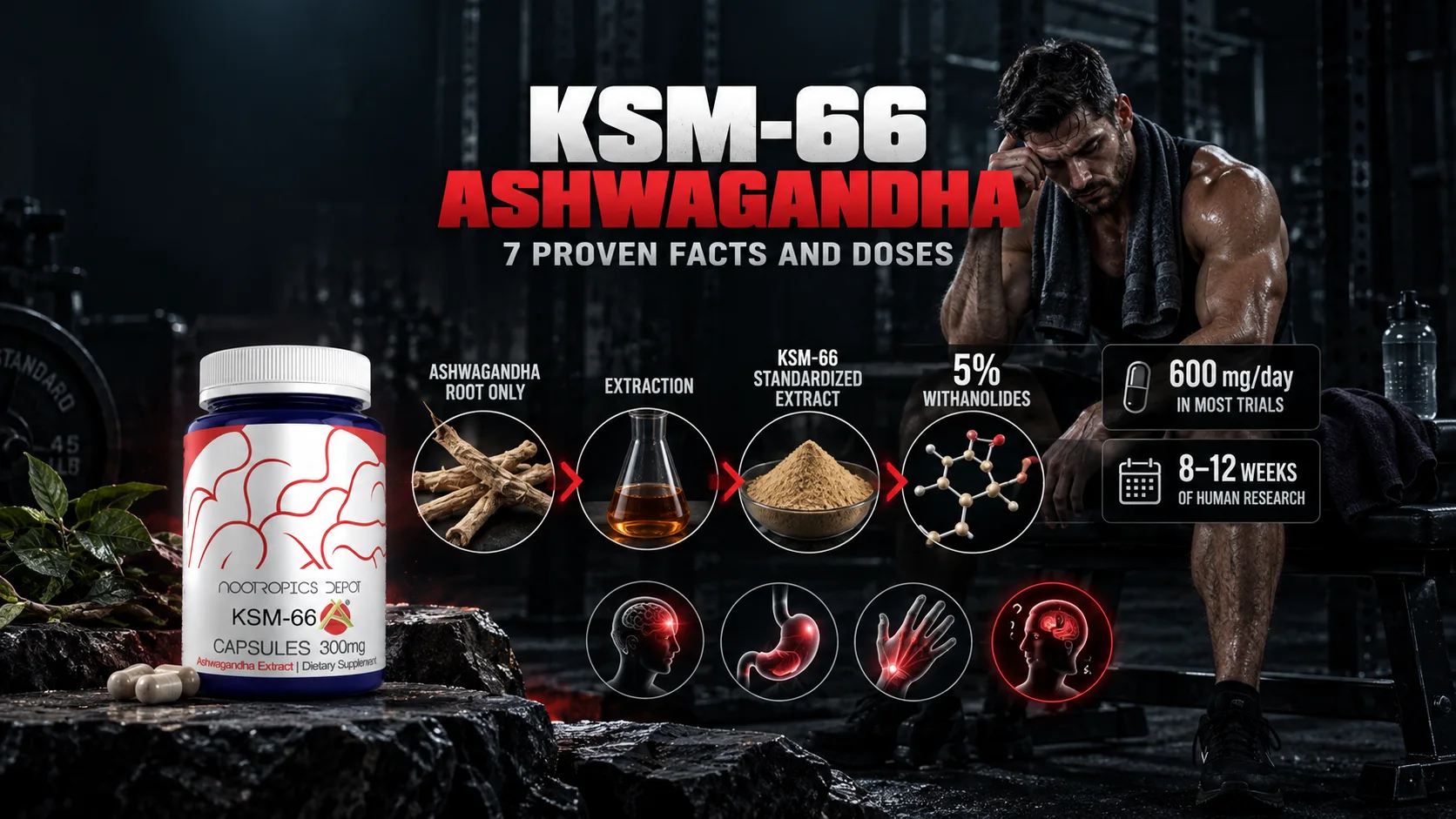
KSM 66 is a branded, root only ashwagandha extract standardised to 5 percent withanolides, and it is the extract behind most of the placebo controlled ashwagandha trials that lifters quote. Those trials used 600 to 675 mg a day for 8 to 12 weeks and reported lower stress scores and cortisol, better sleep, and in one study of untrained men larger strength gains. They were small, short, and mostly run by a handful of research groups. This guide explains what is KSM 66, how KSM 66 ashwagandha differs from generic root powder and from Sensoril, and how to check a label against the doses that were actually tested.
Educational content only. This page summarises published research and manufacturer specifications. It is not medical advice. Ashwagandha can interact with thyroid, sedative and immune medication, so speak with a clinician first if you take any of them.
Supplements Editor · Updated September 2026
Three numbers that frame KSM 66
Four of the seven trials below gave 300 mg twice daily. One used 675 mg in three doses, one compared 250 with 600 mg, and one abstract does not state the dose.
No study on this page followed people for longer than 90 days, so long term safety and benefit are untested.
These are manufacturer specifications as listed on retailer product pages such as Nootropics Depot in September 2026, not independent lab results. Sensoril is a root and leaf extract standardised to 10 percent withanolides and Shoden is standardised to 35 percent withanolide glycosides, by the same source.
Trial figures come from the published abstracts. Extract specifications are manufacturer statements and were not independently verified by us.
What this guide covers
What KSM 66 is. The extract, the company behind it, and what standardisation does and does not promise.
KSM 66 vs ashwagandha in other forms. Generic root powder, Sensoril and Shoden compared on plant part, withanolide content and typical dose.
The human trials. Seven placebo controlled studies with dose, duration, sample size and headline result.
Label checks and safety. How to match a bottle to the trial dose, and the liver and thyroid signals worth knowing.
What is KSM 66 and what does standardisation mean?
KSM 66 is a trademarked ashwagandha extract made by Ixoreal Biomed. On supplement labels it is usually written KSM-66. The manufacturer describes it as a full spectrum extract made only from the root of Withania somnifera, standardised to 5 percent withanolides. Those figures are taken from retailer listings and manufacturer marketing, September 2026, and are not independent measurements. Supplement brands buy it as a raw ingredient and put it in their own capsules, powders and gummies, which is why the same name appears on dozens of bottles.
Standardisation means each batch is adjusted to contain a stated amount of a marker compound. For ashwagandha the markers are withanolides, a family of steroidal lactones thought to drive most of its effects. A standardised extract tells you two useful things: the dose of marker compounds is repeatable from bottle to bottle, and it matches the material used in research. It does not tell you the product works for your goal, and it does not replace third party testing of the finished capsule.
Many KSM 66 product labels carry a milk allergen line, which sellers attribute to a traditional pre treatment step in the extraction. We did not find that process described on the manufacturer's public pages, so treat the allergen line on your own bottle as the fact that matters. That matters for vegans and for anyone with a milk allergy, and it is a detail that generic ashwagandha does not share. If you are new to reading panels, our guide on how to read supplement labels covers the basics.
KSM 66 vs ashwagandha powder, Sensoril and Shoden
The phrase KSM 66 vs ashwagandha is slightly misleading, because KSM 66 is ashwagandha. The real comparison is between one standardised root extract and the other forms sold under the same plant name. They differ in plant part, in how concentrated they are, and in the dose that was studied.
| Form | Plant part | Marker content | Typical studied dose |
|---|---|---|---|
| KSM 66 | Root only | 5% withanolides | 600 mg a day |
| Sensoril | Root and leaf | 10% withanolides, per retailer listing | 125 to 500 mg a day |
| Shoden | Root and leaf, per maker | 35% withanolide glycosides | 240 mg a day |
| Generic root powder | Root, not extracted | Not standardised | Grams a day in traditional use, rarely tested |
The three branded extracts are not interchangeable milligram for milligram. Lopresti and colleagues gave 240 mg of Shoden once daily for 60 days to 60 stressed adults and saw a significant drop in the Hamilton anxiety score along with lower morning cortisol. Ziegenfuss and colleagues gave 500 mg of Sensoril a day to 38 recreationally active men during 12 weeks of lifting and reported larger gains in squat and bench press than placebo. Both results sit close to the KSM 66 findings, at lower milligram doses, which is consistent with their higher stated concentration.
Generic root powder is the weak point. With no marker content on the label there is no way to know how a teaspoon compares with anything that was tested. When a bottle says only ashwagandha root and a milligram figure, you are buying the plant, not the research.
Which trials used KSM 66 ashwagandha?
Seven placebo controlled trials make up the core of the evidence. We checked the open access full texts on Europe PMC in September 2026: six of the seven papers name KSM 66 in the text. The seventh, Choudhary 2017 on memory, is not open access, so we could not confirm it beyond the manufacturer listing it among its studies. Use the table to compare your own bottle with what was tested.
| Trial | Who | Dose and length | Headline result |
|---|---|---|---|
| Chandrasekhar 2012 | 64 adults with chronic stress | 300 mg twice daily, 60 days | Lower scores on every stress scale and lower serum cortisol than placebo |
| Ambiye 2013 | 46 men with low sperm count | 675 mg a day in three doses, 90 days | Sperm count rose 167%, motility 57%, with minimal change on placebo |
| Wankhede 2015 | 57 men new to lifting | 300 mg twice daily, 8 weeks | Bench press 1RM up 46.0 kg against 26.4 kg, testosterone up 96 against 18 ng/dL |
| Choudhary 2015 | 49 healthy athletic adults | Dose not stated in abstract, 12 weeks | VO2 max up 5.67 against 1.86 on placebo |
| Choudhary 2017 | 50 adults | 300 mg twice daily, 8 weeks | Better immediate and general memory scores than placebo |
| Langade 2019 | 60 patients with insomnia | 300 mg twice daily, 10 weeks | Shorter time to fall asleep and better sleep quality |
| Salve 2019 | 60 stressed healthy adults | 125 or 300 mg twice daily, 8 weeks | Perceived stress and cortisol fell at both doses, more clearly at 600 mg a day |
The pattern is consistent, and so are the limits. Every trial had between 46 and 64 participants, none ran past 90 days, and most came from a small circle of Indian research groups. The strength study by Wankhede and colleagues is the one lifters cite, and it deserves a careful read: the men had little training experience, which is when almost anything paired with a structured program produces large gains. The testosterone rise of about 96 ng/dL stayed inside the normal range and is not comparable to hormone therapy, which we explain in what is TRT.
A wider view helps. Bonilla and colleagues pooled 13 ashwagandha studies on physical performance, 12 of them in the quantitative analysis, and found the herb more effective than placebo for strength, fitness and recovery measures, with a low to moderate risk of bias overall. That supports a real but modest effect. It does not show that KSM 66 beats other standardised extracts, because no trial has compared them head to head.
KSM 66 dosage in the trials, and how long it took
Dose is where the research is unusually tidy. Nearly every KSM 66 study landed on the same daily amount, split into two doses.
Salve and colleagues provide the only dose comparison. Both 250 mg and 600 mg a day lowered perceived stress and cortisol against placebo over eight weeks, and the statistics were stronger at 600 mg. Nothing above 675 mg a day was tested in these trials, so taking more rests on no human data at all.
Length of each trial in weeks
Outcomes were measured at the end of these periods, with some interim checks at four or five weeks. Anyone expecting an effect within days is working outside the evidence. It also means that nobody has studied what happens after three months of continuous use, which is a reason for caution with open ended daily use. No trial has tested cycling on and off either.
How to check a KSM 66 label against the research
Because KSM 66 is an ingredient and not a finished product, quality depends on the brand that bottles it. Four checks take less than a minute.
The name is on the panel. Look for KSM-66 in the Supplement Facts box, next to a milligram amount. The name on the front of the bottle alone is not enough.
The amount is per capsule. Many products list 600 mg per serving of two capsules. Others put 300 mg in a serving of one. Read the serving size line first.
It is not hidden in a blend. A proprietary blend that includes KSM 66 without its own milligram figure cannot be matched to any trial.
The finished product is tested. A standardised ingredient does not guarantee a clean capsule. Look for a third party seal or a published certificate of analysis.
Capsules per day to match the trial dose
Rounds up to whole capsules. The marker shows a 30 day month. Assumes the label is accurate. Educational estimate only, not a dosing recommendation.
Gummies and drink mixes deserve extra care. They often carry less extract per serving than the trial dose, and some do not name the extract at all. For the broader picture on which products have human data behind them, see our overview of evidence based supplements.
Side effects and who should avoid KSM 66
In the trials above the extract was reported as well tolerated. Short trials in small groups cannot detect rare problems, and two signals from outside those trials deserve attention.
The first is the liver. Björnsson and colleagues described five cases of liver injury linked to ashwagandha supplements in Iceland and the United States. All five developed jaundice after 2 to 12 weeks of use, the injury was cholestatic or mixed, nobody progressed to liver failure, and liver tests returned to normal within one to five months in the four patients who were followed. The reports did not single out one extract, so the caution applies to ashwagandha in general, KSM 66 included.
The second is the thyroid. Sharma and colleagues gave 600 mg a day of root extract to 50 adults with subclinical hypothyroidism for eight weeks and saw significant changes in TSH, T3 and T4 against placebo. That was the goal of the study, but it shows the herb can move thyroid hormones, which matters for anyone on thyroid medication or with an overactive thyroid.
You take thyroid medication. Ashwagandha shifted thyroid hormone levels in a controlled trial.
You have liver disease or drink heavily. Stop and seek care if you notice dark urine, itching or yellowing of the skin or eyes.
You are pregnant or breastfeeding. No trial has included pregnant or breastfeeding women, so safety has not been established and use is generally advised against.
You take sedatives or immune suppressing drugs. Additive drowsiness and immune effects are plausible and poorly studied.
More background on how we weigh risk against evidence sits in our guide to health support supplements.
Seven proven facts about KSM 66 ashwagandha
It is an ingredient, not a product
1 makerKSM 66 is made by one company and sold to many brands. Quality of the finished capsule depends on the brand that bottles it.
The standard is 5 percent withanolides from root
5%That is the manufacturer specification. It makes batches repeatable and lets you match a bottle to the research.
Most trials used 600 mg a day
300 mg x 2Four of seven trials gave 300 mg twice daily. The one dose comparison found 250 mg worked and 600 mg worked more clearly.
Stress and sleep have the most support
4 of 7 trialsTwo stress trials, one sleep trial and one memory trial reported benefits over placebo in 8 to 10 weeks.
The strength result came from beginners
57 menUntrained men gained more on the bench press with the extract than with placebo. Nobody has repeated this in experienced lifters with KSM 66.
No trial lasted longer than 90 days
12.9 weeksBenefits and safety beyond three months of daily use have not been studied.
Liver injury is rare but documented
5 casesA published case series links ashwagandha supplements to jaundice after 2 to 12 weeks. All followed patients recovered.
So, is KSM 66 worth choosing over plain ashwagandha?
If you have decided to try ashwagandha, a standardised extract with its own trials is the sensible way to do it, and KSM 66 has more of those trials than any other form. The evidence is best for perceived stress, cortisol and sleep. For strength and testosterone it is a single study in beginners, which makes it interesting and unproven.
- Your goal is stress or sleep support and you want the studied extract
- You will take 600 mg a day for at least eight weeks before judging it
- You buy from a brand that shows third party testing
- You have no thyroid, liver or pregnancy concerns
- You expect a testosterone booster with drug like effects
- You take thyroid, sedative or immune suppressing medication
- You avoid milk, which many KSM 66 labels list as an allergen
- You want something with long term safety data
Treat it as an 8 to 12 week experiment with one clear outcome in mind, such as sleep quality or how stressed you feel, and stop if nothing changes. Sleep, training and food still do most of the work.
Common questions
What is KSM 66?
KSM 66 is a branded ashwagandha root extract made by Ixoreal Biomed and standardised to 5 percent withanolides. Supplement companies buy it as an ingredient, so it appears on many different labels, usually written KSM-66.
Is KSM 66 better than regular ashwagandha?
It is better documented. Most placebo controlled ashwagandha trials used this type of extract at a known dose. Generic root powder is not standardised, so it cannot be compared with those studies. No trial has tested KSM 66 head to head against another form.
What dose of KSM 66 is used in studies?
Most trials used 300 mg twice daily, for a total of 600 mg a day. One fertility trial used 675 mg a day, and one stress trial found that 250 mg a day also worked, although less clearly than 600 mg.
What is the difference between KSM 66 and Sensoril?
KSM 66 is made from root only and standardised to 5 percent withanolides. Sensoril uses root and leaf and states at least 10 percent withanolide glycosides, so its studied doses are lower, from 125 to 500 mg a day.
How long does KSM 66 take to work?
The trials measured results after 8 to 12 weeks, with some interim checks at four or five weeks. There is no good evidence for effects within a few days.
Does KSM 66 increase testosterone?
One eight week trial in men new to lifting reported a rise of about 96 ng/dL against 18 ng/dL on placebo. The change stayed within the normal range and has not been confirmed in trained lifters, so it should not be treated as a testosterone booster.
Is KSM 66 safe to take every day?
It was well tolerated in trials lasting up to 90 days. Longer daily use has not been studied. Rare cases of liver injury have been reported with ashwagandha supplements, and the herb can change thyroid hormone levels.
Should I take KSM 66 in the morning or at night?
The trials gave it twice daily and none compared timings. If it makes you drowsy, taking the larger share in the evening is a reasonable choice.
References
More on supplements with human data
Final Educational Note
This article is for educational purposes and does not constitute medical advice. Responses to ashwagandha vary, and the herb can interact with thyroid, sedative and immune medication. Do not start or change supplementation based solely on general guidance from any website, including this one. If you have a thyroid or liver condition, are pregnant or take prescription medication, a clinician should make the call.
MuscleScience does not sell ashwagandha, supplements or medical services. We have no financial relationship with Ixoreal Biomed, Natreon, Arjuna Natural or any brand named on this page. The goal of this article is to give you the specifications and the published research so you can decide for yourself. For more breakdowns, see the supplements hub.