Gorilla Mind Energy Drink: 7 Critical Label Facts
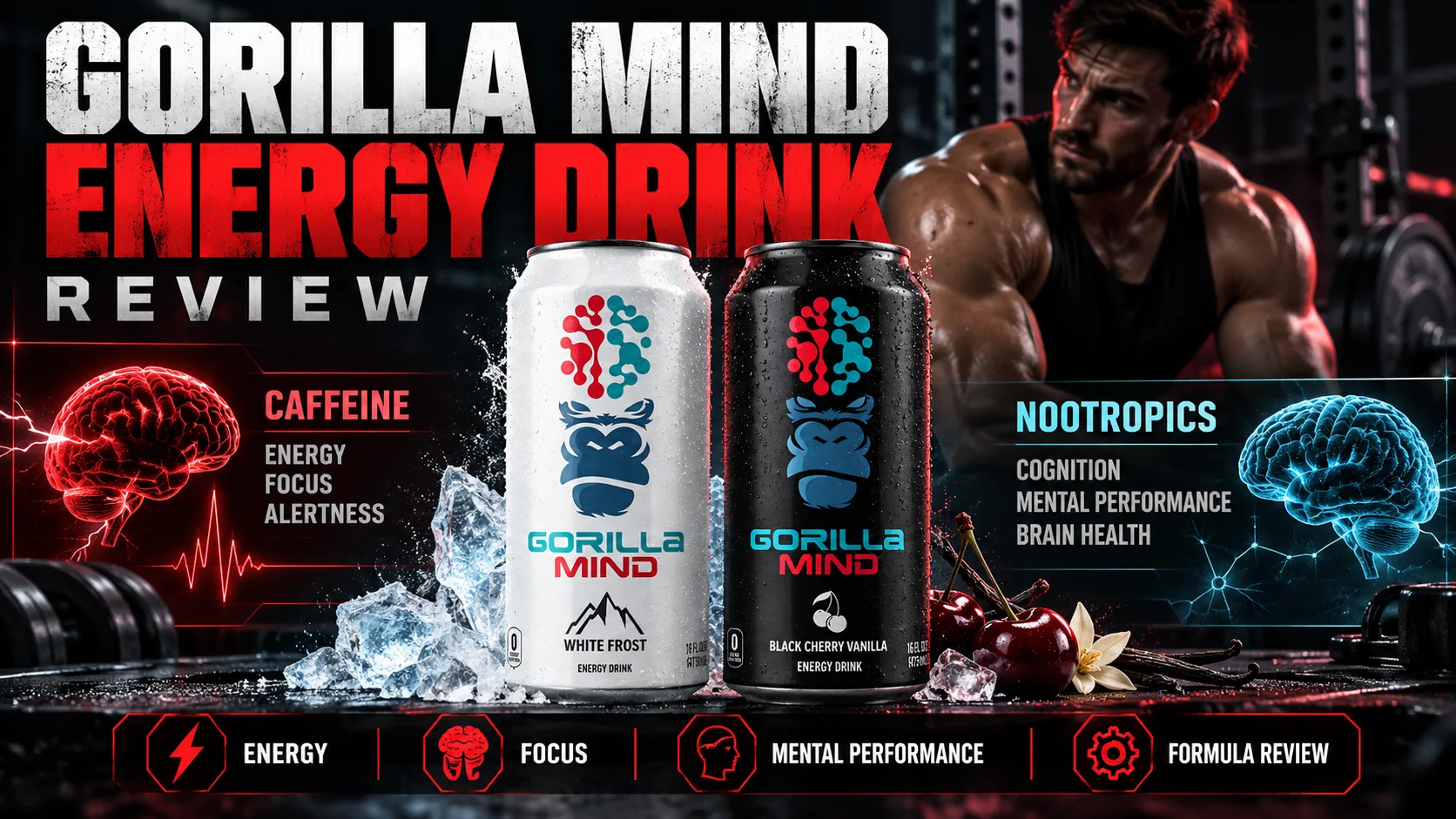
Gorilla Mind Energy Drink: 7 Critical Label Facts
Gorilla Mind Energy is a 16 oz sugar free can that claims 200 mg of caffeine plus six nootropic ingredients at disclosed doses. If the label is accurate, the caffeine and L-theanine doses line up with published research, while the Gorilla Mind energy drink ingredients that sound most exotic, uridine and saffron, sit well below the amounts used in human studies. The can also carries 200 mcg of huperzine A, a long acting compound that deserves respect if you drink more than one. This Gorilla Mind energy drink review reads every line of the panel. We did not lab test the product, so every product figure below is a label claim by the manufacturer.
Educational content only. This page reads the manufacturer label against published research. It is not medical advice. If you are pregnant, under 18, sensitive to caffeine or take prescription medication, talk to a clinician before using high caffeine products.
Supplements Editor · Updated September 2026
Three numbers that frame Gorilla Mind Energy
That is 12.5 mg per fluid ounce, a quarter more than a standard 16 oz Monster at 160 mg, and half of the 400 mg daily guide for adults.
Every ingredient in the energy matrix has its own milligram figure, so each one can be checked against research.
The can lists 200 mg of uridine monophosphate. The human study we found used 2 g a day.
Label figures were read from the Nutrition Facts image on the brand site in September 2026, Red Gummy Fish flavour. Formulas and prices can change.
What this review covers
The full panel. Calories, sodium, vitamins and the complete ingredient list in order.
Caffeine in context. How 200 mg compares with coffee, Monster and a scoop of pre workout, and what two cans mean.
The nootropic matrix. Each dose set against the amounts used in published human studies.
Additives, cost and fit. Sweeteners and preservatives, the can against Gorilla Mode powder, and who the drink suits.
Gorilla Mind energy drink ingredients and nutrition, line by line
The panel below is for one 16 fl oz can. The brand sells Gorilla Mind Energy in cases of 12 and publishes a Nutrition Facts image for each flavour.
| Line | Per 16 oz can | What it means | Status |
|---|---|---|---|
| Calories | 15 | From 2 g of carbohydrate, with 0 g sugar | ● strength |
| Sodium | 80 mg, 3% DV | From sodium citrate and preservatives. Negligible | ● neutral |
| Caffeine | 200 mg | Caffeine anhydrous. Half the adult daily guide in one can | ● trade off |
| N-Acetyl-L-Tyrosine | 1000 mg | A soluble form of tyrosine. Research base is for L-tyrosine | ● neutral |
| Alpha-GPC 50% | 400 mg | About 200 mg of actual alpha-GPC if the 50% figure is by weight | ● neutral |
| Uridine monophosphate | 200 mg | A tenth of the 2 g a day used in the human study we found | ● trade off |
| L-Theanine | 100 mg | Matches doses used with caffeine in attention studies | ● strength |
| Saffron extract | 15 mg | Half of the 30 mg a day typical in mood trials | ● neutral |
| Huperzine A | 200 mcg | A potent, long acting compound. Two cans double it | ● trade off |
| Vitamins C, B3, B5, B6, B12 | 100 to 290% DV | Active forms P5P and methylcobalamin. No megadoses | ● strength |
The ingredient list reads: carbonated filtered water, citric acid, N-acetyl-L-tyrosine, natural flavor, alpha-GPC 50%, sucralose, sodium citrate, caffeine anhydrous, uridine monophosphate, acesulfame potassium, sodium benzoate, potassium sorbate, tartaric acid, L-theanine, ascorbic acid, niacinamide, saffron extract, calcium disodium EDTA, calcium pantothenate, pyridoxal phosphate, methylcobalamin and huperzine A from Huperzia serrata. The brand states that its ingredients are third party tested for potency and purity. It does not publish those reports on the product page, so we treat that as a claim. For help with panels like this, see how to read supplement labels.
How much caffeine is in Gorilla Mind Energy?
The label lists 200 mg of caffeine anhydrous per can. That puts Gorilla Mind Energy above the mainstream cans and level with one scoop of a strong pre workout.
Guest and colleagues, writing for the International Society of Sports Nutrition, place the performance range for caffeine at 3 to 6 mg per kg of body weight, taken about an hour before exercise. For an 80 kg adult one can delivers 2.5 mg per kg, a little under that range. For a 60 kg adult it is 3.3 mg per kg. One Gorilla Mind Energy can before training is a reasonable dose for most adults who tolerate caffeine.
The ceiling matters more than the single can. Two cans equal 400 mg before any coffee, tea or pre workout. The same review set 300 mg a day for pregnant women and much lower figures for adolescents, which is why Gorilla Mind Energy is not a product for teenagers. Our breakdown of caffeine in Monster Energy shows how the mainstream cans compare.
Your caffeine for the day
The marker shows 400 mg. Coffee varies widely by brew. Assumes the label is accurate. Educational estimate only.
The energy matrix: each dose against the research
The brand describes Gorilla Mind Energy as the most efficacious energy drink on the market. A disclosed label lets us test that line ingredient by ingredient. The picture is mixed: two doses match human research, three fall short of it, and one has little research in healthy people at all.
Label dose as a share of the lowest dose in the human study cited
L-theanine and caffeine. This is the best supported pairing in Gorilla Mind Energy. Owen and colleagues found that 100 mg of L-theanine with 50 mg of caffeine improved attention switching and reduced distraction, and Haskell and colleagues reported faster reaction time and better alertness ratings with 250 mg of L-theanine and 150 mg of caffeine. The meta analysis by Camfield and colleagues confirmed benefits for alertness and attention in the first two hours. Note that those studies used as much or more theanine than caffeine, while the can has half as much.
Alpha-GPC. Kerksick tested 315 mg and 630 mg in 20 trained men and found better Stroop test performance an hour later at both doses, with no change in physical performance. Bellar and colleagues used 600 mg a day for six days and reported a gain in isometric pulling strength. If the 50 percent figure on the label is by weight, Gorilla Mind Energy supplies about 200 mg, below both studies.
N-acetyl-L-tyrosine. The review by Jongkees and colleagues concluded that tyrosine helps cognition mainly under acute stress or heavy mental load, such as cold, sleep loss or multitasking. Those studies used L-tyrosine. The acetylated form dissolves better, which suits a drink, but it has not been tested in the same way, so 1000 mg here is a reasonable guess at an effective dose and not a confirmed one.
Uridine, saffron and huperzine A. Agarwal and colleagues gave healthy men 2 g of uridine a day for a week to change brain phospholipid markers, ten times the amount in Gorilla Mind Energy. Saffron trials pooled by Hausenblas and colleagues treated depression, typically with 30 mg a day for weeks, not single 15 mg servings for focus. Huperzine A has real pharmacology: Yang and colleagues pooled 20 trials in Alzheimer's disease, where it improved cognitive scores, but those trials were in patients and were rated at high risk of bias. Evidence in healthy young adults is thin.
Sweeteners, preservatives and what zero sugar means here
Gorilla Mind Energy is sweetened with sucralose and acesulfame potassium, the same pair found in most sugar free energy drinks. Toews and colleagues reviewed 56 studies of non sugar sweeteners for the BMJ and found no clear benefit and no clear harm, with most evidence rated low certainty. One can a day is a small exposure. Several cans on top of diet soda and flavoured supplements add up.
Sodium benzoate and potassium sorbate. Standard preservatives for acidic drinks, both on the FDA generally recognized as safe list.
Ascorbic acid with benzoate. Benzoate and vitamin C can form trace benzene in warm, acidic drinks. Storing cans cool and out of sunlight is the usual precaution. We have no test data for this product.
Calcium disodium EDTA. A chelating agent that protects flavour. It is also commonly used to limit the benzoate reaction described above.
No artificial colors. The brand states that no artificial colors are used, which the ingredient list supports.
With 15 calories and no sugar, Gorilla Mind Energy does not carry the sugar load that drives most criticism of energy drinks. The questions that remain are about caffeine total and the long acting nootropics, not about calories.
Gorilla Mind Energy against a scoop of Gorilla Mode
The same company sells a scooped pre workout, and the two products overlap more than the packaging suggests. One scoop of Gorilla Mode lists the same 200 mg of caffeine and the same 400 mg of alpha-GPC 50%.
| Per serving | Energy drink, 1 can | Gorilla Mode, 1 scoop |
|---|---|---|
| Caffeine | 200 mg | 200 mg |
| Alpha-GPC 50% | 400 mg | 400 mg |
| Tyrosine | 1000 mg N-acetyl form | 2.5 g L-tyrosine |
| Huperzine A | 200 mcg | 100 mcg |
| L-Citrulline | None | 5 g |
| Creatine monohydrate | None | 2.5 g |
| L-Theanine, uridine, saffron | 100 mg, 200 mg, 15 mg | None |
| Price per serving | $2.92 | $1.50 |
Gorilla Mind Energy is a focus product. It has no citrulline, creatine or betaine, so it does nothing for pump or strength beyond what caffeine provides. The powder is a training product at about half the price per serving. Using both in one day stacks caffeine to 400 mg and huperzine A to 300 mcg, which is the combination to avoid. For another pre workout comparison, see our C4 pre workout review.
Gorilla Mind Energy flavors and how it is sold
At the time of writing the brand site listed 13 single flavours, including Red Gummy Fish, Rainbow Sherbet, White Frost, White Gummy Bear, Citrus Rain, Rocket Frost, Blue Raspberry, Blackberry Lemonade, Wild Grape, Black Cherry Vanilla, Fruit Punch, Root Beer and Candy Apple, plus two variety packs. We did not taste them, so we do not rank them. The brand lists one set of active doses per can for the whole range and publishes a separate Nutrition Facts image for each flavour. We read the Red Gummy Fish panel.
A case of 12 cans of Gorilla Mind Energy was $34.99, or $2.92 a can, with a limit of two cases per order and no free shipping on cases. Single cans in gyms and convenience stores usually cost more. Flavour choice is personal. The label is what decides whether the drink suits you.
Seven critical label facts about Gorilla Mind Energy
Caffeine is high for a can
200 mgOne can of Gorilla Mind Energy is half of the 400 mg a day guide for healthy adults and 25 percent more than a standard 16 oz Monster.
Every active dose is disclosed
7 of 7There is no proprietary blend, which is unusual for an energy drink and makes the label checkable.
Theanine with caffeine is the supported pair
100 mgHuman studies show better attention with the combination, although they used at least as much theanine as caffeine.
Alpha-GPC is likely under the studied dose
about 200 mgStudies used 315 to 630 mg. At 50 percent purity, 400 mg of raw material supplies roughly 200 mg.
Uridine and saffron are label dressing at these doses
10% and 50%Gorilla Mind Energy has a tenth of the uridine and half of the saffron used in the human research we found.
Huperzine A is the ingredient to respect
200 mcgIt is pharmacologically active and long acting. Two cans, or a can plus a huperzine pre workout, stack it quickly.
Sugar free does not mean additive free
2 + 2Two sweeteners and two preservatives, all approved. Keep cans cool, since the formula combines benzoate with vitamin C.
Gorilla Mind energy drink review verdict: is it worth it?
As a label, Gorilla Mind Energy is more transparent than almost any mainstream energy drink, and its core of caffeine and L-theanine is sound. The claim of unmatched efficacy is harder to support, because several of the headline nootropics are dosed below the research, and the most potent one, huperzine A, is a reason for moderation and not for a second can.
- You tolerate 200 mg of caffeine in one serving
- You want a focus drink for work or study more than a pump product
- You value a fully disclosed label with no sugar
- You will keep it to one can a day
- You are under 18, pregnant or sensitive to caffeine
- You already use a pre workout with caffeine and huperzine A
- You take medication that acts on acetylcholine or the heart
- You want training ingredients such as citrulline or creatine
One can, early in the day, is the sensible ceiling. If the goal is training performance, a scooped pre workout gives more for less money. If the goal is a cleaner alternative to a sugary energy drink, Gorilla Mind Energy makes its case on the label.
Common questions
How much caffeine is in Gorilla Mind Energy?
The label claims 200 mg of caffeine anhydrous per 16 oz can. That is half of the 400 mg a day that reviews consider safe for most healthy adults.
Is Gorilla Mind Energy a pre workout?
Gorilla Mind Energy can be used before training because of the caffeine, but it contains no citrulline, creatine, betaine or beta alanine. It is built for focus. A scoop of Gorilla Mode pre workout has the same caffeine plus training ingredients, dose by dose on its own page.
Is it safe to drink Gorilla Mind Energy every day?
For a healthy adult, one can a day keeps caffeine within accepted limits. Daily use of 200 mcg of huperzine A has not been studied in healthy young people, which is a reason not to exceed one can.
What are the Gorilla Mind energy drink ingredients?
Per can: 1000 mg N-acetyl-L-tyrosine, 400 mg alpha-GPC 50%, 200 mg caffeine, 200 mg uridine monophosphate, 100 mg L-theanine, 15 mg saffron extract and 200 mcg huperzine A, plus vitamins C, B3, B5, B6 and B12, sucralose and acesulfame potassium.
Does Gorilla Mind Energy have sugar or calories?
The Gorilla Mind Energy label lists 15 calories, 2 g of carbohydrate and 0 g of sugar per can. Sweetness comes from sucralose and acesulfame potassium.
Can I drink two cans in a day?
Two cans of Gorilla Mind Energy supply 400 mg of caffeine, the full daily guide, and 400 mcg of huperzine A. We would not make that a habit, and it leaves no room for coffee or pre workout.
What is huperzine A and why does it matter?
It is a compound from the plant Huperzia serrata that slows the breakdown of acetylcholine. It has been studied mainly in Alzheimer’s disease. Because it is potent and long acting, doses from several products should not be stacked.
How much does Gorilla Mind Energy cost?
On the brand site a case of 12 cans was $34.99 in September 2026, which is $2.92 per can before shipping. Single cans in shops usually cost more.
References
More on caffeine and pre workouts
Final Educational Note
This article is for educational purposes and does not constitute medical advice. Caffeine tolerance varies widely, and product formulas and prices change without notice. Do not start or change supplementation based solely on general guidance from any website, including this one. If you are pregnant, under 18, have a heart condition or take prescription medication, a clinician should make the call.
MuscleScience does not sell energy drinks, supplements or medical services. We have no financial relationship with Gorilla Mind or any other brand named on this page. The goal of this article is to give you the label claims and the research so you can decide for yourself. For more breakdowns, see the supplements hub.
Community Reviews
Tried this product? Rate it and share your experience. A valid email is required, kept private and never shown; reviews appear after moderation.
What readers say
There are no reviews yet. Be the first one to write one.