Caffeine in Monster Energy: 6 Critical Facts
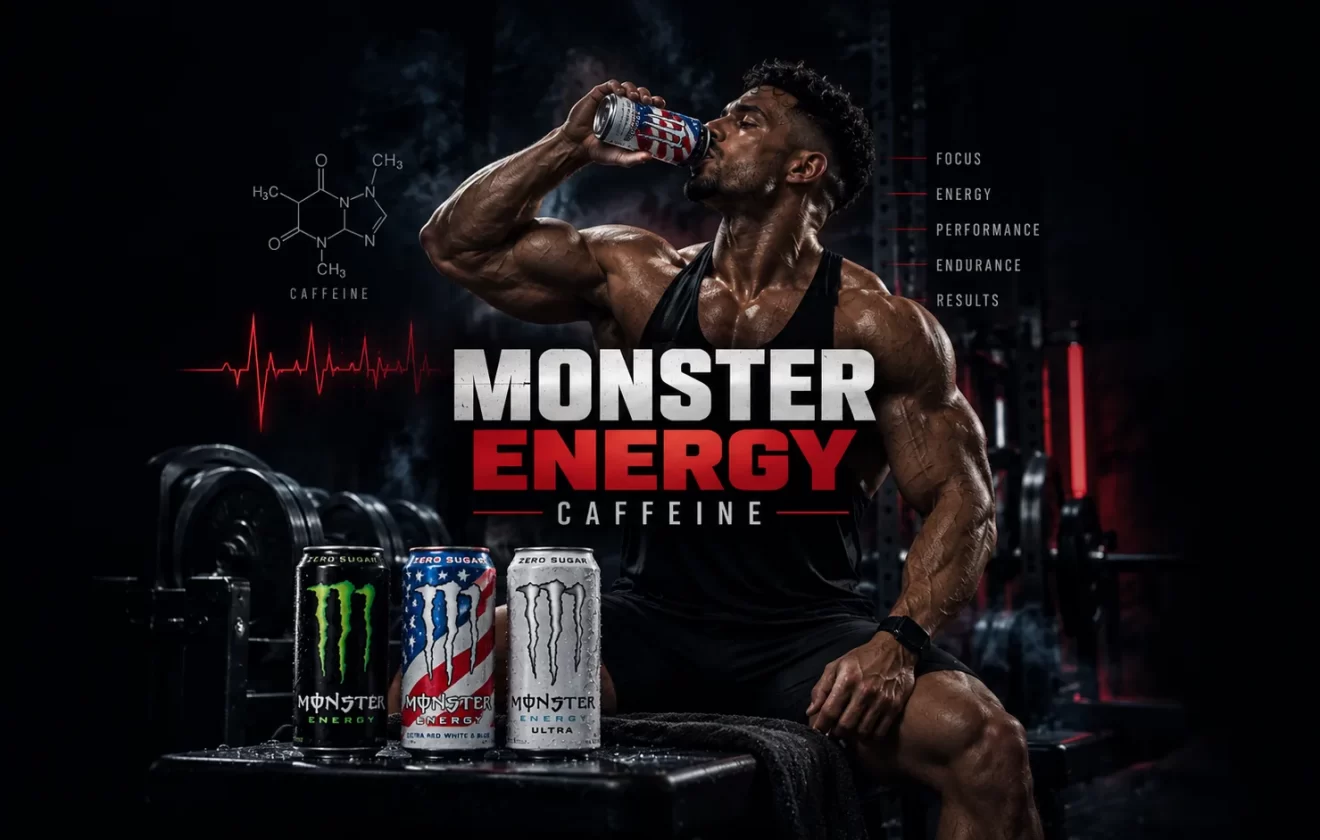
Caffeine in Monster Energy: 6 Critical Facts
Caffeine in Monster Energy is 160 mg in the standard 16 fl oz (473 mL) can according to the label, and that printed number already includes the caffeine carried by guarana. Every US can states the figure as caffeine from all sources, so guarana is inside the total rather than stacked on top of it. Across the full line, caffeine in Monster Energy runs from 150 mg in a white Ultra can to 240 mg in the 24 fl oz can, with 200 mg in a Java Monster. The most common follow up is how much caffeine in White Monster, and the label answer is 150 mg.
Educational content only. This page reports label figures and published research. We did not lab test any can, so every caffeine figure is the manufacturer's label claim. It is not medical advice and it is not a recommendation to drink energy drinks. Caffeine tolerance, heart rhythm history and medication use are individual, so talk to a clinician before adding a stimulant habit.
Supplements Editor · Updated September 2026
From how much caffeine in White Monster to the daily ceiling: three numbers
The standard green 16 fl oz can, Zero Sugar, Rehab and Juice Monster all land on the same 160 mg. That is roughly 34 mg per 100 mL, and it is the figure most people mean when they ask about caffeine in Monster Energy.
White Ultra sits lowest at 150 mg. The 24 fl oz can is labelled as two servings of 120 mg, so caffeine in Monster Energy reaches 240 mg if you finish it. Java Monster Mean Bean is 200 mg.
Nawrot and colleagues concluded that up to 400 mg a day carries no established adverse effect in healthy adults, about 6 mg per kg for a 65 kg person. Two standard cans put you at 320 mg before coffee.
Every figure for caffeine in Monster Energy on this page was read off physical cans, not copied from third party charts. Regional labels differ, so a European 500 mL can and a US 473 mL can are not interchangeable.
What this page covers
Label figures per variant. Caffeine in Monster Energy is listed can by can, in milligrams per container and per 100 mL, so the sizes can actually be compared.
What the wording means. Caffeine from all sources is a legal phrase with a specific consequence for how you read guarana on the ingredient list.
How tight the number is. Caffeine in Monster Energy is a specification rather than a measurement, and analytical work on labelled caffeine products shows the real content clusters near the claim but does not sit exactly on it.
What the dose does. What that much caffeine in Monster Energy does to sleep, blood pressure, QT interval, withdrawal and the genuine daily ceiling, with the study numbers behind each claim.
Caffeine in Monster Energy by can, every variant
The single most useful thing about this drink is that the company prints the number. Most coffee has no figure on the cup, so caffeine in Monster Energy is easier to audit than an espresso from the shop on the corner. The catch is that the line reads per can on some labels and per serving on others, and the 24 fl oz can quietly contains two servings. Caffeine in Monster Energy is a published specification, so it pays to read which unit that specification uses.
The table below is built from physical labels. The per 100 mL column is the honest way to compare sizes, because it strips out the effect of pouring more liquid into a bigger container. Read down that column and you see something useful: caffeine in Monster Energy is engineered to roughly 30 to 35 mg per 100 mL in almost every variant, with Java Monster as the outlier at 45 mg.
| Variant | Can size | Caffeine per can | Per 100 mL | Sugar | Calories | Status |
|---|---|---|---|---|---|---|
| Monster Energy Original | 16 fl oz / 473 mL | 160 mg | 34 mg | 54 g | 230 | ● standard |
| Monster Energy Zero Sugar | 473 mL | 160 mg | 34 mg | 0 g | 10 | ● standard |
| Monster Energy Ultra (white) | 473 mL | 150 mg | 32 mg | 0 g | 10 | ● low |
| Monster Energy 24 fl oz | 710 mL | 240 mg (2 x 120 mg) | 34 mg | 81 g | 340 | ● two servings |
| Juice Monster (16 percent juice) | 473 mL | 160 mg | 34 mg | 46 g | 190 | ● standard |
| Monster Rehab | 15.5 fl oz / 458 mL | 160 mg | 35 mg | 3 g | 15 | ● standard |
| Java Monster Mean Bean | 15 fl oz / 443 mL | 200 mg | 45 mg | 35 g | 220 | ● high |
| Juice Monster Pipeline Punch (AU) | 500 mL | 155 mg | 31 mg | 45 g | 193 | ● low |
| Monster Nitro Super Dry (EU) | 500 mL | 160 mg | 32 mg | 53 g | 233 | ● standard |
| Monster Super Fuel Subzero (EU) | 568 mL | 170 mg | 30 mg | 0 g | 10 | ● low |
Two rows deserve a second look. The 24 fl oz can is the one that catches people out, because the nutrition panel is written per 12 fl oz serving and the can holds two of them. If you drink it in one sitting, caffeine in Monster Energy has quietly doubled to 240 mg and the sugar has reached 81 g.
European labels take a different route again and state caffeine as a percentage by volume, which is how caffeine in Monster Energy is expressed across the EU, so a Nitro Super Dry at 0.032 percent works out to about 32 mg per 100 mL, or roughly 160 mg for the 500 mL can.
Java Monster is the genuinely stronger form of caffeine in Monster Energy, at 200 mg in a smaller 443 mL can. Its label also carries a sentence the other cans do not: caffeine values may vary based on coffee sources. That is the company saying in plain English that real coffee is a variable raw material, which is a useful admission to keep in mind for the next section.
Why guarana is not extra caffeine
Almost every article about caffeine in Monster Energy repeats the same mistake: it lists guarana as a separate stimulant and implies you are getting 160 mg plus whatever the guarana contributes. The label says otherwise. The line on the US can reads caffeine from all sources, followed by the milligram figure per can. Guarana seed is roughly 3 to 6 percent caffeine by weight, and that contribution is counted inside the stated total, not alongside it.
This matters for dose arithmetic. If you believed the guarana was additive you would assume a can delivers perhaps 180 or 200 mg, and you would then wrongly conclude you are near the daily ceiling after two of them. The correct reading is simpler. Caffeine in Monster Energy is whatever the can says, and the ingredient panel is telling you where that caffeine came from, not adding to it.
Taurine, panax ginseng and B vitamins are separate ingredients and they are not caffeine. An Australian Pipeline Punch label, for example, declares 2000 mg taurine, 425 mg panax ginseng extract and only 10 mg guarana alongside its 155 mg of caffeine. Those are real doses of other compounds with their own literature, but none of them changes how much caffeine in Monster Energy the can actually holds. If you want the wider skill of decoding these panels, our guide on how to read supplement labels works through the same traps on protein and pre workout tubs.
How close the printed number really is
How exact is the printed figure for caffeine in Monster Energy? A printed figure is a specification, not a measurement of the can in your hand. The best public data on this comes from the US Department of Agriculture team that built the Dietary Supplement Ingredient Database. Andrews and colleagues bought caffeine containing products off the shelf, took two or three lots of each and ran them by high pressure liquid chromatography. For the 28 products that declared a label amount, 89 percent measured within plus or minus 16 percent of the claim.
Turn that tolerance onto a can and it is easy to picture. If caffeine in Monster Energy is labelled at 160 mg and the same band applies, the plausible real content of a given can runs from roughly 134 mg to 186 mg. The same paper found lot to lot variability under 10 percent in 72 percent of products, which means just over a quarter of products moved more than that between batches. Nobody is being deceived here. This is simply what happens when a compound is dosed into a liquid at industrial scale.

How caffeine in Monster Energy stacks up against the 400 mg adult daily ceiling
The last row is the one that ends badly. A single scoop of a strong pre workout can carry 300 mg on its own, and adding caffeine in Monster Energy on top pushes the day past the ceiling before lunch. Our breakdown of C4 pre workout shows how quickly those two habits collide for anyone who trains after work.
Monster against coffee, tea and pre workout
Context turns a milligram figure into a decision. People ask about caffeine in Monster Energy as though energy drinks were a category apart, but a 473 mL can sits in the same band as a large filter coffee. Judged purely on stimulant load, caffeine in Monster Energy is unremarkable. What separates it is consistency and sugar.
| Source | Serving | Caffeine | Number printed on the pack | Status |
|---|---|---|---|---|
| Monster Energy Original | 473 mL can | 160 mg | Yes, per can | ● 100 to 200 |
| Monster Energy 24 fl oz | 710 mL can | 240 mg | Yes, per 12 fl oz serving | ● 200 to 300 |
| Java Monster Mean Bean | 443 mL can | 200 mg | Yes, with a variation note | ● 200 to 300 |
| Brewed filter coffee | 240 mL cup | Around 95 mg | No | ● under 100 |
| Double espresso | 60 mL | Around 125 mg | No | ● 100 to 200 |
| Black tea | 240 mL cup | Around 47 mg | No | ● under 100 |
| Cola | 355 mL can | Around 34 mg | Sometimes | ● under 100 |
| Strong pre workout | One scoop | 250 to 400 mg | Yes, per scoop | ● over 300 |
Coffee and tea figures are population averages, because brew strength, grind and steep time move them by a factor of two. That is the real argument in favour of a can: caffeine in Monster Energy is a declared quantity, while your cafe americano is a guess. The argument against a can is everything else in it, starting with 54 g of sugar in the original green version.
Pre workout is the category that makes caffeine in Monster Energy look mild. A single scoop of a heavily dosed formula can double what a can delivers, which is why stacking the two is the most common way people blow past a sensible day. The older generation of those products went further still, as our history of Jack3d makes clear.
Where the safe limit actually sits
The 400 mg figure that circulates online is not marketing. It comes from a review by Nawrot and colleagues which concluded that moderate daily intake up to 400 mg, equivalent to about 6 mg per kg of body weight in a 65 kg person, was not associated with general toxicity, cardiovascular harm or effects on bone status in healthy adults. The same review set a lower bar of 300 mg per day for women of reproductive age and 2.5 mg per kg for children.
Put caffeine in Monster Energy against that. One 473 mL can is 40 percent of the adult ceiling. Two cans reach 320 mg, leaving room for one small coffee and nothing else. A single 24 fl oz can plus a morning coffee lands near 335 mg. For a 60 kg person the per kilogram version of the limit is 360 mg rather than 400 mg, which is why caffeine in Monster Energy hits lighter people harder than the flat number suggests.
Performance dosing follows a different logic. The International Society of Sports Nutrition position stand puts the reliably ergogenic range at 3 to 6 mg per kg of body mass, notes that the minimum effective dose may be as low as 2 mg per kg, and warns that very high doses such as 9 mg per kg bring a high incidence of side effects without extra benefit. For an 80 kg lifter, 3 mg per kg is 240 mg, so caffeine in Monster Energy from a single can is a genuine pre training dose at the lower end of that window.
Your ceiling in cans. Divide 400 by the caffeine in Monster Energy on your usual can. At 160 mg that is 2.5 cans, and that assumes zero coffee, tea, cola or pre workout across the whole day.
Your training dose. Multiply body weight in kg by 3. If the answer is under the caffeine in Monster Energy in one can, that can is already a full ergogenic dose and a second adds side effects rather than output.
Your cut off time. Count back at least 6 hours from bedtime, and longer if you are a light sleeper. The research on that number is in the next section.
Your day against the 400 mg ceiling
Uses the label figures on this page, 95 mg per brewed cup and 300 mg per strong pre workout scoop. An educational estimate, not medical advice.
Six ways this goes wrong
The afternoon can that wrecks the night
6 hDrake and colleagues gave a moderate dose of caffeine at bedtime, 3 hours before bed and 6 hours before bed. All three timings produced significant sleep disturbance against placebo, and the authors concluded the reduction in total sleep time 6 hours out was large enough to matter. Caffeine in Monster Energy at 4 pm is a 10 pm problem.
Two cans in an hour moves the ECG
+19.6 msShah and colleagues ran a randomised crossover trial in 34 healthy volunteers aged about 22 who drank 32 fl oz of an energy drink within 60 minutes. Corrected QT interval rose by 17.9 and 19.6 milliseconds for the two drinks against 11.9 for placebo, and both peripheral and central blood pressure rose significantly.
A small but real blood pressure shift
+1.94 mmHgA meta analysis of randomised trials by Abbas-Hashemi and colleagues pooled 11 effect sizes and found caffeine supplementation raised systolic blood pressure by 1.94 mmHg. That is minor for one healthy adult and not minor for someone already being treated for hypertension who drinks two cans daily.
The sugar, not the stimulant
54 gThe green 473 mL can carries 54 g of sugar and the 710 mL can carries 81 g. Caffeine in Monster Energy is a fixed 160 mg whether you pick Zero Sugar or Original, so the sugar is a free choice. A UK survey by Hashem and colleagues found energy drinks averaged 9.5 g of sugar per 100 mL in 2017.
Withdrawal on the days you skip
2 to 9 daysJuliano and Griffiths documented headache, fatigue, low alertness, depressed mood and difficulty concentrating as validated withdrawal symptoms. Onset is 12 to 24 hours after the last dose, peak intensity falls at 20 to 51 hours, and symptoms can run 2 to 9 days. Doses as low as 100 mg a day were enough to produce them, far under the caffeine in Monster Energy in a single can.
Teenagers on adult doses
2.5 mg/kgMoussa and colleagues reviewed cardiovascular effects of energy drinks in the paediatric population, including short term blood pressure rises, reduced cerebral blood flow and unmasked channelopathies. A Medicina narrative review by Constantinou and colleagues covers arrhythmias in adolescents and young adults specifically.
None of this says a can is dangerous for a healthy adult. It says the dose is an adult dose, the timing matters more than the total, and the combination with other stimulants is where genuine problems start. For scale on the teenage question, Chapman and colleagues found that 55.6 percent of surveyed US high schools sold caffeinated beverages, with energy drinks averaging 95 mg per item.
The CYP1A2 excuse is weaker than it sounds
You will read that slow metabolisers of the CYP1A2 enzyme should avoid caffeine and fast metabolisers can drink freely. The genuine evidence is thinner than the confidence of the claim. Sicova and colleagues tested caffeine against several candidate genes on Wingate anaerobic performance and found no main effect of caffeine on Wingate outcomes at all. One interaction reached significance for CYP1A2 on average power, but post hoc analysis showed no difference between genotypes.
The practical version is this. Genotype is not a reliable predictor of how a given can will treat you, and you do not need a test to work it out. If caffeine in Monster Energy at 2 pm leaves you awake at midnight, your cut off is earlier than average. If a full can produces a racing pulse and jitter rather than focus, your effective dose is half a can. Those two observations tell you more about how caffeine in Monster Energy treats you than a saliva kit ever will.
Five mistakes people make with the numbers
1. Reading the serving instead of the can. The 24 fl oz can is labelled per 12 fl oz serving. Anyone reporting caffeine in Monster Energy as 120 mg for that can has read one line and stopped.
2. Adding guarana on top. Caffeine from all sources means exactly that. Guarana is already counted, so the caffeine in Monster Energy total is the total.
3. Comparing a US can with a European one. Caffeine in Monster Energy is specified region by region. A 500 mL EU can at 32 mg per 100 mL is a different product to a 473 mL US can, even when the flavour name matches.
4. Treating the label as an exact measurement. Analytical data puts most labelled products within about 16 percent of the claim, not on it. Plan the caffeine in Monster Energy around a band, not a point.
5. Forgetting the rest of the day. The ceiling is a daily total. Caffeine in Monster Energy competes with coffee, tea, cola, chocolate and pre workout for the same 400 mg, and the pre workout usually wins.
Who a can suits, and who should skip it
None of this is a recommendation to drink energy drinks. It is a reading of the label claims against the research: if the printed figures are accurate, caffeine in Monster Energy is an ordinary adult dose that fits some days and some people better than others.
- You are a healthy adult and the can is your main caffeine source for the day.
- You want a declared dose, because the label prints the milligrams and a coffee cup does not.
- You want a modest pre training dose: 160 mg is about 2 mg per kg for an 80 kg lifter, the lowest dose the ISSN describes as possibly effective.
- You pick Zero Sugar or Ultra, which carry the same caffeine claim without the 54 g of sugar.
- You are under 18, pregnant or breastfeeding.
- You have high blood pressure, a heart rhythm condition or an anxiety disorder.
- You already take a pre workout: a 300 mg scoop plus one can passes the 400 mg ceiling.
- It is less than 6 hours before you plan to sleep.
Common questions
How much caffeine is in a standard Monster can?
The 16 fl oz or 473 mL can is labelled at 160 mg, which works out to about 34 mg per 100 mL. Zero Sugar, Rehab and the juice versions use the same 160 mg figure. That makes caffeine in Monster Energy roughly equal to a large filter coffee or a double espresso and a half.
How much caffeine is in white Monster?
White Monster, sold as Monster Energy Ultra, carries 150 mg in the 473 mL can. It is the lowest of the mainstream US line by 10 mg, and it contains no sugar and 10 calories. The 10 mg gap in caffeine in Monster Energy Ultra is far too small to notice, so pick Ultra for the sugar, not for the stimulant.
Which Monster has the most caffeine?
In a single container the 24 fl oz can wins at 240 mg, because it holds two labelled servings of 120 mg. By concentration the winner is Java Monster at about 45 mg per 100 mL and 200 mg in a 443 mL can. Both sit well above the 160 mg of caffeine in Monster Energy that most people picture.
Does a can have more caffeine than coffee?
More than an average cup, yes. A 240 mL brewed coffee averages around 95 mg, so one can is close to two cups. Against a large coffee shop drink it is roughly even. The real difference is that caffeine in Monster Energy is printed on the can and the coffee figure is not, so the can is the predictable one.
Is 160 mg of caffeine a lot?
It is 40 percent of the 400 mg daily ceiling that Nawrot and colleagues described for healthy adults, and for an 80 kg person it sits at the bottom of the 3 to 6 mg per kg range the sports nutrition literature associates with performance benefits. Caffeine in Monster Energy at that level is a normal adult dose, not a small one.
Can I drink two cans in a day?
Two 473 mL cans come to 320 mg of caffeine in Monster Energy, which stays under 400 mg for a healthy adult with no other caffeine that day. The catch is that most people do have other caffeine. Add one coffee and you are at the ceiling. Add a scoop of pre workout and you are past it.
Does guarana add caffeine on top of the label figure?
No. US cans state caffeine from all sources, which means the guarana contribution is already inside the printed milligram total. Taurine, ginseng and B vitamins are separate ingredients with their own effects, but none of them is caffeine and none of them raises the caffeine in Monster Energy number on the label.
How long before bed should the last can be?
At least 6 hours, and the honest answer for many people is longer. In a controlled trial, a moderate caffeine dose taken 6 hours before bed still produced significant sleep disruption compared with placebo. If you go to bed at 11 pm, the last dose of caffeine in Monster Energy belongs before 5 pm at the very latest.
References
Next in this series
Final Educational Note
This article is for educational purposes and does not constitute medical advice. Caffeine tolerance depends on body weight, medication, heart rhythm history and sleep, and label figures vary by region and batch. Do not change your caffeine intake, stack stimulants or ignore symptoms such as palpitations based solely on general guidance from any website, including this one. If you have high blood pressure, a heart rhythm condition, an anxiety disorder, are pregnant or are under 18, a clinician should make the call.
MuscleScience does not sell energy drinks, supplements or medical services. We have no financial relationship with Monster Beverage or any other drink manufacturer. The goal of this article is to give you the label facts and the research behind the caffeine in Monster Energy so you can decide for yourself. For the pre workout side of the same question, see the C4 pre workout breakdown, or browse the supplements hub.
Community Reviews
Tried this product? Rate it and share your experience. A valid email is required, kept private and never shown; reviews appear after moderation.
What readers say
There are no reviews yet. Be the first one to write one.