Creatine Gummies vs Powder: 6 Honest Differences
Creatine Gummies vs Powder: 6 Honest Differences
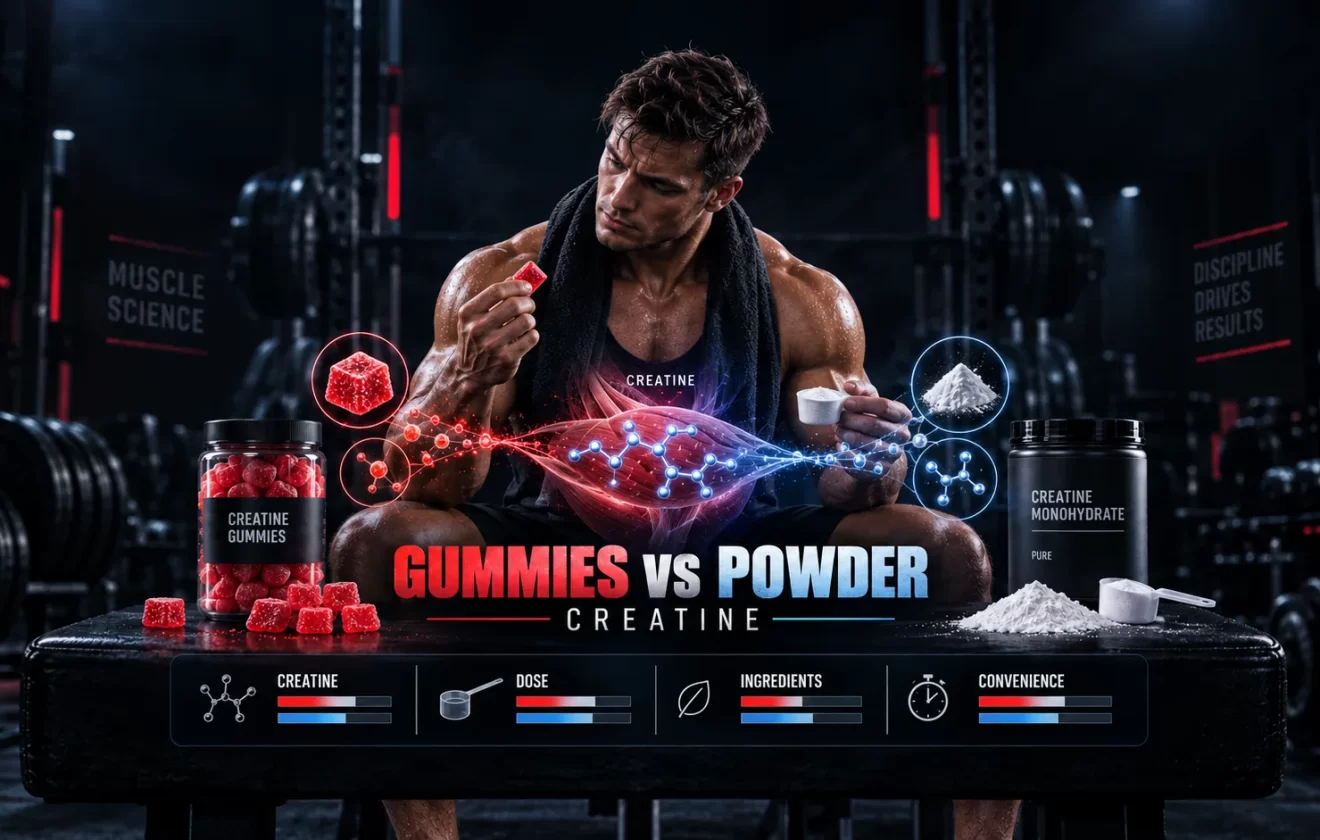
Creatine gummies vs powder comes down to three things: whether the dose on the label is really in the product, what each 5 g costs, and how much you value convenience. The creatine molecule is the same in both. In two independent test rounds about half of the creatine gummies checked fell short of their label, while every powder passed. At list prices, creatine gummies and creatine chews cost roughly 3 to 13 times more per 5 g than a plain tub. We did not lab test any product, so every product figure below is a label claim by the manufacturer or a result reported by the named tester.
Educational content only. This page compares manufacturer labels, list prices and published research. It is not medical advice. If you have kidney disease or take medication that affects kidney function, talk to your clinician before using creatine in any form.
Supplements Editor · Updated September 2026
Three numbers that frame the choice
SuppCo sent six creatine gummies and five powders to an ISO 17025 accredited lab. It reported that four gummies failed on identity and potency, two with no detectable creatine, and that all five powders passed.
At list price a 5 g serving of Force Factor gummies works out to $1.33. The same 5 g from a 500 g Nutricost tub works out to about $0.17. The gap is the cost of turning creatine into creatine gummies, not of better creatine.
Harris and colleagues found that creatine swallowed in solid form produced a 30 to 35 percent smaller plasma curve than the same dose in solution. It still raised plasma creatine five to six fold.
Label figures and list prices were read from manufacturer and retailer pages in September 2026. Test results are quoted from the published reports of SuppCo and NOW. Prices move often, so treat the cents as a method.
What this comparison covers
Dose per serving. How many creatine gummies or chews it takes to reach 5 g, brand by brand, against one scoop.
Independent testing. What two published test rounds found when creatine gummies were checked against their labels.
Stability and absorption. Why water is the enemy of creatine, and what happens when creatine is eaten as a solid.
Cost per 5 g. Six brands at list price, plus a calculator for the bottle in your own cart.
Creatine chews, gummies and powder: dose per serving
The research dose is simple. The International Society of Sports Nutrition position stand by Kreider and colleagues describes 3 to 5 g of creatine monohydrate a day as the maintenance dose. In the creatine gummies vs powder comparison, the first practical difference is how many pieces that takes.
| Product | Format | Serving | Creatine claimed | Pieces for 5 g | List price | Per 5 g | Status |
|---|---|---|---|---|---|---|---|
| Nutricost Creatine Monohydrate | Powder | 1 scoop | 5 g | 1 scoop | $16.97 for 500 g | $0.17 | ● low |
| Optimum Nutrition Micronized | Powder | 1 scoop | 5 g | 1 scoop | $20.49 for 60 servings | $0.34 | ● low |
| Thorne Creatine | Powder | 1 scoop | 5 g | 1 scoop | $44 for 90 servings | $0.49 | ● low |
| Animal Creatine Chews | Chewable tablet | 4 chews | 5 g | 4 | $29.95 for 120 chews | $1.00 | ● mid |
| Force Factor Creatine Gummies | Gummy | 5 gummies | 5 g | 5 | $39.99 for 150 gummies | $1.33 | ● mid |
| Create Creatine Gummies | Gummy | 3 gummies | 4.5 g | 3 to 4 | $2 a day, as stated by the brand | $2.22 | ● high |
Two details matter when you compare creatine gummies vs powder on dose. First, a serving of creatine gummies is not always 5 g: the Create label claims 4.5 g per three gummies, so always read the per gummy figure and do the multiplication yourself. Second, the gummy carries sugar. The Force Factor panel lists 45 calories and 6 g of total sugars per five gummies, which is small, but it is not zero the way a scoop of plain powder is.
If you are still deciding how much to take and when, our guides on the creatine loading phase and on creatine before or after a workout cover the dose and timing research.
What independent tests found in creatine gummies
This is the difference that decides the creatine gummies vs powder question for many buyers. Two organisations have published test rounds, and both reached a similar result.
NOW, February 2024. The supplement maker NOW bought 12 brands of creatine gummies online and ran them through its own HPLC method, noting that outside labs were not yet set up to test gummies. It reported that half of the brands failed to meet their label claim, and that the failing products contained creatinine, the breakdown product of creatine. NOW is a competitor that sells creatine powder, which is worth keeping in mind when reading its report.
SuppCo, June 2025. SuppCo sent 11 products to an independent ISO 17025 accredited lab. It reported that two creatine gummies contained no detectable creatine and two contained under 1 percent of the claimed dose. Two passed: Force Factor measured 6.3 g against a 5 g claim and Create measured 4.59 g against a 4.5 g claim. The five powders delivered their 5 g servings at 98 to 101 percent purity.
Creatine found as a share of the label claim, six gummies, as reported by SuppCo in June 2025
One detail deserves attention. A brand that NOW listed among the failures in 2024 passed the SuppCo round in 2025 and now states NSF Certified for Sport on its product page. If those reports are accurate, the gummy format can be made to work, but the buyer has to check for certification instead of assuming it.
Why creatine gummies lose potency and powder does not
Dry creatine monohydrate is one of the most stable supplements on the shelf. In water it is a different story: creatine slowly converts to creatinine, which has no ergogenic value, and the conversion speeds up with warmth and acidity. Ganguly and colleagues stored a creatine solution for 45 days and measured 90 percent degradation at room temperature and 80 percent under refrigeration.
Creatine gummies are not a solution, but they are made with water, cooked, and usually acidified with citric acid for flavour. NOW put it plainly in its report: water is used to make gummies, so it can be difficult to get the correct dosage of creatine. That chemistry is the most likely reason creatinine showed up in the failing products.
This is why the creatine gummies vs powder gap in test results is not just about careless brands. A tub of powder has to survive nothing. Creatine gummies have to survive manufacturing, a warehouse and a summer delivery truck. Reviews of creatine forms by Jager and colleagues and by Kreider and colleagues both conclude that no alternative form or delivery format has been shown to beat plain monohydrate.
Do creatine gummies absorb as well as powder
No study has measured creatine uptake from a gummy. The closest evidence comes from solid and food based formats. Harris and colleagues compared creatine dissolved in water with the same 2.3 g dose taken as a lozenge or as undissolved crystals. The solid forms produced a 20 percent lower peak and a 30 to 35 percent smaller area under the plasma curve.
That sounds bad for creatine gummies, but the authors added an important line: the solid dose was still enough to raise plasma creatine five to six fold. Deldicque and colleagues then fed 17 men 2 g of creatine in water or incorporated in food bars. The bars slowed absorption four to eight fold, yet the total area under the curve did not change, and less creatine was lost in urine with the fibre rich bar.
The fair reading for creatine gummies vs powder: slower absorption is not a problem, because creatine works by saturating muscle over weeks, not by spiking blood levels. Hultman and colleagues showed that 3 g a day reached the same muscle creatine level as a loading protocol after 28 days. If creatine gummies really contain their dose, the format should work. The open question is the dose, not the gut.
Creatine gummies vs powder on cost per 5 g
Price is where the two formats separate most clearly. Every figure below is a list price divided by the grams of creatine the label claims, scaled to a 5 g serving. Sales and subscriptions will move the numbers, but not the order.
Gummies, a year
List price of $39.99 for 30 servings, label figures, September 2026.
Powder, a year
List price of $16.97 for a 500 g tub, 100 servings, September 2026.
Over a year the difference between these two examples is a little over 420 dollars. That is the real price of not stirring a drink. For some people it is worth it, and the calculator below lets you run the creatine gummies vs powder maths on the bottle you are actually looking at.
What your bottle costs per 5 g
Divides the price by the grams of creatine the label claims and scales to 5 g a day. The marker shows $0.34 per 5 g, the list price of a mainstream micronized powder. Educational estimate only, and only as accurate as the label.
What the research on creatine itself supports
Almost every creatine trial ever run used monohydrate powder dissolved in a drink. That matters for the creatine gummies vs powder debate, because the evidence belongs to the molecule and the dose, not to a delivery format.
The effect. Jager and colleagues summarise that monohydrate raises muscle creatine and phosphocreatine by roughly 15 to 40 percent and improves high intensity exercise capacity.
The dose. Harris and colleagues first showed muscle creatine rising with 5 g doses, and Hultman and colleagues showed 3 g a day gets to the same place in 28 days.
Low doses still count. Rawson and colleagues gave 0.03 g per kg a day, about 2.3 g for a 75 kg adult, for six weeks and measured better fatigue resistance without any change in body mass.
Safety. The meta analysis by de Souza e Silva and colleagues found no significant effect of creatine on kidney function markers, and Antonio and colleagues address the common myths one by one.
Two practical points follow. Creatine gummies that really deliver 3 to 5 g a day should do what powder does. And stomach upset, the main complaint with powder, is dose related: Ostojic and Ahmetovic found that a single 10 g dose caused more diarrhoea than 5 g doses, so splitting the dose solves it without changing format. For the chemistry of other forms, see our breakdown of creatine HCL.
Six honest differences between creatine gummies and powder
Label accuracy
4 of 6 failedIn the published test rounds about half of the creatine gummies checked fell short of their claim, some with no detectable creatine. Every powder in the SuppCo round passed at 98 to 101 percent purity.
Cost per 5 g
3x to 13xAt list prices the chews and gummies in our table run from $1.00 to $2.22 per 5 g. The powders run from $0.17 to $0.49. Nothing in the research says the extra money buys better creatine.
Stability
WaterDry monohydrate is stable for years. Creatine exposed to water and acid converts to creatinine, and creatine gummies are made with both. This is a manufacturing problem that good brands solve and weak brands do not.
Pieces per dose
4 to 5One scoop is 5 g. Reaching 5 g takes four Animal chews, five Force Factor gummies or a little over three Create gummies on label figures. A loading phase of 20 g a day would mean 16 to 20 pieces.
Sugar and calories
6 g sugarThe Force Factor panel lists 45 calories and 6 g of total sugars per serving. That is trivial for most people and irrelevant to results, but it is a real difference from plain powder, which has neither.
Convenience and adherence
Daily habitCreatine only works if you take it every day for weeks. If creatine gummies are the difference between taking creatine and forgetting it, that benefit is real. It is also the only advantage the format has.
Creatine chews sit between the two formats. The Animal product is a pressed chewable tablet rather than a cooked gummy, which in principle involves less water in manufacturing, and at list price it is the cheapest of the three chewable options in our table.
Creatine gummies vs powder: which one to buy
If the only question is what works and what it costs, powder wins on every measured point: test results, stability and price. If the label on creatine gummies is accurate, they should work just as well, so the decision becomes whether convenience is worth several hundred dollars a year and the extra homework of checking certification.
- You have tried powder and keep skipping days
- You travel often and do not want a tub and a shaker
- You will only buy a product with NSF Certified for Sport or a published lab report
- The extra dollar or so a day does not matter to you
- You want the format used in nearly all creatine research
- You care about cost per gram
- You plan a loading phase of 20 g a day
- You buy from marketplaces where unknown brands are common
The research caveat is simple. No trial has compared the two formats head to head for strength or muscle creatine. The case for powder rests on decades of monohydrate studies plus two test rounds that were not peer reviewed. The case for creatine gummies rests on adherence, which no one has measured either.
Common questions
Are creatine gummies as effective as powder?
They should be if they contain the dose on the label, because the creatine molecule is identical. The problem is that in two published test rounds about half of the gummies checked did not contain what they claimed. Certified creatine gummies at 3 to 5 g a day are expected to work like powder, although no trial has compared them directly.
How many creatine gummies equal 5 g?
It depends on the brand. On label figures it takes five Force Factor gummies, four Animal creatine chews, or a little over three Create gummies at 1.5 g each. Always multiply the per gummy amount yourself, because a serving on the label is sometimes less than 5 g.
Do creatine gummies lose potency?
They can. Creatine converts to creatinine when exposed to water, warmth and acid, and gummies are made with water and usually citric acid. NOW reported creatinine in the gummies that failed its 2024 tests. Dry powder does not have this problem, and every powder passed the SuppCo round.
Why do creatine gummies cost more than powder?
You are paying for manufacturing, flavouring, packaging and convenience. At list prices a 5 g serving costs $1.00 to $2.22 from chews and gummies and $0.17 to $0.49 from powder. Over a year that gap runs from roughly 190 to over 700 dollars depending on the brands compared.
Are creatine chews better than gummies?
Creatine chews are pressed tablets rather than cooked gels, which in principle means less water during manufacturing. The Animal chews in our table claim 5 g per four chews and cost about $1.00 per serving at list price, the cheapest chewable option we found. We have not seen independent test results for them.
How do I know if a creatine gummy is legit?
Look for NSF Certified for Sport or Informed Sport on the product page, or a recent certificate of analysis that names the creatine content per gummy. Be careful with unknown marketplace brands that claim 5 g in one or two gummies, since a gummy large enough to hold that much creatine would be unusually big.
Can I do a loading phase with gummies?
You can, but it is impractical. Loading uses about 20 g a day, which is 16 to 20 pieces and several dollars daily. Loading is optional anyway: Hultman and colleagues showed that 3 g a day reaches the same muscle creatine level in 28 days.
Do creatine gummies absorb more slowly?
Probably, and it should not matter. Harris and colleagues found a 30 to 35 percent smaller plasma curve from solid creatine than from dissolved creatine, and Deldicque and colleagues found food bars slowed absorption without reducing the total absorbed. Creatine works by saturating muscle over weeks, not by peaking in blood.
References
More on creatine
Final Educational Note
This article is for educational purposes and does not constitute medical advice. Creatine needs depend on body weight, diet, training and medical history, and product formulas and prices change without notice. Do not start or change supplementation based solely on general guidance from any website, including this one. If you have kidney disease or take medication that affects kidney function, a clinician should make the call.
MuscleScience does not sell creatine, supplements or medical services. We have no financial relationship with any brand or testing organisation named on this page. The goal of this article is to give you the label claims, the published test results and the research so you can decide for yourself. For more breakdowns, see the supplements hub.