Creatine HCL vs Monohydrate: 7 Proven Facts
Creatine HCL vs Monohydrate: 7 Proven Facts
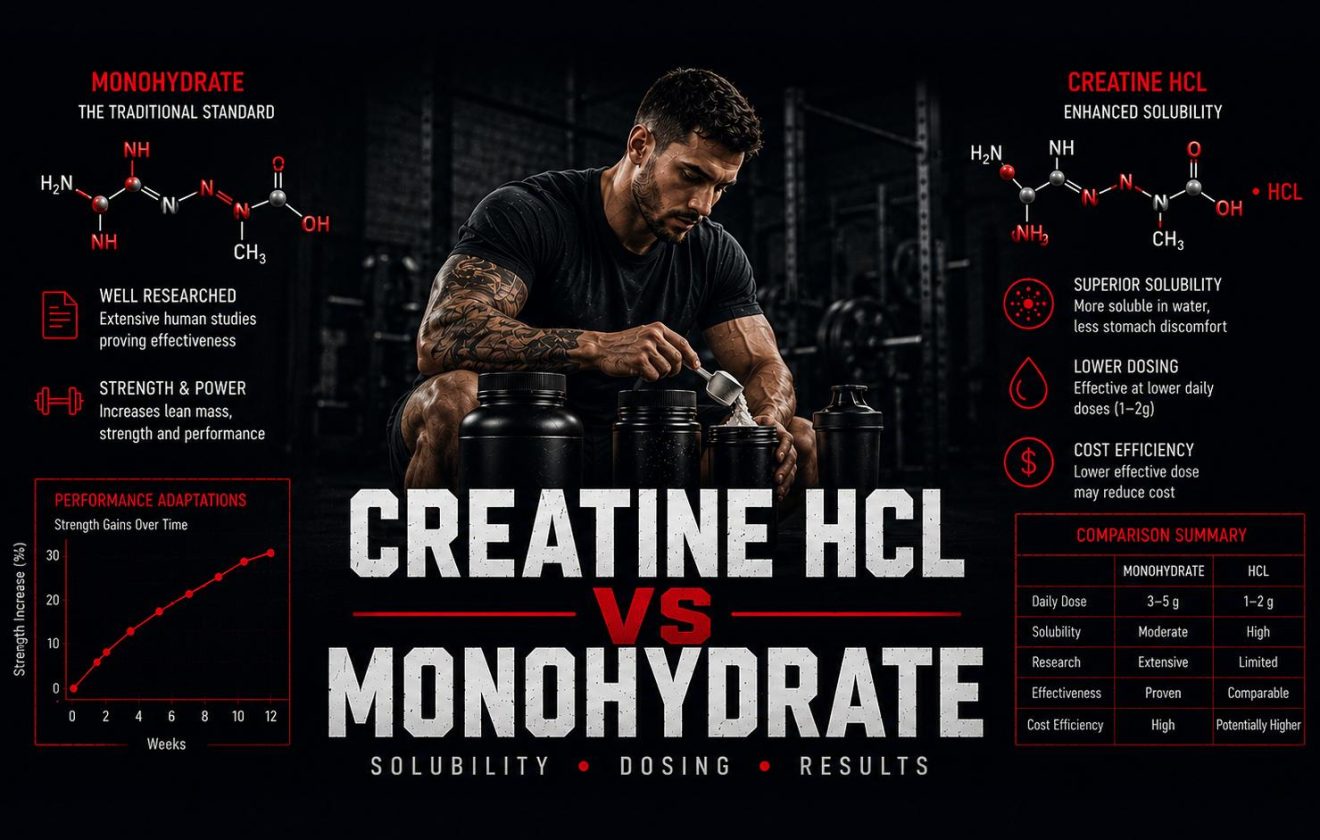
Creatine HCL is creatine bound to hydrochloric acid instead of a water molecule. It dissolves about 38 times better than monohydrate, but in the two human trials that compared them directly it did not build more strength or muscle in one, and showed only a small short term edge in the other. Whether you search for creatine monohydrate vs HCL or creatine HCL vs creatine monohydrate, the answer is the same: the salt changes how the powder behaves in a glass, not what creatine does in muscle. We did not lab test any product, so every product figure below is a label claim by the manufacturer.
Educational content only. This page compares published research, manufacturer labels and list prices. It is not medical advice. If you have kidney disease or take medication that affects kidney function, talk to your clinician before using creatine in any form.
Supplements Editor · Updated September 2026
Three numbers that settle most of it
Creatine HCL was 38 times more soluble in water than monohydrate in the lab. That is a real, measured property. It explains the clear glass, and it is the whole basis of the marketing.
Eghbali and colleagues trained 40 young adults for eight weeks on the HCL form, monohydrate with or without loading, or placebo. Every creatine group beat placebo, and the authors reported no benefit of HCL over monohydrate.
A common creatine HCL label suggests one 750 mg serving per 100 lb of body weight. That supplies about 0.6 g of actual creatine, a fraction of the 3 to 5 g a day used in the monohydrate literature.
Trial figures come from the published abstracts. Label and price figures were read from manufacturer pages in September 2026. Creatine content per gram is calculated from molecular weights.
What this comparison covers
The molecule. What creatine HCL actually is, how much creatine a gram contains, and what higher solubility does and does not change.
The dose question. Whether you really need less creatine HCL, with a calculator that converts any label into grams of actual creatine.
Human trials. The two studies that put creatine HCL and monohydrate in the same experiment, including the one that favours HCL.
Every other form. Micronized, Creapure, buffered, ethyl ester, nitrate, citrate and pyruvate in one table with an evidence status for each.
What creatine HCL is and what solubility changes
Every creatine supplement is the same active molecule attached to something that makes it a stable powder. In monohydrate that something is one water molecule. In creatine HCL it is hydrochloric acid, which forms a salt. Once either powder dissolves in the stomach, the partner falls away and free creatine is what gets absorbed.
The salt form does change the chemistry in the glass. Gufford and colleagues measured creatine HCL at 38 times the aqueous solubility of monohydrate. The powder dissolves fully in a small amount of water and leaves no grit. Solubility in a glass, however, is not absorption in the gut. Jager and colleagues, comparing creatine salts in humans, noted that absorption of monohydrate is already close to 100 percent, so there is little left to improve.
One animal study cuts the other way and deserves a fair mention. Alraddadi and colleagues gave rats labelled creatine and built a model that predicted 66 percent oral bioavailability for creatine HCL against 17 percent for monohydrate at a very high dose of 70 mg per kg. That is a simulation in rats at a dose far above a human scoop, not a human result, but it is the strongest piece of evidence the HCL side has.
Actual creatine in each gram of powder, by form
The format question is separate from the salt question. If you are weighing chewables against a tub, our creatine gummies vs powder comparison covers what solid formats do to absorption and price.
Creatine monohydrate vs HCL on dose: do you really need less
The central marketing claim for creatine HCL is that a micro dose does the job of a full scoop. The Kaged label, for example, suggests one 750 mg serving per 100 lb of body weight and states that no loading phase is needed. A 200 lb lifter following that label takes 1.5 g of creatine HCL a day.
Run the chemistry. Hydrochloric acid is heavier than the water in monohydrate, so a gram of creatine HCL contains about 0.78 g of creatine against 0.88 g in a gram of monohydrate. That 1.5 g label dose therefore delivers about 1.2 g of actual creatine. The ISSN position stand by Kreider and colleagues describes 3 to 5 g a day as the maintenance dose, and Hultman and colleagues needed 3 g a day for 28 days to fill muscle stores.
No human study has shown that 1 to 2 g of creatine HCL saturates muscle the way 3 to 5 g of monohydrate does. The only training trial that matched the two forms, by Eghbali and colleagues, used the same 0.03 g per kg for both, not a smaller HCL dose. If you choose creatine HCL, the evidence supports dosing it like creatine, which the Kaged label also allows at up to four servings a day.
How much actual creatine your HCL dose delivers
Multiplies 750 mg servings by 0.78, the creatine fraction of creatine HCL by molecular weight. The marker sits at 3 g a day, the lowest dose shown by Hultman and colleagues to fill muscle stores. Educational estimate, not medical advice.
Creatine HCL vs creatine monohydrate in human trials
For years the HCL debate ran on chemistry alone. Two recent trials finally put both forms in the same experiment, and they do not fully agree, which is exactly why both belong here.
Eghbali 2024
Physiol Res. The authors conclude that creatine HCL showed no benefit over monohydrate.
Duan 2026
J Int Soc Sports Nutr. Mean power and VO2max did not differ between groups.
How should the two be weighed? Both had ten people per group, which is small. The longer trial measured strength and muscle size, the outcomes most lifters care about, and found the forms equal. The shorter trial measured sprint and jump tests and found an edge for the HCL and ethyl ester groups. A four week window may simply favour whichever powder raises plasma creatine fastest, a difference that disappears once muscle is saturated.
The ethyl ester result also conflicts with earlier work. Spillane and colleagues found ethyl ester was not as effective as monohydrate at raising serum and muscle creatine during seven weeks of training. One small positive study does not overturn that, and the same caution applies to the HCL result. The fair summary: equal at best guess, possibly a little faster out of the gate, never shown to be better over a full training block.
Is creatine HCL easier on the stomach
This is the most common reason people switch, and it is the claim with the least data behind it. No published trial has compared stomach symptoms between creatine HCL and monohydrate. The idea is plausible: a powder that dissolves completely leaves no undissolved crystals to pull water into the gut. Plausible is not the same as measured.
Split the dose. Stomach complaints with monohydrate cluster around large single doses during loading. Two or three smaller doses with meals usually solve it.
Skip loading. Hultman and colleagues reached the same muscle creatine level with 3 g a day in 28 days. See our guide to the creatine loading phase for the timeline.
Dissolve it properly. Warm water and a minute of stirring dissolve far more monohydrate than a cold shaker does.
Then try HCL. If monohydrate still upsets your stomach at 3 g a day with food, creatine HCL is a reasonable experiment, dosed at 3 to 4 g rather than the label micro dose.
Timing will not fix a stomach problem either. As our review of creatine before or after a workout shows, the daily total matters far more than the clock.
Creatine HCL price per gram of actual creatine
Tubs of creatine HCL look cheap because they are small. The honest comparison divides the price by the grams of actual creatine inside, after removing the weight of the hydrochloride or the water. On that measure the gap is wide.
At list price, Kaged Creatine HCL costs $24.99 for 75 servings of 750 mg. That is 56 g of powder and about 44 g of actual creatine, or 57 cents per gram. A 500 g tub of Nutricost monohydrate at $16.97 works out to about 4 cents per gram of creatine. Taking 3 g of actual creatine a day would cost roughly $1.70 from the HCL tub and 12 cents from the monohydrate tub.
The micro dose on the label is what makes the product look affordable: two servings a day is about 67 cents. The catch is that those two servings hold 1.2 g of creatine. You can pay less per day only by taking less creatine than the trials used.
Every creatine form in one table
Creatine HCL is one of many attempts to improve on monohydrate. Reviews by Jager and colleagues in 2011 and Kreider and colleagues in 2022 reached the same conclusion: no other form has been shown to raise muscle creatine more than monohydrate. The table shows what each form changes and what was actually measured in people.
| Form | What is different | What human studies measured | Status |
|---|---|---|---|
| Creatine monohydrate | Creatine plus one water molecule, 88 percent creatine | The form used in nearly all trials. Raises muscle creatine by about 15 to 40 percent | ● supported |
| Micronized monohydrate | Same molecule milled to smaller particles, mixes more easily | No separate trials needed. It is monohydrate | ● supported |
| Creapure | A branded monohydrate made in Germany. The maker claims very high purity | No trial against generic monohydrate. Relevant for purity, not for effect | ● supported |
| Creatine HCL | Hydrochloride salt, 38 times more soluble, 78 percent creatine | Equal to monohydrate over 8 weeks of lifting. A small edge in one 4 week sprint study | ● mixed |
| Buffered creatine (Kre-Alkalyn) | Monohydrate with an alkaline buffer, sold at 1.5 g doses | Jagim and colleagues: no greater muscle creatine, strength or body composition change than monohydrate | ● unsupported |
| Creatine ethyl ester | Esterified with the aim of passing membranes more easily | Spillane and colleagues: less effective than monohydrate at raising serum and muscle creatine. One 4 week study favoured it | ● unsupported |
| Creatine nitrate | Nitrate salt, highly soluble | Galvan and colleagues: 3 g was well tolerated with performance benefits similar to 3 g of monohydrate | ● limited |
| Creatine citrate and pyruvate | Organic acid salts, 60 to 66 percent creatine | Jager and colleagues: slightly higher plasma peaks with pyruvate, judged unlikely to change muscle creatine | ● limited |
Two patterns repeat. Every alternative carries less creatine per gram than monohydrate, and most are sold at lower doses, which compounds the shortfall. Blends are a separate topic: our review of creatine with HMB looks at what a second ingredient adds, and our overviews of performance supplements and evidence based supplements show where creatine ranks among everything else.
Seven facts about creatine HCL the evidence supports
It dissolves far better
38xGufford and colleagues measured creatine HCL at 38 times the water solubility of monohydrate. If a gritty drink is what stops you taking creatine, this is a real advantage.
A gram holds less creatine
78%By molecular weight, creatine HCL is 78 percent creatine and monohydrate is 88 percent. Gram for gram you get about 11 percent less of the active molecule.
Monohydrate was already absorbed
~100%Human comparisons of creatine salts describe monohydrate absorption as close to complete. The rat model that favours HCL used 70 mg per kg, far above a normal human dose.
The micro dose is untested
1.2 gNo human study shows that 1 to 2 g of creatine HCL fills muscle stores. The matched trial used the same dose for both forms.
Equal results over eight weeks
No benefitEghbali and colleagues found that creatine HCL and monohydrate both improved strength and muscle size against placebo, with no benefit of HCL over monohydrate.
One short study favours it
4 weeksDuan and colleagues reported larger gains in jump, sprint and peak power with the HCL form than with monohydrate in soccer players, ten per group. It needs replication before it changes advice.
It costs far more per gram
15xAt list prices a gram of actual creatine costs about 57 cents from a typical creatine HCL tub and about 4 cents from budget monohydrate.
The stomach comfort claim is missing from this list on purpose. It may be true, but no published trial has measured it.
So, is creatine HCL worth it
For most people, no. If the published trials are representative, creatine HCL performs like monohydrate when it is dosed like monohydrate, and at that dose it costs many times more. Its one proven advantage is that it disappears in water.
- Monohydrate still upsets your stomach at 3 g a day with food
- You cannot stand any grit in a drink
- You want capsules and accept taking several a day
- The price per gram does not matter to you
- You want the form behind nearly all creatine research
- You care about cost per gram of actual creatine
- You were planning to take the 750 mg label micro dose
- You are buying it because a label says no bloating
The research caveat runs both ways. There are only two head to head trials, each with ten people per group, and one of them favours HCL on short sprint tests. If larger and longer studies repeat that finding, this verdict should change. Until then the weight of evidence sits with the cheaper powder.
Common questions
Is creatine HCL better than monohydrate?
Not on current evidence. In an eight week training trial creatine HCL and monohydrate improved strength and muscle size equally, and the authors reported no benefit of HCL. One four week sprint study in soccer players favoured HCL. Both were small, so the fair reading is equal, at a much higher price.
Do you need less creatine HCL?
There is no human evidence for that. A gram of creatine HCL actually contains less creatine than a gram of monohydrate, 78 percent against 88 percent. The label micro dose of 750 mg per 100 lb delivers roughly 1 to 1.5 g of creatine a day, below the 3 to 5 g used in research.
Is creatine HCL easier on the stomach?
It might be, because it dissolves completely, but no published trial has compared stomach symptoms between the two forms. Most stomach trouble with monohydrate comes from large single doses. Splitting the dose, skipping the loading phase and taking it with food solves it for most people.
Which creatine form is best?
Creatine monohydrate. Reviews from 2011 and 2022 both concluded that no other form has been shown to raise muscle creatine more. Micronized and Creapure are simply monohydrate with finer particles or a purity guarantee. Buffered creatine and ethyl ester failed to beat it in controlled trials.
Does creatine HCL need a loading phase?
Labels say no, but monohydrate does not need one either. Hultman and colleagues showed that 3 g a day fills muscle stores in about 28 days without loading. What matters is reaching 3 to 5 g of actual creatine a day, whichever form you use.
How much creatine HCL should I take?
If you want the dose the research supports, aim for 3 to 5 g of actual creatine, which is about 4 to 6.5 g of creatine HCL powder, or five to nine 750 mg servings. The Kaged label allows up to four servings a day, which is about 2.3 g of creatine.
Does creatine HCL cause less water retention?
There is no trial showing that. The water gain seen with creatine happens inside muscle as stores fill, and it depends on how much creatine reaches the muscle, not on the salt it arrived with. A lower dose will cause less water gain simply because it delivers less creatine.
Is Kre-Alkalyn better than creatine HCL or monohydrate?
No. Jagim and colleagues tested buffered creatine at the recommended 1.5 g a day and at monohydrate sized doses. Neither produced greater muscle creatine, strength or body composition changes than standard monohydrate.
References
More on creatine
Final Educational Note
This article is for educational purposes and does not constitute medical advice. Creatine needs depend on body weight, diet, training and medical history, and product formulas and prices change without notice. Creatine can raise serum creatinine, which can confuse a kidney blood test, so tell your clinician you take it and see our guide to kidney markers. If you have kidney disease, a clinician should make the call.
MuscleScience does not sell creatine, supplements or medical services. We have no financial relationship with any brand named on this page. The goal of this article is to give you the chemistry, the trials and the label claims so you can decide for yourself. For more breakdowns, see the supplements hub and our guide on how to read supplement labels.
Community Reviews
Tried this product? Rate it and share your experience. A valid email is required, kept private and never shown; reviews appear after moderation.
What readers say
There are no reviews yet. Be the first one to write one.