Training Volume Explained
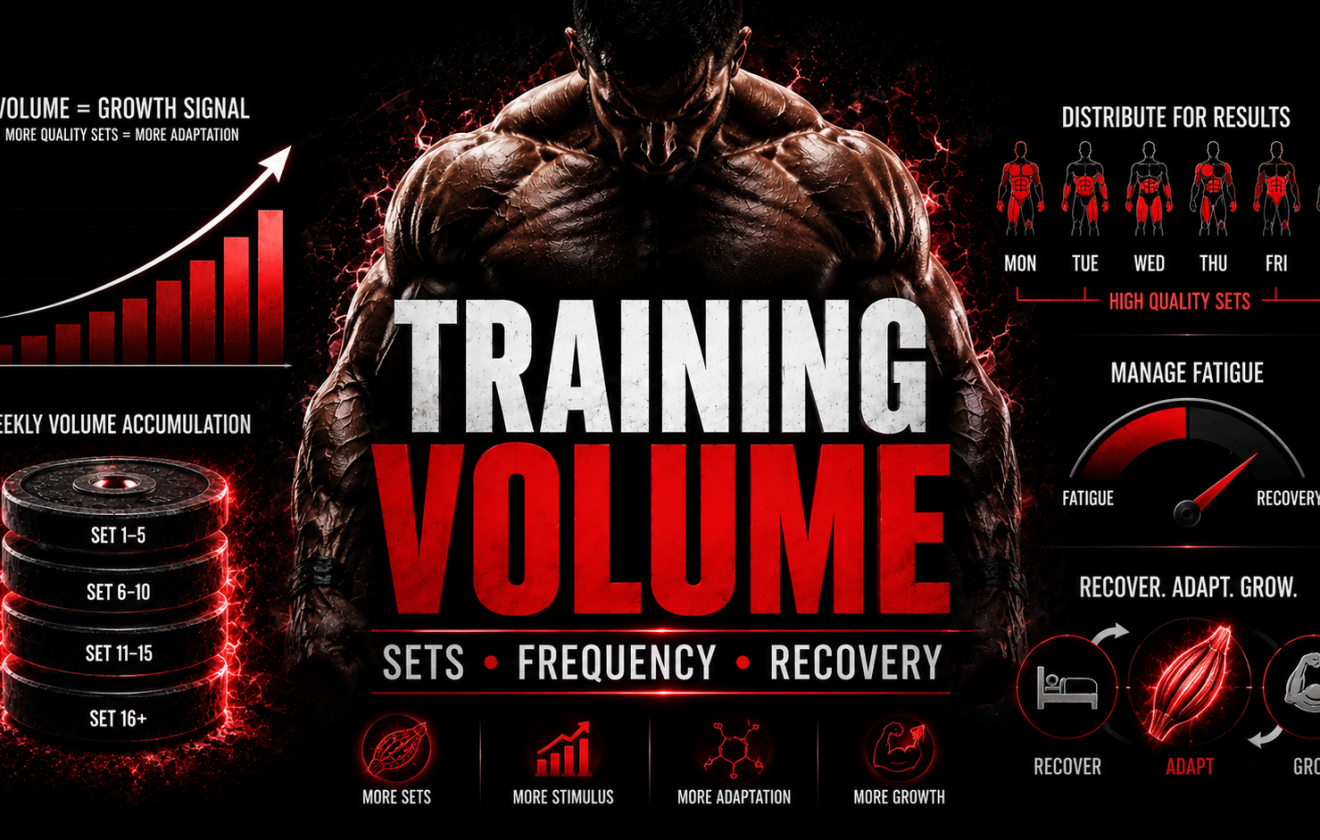
How much work drives real growth
Training volume is the primary dose variable for muscle hypertrophy. More total hard sets per muscle group per week produces more growth — up to a point. The dose-response relationship between volume and hypertrophy is well established in the research, but the upper boundary is individual, changes with training status, and must be managed within recovery capacity. This guide covers what training volume means precisely, how the dose-response curve works, how to progress volume across a training block, and how to avoid the two most common errors: chronic undertraining and unrecoverable overreach.
Training Volume: Key Points
For hypertrophy, training volume is best measured as hard sets per muscle group per week — not total reps, not tonnage. A hard set is one taken within 1-3 reps of failure.
More volume produces more hypertrophy up to a recovery ceiling. Below the minimum effective dose, gains are suboptimal. Above the maximum recoverable dose, gains stall and injury risk rises.
Volume should increase progressively within a training block and be reduced in a deload before the next block begins. Flat volume across months produces flat results.
- How training volume is correctly defined and measured
- The dose-response curve for hypertrophy
- Volume landmarks: MEV, MAV, MRV
- Per-muscle-group volume recommendations
- How to progress volume within and across blocks
- Enhanced vs natural volume tolerance
- Specific split programs (see Training hub)
- Nutrition for recovery (see Nutrition hub)
- Hypertrophy mechanisms (see What Builds Muscle)
- Load and rep selection (see Progressive Overload)
What Training Volume Actually Means
Training volume is one of the most misused terms in lifting. It is often equated with tonnage — the product of sets × reps × load — which produces a single large number that looks precise but is a poor predictor of hypertrophic response. A set of 20 reps at 40% of 1RM and a set of 6 reps at 80% of 1RM may have similar or identical tonnage figures but produce different hypertrophic stimuli depending on proximity to failure, muscle length, and other factors.
For the purpose of hypertrophy programming, training volume is most usefully defined as the number of hard working sets per muscle group per week. A hard working set is one taken within approximately 1-3 reps of muscular failure. Sets that end with 4 or more reps in reserve contribute little to the hypertrophic stimulus and should not be counted toward the meaningful volume total.
Why Hard Sets Are the Correct Unit
Research on volume dose-response consistently uses set count — not tonnage — as the primary independent variable. This is because effort level determines how many motor units are exposed to meaningful tension during a set. A set that ends well short of failure fails to recruit high-threshold motor units, which contain the largest muscle fibers with the greatest growth potential. Counting only hard sets captures the actual hypertrophic dose; counting all sets regardless of effort inflates the apparent volume without reflecting the real training stimulus.
A warm-up set is not a working set. A set of 15 reps stopped at 8 because the prescribed reps said 8 is not a working set if 7 more reps were available. Only sets where the load and rep target were genuinely challenging — where the last reps required real effort — count toward volume for hypertrophy purposes.
How Training Volume Drives Muscle Growth
The relationship between training volume and muscle hypertrophy follows a dose-response curve. At very low volumes, minimal hypertrophic adaptation occurs. As volume increases, muscle growth increases proportionally. At very high volumes, recovery becomes the limiting factor, growth plateaus, and eventually performance degrades. The goal of volume management is to operate in the productive zone — above the minimum effective dose, below the maximum recoverable dose — and to progressively shift that zone upward as fitness improves.
Multiple meta-analyses confirm this relationship. Research comparing 1, 5, and 10+ sets per muscle group per week consistently shows superior hypertrophic outcomes at higher volumes, with the advantage becoming less pronounced as volume increases further. There is no single threshold number that applies universally — but the broad consensus from the literature points to 10-20 hard sets per muscle group per week as the productive range for most intermediate lifters under natural conditions.
The Law of Diminishing Returns
Each additional set beyond the minimum effective dose produces less marginal growth than the previous set. The first 10 sets per week drive substantially more growth than the second 10. This is a critical insight for training economy: loading sessions with 30+ sets per muscle group per week is unlikely to produce proportionally more growth than 15-20 sets, but it will produce substantially more recovery demand, fatigue accumulation, and connective tissue stress. Volume should be the minimum dose that produces the target rate of progress — not the maximum volume possible.
5 Training Volume Concepts That Define Your Programming
Volume management becomes more precise when the key landmarks are understood. These are not fixed numbers — they are individual thresholds that shift with training status, recovery capacity, and hormonal environment. Their value is as a framework for thinking about where your volume currently sits and how to move it productively.
Minimum Effective Volume (MEV)
The lowest number of sets per week that produces measurable muscle growth. Below MEV, training maintains existing muscle but does not grow it. For most muscle groups in intermediate lifters, MEV sits around 6-10 sets per week. Deload weeks intentionally drop below MEV to allow recovery.
Maximum Adaptive Volume (MAV)
The volume that produces the best growth response. MAV is not a fixed point — it is a range that shifts upward as fitness improves. A lifter whose MAV is currently 14 sets per week for quads will develop a higher MAV over months of progressive volume accumulation.
Maximum Recoverable Volume (MRV)
The highest volume from which the body can recover before the next session. Exceeding MRV produces diminishing returns at best and accumulated fatigue, performance decline, and injury at worst. MRV varies significantly between individuals and muscle groups, and is substantially higher in enhanced athletes.
Per-Session Volume Ceiling
Beyond a certain number of sets per muscle group per session — typically 6-8 for most muscles — performance quality and hypertrophic stimulus per set decline due to local fatigue. Distributing volume across 2 sessions per week is more efficient than concentrating it in 1 session for most muscle groups.
Volume Progression Rate
Within a training block, volume should increase progressively — typically by adding 1-2 sets per muscle group every 1-2 weeks. This progressive increase keeps the stimulus ahead of adaptation (see Progressive Overload Explained) and builds toward the top of the productive range before the deload resets the accumulation cycle.
Training Volume Recommendations by Muscle Group
Volume requirements differ significantly across muscle groups. Large compound-dominant groups — quads, back, chest — tolerate and often benefit from higher volumes because they can be trained through multiple exercises and movement patterns. Small isolation-dependent groups — biceps, triceps, calves — are often stimulated through compound work and require less dedicated isolation volume.
| Muscle Group | MEV (sets/week) | Productive Range | Notes |
|---|---|---|---|
| Quads | 6–8 | 10–20 | Counts compound lower body work (squat, leg press) |
| Hamstrings | 4–6 | 8–16 | Hip-hinge and leg curl volume combined |
| Glutes | 4–6 | 8–16 | Hip thrust, RDL, split squat — overlaps with hamstring work |
| Back (thickness + width) | 8–10 | 12–22 | Row and pull variants each count; large total capacity |
| Chest | 6–8 | 10–20 | Horizontal and incline press variants |
| Shoulders (lateral head) | 6–8 | 12–20 | Low baseline from compound work; isolation required |
| Biceps | 4–6 | 8–16 | Receives significant stimulus from back pulling movements |
| Triceps | 4–6 | 8–16 | Heavy pressing covers a large portion of tricep volume |
| Calves | 6–8 | 10–16 | High recovery capacity; can tolerate higher frequency |
These ranges reflect intermediate natural lifters. Beginners will see growth at the lower end. Advanced natural lifters may benefit from the upper ranges. Enhanced athletes can often train productively above these ranges due to improved recovery capacity driven by elevated androgen levels.
How to Progress Training Volume Within and Across Blocks
Training volume should not be static. A lifter training at the same set count week after week for months is not applying progressive overload at the volume dimension — and growth will stagnate even if loads are progressing, because the total training stimulus per muscle per week is not increasing. Volume must be periodized: progressively increased within a block, then reduced in a deload, then restarted at a slightly higher baseline in the next block.
Within a Training Block (4-8 Weeks)
Start a training block at or slightly above MEV. Each week, add 1-2 sets per muscle group per week. By the end of the block, total weekly sets should approach the upper end of the MAV range. At this point, a deload is indicated: reduce volume to MEV or below for 5-7 days, maintaining load. The deload clears accumulated fatigue and allows the muscular adaptations from the block to consolidate.
An example progression for quads: Week 1 — 10 sets, Week 2 — 12 sets, Week 3 — 14 sets, Week 4 — 16 sets, Week 5 deload — 6 sets. The next block begins at 12 sets and works up to 18 sets. This ratcheting structure is how the productive volume range expands over months and years.
Across Training Blocks
Each successive block should start slightly above where the previous block started — not where it ended. Starting every block at the peak volume of the previous block would place the lifter near MRV from week one, leaving no room for intra-block progression. The general principle: start 2-4 sets below the previous block’s peak and work to a slightly higher peak.
How Training Volume Tolerance Differs for Enhanced Athletes
The volume landmarks described above apply most directly to natural lifters. Enhanced athletes — those using anabolic-androgenic steroids, testosterone replacement therapy at supraphysiological doses, or growth hormone — have substantially higher MRV, MAV, and even MEV for well-trained muscle groups. This is one of the most significant practical differences between natural and enhanced training.
Androgens increase the rate of muscle protein synthesis and reduce muscle protein breakdown, which means recovery from a given volume of training is faster and more complete. A natural lifter may reach MRV at 18 sets per week for a given muscle group. An enhanced lifter with a comparable training background may not reach MRV until 25-30 sets per week. This is not the purpose of anabolic steroid use from a medical standpoint, but it is the physiological reality of elevated androgen levels in the context of resistance training.
The Monitoring Requirement for High-Volume Enhanced Training
Higher training volumes combined with anabolic compound use impose meaningful cardiovascular and hematological demands. Elevated hematocrit — a common effect of androgen use — is further stressed by high training volumes that promote erythropoiesis. Lipid profiles and blood pressure both respond to the combination of high training load and androgenic hormones. Regular monitoring is the mechanism by which these variables stay within manageable ranges.
See the Bloodwork & Health hub for the full monitoring framework. Key markers relevant to high-volume enhanced training include hematocrit and hemoglobin, lipid panel, and blood pressure. The pre-cycle bloodwork guide outlines baseline testing before any enhanced training begins. For the clinical context of testosterone management, see the TRT & Hormones hub.
5 Training Volume Mistakes That Limit Results
- 1. Chronic low volume. Many intermediate lifters train at 6-8 sets per muscle group per week indefinitely — often because this is what their program prescribed when they were beginners and they never adjusted it. At 6-8 sets per week, results for most intermediate lifters are suboptimal. Moving to 12-14 hard sets per week for lagging muscle groups, with proper effort, reliably produces better results. The minimum effective dose for beginners is not the minimum effective dose for lifters with 2-3 years of training history.
- 2. Counting all sets including warm-ups. A lifter who does 4 warm-up sets before 4 working sets is doing a 4-set session for hypertrophy, not an 8-set session. Miscounting inflates apparent volume while the actual stimulus remains low. This produces the frustrating experience of training “high volume” without results — because the volume is being measured incorrectly.
- 3. Accumulating volume without deloading. Running progressively higher volume across 12+ weeks without a deload produces fatigue accumulation that masks fitness and degrades performance. Signs of overreach: decreasing strength at maintained loads, persistent joint soreness, poor sleep, flat affect toward training. A 5-7 day deload at MEV resolves this within days to a week, and performance typically rebounds above pre-deload levels as the accumulated adaptations become expressed.
- 4. Equal volume across all muscle groups. Prioritizing lagging muscle groups with higher volume while maintaining or reducing volume on advanced groups is a standard intermediate programming decision. Running 20 sets per week for both chest (already developed) and lateral deltoids (lagging) when recovery is limited is poor allocation. Prioritize volume toward the groups that need development; maintain the groups that are already strong with lower volumes.
- 5. Ignoring caloric intake when running high volume. High training volume increases caloric expenditure. Running high volume in a significant caloric deficit limits muscle protein synthesis and impairs recovery. If the goal is hypertrophy, adequate caloric intake — at minimum maintenance, ideally a modest surplus — is a prerequisite for high training volume to produce results. Use the Calorie & TDEE Calculator to confirm intake is supporting the training load. Track body composition trends with the BMI & Body Fat Calculator.
External References
- Schoenfeld BJ et al. (2017). Dose-response relationship between weekly resistance training volume and increases in muscle mass. Journal of Sports Sciences. PubMed.
- Krieger JW. (2010). Single vs. Multiple Sets of Resistance Exercise for Muscle Hypertrophy: A Meta-Analysis. Journal of Strength and Conditioning Research. PubMed.
- Schoenfeld BJ et al. (2019). Resistance Training Volume Enhances Muscle Hypertrophy but Not Strength in Trained Men. Medicine & Science in Sports & Exercise. PubMed.
- Colquhoun RJ et al. (2018). Training Volume, Not Frequency, Indicative of Maximal Strength Adaptations to Resistance Training. Journal of Strength and Conditioning Research. PubMed.
- Ralston GW et al. (2017). The Effect of Weekly Set Volume on Strength Gain: A Meta-Analysis. Sports Medicine. PubMed.
- American College of Sports Medicine. (2009). Progression Models in Resistance Training for Healthy Adults. Medicine & Science in Sports & Exercise. PubMed.
Managing Training Volume for Long-Term Results
Training volume is the primary lever for hypertrophy — more than exercise selection, more than training frequency, more than any specific technique variable. The dose-response relationship is clear: more hard sets per muscle group per week produce more growth, up to the recovery ceiling. Managing that ceiling — through periodized volume accumulation, planned deloads, and progressive block-to-block increases — is what separates lifters who keep progressing from those who stall.
The next article in this series covers recovery and fatigue — the variables that determine how much training volume the body can absorb and adapt to. For tracking body composition alongside volume progression, use the Fitness Calculators hub. For the full site content map, see Start Here. For enhanced athletes, bloodwork monitoring during high-volume training phases is covered in the Bloodwork & Health hub. For context on the side-effect profile of compounds that affect volume tolerance, see the PED Side Effects hub.
Final Note
All information on this page is provided for educational purposes. Nothing here constitutes personal training advice or a recommendation to use any pharmacological agent. References to anabolic steroids and testosterone therapy are included because this site serves an audience that trains in that context — not as an endorsement of their use.
MuscleScience.org is an educational publication. We do not sell training programs, supplements, or pharmacological agents.