Progressive Overload Explained

The core principle behind getting stronger
Progressive overload is the non-negotiable requirement for continued muscle and strength development. Muscles adapt to training stress - once adaptation is complete, growth stops regardless of how hard the sessions feel. This guide explains precisely what progressive overload means, the different forms it takes, how to apply and track it systematically, and why most lifters fail to do it consistently over the long term.
Progressive Overload: Key Points
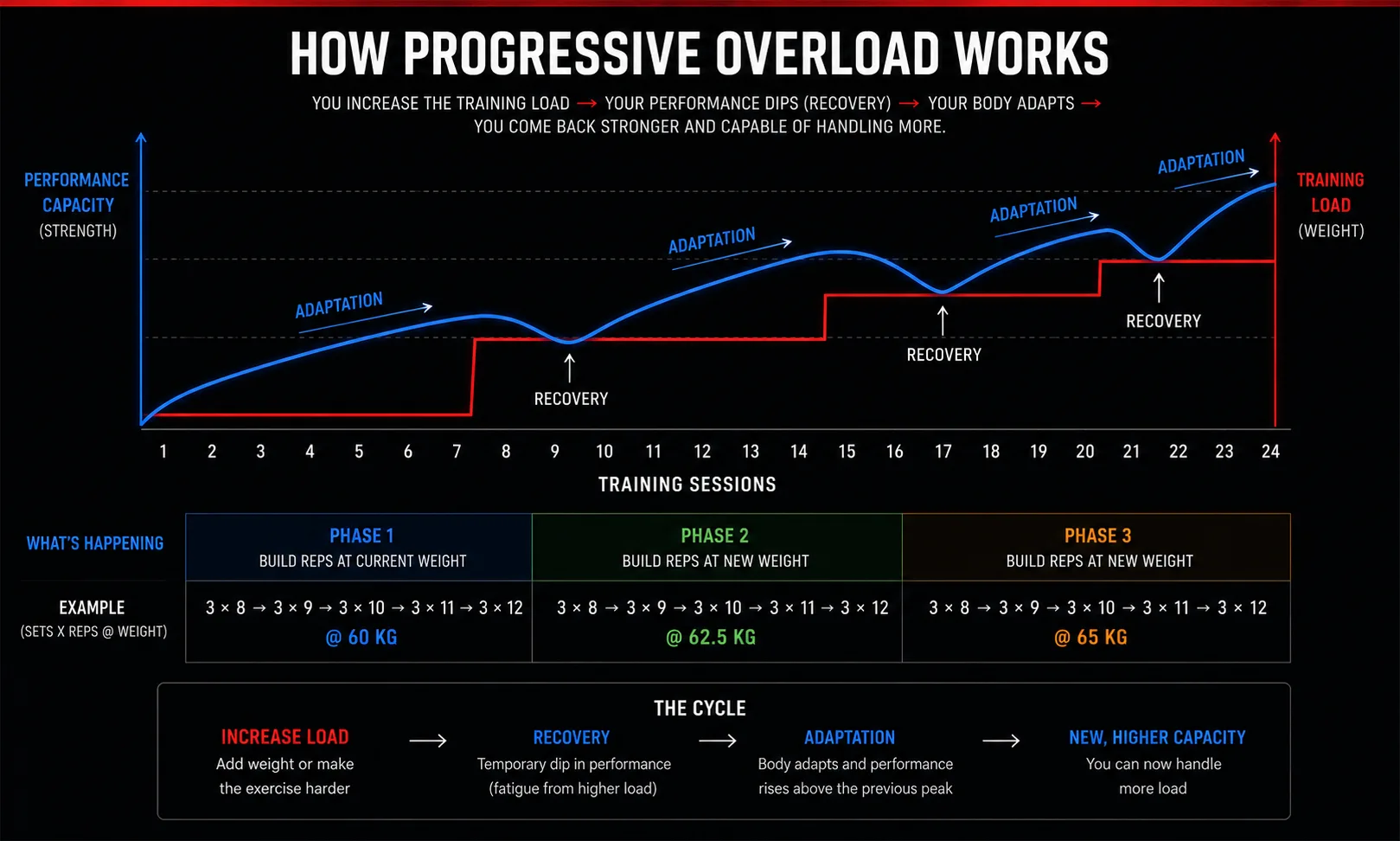
Muscles adapt to training stress. Once adaptation is complete, the stimulus must increase to continue producing growth. Progressive overload is the systematic application of that increasing stimulus.
Load, reps, volume, technique, range of motion, rest period reduction, tempo. Load and volume are the primary long-term drivers. The others have limits and diminish as training matures.
A training log is mandatory. Without a record of previous performance, there is no way to know whether progression has actually occurred. Effort is not a reliable indicator - numbers are.
- Definition and biological basis of progressive overload
- All 6 forms with relative importance ranked
- Tracking methods and log structure
- Realistic progression rates by training status
- How to diagnose and respond to plateaus
- Natural vs enhanced progression differences
- Specific program templates (see Training hub)
- Nutrition for recovery (see Nutrition hub)
- Supplement protocols (see Supplements hub)
- Mechanisms of muscle growth (see What Builds Muscle)
What Progressive Overload Actually Means
Progressive overload means applying a training stimulus that is greater than what your neuromuscular system has already adapted to. The body adapts to stressors - this is the specific adaptation to imposed demands (SAID) principle. When you first begin training, almost any resistance triggers adaptation. As you get stronger, the same stimulus becomes progressively less effective because your body has already adapted to it. The gain stops. The stimulus must increase to restart it.
This is often simplified to "add weight to the bar over time," which is correct but incomplete. Weight is one form of overload. The broader principle covers any variable that makes the training demand greater than what the body has previously encountered and adapted to. Understanding all the forms progressive overload can take - and their relative importance - determines how effectively a lifter can keep progressing as training experience accumulates.
The Biological Basis
When a muscle encounters mechanical tension that exceeds what it has previously adapted to, mTORC1 signaling activates and muscle protein synthesis rises above breakdown, producing net muscle growth. As the muscle grows and the nervous system becomes more efficient at recruiting motor units, the same load no longer generates the same relative tension. The stimulus has to increase to continue eliciting the same adaptive response. For a full explanation of the underlying hypertrophy mechanisms, see What Builds Muscle.
This principle is the most consistently supported finding across decades of resistance training research. Studies comparing periodized training - where volume and load are systematically increased over time - to non-periodized training reliably show superior long-term outcomes for the progressively structured approach. The mechanism is well understood; the application is what most lifters get wrong.
6 Forms of Progressive Overload - Ranked by Long-Term Importance
Not all forms of progressive overload carry equal weight across a full training career. Load and volume are the primary drivers of long-term hypertrophy and strength. The others matter - particularly technique and range of motion in the early and intermediate stages - but they have limits. Once technique and range of motion are optimized, further gains require load or volume increases. Understanding the hierarchy prevents misallocating focus on minor variables when the primary levers are being neglected.
- 1. Load Progression - primary long-term driver of strength. Adding weight to the bar or dumbbell is the most straightforward expression of progressive overload. When a lifter successfully completes the target reps at a given load with 1-2 reps in reserve, increasing load at the next session is the correct next step. Load progression is the metric most directly tied to strength development and the one most reliably tracked over months and years. On compound movements, it remains the primary variable to optimize. Rate of load progression decreases substantially with training experience - this is normal, not a signal to abandon the program.
- 2. Volume Progression - primary long-term driver of hypertrophy. Total hard sets per muscle group per week is the primary dose variable for muscle growth. Progressively increasing volume over a training block - from 10 to 14 sets per muscle group per week, for example - constitutes volume-based overload. This is often more practical than load increases on isolation exercises or when approaching strength ceilings. Volume has a recovery ceiling within any training block; periodized programs include planned reductions (deloads) to allow recovery before a new progressive cycle begins.
- 3. Rep Progression - practical bridge between load increases. If the goal is 4 sets of 10 reps at a given load and the current performance is 4 sets of 8, increasing to 4 sets of 9 before adding load is rep-based progressive overload. Rep progression is effective and avoids premature load jumps that compromise technique. The standard model: work within a rep range, progress reps until the top of the range is reached with adequate proximity to failure, then add load and restart from the bottom of the rep range.
- 4. Technique Progression - high early impact, diminishing returns. Improved technique means the target muscle does more of the work across a fuller range of motion, increasing the effective tension applied per rep. A squat with full depth and controlled tempo under load delivers more mechanical stimulus to the quads and glutes than a partial-range squat at the same load. Technique progression is significant in the beginner and early intermediate stages. Once technique is dialed in, it no longer constitutes a meaningful source of overload - at that point, load and volume must carry the progression.
- 5. Range of Motion Progression - underutilized in intermediate training. Loading a muscle through a longer range of motion - particularly in the lengthened position - increases mechanical work per rep and produces stronger hypertrophic signaling. Moving from partial to full range of motion on a key exercise, or switching to a variation that emphasizes the stretched position (incline curls over flat curls, deficit Romanian deadlifts over standard), constitutes a form of overload. This variable intersects with technique and has a natural ceiling once full range is achieved consistently.
- 6. Rest Period Reduction - minor contribution, useful context. Completing the same sets and reps at the same load with shorter rest periods increases the metabolic demand and makes each subsequent set harder relative to full recovery. This is the least important form of progressive overload for hypertrophy and strength. It is more relevant for conditioning and metabolic stress contribution. Using rest period reduction as a primary progression strategy - instead of load or volume increases - is a common mistake that caps development unnecessarily.
A Realistic 8-Week Progression Example
Theory is tidy. Training is not. Here is what double progression looks like across a real block on the bench press, starting at 60 kg for 3 sets with a target of 8 to 12 reps. You climb the reps to the top of the range, then add a small load jump and let the reps reset. Both adding reps and adding load drive adaptation, so the model always leaves you a lever to pull.
| Week | Weight | Sets and reps | Note |
|---|---|---|---|
| 1 | 60 kg | 8, 8, 7 | Last set short, normal |
| 2 | 60 kg | 9, 8, 8 | Building |
| 3 | 60 kg | 10, 9, 9 | Climbing |
| 4 | 60 kg | 12, 11, 10 | Top of the range |
| 5 | 62.5 kg | 9, 8, 8 | Add load, reps reset |
| 6 | 62.5 kg | 10, 10, 9 | Building again |
| 7 | 62.5 kg | 12, 11, 10 | Top again |
| 8 | 65 kg | 9, 8, 8 | Next jump |
Over eight weeks the bar moved from 60 to 65 kg, and the work performed at any given load rose the whole time. That is progressive overload in its most repeatable form. Notice what it is not: it is not adding weight every session, and it is not a straight line. Some weeks barely move, and that is fine. The direction across a block of eight to twelve weeks is what counts. Micro-loading plates of 1.25 kg or smaller are worth owning, since they let you make the jump at week five without the reps collapsing.
How to Track Progressive Overload Systematically
Progressive overload requires a training log. Without a record of what loads, reps, and sets were completed in previous sessions, there is no objective basis for determining whether progression has occurred. Training feels hard regardless of whether the numbers moved - effort is not a reliable indicator of progression. The session that felt like a personal record might have been performed at the same weight and reps as the session three weeks ago, just under worse recovery conditions.
What a Training Log Needs to Capture
- Date and session identifier (e.g., Week 4 / Day A)
- Exercise name and variation - including specifics (barbell vs dumbbell, incline angle, grip width) that affect load comparability
- Sets × Reps × Load - every working set, not just the top set
- Effort level - reps in reserve (RIR) or RPE scale, to contextualize whether a set at a given load was a true working set or a conservative warm-up
- Notes - relevant context: sleep quality, previous injury, technique change, equipment difference
Using Log Data to Make Progression Decisions
At the start of each session, review the log from the last time that specific exercise was performed. Apply a consistent decision rule: if the top of the rep range was reached at a given load with 2+ reps in reserve, add load. If the top of the rep range was reached at 0-1 reps in reserve, add load or maintain and push closer to failure. If the rep target was not reached, maintain load and target and push closer to failure next session.
This removes guesswork from progression decisions. The log tells you whether to add weight, add reps, or hold and push harder. Without the log, every session defaults to whatever felt reasonable that day - which is not progressive overload, it is random effort.
The Bench Press 1RM Calculator can help estimate theoretical strength progression on a key compound lift. For tracking body composition changes alongside strength progression, use the BMI & Body Fat Calculator.
Realistic Rates of Progressive Overload by Training Status
The rate at which progressive overload can be applied decreases with training experience. This is the most important thing to understand about long-term progression and the source of most frustration for intermediate and advanced lifters who benchmark themselves against their beginner gains. Beginner rates of progression are not sustainable - they reflect rapid neural adaptations and muscle growth from a very low baseline, not a permanent rate of return.
| Training Status | Experience | Realistic Load Progression | Primary Overload Method |
|---|---|---|---|
| Beginner | 0-12 months | Weekly increases possible on most lifts | Load + technique simultaneously |
| Intermediate | 1-3 years | Monthly increases on primary compound lifts | Load + volume within periodized blocks |
| Advanced | 3+ years | Meaningful load gains over 3-6 month cycles | Volume periodization + technique refinement |
| Enhanced (AAS) | Variable | Faster rates sustainable for longer periods | Higher volume + load ceiling elevated by hormonal environment |
Enhanced athletes - those using anabolic-androgenic steroids or testosterone replacement therapy - can sustain higher progression rates for longer periods because elevated androgens increase muscle protein synthesis, reduce protein breakdown, and accelerate recovery. The principle of progressive overload is unchanged; the hormonal environment raises the ceiling and extends the timeline over which each level of training stress produces adaptation. For the clinical context of testosterone management, see the TRT & Hormones hub.
How Progression Differs for Female Lifters
The principle and the levers are identical for women and men. Relative gains in strength and size are similar between sexes (Roberts et al., 2020). What differs is where the emphasis pays off. Many female lifters tolerate higher reps and greater weekly volume well, and often recover faster between sessions on lower-body work, which means volume progression is frequently the most productive lever to lean on. Load still progresses, but the jumps are usually smaller in absolute terms, so micro-loading matters more, not less.
Two practical adjustments follow. First, favor rep and set progression before chasing load on isolation and accessory movements, and reserve the largest load jumps for the main compounds. Second, some women autoregulate around the menstrual cycle, pushing harder in the weeks they feel strong and holding or leaning on lighter, higher rep work when energy and recovery dip. This is individual, not a rule. The honest guidance is to track how you respond in the log and let the reps-in-reserve targets adjust the load for you, rather than forcing a fixed weekly increase.
When Progression Stalls
A genuine plateau - no load or volume progression over 3-4 weeks despite consistent training - has identifiable causes. The correct response is systematic investigation, not program-hopping.
- Insufficient recovery: Sleep below 7 hours, sustained high psychological stress, or caloric deficit without adjusted protein intake all reduce recovery capacity and cap progression. Address nutrition first. Use the Calorie & TDEE Calculator to verify intake targets.
- Volume at the recovery ceiling: Weekly set volume has reached the point where recovery is limiting performance at the next session. A planned deload (30-50% volume reduction for 1 week) followed by a new progressive block resolves this.
- Technique limiting before the target muscle: Grip strength failing before back in rows, hip flexor fatigue before quad in leg press, lower back fatigue before glute in Romanian deadlifts - all indicate the target muscle is not the limiting factor. Accessory work or technique adjustment is required.
- Progression strategy needs updating: Linear progression (add weight every session) stops working for intermediate lifters. Moving to wave loading, undulating periodization, or other structured progression models is a normal maturation of the training approach, not a sign of failure.
Choosing a Progression Model: Linear, Undulating, or Block
When linear progression stops working, the fix is to organize progression across a block rather than grinding a straight line. Linear stalls because fatigue accumulates faster than it can be recovered from, usually somewhere between three and six months of steady training for most lifters. These are the three common models and who each suits.
| Model | What it is | Best for |
|---|---|---|
| Linear | Add load or reps steadily each week, one variable at a time | Beginners and early intermediates, roughly the first 6 months |
| Undulating (DUP) | Vary reps and effort across the week, for example heavy, medium and lighter days | Intermediates who have stalled on straight linear |
| Block | Spend a few weeks emphasizing volume, then a few emphasizing intensity | Advanced lifters and anyone peaking for a goal |
The rule of thumb: use the simplest model that is still working, and only move up in complexity when it stops. Most lifters leave linear progression years before they have actually exhausted it.
5 Progressive Overload Mistakes That Stall Development
- 1. No training log. Without a record of previous performance, every session is navigated by feel. Training by feel systematically underestimates what has been done before and produces inconsistent progression decisions. A training log converts subjective effort into objective data. If the only thing you change in your training approach is adding a log, it will produce measurable improvement in progression rate within 8-12 weeks.
- 2. Adding load before it is earned. Increasing weight before the current load is fully controlled near the top of the rep range causes technique to degrade at the new load. Technique degradation reduces the mechanical tension reaching the target muscle, reduces the effective range of motion, and increases injury risk. The progression standard is: hit the top of your rep range at the current load with 1-2 reps in reserve, then add load. Not before.
- 3. Changing exercises too frequently. Each new exercise requires a familiarization period - typically 2-4 weeks - during which technique is being established and motor patterns are learning. Load progression during familiarization is partially neural, not purely muscular. Rotating exercises before a reliable performance baseline exists makes it impossible to determine whether progressive overload is being applied. Build a core exercise selection per muscle group and progress those movements systematically across multiple blocks.
- 4. Confusing effort with progression. Training hard is necessary but not sufficient for progressive overload. A session can be genuinely effortful - high perceived exertion, significant fatigue, soreness afterward - without producing any load or volume increase over the previous session. Effort is the input. Progression is the output. The log is the only way to distinguish them.
- 5. Expecting beginner progression rates as an intermediate. The most demoralizing experience in intermediate training is applying the same effort that produced rapid beginner gains and seeing the progress slow dramatically. This is not a training failure - it is the normal trajectory of adaptation. Intermediate and advanced progressions are measured in months and cycles, not sessions and weeks. Recognizing this prevents unnecessary program changes at the exact moment the current program needs consistent execution most.
External References
- American College of Sports Medicine. (2009). Progression Models in Resistance Training for Healthy Adults. Medicine & Science in Sports & Exercise. PubMed.
- Kraemer WJ, Ratamess NA. (2004). Fundamentals of resistance training: Progression and exercise prescription. Medicine & Science in Sports & Exercise. PubMed.
- Schoenfeld BJ et al. (2017). Dose-response relationship between weekly resistance training volume and increases in muscle mass. Journal of Sports Sciences. PubMed.
- Ralston GW et al. (2017). The Effect of Weekly Set Volume on Strength Gain: A Meta-Analysis. Sports Medicine. PubMed.
- Helms ER et al. (2014). Evidence-based recommendations for natural bodybuilding contest preparation. Journal of the International Society of Sports Nutrition. PubMed.
- Colquhoun RJ et al. (2018). Training Volume, Not Frequency, Indicative of Maximal Strength Adaptations to Resistance Training. Journal of Strength and Conditioning Research. PubMed.
- Plotkin D et al. (2022). Progressive overload without progressing load? The effects of load or repetition progression on muscular adaptations. PeerJ.
- Zourdos MC et al. (2016). Novel resistance training-specific rating of perceived exertion scale measuring repetitions in reserve. Journal of Strength and Conditioning Research. PubMed.
- Roberts BM et al. (2020). Sex Differences in Resistance Training: A Systematic Review and Meta-Analysis. Journal of Strength and Conditioning Research. PubMed.
Applying Progressive Overload Consistently
Progressive overload is not a technique or a program - it is a requirement. Muscles grow and strengthen in response to demands that exceed what they have previously adapted to. Remove that requirement and growth stops, regardless of how hard the training feels. Apply it systematically and document it accurately, and long-term progression becomes predictable rather than random.
The practical summary: track every session, use a consistent decision rule for when to add load or reps, understand that progression rate naturally decreases with training experience, and address plateaus by investigating recovery and nutrition before changing the program. The next articles in this series cover training volume and recovery - the two variables that determine how much progressive overload the body can absorb and adapt to. For body composition tracking alongside strength progression, use the Fitness Calculators hub. For the full content map, see Start Here. Enhanced athletes: all bloodwork monitoring references are in the Bloodwork & Health hub - start with the pre-cycle bloodwork guide.
Final Note
All information on this page is provided for educational purposes. Nothing here constitutes personal training advice or a recommendation to use any pharmacological agent. References to anabolic steroids and testosterone therapy are included because this site serves an audience that trains in that context - not as an endorsement of their use.
MuscleScience.org is an educational publication. We do not sell training programs, supplements, or pharmacological agents.