What Builds Muscle
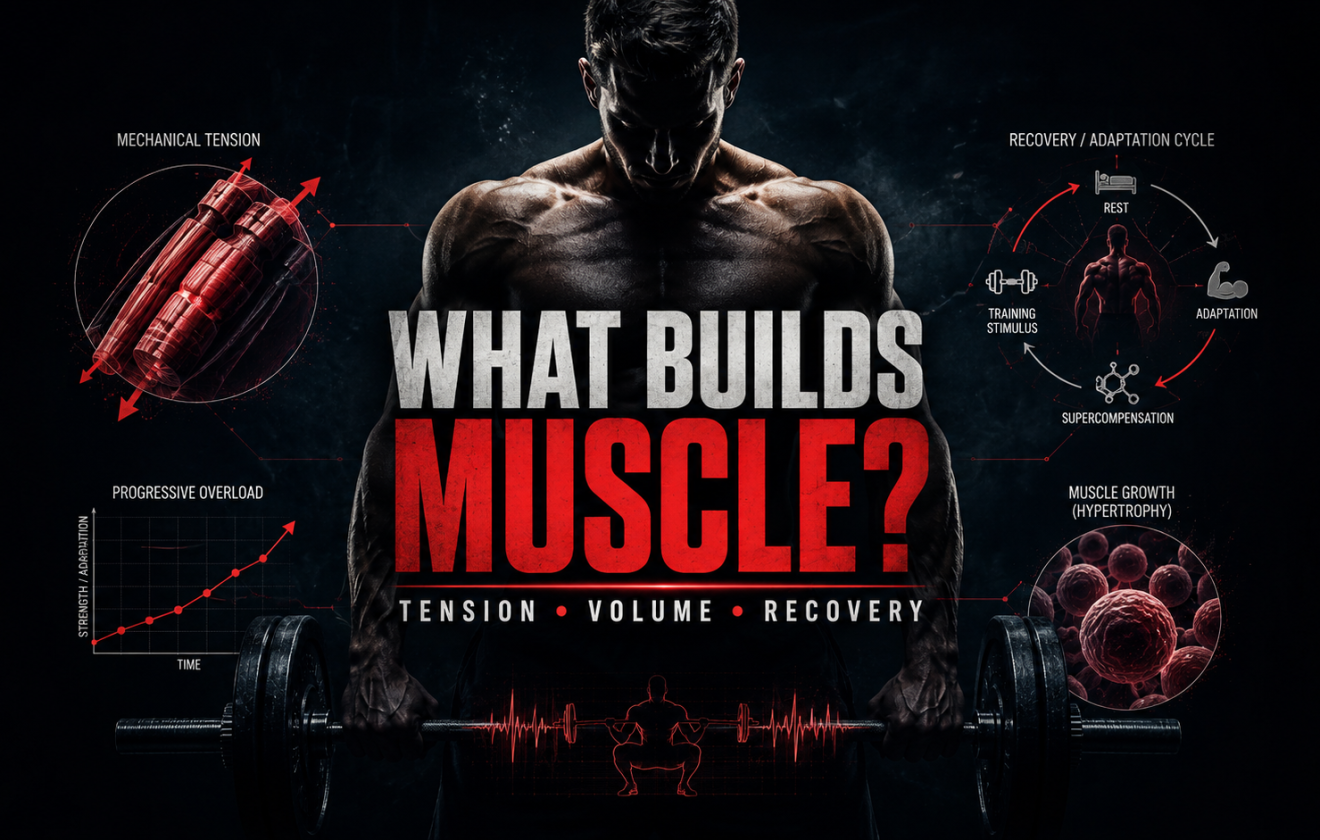
The real drivers of muscle growth
What builds muscle is mechanical tension - force applied to muscle fibers through resistance training, sustained with adequate protein and recovery. Understanding what builds muscle at the physiological level is what separates a training program that produces consistent results from one that produces confusion. This guide covers every mechanism behind muscle hypertrophy: what builds muscle at the cellular level, what determines the rate at which training stimuli translate into tissue growth, and how the hormonal environment sets the ceiling for all of it.
What Builds Muscle - 3 Core Principles
What builds muscle at the cellular level is mechanical tension - force on muscle fibers detected by mechanosensors that activate the mTORC1 protein synthesis pathway. Every other variable works through or alongside this mechanism.
Metabolic stress and muscle damage contribute to hypertrophy but are not what builds muscle primarily. Chasing soreness or the pump is not a reliable strategy - the research consistently points back to mechanical tension and effort.
What builds muscle over time is a positive net protein balance: muscle protein synthesis exceeding breakdown across weeks and months. Training and protein intake are the two variables that control this balance - everything else is secondary.
- Mechanical tension and mTORC1 signaling
- Metabolic stress and muscle damage
- Muscle protein synthesis vs breakdown
- Training volume, load, frequency, effort
- Hormonal environment: testosterone, GH, IGF-1
- How enhanced athletes differ mechanistically
- Specific program templates - see Training hub
- Detailed nutrition protocols - see Nutrition hub
- Supplement stacks - see Supplements hub
- Steroid cycles or PED protocols
- Bloodwork monitoring - see Bloodwork hub
Mechanical Tension - The Primary Answer to What Builds Muscle
Mechanical tension is the pulling force generated along a muscle fiber when it contracts under load. It is the primary answer to what builds muscle - force applied to muscle tissue, detected by mechanosensors embedded in the cell membrane, initiating a signaling cascade whose key node is mTORC1 (mechanistic target of rapamycin complex 1). When mTORC1 is activated, it upregulates muscle protein synthesis - the process that produces new contractile proteins and increases the fiber's cross-sectional area. This is what builds muscle at the cellular level. Everything else - metabolic stress, muscle damage, hormones, nutrition - either amplifies this mechanism or supports the recovery that allows it to repeat.
Programs that consistently deliver high mechanical tension to target muscles, across months and years, are programs where what builds muscle is actually occurring. Programs that spread training effort across too many variables without consistently delivering tension do not reliably produce hypertrophy - regardless of how scientific or varied they appear.
Load Range - Why Effort Determines What Builds Muscle More Than Weight
Research across multiple meta-analyses shows that what builds muscle is not a specific load range, but sufficient effort within a load range. Hypertrophy occurs from approximately 30% of 1RM up to 90%+, provided sets are taken close to muscular failure. A set of 20 reps at 40% of 1RM taken to within 1-2 reps of failure stimulates comparable muscle growth to a set of 5 reps at 85% of 1RM taken to the same proximity of failure. The common denominator is motor unit recruitment - when a set is genuinely hard, more muscle fibers are recruited to sustain force output. More fibers under tension means a stronger signal for what builds muscle downstream.
The classic bodybuilding range of 6-15 reps at 65-80% of 1RM is not what builds muscle because of those specific numbers. It works because it efficiently balances mechanical tension, volume capacity, and recovery demand. You can get results with heavier or lighter loads. What you cannot do is consistently achieve what builds muscle with sets that end well short of failure - the tension signal reaching high-threshold motor units is insufficient to drive meaningful adaptation.
Range of Motion and Muscle Length
Research has made clear that what builds muscle is not just load but where in the range of motion the load is applied. Muscles loaded in their lengthened position produce a stronger hypertrophic signal than those loaded primarily in a shortened position. Full range of motion exercises that challenge the muscle through its stretched position - Romanian deadlifts for hamstrings, incline dumbbell curls for biceps, deficit push-ups for chest - consistently demonstrate superior hypertrophic outcomes per set compared to partial-range alternatives.
The mTORC1 pathway that explains what builds muscle through training is the same pathway activated by leucine from protein intake. Both converge on the same downstream signaling. This is why protein timing around training has a biological rationale - but total daily protein intake remains far more important than timing for most practical purposes.
Metabolic Stress and Muscle Damage - Secondary Drivers
Metabolic Stress
Metabolic stress - the accumulation of lactate, hydrogen ions, and inorganic phosphate during high-rep training with limited rest - contributes to hypertrophy but is not the primary answer to what builds muscle. The blood pooling and pump during high-volume training represents cellular swelling that acts as a secondary hypertrophic signal through osmotic mechanisms. High-rep, high-volume training does contribute to hypertrophy. But what builds muscle in that context is not primarily the metabolic stress - it is that sufficient volume and proximity to failure deliver adequate mechanical tension across a large number of repetitions. Metabolic stress amplifies the signal; it does not replace the fundamental mechanism of what builds muscle.
Muscle Damage
Muscle damage - the microstructural disruption that produces delayed onset muscle soreness 24-48 hours after training - was historically proposed as a primary driver of hypertrophy. The logic was intuitive: damage triggers repair, and repair produces a larger muscle. The research has largely moved away from this view when it comes to understanding what builds muscle long-term. Excessive muscle damage impairs protein synthesis, prolongs recovery, and forces reduction in training frequency. The repeated bout effect - where the same exercise produces less damage over time - does not reduce the hypertrophic adaptation, which demonstrates clearly that damage and what builds muscle are separate phenomena. Soreness is not a reliable indicator of what builds muscle in a given session.
Muscle Protein Synthesis - The Cellular Process Behind What Builds Muscle
At the cellular level, what builds muscle is a net positive protein balance: muscle protein synthesis (MPS) exceeding muscle protein breakdown (MPB) over time. Both run simultaneously and continuously. Muscles grow when MPS exceeds MPB across the full recovery period - not just in the hours after training, but into the next session. Training elevates both MPS and MPB. Without adequate protein intake, MPB can outpace MPS even after a hard session, resulting in net protein loss. This is the biological basis for why protein intake is non-negotiable for what builds muscle - training creates the stimulus, protein provides the substrate, and the net balance determines whether adaptation occurs.
Protein Requirements
The current meta-analytic evidence places the optimal protein intake for what builds muscle at approximately 1.6-2.2g per kg of bodyweight per day. A 90 kg person needs 144-198g of protein daily to support what builds muscle at the optimal rate. Below 1.6g/kg, the MPS response to training is substrate-limited - the signal is present but the building blocks are insufficient. Above 2.2g/kg, additional protein shows diminishing returns for hypertrophy specifically. Use the Calorie & TDEE Calculator to set your baseline, then adjust protein to the optimal range for what builds muscle.
MPS Elevation After Training
Muscle protein synthesis remains elevated for approximately 24-48 hours after a resistance training session, then returns to baseline. The practical implication for understanding what builds muscle over weeks and months: training a muscle group twice per week keeps MPS elevated for a greater proportion of the week than training it once. Whether you use a Push/Pull/Legs split, Upper/Lower, or Full Body approach matters less than whether your structure hits each muscle group at least twice per week with sufficient volume - because that frequency is what builds muscle more efficiently than once-per-week training for most natural lifters.
Protein timing - consuming protein immediately post-workout - has a biological rationale given that training and protein intake converge on the same mTORC1 pathway. Large reviews find no meaningful advantage from post-workout protein over the same amount consumed across the day when total daily intake is matched. Total daily protein is what builds muscle at the macronutrient level. Timing is fine-tuning.
5 Variables That Determine What Builds Muscle in Practice
- 1. Volume - the primary dose variable. Volume is the total number of hard working sets per muscle group per week. More volume drives what builds muscle up to a recovery threshold, beyond which additional sets accumulate fatigue without adding hypertrophic stimulus. For intermediate lifters, 10-20 working sets per muscle group per week is the well-supported productive range. The lower end works when intensity is high and sets are taken close to failure. The upper end requires greater recovery capacity - where nutrition, sleep, and hormonal status become the limiting factors for what builds muscle week to week.
- 2. Load and effort - quality determines what builds muscle more than quantity. Heavy loads (80-90% of 1RM) recruit more motor units per set and create high tension per fiber. Lighter loads with high effort - within 1-2 reps of failure - achieve comparable hypertrophy with more total reps. The worst approach is moderate loads with moderate effort. Sets that end with 4-5 reps in reserve contribute minimal signal for what builds muscle, regardless of how heavy the weight feels or how much volume has been accumulated.
- 3. Frequency - how often the muscle receives what builds muscle stimulus. Two sessions per muscle group per week is well-supported for most lifters. This allows adequate volume per session while keeping MPS elevated for more of the week. Training a muscle group three times per week can produce strong results but requires careful volume management to prevent fatigue from exceeding the stimulus for what builds muscle. Once per week can work at high volume per session but is suboptimal for most natural lifters due to the 24-48 hour MPS window.
- 4. Exercise selection - matching load to the muscle's function. Compound movements produce high mechanical tension across multiple muscle groups and allow heavy progressive loading across years of training - the long-term foundation of what builds muscle. Isolation movements allow targeted tension on specific muscles with less systemic fatigue. A program built primarily on compound movements with strategic isolation work covers most of what builds muscle efficiently. Use the Bench Press Calculator to track strength progression on key lifts.
- 5. Progressive overload - the long-term driver of what builds muscle. What builds muscle over months and years is not any individual session but the consistent pattern of applying more stimulus than the muscle has previously adapted to. This doesn't require constant weight increases - better technique, longer range of motion, higher effort, and more volume all count as overload. What stops what builds muscle from occurring is static training: the same weights, same reps, same effort, session after session with no progression.
How Hormones Determine the Ceiling of What Builds Muscle
The anabolic hormone environment sets the ceiling for what builds muscle in any individual. Testosterone, growth hormone, IGF-1, and insulin are the primary anabolic hormones. They don't produce hypertrophy independently - they amplify the signaling from training and the substrate from protein intake, and they regulate the balance between MPS and MPB that determines how efficiently what builds muscle translates into tissue growth.
Testosterone
Testosterone directly increases muscle protein synthesis by binding to androgen receptors in muscle cells and upregulating gene expression for contractile protein production. It also reduces muscle protein breakdown under caloric deficit or training stress. Men have roughly 10-15x more circulating testosterone than women - the primary biological explanation for the difference in natural ceiling for what builds muscle between sexes. This is also why testosterone replacement therapy and anabolic-androgenic steroids allow enhanced athletes to reach what builds muscle at a significantly higher rate - the same mTORC1 pathway is activated at greater amplitude. For the clinical context of testosterone therapy, see What Is TRT and the TRT & Hormones hub. For health monitoring during enhanced training, start with the pre-cycle bloodwork guide.
Growth Hormone and IGF-1
Growth hormone is released in pulses primarily during deep sleep and stimulates the liver to produce IGF-1 (insulin-like growth factor 1). IGF-1 activates the same mTORC1 pathway that mechanical tension activates - converging on the same downstream target for what builds muscle. GH and IGF-1 are also critical for connective tissue health: tendons, ligaments, and cartilage all respond to GH/IGF-1 signaling. This becomes a limiting factor at high training volumes and loads, where connective tissue integrity determines the sustainability of what builds muscle long-term.
Cortisol and Recovery
Cortisol - the primary stress hormone - is catabolic when chronically elevated. Excessive training volume, inadequate sleep, and sustained psychological stress all chronically elevate cortisol, which promotes MPB and blunts the MPS response to training. Recovery is not passive rest - it is the phase during which what builds muscle from training actually occurs. Compressing recovery limits what any program can produce, regardless of how well-designed the training stimulus is. Enhanced athletes face an additional consideration: anabolic compounds suppress natural testosterone, alter cortisol dynamics, and affect hematocrit and lipid markers. Regular bloodwork monitoring keeps these variables within manageable ranges. The Bloodwork & Health hub covers the full monitoring framework, including hematocrit, lipid panel, liver markers, and blood pressure.
5 Mistakes That Prevent What Builds Muscle From Occurring
- 1. Not tracking progressive overload. If your training log shows the same weights and reps as six months ago, the primary long-term driver of what builds muscle is absent. Progressive overload requires documentation. Record weights, reps, and sets. If the numbers aren't moving - through more weight, more reps at the same weight, or more sets - the adaptation signal is missing. This is the most common reason intermediate lifters plateau despite consistent training.
- 2. Chasing soreness instead of progression. Constantly rotating exercises to produce soreness disrupts the progressive overload model that explains what builds muscle over time. Each new exercise requires a familiarization period during which muscle damage is high but the hypertrophic stimulus per unit of damage is lower than with a practiced movement where heavier loads are possible. Build a core exercise selection and progress those movements systematically - that is what builds muscle across a full training year.
- 3. Training with too much in reserve. Sets that end with 4-5 reps in reserve - common in gym environments where going to near-failure looks uncomfortable - produce minimal stimulus for what builds muscle. A working set should feel genuinely hard in the final reps. If you could easily complete 5 more reps at the end of your set, the mechanical tension applied to high-threshold motor units was insufficient to drive meaningful hypertrophic adaptation regardless of the total volume accumulated.
- 4. Underestimating protein intake. At 1.6g/kg/day, a 90 kg person needs 144g of protein - the substrate that supports what builds muscle at the cellular level. Most people who haven't tracked systematically overestimate their actual intake. Track protein for two to four weeks to establish an accurate baseline. The Calorie & TDEE Calculator provides intake targets, and the BMI & Body Fat Calculator allows body composition monitoring alongside training.
- 5. Ignoring health markers during enhanced training. Supraphysiological androgen use combined with high-volume training stress the cardiovascular system, raise hematocrit, alter lipid profiles, and can elevate blood pressure - all independent of what builds muscle in terms of hypertrophic mechanism. These variables don't manage themselves. The PED Side Effects hub documents common adverse effects. The Bloodwork & Health hub provides the monitoring framework to manage them.
Research Sources
- Schoenfeld BJ. "The mechanisms of muscle hypertrophy and their application to resistance training." J Strength Cond Res, 2010 - PubMed
- Wackerhage H et al. "Stimuli and sensors that initiate skeletal muscle hypertrophy following resistance exercise." J Physiology, 2019 - PubMed
- Schoenfeld BJ et al. "Dose-response relationship between weekly resistance training volume and increases in muscle mass: a systematic review and meta-analysis." J Sports Sciences, 2017 - PubMed
- Morton RW et al. "A systematic review, meta-analysis and meta-regression of the effect of protein supplementation on resistance training-induced gains in muscle mass and strength." Br J Sports Med, 2018 - PubMed
- Burd NA et al. "Muscle time under tension during resistance exercise stimulates differential muscle protein sub-fractional synthetic responses in men." J Physiology, 2012 - PubMed
- Kraemer WJ, Ratamess NA. "Fundamentals of resistance training: progression and exercise prescription." Med Sci Sports Exerc, 2004 - PubMed
Applying the Science of What Builds Muscle
What builds muscle is mechanical tension applied consistently - supported by adequate protein and recovery, repeated across months and years with progressive overload. The training variables covered here - volume, load, frequency, exercise selection, effort - are the levers that deliver that tension. The hormonal environment determines how far those levers move. Monitoring ensures the process stays within acceptable health parameters for as long as what builds muscle remains the goal.
The next articles in this series cover progressive overload in detail, training volume and recovery, and how what builds muscle at the physiological level translates into specific program structures. For tracking strength progression, use the Bench Press Calculator. For body composition monitoring alongside training, use the BMI & Body Fat Calculator. For the full content map, see the Start Here page. For enhanced athletes, all health monitoring references are in the Bloodwork & Health hub - the pre-cycle bloodwork guide is the starting point.
All information on this page is provided for educational purposes only. Nothing here constitutes personal training advice or a recommendation to use any pharmacological agent. The sections referencing anabolic steroids and TRT are included because this site serves an audience that trains in that context - not as an endorsement of their use.
MuscleScience.org is an educational publication. We do not sell training programs, supplements, or pharmacological agents.