What Are Peptides: How They Work as Biological Signaling Molecules
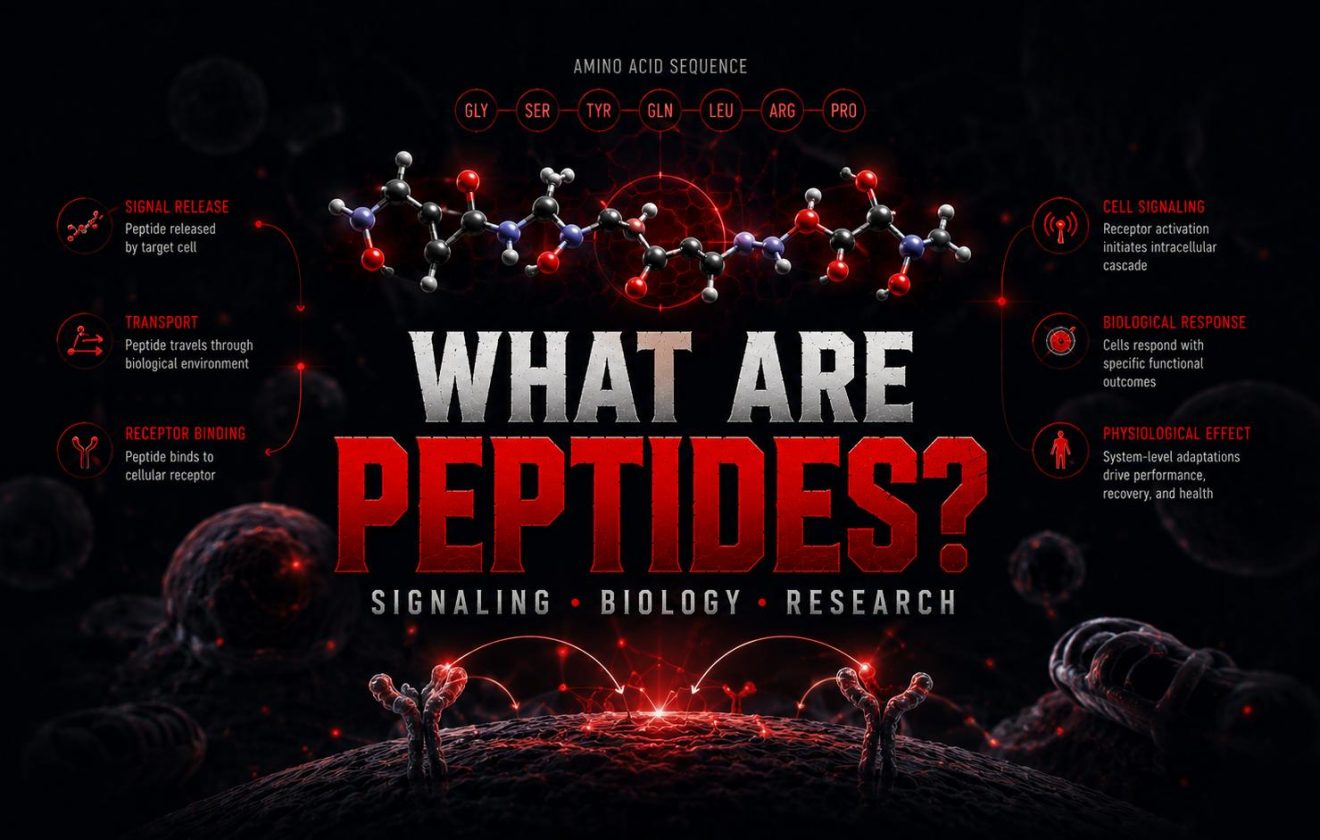
The signaling molecules, explained simply
What are peptides? They are short chains of amino acids that the body uses as biological signals - precise messengers that coordinate hormone release, tissue repair, immune response, and cellular communication. Every major hormonal system in human physiology depends on peptides in some form. Understanding what peptides are at a structural and functional level is the foundation for reading any research claim about their effects accurately.
A clear example is rusfertide, a hepcidin-mimetic peptide now in late-stage FDA review for a red-blood-cell disorder.
What Are Peptides: Three Core Concepts
Before examining any specific compound, three foundational concepts define what peptides are and how they behave. Every research claim about a peptide connects back to one or more of these principles.
Amino Acid Chains
What are peptides structurally? They are molecules formed by linking amino acids through peptide bonds - the same building blocks as proteins, but in shorter chains. Chain length determines classification: fewer than 50 amino acids is generally a peptide; longer chains are proteins. This structural distinction controls how the molecule is transported, metabolized, and how it interacts with cell surface receptors.
Receptor-Mediated Signaling
What are peptides doing in the body? They are signaling. Peptides bind to specific receptors on cell surfaces and trigger defined biological responses - from initiating hormone release to activating tissue repair pathways. This receptor specificity distinguishes peptides from compounds that act more broadly across tissues. Knowing the exact receptor target is the starting point for evaluating any peptide research claim.
Endogenous Origin
Most peptides studied in health and performance research are synthetic analogs of molecules the body already produces. Insulin is a peptide. Growth hormone assembles from a peptide precursor. GLP-1 analogs are peptide-based drugs with robust clinical trial data. Before asking what are peptides capable of in any research compound, the correct first question is: what does the naturally occurring version do, and does human clinical data support the analog claim?
What This Guide Covers
Covered in This Guide
- What peptides are at a structural and biochemical level
- How peptides function as signaling molecules - receptor binding and cascades
- The main peptide categories in health and performance research
- How peptides differ mechanically from anabolic steroids
- Common misconceptions about what peptides are and what research supports
- How to evaluate a peptide research claim accurately
Not Covered Here
- Individual compound profiles - covered in dedicated guides
- Dosing and reconstitution - see the Peptide Dosage Calculator
- Peptide sourcing, purity testing, or legal status
- Stacking or combination protocols
- Growth hormone replacement therapy - see the TRT hub
Starting point. This guide is the foundational reference for the Peptides hub. For dosing math, see the Peptide Dosage Calculator. For study design context, see the Research hub.
This guide covers six topics on what are peptides and how they work. Use the links below to navigate directly to any section.
What Are Peptides at a Molecular Level
What are peptides, precisely? A peptide is a molecule composed of two or more amino acids joined by peptide bonds - covalent links formed between the carboxyl group of one amino acid and the amino group of the next. The sequence of amino acids determines which receptor the peptide binds to and what biological response it triggers. Understanding what peptides are at this structural level is the entry point for interpreting any specific compound research claim.
What are peptides when classified by size? Dipeptides contain two amino acids; tripeptides contain three. Oligopeptides range from four to approximately twenty residues. Polypeptides extend to around fifty amino acids, and beyond fifty residues the molecule is generally classified as a protein. Most compounds discussed under the label of performance peptides fall into the oligopeptide to polypeptide range - large enough to have receptor selectivity, short enough to be synthesized in a laboratory.
What are peptides in terms of biological origin? The body does not synthesize most active peptides directly. It builds a larger precursor protein - a prohormone or prepropeptide - and then cuts it enzymatically at specific sites to release the active fragment. Insulin comes from a precursor called proinsulin; growth hormone-releasing hormone (GHRH) is cleaved from a larger prohormone. Synthetic analogs in research mimic these active cleaved fragments rather than the full precursor.
The Peptide Bond
The peptide bond is the covalent link between amino acids in a chain. It forms through a condensation reaction - one water molecule is released per bond. This bond is rigid and planar, giving each chain a defined backbone geometry. That geometry, combined with each amino acid's side chain, determines how what peptides are folded and which receptor binding surfaces they present.
Chain Length and Category
What are peptides in the performance research context? Mostly polypeptides in the 20-40 residue range - large enough for receptor selectivity, short enough to be synthesized and chemically modified for research. Shorter peptides degrade faster in circulation because proteases encounter more cleavage sites. This metabolic instability is why synthetic research analogs are often modified at specific residue positions to extend their biological window.
Precursor Cleavage
The body controls peptide availability through precursor processing. One gene can encode a prohormone that different tissues cleave into different active peptides depending on which local enzymes are present. Post-translational modifications - phosphorylation, amidation, glycosylation - further tune the activity of each released fragment. This precision is why endogenous peptide signaling is highly tissue-specific and context-dependent.
Half-Life and Degradation
Most naturally occurring peptides have plasma half-lives of minutes because circulating proteases rapidly cleave them. This short window is a design feature - it allows the body to terminate signals precisely. Synthetic peptides used in research are often modified at specific residue positions to resist protease cleavage. This modification changes what peptides are doing pharmacokinetically relative to the natural sequence the compound is based on.
Synthetic vs. endogenous. Research documents typically refer to synthetic analogs - laboratory chains that mimic a natural sequence with added chemical modifications for stability. The synthetic version may have a longer half-life or greater receptor affinity than its endogenous counterpart. These differences explain why what peptides are described as doing in laboratory settings may diverge from what the natural version does in normal physiology.
What Are Peptides Doing: How They Signal Through Receptors
What are peptides doing once they reach their target tissue? They bind to specific receptors on cell surfaces - initiating, amplifying, or terminating biological processes through defined intracellular cascades. This receptor-mediated mechanism is the defining feature of what peptides are as a molecular class. Understanding the receptor target of any given compound is the prerequisite for evaluating what that compound is actually reported to do.
Most peptides act through G protein-coupled receptors (GPCRs) - the largest family of cell surface receptors in the human body. When a peptide binds its cognate GPCR, the receptor changes conformation and activates an intracellular G protein. The activated G protein triggers a second messenger cascade - typically cyclic AMP, calcium, or phospholipid signaling - that ultimately alters gene expression, enzyme activity, or cellular behavior.
The cascade amplifies the original signal significantly. One peptide binding one receptor can initiate thousands of downstream molecular events. What are peptides able to trigger at low concentrations depends entirely on receptor density and G protein coupling efficiency at the target site. This amplification explains why even trace concentrations of peptide hormones produce significant physiological effects - and why dose-response relationships in peptide research are often non-linear.
Some peptides act through receptor tyrosine kinases (RTKs) instead of GPCRs. Insulin, IGF-1, and growth hormone all use RTKs, which autophosphorylate upon ligand binding and initiate phosphorylation cascades connected to mTOR signaling and protein synthesis. Understanding which receptor class a compound targets determines what are peptides in that class capable of producing - and why animal data from one tissue type does not automatically predict effects in a different human tissue.
Receptor Binding
What are peptides doing at the receptor level? They bind surface receptors - primarily GPCRs or RTKs - with selectivity determined by amino acid sequence. A growth hormone secretagogue binds the ghrelin receptor; a healing peptide targets entirely different receptor systems. Receptor identity drives all downstream effects, which is why two compounds both called peptides can have completely unrelated biological profiles and risk profiles.
Signal Cascade
Receptor binding initiates an intracellular cascade - G protein activation triggers second messenger production (cAMP, calcium, IP3), which changes gene transcription or enzyme activity. The cascade amplifies the initial signal: one receptor activation event can drive thousands of downstream molecular changes. This amplification explains why peptide hormones produce significant physiological effects at concentrations far below what small-molecule drugs require.
Signal Termination
Peptide signals terminate rapidly by design. Receptor desensitization, protease degradation, and negative feedback loops all limit signal duration. This tight temporal control is a fundamental feature of peptide physiology - the body uses bursts of signaling, not sustained activation. Laboratory research that bypasses these termination mechanisms may overestimate what a peptide compound produces in intact human physiology with normal clearance operating.
Local vs. systemic signaling. Not all peptides circulate systemically. Many act locally - released at a site of injury or stress and binding receptors in the same tissue without entering general circulation. Subcutaneous injection does not replicate this spatial precision. What peptides are able to achieve when injected systemically depends on whether the compound reaches the target tissue at sufficient concentration after passing through the bloodstream.
What Are Peptides by Research Class
Not all peptides are the same, and treating them as one category is one of the most common errors in interpreting performance research. What are peptides categorized into, broadly? Four research classes appear consistently in health and performance literature, each with distinct receptor targets, biological functions, and evidence bases.
What are peptides in each class capable of is a different question for each group. A compound may appear in more than one category depending on the research context. The classification below reflects how compounds are grouped by their primary studied effects - not by chemical structure alone.
Growth Hormone Secretagogues
What are peptides in this class? They are compounds that act on the ghrelin receptor or GHRH receptors to stimulate endogenous GH release from the pituitary. They do not provide exogenous GH - they signal the pituitary to produce more of its own. Examples include GHRP-2, GHRP-6, ipamorelin, and the GHRH analog CJC-1295. Clinical research is limited, predominantly in older adults or GH-deficient patients, and does not automatically transfer to healthy populations.
Healing and Repair Peptides
What are peptides in this class? They are compounds studied for effects on tissue repair, inflammation modulation, and wound healing. BPC-157, a partial sequence of the gastric pentadecapeptide, is the most widely referenced example. TB-500, a synthetic fragment of thymosin beta-4, is another. Most research is conducted in rodent injury models. Human clinical data remains sparse, and the translation gap between animal findings and human outcomes is substantial.
Metabolic Peptides
What are peptides in this category? They are compounds that influence energy balance, appetite signaling, insulin sensitivity, or fat metabolism. GLP-1 receptor agonists - including semaglutide - are peptide-based drugs with extensive randomized controlled trial data in humans. Older research compounds in this space, such as GH fragment 176-191, have data primarily from animal models. Evidence quality varies enormously within this class.
Cosmetic and Skin Peptides
What are peptides in cosmetic research? They are short chains - tripeptides or tetrapeptides - applied topically to stimulate collagen synthesis or modulate skin inflammation. Compounds like palmitoyl pentapeptide-4 and GHK-Cu appear in both cosmetic formulations and in vitro studies. Topical peptides face a fundamental delivery barrier: intact skin limits absorption of charged, water-soluble molecules, which constrains how much cell culture data applies to real-world product performance.
Evidence quality is not uniform across classes. GLP-1 receptor agonists have years of RCT data in humans. Most research-only GH secretagogues and healing peptides have data primarily from animal models. When evaluating what peptides are capable of in any specific application, the first question is always: in what model was this studied, and does that model reliably predict human outcomes?
What Are Peptides vs. Anabolic Steroids: How They Differ
A common error in performance research discussions is treating peptides and anabolic steroids as variations of the same concept. What are peptides relative to steroids? They are fundamentally different classes of molecules - different structures, different mechanisms of action, different pharmacokinetics, and different evidence frameworks. Conflating them leads to applying the wrong evaluation criteria to both.
Anabolic steroids are synthetic derivatives of testosterone - small, lipid-soluble molecules that cross cell membranes and bind intracellular androgen receptors. The receptor-steroid complex translocates to the nucleus and directly alters gene transcription across multiple tissues simultaneously. This broad, systemic mechanism produces well-documented effects on the HPG axis, lipids, hematocrit, and liver enzymes - all of which require structured bloodwork monitoring. The suppression mechanism is direct and predictable, which is why post-cycle therapy is a defined clinical intervention.
What are peptides doing differently? They are water-soluble molecules that do not cross cell membranes freely. They bind surface receptors and signal through second messenger cascades rather than acting on nuclear transcription. Their effects are generally more tissue-specific, their half-lives shorter, and their impact on the HPG axis varies by class. Most healing peptides operate through receptor systems with no documented androgen receptor involvement. What peptides are not doing, in most research contexts, is suppressing endogenous testosterone the way anabolic steroids do.
Water vs. Fat Soluble
Peptides are water-soluble and circulate in plasma. Anabolic steroids are lipid-soluble and bind sex hormone-binding globulin and albumin in circulation. This difference determines how each class is absorbed, distributed, and eliminated. It also explains why peptides require subcutaneous injection into aqueous solution while many oral steroids are chemically modified to survive first-pass liver metabolism.
Surface vs. Nuclear Receptor
What are peptides targeting mechanically? Surface receptors - GPCRs and RTKs - that trigger intracellular cascades without the peptide entering the nucleus. Steroids bind intracellular androgen receptors that act directly on DNA. This means different HPG axis effects, different organ-specific risks, and different monitoring requirements. The research frameworks appropriate for steroids do not automatically apply to peptides.
Minutes vs. Days
Most naturally occurring peptides have plasma half-lives of minutes. Synthetic analogs extend this to hours. Esterified anabolic steroids have half-lives measured in days - testosterone enanthate roughly 4-5 days. This pharmacokinetic gap means peptide dosing intervals, onset of effects, and washout periods are structurally different from steroid cycle pharmacology. Applying steroid-cycle logic to peptide research protocols produces consistently incorrect interpretations.
4 Misconceptions About What Peptides Are
These four misconceptions appear consistently in how what peptides are - and what they do - gets framed outside of clinical research contexts.
- Mistake 1
Assuming Animal Data Predicts Human Effects
The majority of what peptides are reported to do in performance contexts comes from rodent studies - often acute injury models in healthy animals, not chronic use in humans. What are peptides demonstrating in a rat tendon model? A localized angiogenic and repair response under controlled laboratory conditions. Whether the same outcome occurs in a human with normal immune function, active gut peptidases, and different tissue receptor density is not a question animal data can answer. The translation gap is real and consistently underacknowledged.
- Mistake 2
Treating Research Chemical Status as Safety Evidence
"Research chemical" is a regulatory classification, not a safety endorsement. It means the compound has not completed the clinical trial process required for pharmaceutical approval - not that it has been tested and found safe. Purity, sterility, and accurate concentration in underground-market peptides are not verified by any independent standard. The absence of a documented adverse event record in an unapproved compound reflects the absence of systematic monitoring, not the absence of risk.
- Mistake 3
Conflating All Peptides into One Category
What are peptides as a group? A structurally defined class - amino acid chains - but shared structure does not mean shared function. A GLP-1 analog with years of RCT data and a research-only healing peptide studied only in rat ligaments are both peptides in the same way that aspirin and chemotherapy are both pharmaceuticals. The category label carries no information about mechanism, evidence quality, or appropriate use context. Each compound requires individual evaluation.
- Mistake 4
Ignoring Receptor Availability at the Target Site
What are peptides able to do at a given site depends entirely on whether the target receptor is expressed there at meaningful levels. A GH secretagogue only produces GH release if functional ghrelin receptors are present. A healing peptide injected subcutaneously must reach the injured tissue at sufficient concentration - which depends on biodistribution, local blood flow, and metabolic stability in transit. Research that delivers a compound directly into a specific tissue tells us almost nothing about what happens when the same compound is injected systemically.
Primary Research Sources
Peer-reviewed references from PubMed and NCBI used to verify the biological mechanisms, classification criteria, and pharmacological distinctions in this guide.
- Muttenthaler M, King GF, Adams DJ, Alewood PF. Trends in peptide drug discovery. Nat Rev Drug Discov. 2021;20(4):309-325. PMID 33536635
- Parlak Khalily M, Soydan M. Peptide-based diagnostic and therapeutic agents: where we are and where we are heading. Chem Biol Drug Des. 2023;101(3):772-793. PMID 36366980
- Bhat US, et al. Neuropeptides and behaviors: how small peptides regulate nervous system function and behavioral outputs. Front Mol Neurosci. 2021;14:786471. PMID 34924955
- Hegde RS, Bernstein HD. The surprising complexity of signal sequences. Trends Biochem Sci. 2006;31(10):563-571. PMID 16919958
- von Eggelkraut-Gottanka R, Beck-Sickinger AG. Biosynthesis of peptide hormones derived from precursor proteins. Curr Med Chem. 2004. PMID 15544467
What Are Peptides: The Core Framework
What are peptides, reduced to their essential definition? They are short amino acid chains that the body uses as biological signals - precise messengers that coordinate hormone release, tissue repair, appetite regulation, and immune response. Understanding what peptides are at a structural level is the prerequisite for reading any specific compound claim accurately.
What are peptides capable of in a research context? That question depends entirely on which compound is being discussed, which receptor it targets, in what model the research was conducted, and whether findings in that model have been replicated in humans. The label "peptide" provides structural information only - it carries no evidence of efficacy, safety, or clinical applicability.
The guides that follow in the Peptides hub apply this framework to specific classes and compounds. Each guide identifies the receptor target, the research model, the evidence quality, and the gap between animal data and human clinical outcomes. Before moving to individual compound guides, the Peptide Dosage Calculator covers reconstitution math and the Research hub covers study design context for evaluating what peptides are reported to do versus what is actually confirmed.
For Educational Purposes Only
This guide is produced for educational and harm-reduction purposes. MuscleScience.org does not sell, recommend, or endorse any compound. All content reflects a summary of published research and does not constitute medical advice.
Peptide compounds described as research chemicals are not approved for human use by regulatory agencies. Consult a licensed physician before making any decisions about health, hormones, or pharmacological compounds.
All author names are editorial pseudonyms. See the full site disclaimer and about page for editorial policy and anonymity disclosure.
Before reading any peptide guide, see peptide research vs human use.