Calories and Energy Balance: How Weight Change Actually Works
Why weight really goes up or down
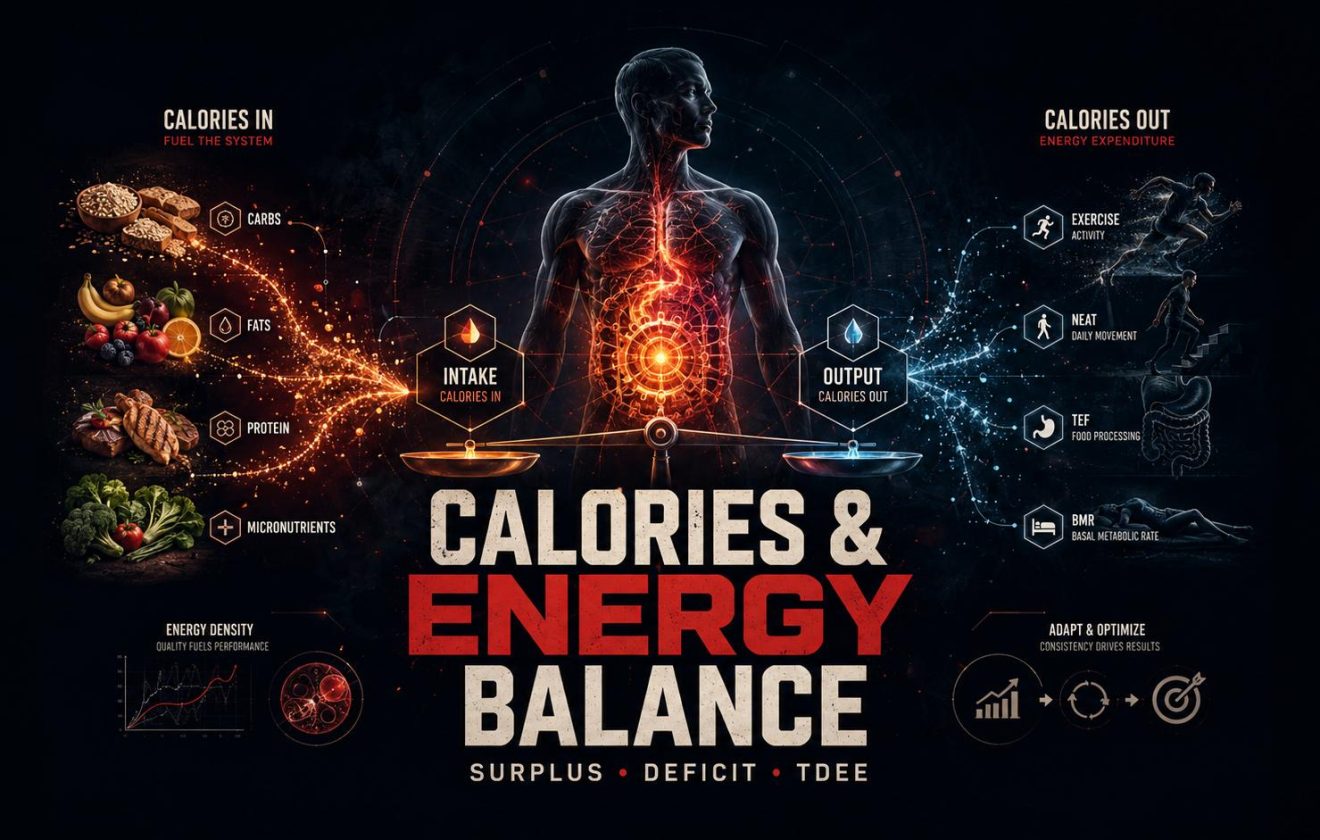
Energy balance is the relationship between calories consumed and calories burned. When intake exceeds expenditure, weight increases. When expenditure exceeds intake, weight decreases. Every diet, bulking protocol, and cutting phase operates through this single mechanism - and understanding its components is the foundation of physique nutrition.
Energy Balance: Three Principles That Drive Every Diet
Before reading further, these three principles define how energy balance operates in practice.
Calories In vs Calories Out
Energy balance has two sides: intake (food and drink consumed) and expenditure (basal metabolism, physical activity, digestion, and non-exercise movement). The difference between these two numbers determines whether you gain, lose, or maintain weight over time. No diet approach bypasses this relationship - low-carb, intermittent fasting, and high-protein diets all work by influencing one or both sides of the energy balance equation. The mechanism is the same regardless of the dietary strategy applied.
Weight Change Is a Rate, Not a Switch
Energy balance operates over time, not meal-to-meal. A single day of excess eating does not produce meaningful fat gain any more than a single day of restriction produces fat loss. What matters is the sustained difference between intake and expenditure across days and weeks. A consistent daily surplus of 300-500 calories produces slow, controlled muscle-building conditions. A consistent daily deficit of 300-500 calories produces steady fat loss. Inconsistent energy balance - high one day, low the next - produces inconsistent results regardless of the weekly average.
Expenditure Is Not Fixed
The output side of energy balance adapts. When calories are reduced for extended periods, total daily energy expenditure decreases through multiple mechanisms - reduced metabolic rate, decreased non-exercise movement, and hormonal adaptations that increase hunger and reduce energy output. This adaptive response is called adaptive thermogenesis. It explains why fat loss slows over time at the same calorie deficit, why maintenance calories after a diet are often lower than before, and why rigid calorie targets need periodic adjustment to remain effective.
What This Guide Covers
Covered in This Guide
- What energy balance is and the two sides of the equation
- The four components of total daily energy expenditure (TDEE)
- How calorie surplus supports muscle gain and what rate to target
- How calorie deficit drives fat loss and how large a deficit to use
- Why calorie counts from labels and apps are estimates, not exact figures
- How adaptive thermogenesis changes energy balance during prolonged dieting
- How to set a starting calorie target and adjust it based on results
- 5 common mistakes when applying energy balance in practice
Not Covered Here
- Macronutrient targets - covered in the Protein Intake and Carbs for Training guides
- Meal timing - covered in the Meal Timing guide
- Supplement use for fat loss or muscle gain - covered in the Supplements hub
- How steroids affect energy balance and body composition - covered in Steroids hub
- Specific diet protocols (keto, IF, carnivore) - not the focus of this foundational guide
Related tools and guides. Use the Calorie and TDEE Calculator to estimate your maintenance calories and set a starting target. For the training side of energy expenditure, see the Training hub. For how nutrition changes across phases, see the Bulking vs Cutting Nutrition guide in the Nutrition hub.
Six topics covering how energy balance works, what determines it, and how to apply it for muscle gain and fat loss.
What Energy Balance Actually Measures
Energy balance is the net difference between the calories your body takes in and the calories it uses. When this difference is zero - when intake matches expenditure - body weight remains stable. When intake exceeds expenditure, the surplus is stored, primarily as body fat, with some contribution to lean tissue under conditions that support muscle protein synthesis. When expenditure exceeds intake, the body draws on stored energy to cover the shortfall, with the composition of what is lost depending on training stimulus, protein intake, and the size of the deficit.
The relationship is grounded in thermodynamics and is not meaningfully disputed in nutrition science. What is frequently misunderstood is the precision implied by the equation. Saying "calories in equals calories out" describes a real mechanism - it does not mean that two people eating the same number of calories will have the same body composition outcome. The equation holds, but both sides are variable, individually determined, and responsive to the conditions under which energy balance is maintained. Understanding what actually influences each side is more useful than knowing the equation exists.
Energy balance is measured in kilocalories - what is colloquially called a "calorie" on food labels. One kilocalorie is the energy required to raise one kilogram of water by one degree Celsius. The body uses this energy for every process it runs: maintaining core temperature, powering muscle contractions, synthesizing proteins, running neural activity, and operating organ systems. Total daily energy expenditure is the sum of all these processes across a full day, and it varies substantially between individuals based on body size, body composition, activity level, age, and genetics.
Intake > Expenditure
Calories consumed exceed calories burned over the measurement period. Surplus energy is stored primarily as body fat. When combined with resistance training and adequate protein, a portion of the surplus also supports muscle protein synthesis and lean mass accrual. The rate of gain depends on the size of the surplus and the training response.
Intake = Expenditure
Calories consumed match calories burned - this is maintenance. Body weight remains stable. Energy balance at maintenance can still support body recomposition in specific populations (beginners, detrained individuals, those returning from a break), but the rate of change is slower than with a controlled surplus or deficit. Maintenance is also the appropriate target during diet breaks and for long-term weight stability.
Expenditure > Intake
Calories burned exceed calories consumed. The deficit must be covered by stored energy - primarily body fat, with some lean tissue loss that increases as the deficit grows or protein intake falls. The rate and composition of weight loss is determined by the size of the deficit, protein intake, training stimulus, and the adaptive responses that reduce expenditure during prolonged restriction.
Energy balance over time, not per meal. The body does not calculate energy balance on a meal-by-meal basis. It accumulates and deploys energy over days and weeks. Short-term fluctuations in intake and body weight - driven by water retention, glycogen, and digestive contents - can mask the direction of energy balance. Tracking weight as a weekly average over 2-3 weeks provides a more accurate signal of whether intake is above, below, or at maintenance than any single day's reading.
The Four Components of Total Daily Energy Expenditure
Total daily energy expenditure - TDEE - is the sum of four distinct components. Each contributes differently to the output side of energy balance, and each responds differently to changes in diet, training, and body composition. Misunderstanding which component dominates, and which is most responsive to intervention, is one of the main reasons people misjudge their calorie needs.
TDEE is not a fixed number. It changes as body weight changes, as training volume changes, and as the body adapts to sustained calorie restriction or surplus. The TDEE estimate produced by any calculator - including TDEE-based formulas - is a starting point, not a permanent target. Actual energy balance is determined by tracking bodyweight changes relative to intake over time and adjusting accordingly.
| Component | What It Is | % of TDEE | Modifiable? |
|---|---|---|---|
| BMR | Basal Metabolic Rate - calories burned at complete rest to maintain organ function, temperature, and basic physiology | 60-70% | Partially - scales with lean mass and body weight |
| NEAT | Non-Exercise Activity Thermogenesis - calories burned through all movement that is not formal exercise: walking, fidgeting, posture, daily tasks | 15-30% | Highly variable - the most individually variable component |
| EAT | Exercise Activity Thermogenesis - calories burned during intentional, structured training sessions | 5-15% | Yes - directly controlled by training volume and intensity |
| TEF | Thermic Effect of Food - calories used to digest, absorb, and process macronutrients; protein has the highest TEF at 20-30% | 8-12% | Partially - influenced by protein intake and food composition |
Percentages are approximate ranges. Individual values vary based on body size, activity level, body composition, and dietary composition.
Why NEAT Is the Most Important Variable
NEAT - non-exercise activity thermogenesis - is the component of energy expenditure that varies most between individuals and responds most dramatically to changes in energy balance. Two people with the same body weight and exercise habits can differ by 500-1000 calories per day in NEAT alone, driven by differences in how much they move outside of structured training. This variability explains a large portion of why some people appear to maintain weight effortlessly while others gain weight on relatively low calorie intakes.
During calorie restriction, NEAT declines significantly and without deliberate effort. The body reduces spontaneous movement - people sit more, walk less, use less animated gestures, and generally move with less energy expenditure throughout the day. This reduction is not fully consciously perceived, which is why dieting individuals often report feeling tired and less active even when their formal training schedule is unchanged. The NEAT decline contributes substantially to the plateau effect that occurs during extended calorie deficits and is a key component of the adaptive response that limits sustained fat loss.
Exercise burns fewer calories than apps suggest. Fitness trackers and training apps consistently overestimate calorie burn during exercise - often by 30-50%. Structured exercise (EAT) contributes only 5-15% of total daily expenditure for most people, and the net calorie burn above resting baseline is lower than the gross figures displayed. Eating back exercise calories as estimated by a tracker is one of the most common ways people unknowingly neutralize their energy balance deficit. Use the TDEE Calculator to set a total daily target rather than adjusting intake based on individual session burn estimates.
Calorie Surplus: How Much Energy Balance Supports Muscle Growth
Building muscle requires a positive energy balance - calories consumed must exceed calories burned - but the surplus required is smaller than most people assume. Muscle tissue is metabolically expensive to synthesize, but the rate at which trained individuals can actually accrue lean mass is limited by biology, not by how aggressively they eat. Exceeding the surplus needed for muscle protein synthesis does not accelerate lean mass gains; it primarily accelerates fat gain.
For most trained individuals, a daily surplus of 200-400 calories above maintenance supports near-maximum rates of muscle growth when combined with structured resistance training and adequate protein. Beginners respond to slightly larger surpluses because their initial rate of muscle protein synthesis is higher. Advanced trainees accrue lean mass more slowly regardless of how generous their energy balance is. The surplus does not need to be large - it needs to be consistent, appropriately sized, and paired with training that provides the stimulus for muscle protein synthesis to occur.
Aggressive surpluses - often called "dirty bulking" - accelerate fat gain disproportionately to any additional muscle gain. The excess calories beyond what muscle protein synthesis can use are stored as body fat. The result is a longer, harder cutting phase later with higher muscle loss risk during the deficit. A controlled surplus with periodic tracking of body composition changes is more efficient over a full bulk-cut cycle than chasing rapid scale weight increases.
250-400 kcal Surplus
Beginners have the highest rate of potential muscle gain, and a modest energy balance surplus of 250-400 calories above maintenance is sufficient. The primary driver of muscle growth in beginners is the training stimulus, not the size of the surplus. Exceeding this range adds fat without meaningfully accelerating lean mass gain.
200-300 kcal Surplus
As training age increases, the rate of muscle gain slows and the size of the required energy balance surplus decreases. Intermediate trainees typically need 200-300 calories above maintenance. Larger surpluses produce additional fat gain with no proportional increase in lean mass because the ceiling for muscle protein synthesis per unit time is lower than in beginners.
100-200 kcal Surplus
Advanced trainees gain lean mass very slowly regardless of energy balance. A positive energy balance is still required, but a large surplus produces primarily fat gain. Advanced individuals often cycle between small surpluses and maintenance phases rather than extended aggressive bulking periods, minimizing fat accumulation relative to lean mass gained.
0.25-0.5% Bodyweight/Week
The rate of scale weight gain is the most practical indicator of whether energy balance is appropriately set during a muscle gain phase. A rate of 0.25-0.5% of bodyweight per week for intermediate and advanced trainees, and up to 0.75-1% for beginners, suggests the surplus is in a productive range. Faster gains indicate excess fat accumulation.
Calorie Deficit: How Energy Balance Drives Fat Loss
Fat loss requires a negative energy balance - expenditure must exceed intake. The rate of fat loss is determined by the size of the deficit, the composition of the diet, the training stimulus provided to the body, and the adaptive responses that reduce expenditure during prolonged restriction. All of these variables interact, which is why identical deficits can produce different rates and compositions of weight loss in different individuals.
A deficit of 300-500 calories per day below maintenance produces fat loss without triggering the aggressive adaptive responses that occur with larger deficits. This translates to approximately 0.3-0.5 kg of fat loss per week under controlled conditions. Larger deficits of 500-750 calories per day are appropriate for individuals with significant fat mass and can be used for shorter periods, but they increase the risk of lean mass loss, accelerate NEAT suppression, and are harder to sustain. Extreme deficits - below 1200 calories for women and below 1500 calories for men - typically cannot meet protein and micronutrient targets and are not recommended for physique-oriented fat loss.
Preserving Muscle During Energy Balance Deficits
Muscle retention during a calorie deficit depends on two factors more than any other: protein intake and resistance training stimulus. When energy balance is negative, the body's demand for amino acids from muscle protein breakdown increases, particularly if protein intake is insufficient to meet synthetic demands. Maintaining protein at 1.8-2.4 g per kg of bodyweight during a deficit provides the substrate needed to minimize muscle protein breakdown, even when total calorie intake is reduced. Resistance training signals the body to preserve lean mass by demonstrating that the muscle is needed - without this signal, deficit-driven weight loss includes a higher proportion of lean tissue.
Deficit size and lean mass loss risk. Moderate deficits of 300-500 calories carry lower risk of muscle loss when protein intake is adequate and training is maintained. Aggressive deficits of 750+ calories significantly increase lean mass loss risk regardless of protein intake, because the body's adaptive response increases muscle protein catabolism as an energy source. A slower fat loss rate with better body composition outcomes is generally preferable to rapid scale weight loss that includes a substantial lean mass component. Track energy balance progress by measuring waist circumference and how clothes fit alongside scale weight rather than scale weight alone.
Why Calorie Numbers Are Estimates, Not Exact Figures
Calorie counting creates an impression of precision that the underlying data does not support. Food labels are permitted to be off by up to 20% in most regulatory frameworks. The calorie values on labels are derived from bomb calorimetry or Atwater factor calculations that do not account for individual digestive efficiency, food preparation method, or fiber content. A label reading 300 calories may deliver anywhere from 240 to 360 calories depending on these factors.
Metabolic rate is equally imprecise at the individual level. TDEE calculators estimate resting metabolic rate using population-derived equations - the most commonly used formulas have margins of error of 10-15% at the individual level. Two people of the same height, weight, age, and activity level can differ by 200-400 calories in actual daily expenditure. This is not a failure of the equations; it reflects genuine biological variation in metabolic efficiency, thyroid function, gut microbiome composition, and lean mass distribution.
The practical implication is that calorie targets derived from calculators or apps are starting points, not fixed prescriptions. The correct response to this imprecision is to start with a calculated estimate, track bodyweight changes over 2-3 weeks, and adjust intake by 100-200 calories in the appropriate direction based on the observed rate of change relative to the expected rate. This feedback loop - setting energy balance targets and adjusting based on results - is more accurate than any single calculation because it uses actual body response data rather than population estimates.
Where Energy Balance Estimates Are Least Reliable
Restaurant and takeaway food carries the largest calorie estimation errors of any food source. Studies comparing actual calorie content of restaurant meals to listed values have found consistent underreporting of 10-25%, with individual meals sometimes 50% higher than listed. Mixed dishes - curries, stews, casseroles - are particularly difficult to estimate because portion composition varies significantly. Training app calorie burn estimates from cardio equipment are also known to overestimate by 15-40%, and heart rate-based calorie formulas assume a standard metabolic efficiency that individual variation frequently violates.
Adaptive Thermogenesis and Long-Term Energy Balance
Adaptive thermogenesis is the reduction in total daily energy expenditure that occurs during sustained calorie restriction, beyond what would be predicted by weight loss alone. When the body enters a prolonged negative energy balance, multiple systems respond to reduce energy output: resting metabolic rate decreases, NEAT declines substantially, thyroid hormone activity is suppressed, and leptin - the primary satiety and metabolic signaling hormone - falls. The combined effect is a meaningful reduction in the maintenance calorie level, which means a deficit that was effective initially becomes less effective over time at the same intake level.
Research suggests that adaptive thermogenesis can account for an additional 100-400 calories of suppressed expenditure beyond what weight loss alone would predict, and that this suppression can persist for months to years after a diet ends. This is a key mechanism behind weight regain after dieting - the post-diet body has a lower energy expenditure set point, meaning that returning to pre-diet intake levels now represents a positive energy balance rather than maintenance.
Practical Responses to Energy Balance Adaptation
Structured diet breaks - periods of 1-2 weeks at maintenance calories within an extended cutting phase - partially restore leptin levels, NEAT, and resting metabolic rate, reducing the cumulative depth of adaptive thermogenesis. Diet breaks are not cheat periods or unstructured eating; they are deliberate maintenance phases calculated from the current bodyweight, not the pre-diet starting point. Reverse dieting - gradually increasing calories toward maintenance after a cut ends - is another strategy to manage energy balance adaptation and reduce the risk of rapid fat regain. Neither strategy fully eliminates adaptive thermogenesis, but both reduce its impact on the overall energy balance trajectory.
Fat loss plateaus are usually adaptive, not calculational. When weight loss stalls on an unchanged calorie intake, the most likely explanation is that energy balance has shifted because expenditure has decreased - not that the calorie target was wrong from the start. The correct response is to reduce intake by 100-200 calories, increase structured activity moderately, or implement a short maintenance phase before resuming the deficit. Dramatically slashing calories in response to a plateau accelerates adaptive thermogenesis rather than correcting it. Sustainable energy balance management means adjusting incrementally and giving the body 2-3 weeks to show a response before making further changes.
5 Energy Balance Mistakes That Stall Progress
- Mistake 01
Using App Calorie Burn Estimates to Justify Extra Intake
Fitness apps and cardio equipment displays consistently overestimate calorie burn during exercise. Using these estimates to eat back calories after training is one of the most common ways people eliminate a calorie deficit without realizing it. The energy balance math looks correct - deficit set, exercise calories eaten back - but the actual net balance is neutral or positive because the burn estimate was inflated. Set a total daily calorie target based on an activity-adjusted TDEE calculation and stay within it regardless of individual session data from apps or equipment.
- Mistake 02
Treating the First Week of Deficit Weight Loss as Fat Loss
Starting a calorie deficit typically produces a large initial drop in scale weight - often 1-3 kg in the first week. Most of this is glycogen depletion and the associated water loss (glycogen stores approximately 3-4 g of water per gram), plus reduced digestive content from lower food volume. This is not energy balance-driven fat loss, and it does not represent the rate at which fat will be lost going forward. Using first-week weight changes to calibrate calorie targets produces a distorted picture. Use week 2-4 averages to assess whether energy balance is set appropriately.
- Mistake 03
Applying the Same Calorie Target Indefinitely
As body weight decreases, TDEE decreases - both because there is less mass to maintain and because of adaptive thermogenesis. A calorie target that created a 400-calorie deficit at 90 kg may create no meaningful deficit at 80 kg, because the baseline energy balance calculation has shifted. Recalculate maintenance calories every 4-6 kg of weight loss and adjust the target accordingly. Failure to do this is why many dieting individuals experience progressive slowdowns in fat loss over a long cut despite no change in behavior.
- Mistake 04
Ignoring Liquid Calories in Energy Balance Tracking
Beverages - protein shakes, coffee drinks, juice, alcohol, sports drinks - contribute meaningfully to total calorie intake but are frequently omitted from tracking because they do not feel like "food." Alcohol carries 7 calories per gram and is particularly easy to undercount because serving sizes are variable and social drinking occasions make accurate tracking difficult. A single evening with two or three drinks, a coffee with milk, and a protein shake not logged can add 400-700 untracked calories, fully neutralizing a day's energy balance deficit without any deliberate food choices being responsible.
- Mistake 05
Confusing Scale Weight Fluctuation with Energy Balance Change
Day-to-day scale weight fluctuates by 1-3 kg based on factors unrelated to energy balance: dietary sodium, water intake, menstrual cycle phase, training volume, sleep quality, and digestive contents. A single high-sodium meal can add apparent weight gain of 1-2 kg overnight through water retention. Interpreting these fluctuations as real fat gain or fat loss leads to unnecessary and counterproductive calorie adjustments. Track weekly averages over 2-3 weeks and use the direction of the trend - not individual daily readings - as the signal for whether energy balance adjustments are needed.
Published Research on Energy Balance
- Hall KD, Heymsfield SB, Kemnitz JW, Klein S, Schoeller DA, Speakman JR. Energy balance and its components: implications for body weight regulation. Am J Clin Nutr. 2012;95(4):989-994. pubmed.ncbi.nlm.nih.gov/22434603
- Pontzer H, et al. Constrained total energy expenditure and metabolic adaptation to physical activity in adult humans. Curr Biol. 2016;26(3):410-417. pubmed.ncbi.nlm.nih.gov/26832439
- Rosenbaum M, Leibel RL. Adaptive thermogenesis in humans. Int J Obes (Lond). 2010;34 Suppl 1:S47-S55. pubmed.ncbi.nlm.nih.gov/20935667
- Levine JA. Non-exercise activity thermogenesis (NEAT). Best Pract Res Clin Endocrinol Metab. 2002;16(4):679-702. pubmed.ncbi.nlm.nih.gov/12468415
- Dhurandhar NV, et al. Energy balance measurement: when something is not better than nothing. Int J Obes (Lond). 2015;39(7):1109-1113. pubmed.ncbi.nlm.nih.gov/25394308
Energy Balance Is the Foundation - Everything Else Is Context
Every approach to changing body composition - whether for muscle gain, fat loss, or maintenance - operates through the mechanism of energy balance. Calories consumed versus calories burned is not one variable among many; it is the primary variable, and all other nutritional and training choices exist within it. Understanding the four components of expenditure, how adaptive thermogenesis shifts the equation over time, and why calorie counts are estimates rather than precise figures gives you a more accurate and adaptable framework than any rigid diet protocol can provide.
The most practical implementation of energy balance is simple in structure: estimate your maintenance calories, apply a conservative surplus or deficit appropriate to your goal and training level, track scale weight as a weekly average over 2-3 weeks, and adjust intake by 100-200 calories in the appropriate direction based on observed results. This feedback-based approach is more accurate than static calculations because it uses your actual body response as the measurement tool.
- Calorie and TDEE Calculator - estimate your maintenance calories and set a starting surplus or deficit target
- BMI and Body Fat Calculator - assess body composition context alongside energy balance tracking
- Fitness Calculators Hub - all calculation tools for training and nutrition in one place
- Nutrition Hub - complete library of nutrition guides covering protein, carbs, fats, and meal timing
- Training Hub - how resistance training interacts with energy balance for muscle gain and fat loss
- Supplements Hub - evidence-based context on supplements that interact with body composition goals
- Bloodwork and Health Hub - metabolic markers relevant to long-term diet and body composition health
- Peptide Dosage Calculator - dosing reference for research peptides discussed in the education library
- Start Here - overview of all educational content and how to navigate the site
- Ethan Walker - Training and Nutrition Editor - author profile and editorial scope
For Educational Purposes Only
This article discusses calories, energy balance, and body composition for educational purposes. The information provided reflects published nutritional science research and is intended to support informed decision-making about diet and training. It does not constitute medical or dietary advice and is not a substitute for consultation with a qualified physician, registered dietitian, or other licensed healthcare professional.
MuscleScience.org does not sell any compounds, supplements, or products. All author names are pseudonyms. Author photographs are stylized portraits, not images of real individuals. See our About page and Disclaimer for full disclosure on editorial policy and anonymity.