Meal Timing Explained: When and How Often to Eat for Muscle and Performance
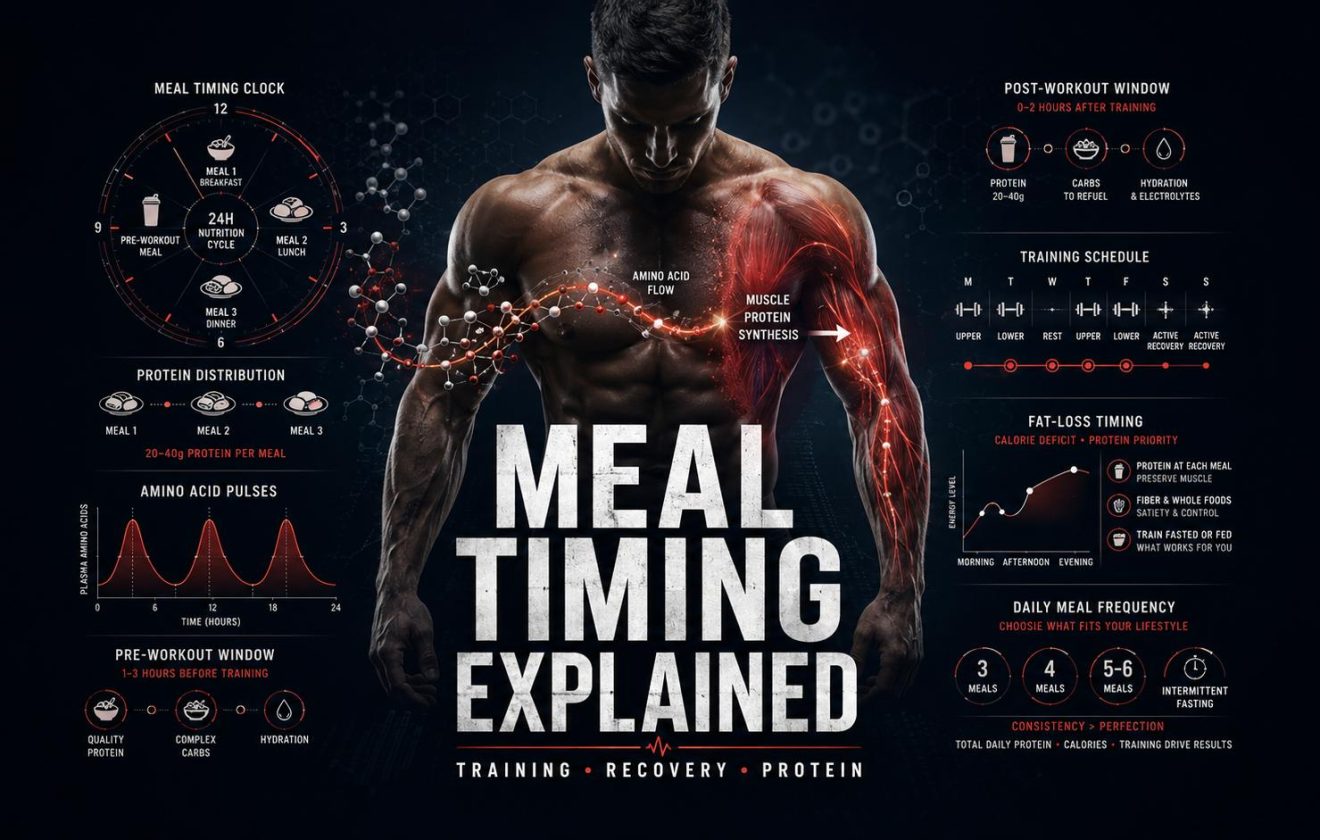
When and how often eating really matters
Meal timing determines when muscle protein synthesis is elevated, when glycogen replenishment is most efficient, and how feeding patterns align with circadian metabolic rhythms. It is not the most important nutrition variable - calorie balance, protein intake, and carbohydrate allocation all rank higher - but in the right context, meal timing produces measurable differences in training adaptation, recovery speed, and body composition outcomes that cannot be achieved by total macronutrient targets alone.
Meal Timing: Three Evidence-Based Principles
Three principles that define what meal timing controls, what the research confirms, and where it ranks in the nutrition priority hierarchy.
Timing Amplifies - It Does Not Replace
Meal timing produces real but secondary effects on muscle protein synthesis, recovery, and body composition. It amplifies the results of a well-constructed nutrition plan but cannot compensate for insufficient total protein, a calorie surplus or deficit that is off target, or inadequate carbohydrate for the training load. Trainees who have not yet dialled in their total macronutrient targets will gain more from fixing those fundamentals than from optimising meal timing. For trainees whose intake is already accurate, the meal timing layer adds a measurable but modest advantage.
The Anabolic Window Is Wider Than Believed
The concept of a narrow 30-to-60-minute anabolic window after training - in which protein must be consumed or muscle growth is blunted - is not supported by current evidence. Meal timing research places the effective post-workout window at 4-5 hours for individuals who ate a protein-containing meal 2 hours before training, and at 1-2 hours for those who trained fasted or more than 3 hours after their last meal. The urgency of peri-workout nutrition scales with the interval between the last protein meal and the session, not with the session itself.
Protein Distribution Matters More Than Window Precision
Of the variables within meal timing, protein distribution across the day - how many meals contain protein and whether doses are evenly spread - has stronger evidence for impact on 24-hour muscle protein synthesis than minute-level precision around training. Research consistently shows that 3-5 evenly distributed protein meals per day produces greater 24-hour MPS than the same daily protein consumed in fewer, larger doses. Getting protein into each feeding occasion, and spacing those occasions across the full day, is a more effective meal timing strategy than fixating on the exact minutes around a workout.
What This Guide Covers
Covered in This Guide
- What meal timing actually controls - MPS windows, glycogen replenishment, circadian metabolism
- Pre and post workout feeding windows with evidence-based time ranges
- Optimal protein distribution: how many meals, what dose per meal
- How training goals - muscle growth vs fat loss - affect the timing priority
- How meal frequency and feeding structure shift between bulking and cutting phases
- 5 common mistakes that undermine the training nutrition window
Not Covered Here
- Total calorie targets - covered in the Calories and Energy Balance guide
- Daily protein targets - covered in the Protein Intake guide
- Carbohydrate amounts for training - covered in the Carbs for Training guide
- Fat intake and hormonal health - covered in the Dietary Fats and Hormones guide
- Supplement timing (creatine, pre-workouts) - covered in the Supplements hub
- Clinical eating disorder management - consult a registered dietitian
Where timing fits in the hierarchy. Before applying meal timing recommendations, confirm that daily protein (1.8-2.4 g/kg), total calories, and training carbohydrate targets are accurate. Read the Protein Intake guide and the Carbs for Training guide first. Meal timing built on top of accurate intake compounds the results. Meal timing layered onto inaccurate intake does not fix the underlying problem.
Six topics covering what meal timing controls, the training window, protein distribution, goal-specific strategies, phase management, and common errors.
What Meal Timing Actually Controls
Meal timing operates through three distinct physiological mechanisms, each with a different time scale and a different level of evidence for practical impact. Understanding what meal timing controls - and what it does not - prevents the common errors of both over-engineering peri-workout nutrition and ignoring the feeding window entirely. The variable sits fourth in the nutrition priority hierarchy, below calorie balance, protein sufficiency, and macronutrient composition, but it is not trivial: for trained individuals with accurate intake targets, optimising the feeding structure can meaningfully improve muscle protein synthesis efficiency and training recovery.
The first mechanism controlled by meal timing is the muscle protein synthesis window. Each protein-containing meal stimulates an acute period of elevated MPS that lasts approximately 3-5 hours before returning to baseline, regardless of whether additional amino acids are circulating. This refractory period - during which a second protein dose produces little additional MPS stimulation - means that frequent, evenly spaced protein meals are more effective than infrequent large doses at maximising the cumulative anabolic signal over a full day. Meal timing within the peri-workout period matters because training itself creates a period of enhanced MPS sensitivity that can be exploited or missed depending on when protein is consumed relative to the session.
The second mechanism is glycogen resynthesis. Muscle glycogen replenishment occurs most efficiently in the 2-4 hours immediately after training, when exercise-induced GLUT4 transporter upregulation enables insulin-independent glucose uptake into muscle cells. Meal timing carbohydrate within this window accelerates glycogen restoration - which matters most for athletes training twice per day, those with less than 24 hours between sessions, and high-volume programmes where incomplete glycogen recovery limits subsequent session quality. For trainees with 48 hours between sessions for the same muscle group, post-workout carbohydrate timing is substantially less critical because glycogen restores fully with any meal pattern over that interval. The third mechanism is circadian metabolic alignment - the matching of meal timing to the body's internal clock - which affects insulin sensitivity, fat oxidation, and hormonal rhythm independently of macronutrient content.
Muscle Protein Synthesis Window
Each protein dose elevates MPS for 3-5 hours before returning to baseline - a refractory period during which additional protein produces little marginal MPS stimulation. Effective meal timing around this window means spacing protein doses 3-5 hours apart rather than concentrating intake in one or two meals. Training enhances MPS sensitivity for several hours post-session, making the peri-workout window an opportunity to exploit rather than miss. For trainees who ate protein 1-2 hours before training, circulating amino acids are still elevated and the post-workout urgency is reduced. For those who trained fasted or 4+ hours after their last meal, consuming protein promptly after training captures the enhanced sensitivity window.
Glycogen Resynthesis Rate
Post-exercise GLUT4 translocation to the muscle cell membrane enables rapid glucose uptake independent of insulin for 2-4 hours after training. Meal timing carbohydrate within this window - roughly 0.5-1 g/kg within 1-2 hours post-session - produces glycogen resynthesis rates of approximately 5-7 mmol/kg wet weight per hour, compared to 2-3 mmol/kg/h without timely carbohydrate. For trainees with same-day double sessions, the resynthesis window is critical. For those with 24-48 hours between training sessions for the same muscle group, any reasonable carbohydrate-containing diet will fully restore glycogen before the next session regardless of whether post-workout carbohydrate is deliberately timed.
Circadian Metabolic Alignment
The body's circadian clock regulates insulin sensitivity, cortisol, growth hormone, and substrate oxidation on a 24-hour cycle. Meal timing relative to this biological rhythm affects how the same macronutrient is processed: insulin sensitivity peaks in the morning and declines toward evening, meaning that carbohydrate consumed earlier in the day produces a smaller glycaemic response and less fat storage signal than the same carbohydrate consumed late at night. Front-loading calorie and carbohydrate intake toward the first half of the waking day aligns eating patterns with metabolic peak performance. This circadian dimension of meal timing is relevant primarily for body composition - it has less direct impact on acute training performance than peri-workout nutrition.
Meal timing in the priority stack. Fix total daily protein first, then carbohydrate for your training load, then fat floor for hormonal health. Only then does optimising the distribution and timing of those macronutrients across the day produce a return. Meal timing applied before the macronutrient targets are accurate is an investment in the wrong layer. See the full Nutrition hub at musclescience.org/nutrition for the complete sequence.
Meal Timing Around Training: The Pre and Post Workout Window
Peri-workout meal timing - what is consumed before, during, and after a training session - is the most studied and most practically relevant application of training nutrition. The core finding from current research is that meal timing relative to the last protein-containing meal before training determines how urgently post-workout nutrition is needed. The gap between the pre-workout meal and the post-workout meal defines the effective protein-depleted window, not the training session itself. A trainee who ate 40 g of protein 90 minutes before a session enters the post-workout period with amino acids still circulating and MPS still elevated - the urgency of immediate post-workout protein is low. A trainee who trained after an overnight fast or 5 hours after their last meal has a fully depleted window that should be closed promptly.
Pre-workout meal timing should target 1-3 hours before training for a full mixed meal containing protein and carbohydrate. The protein component - 0.4 g/kg or approximately 30-40 g for most trainees - primes circulating amino acid availability and initiates MPS before the session begins. The carbohydrate component provides muscle glycogen and blood glucose for session performance, with 0.5-1 g/kg being appropriate for moderate to high volume training. A smaller snack of protein plus carbohydrate can be consumed 30-60 minutes before training when a full meal is impractical, though digestion-related discomfort risk is higher the closer to the session it is eaten. For early morning training where a full pre-workout meal is not feasible, a smaller protein dose (20-25 g) immediately before training is more effective for MPS than training fully fasted.
| Training Scenario | Pre-Workout Strategy | Post-Workout Window | Priority |
|---|---|---|---|
| Trained fasted (5+ hours since last meal) | 20-25 g protein 30-60 min before, or immediately before if no time | High - consume 0.4 g/kg protein + carbs within 30-60 min post-session | High |
| Ate 1-2 hours before training | Covered - amino acids still circulating from pre-workout meal | Moderate - protein meal within 1-2 hours post-session is sufficient | Moderate |
| Ate 3-4 hours before training | Optional small protein + carb snack 30-60 min before if session is high volume | High - protein + carbs within 1 hour post-session recommended | Moderate-High |
| Back-to-back sessions (same day) | Critical - glycogen and protein must be consumed between sessions promptly | First available window between sessions; carbohydrate priority is elevated | Critical |
| Session under 60 min, not fasted | Standard pre-workout meal 1-2 hours prior is sufficient | Low urgency - standard meal within 2 hours covers both glycogen and MPS | Low-Moderate |
Post-workout carbohydrate dose: 0.5-1 g/kg for glycogen replenishment alongside protein. Higher end of the range applies for same-day double sessions or high-volume programmes with less than 24 hours between sessions. Lower end applies for moderate volume with 48-hour recovery intervals.
Meal timing and the pre vs post debate. A 2017 controlled trial by Schoenfeld and Aragon found no significant difference in hypertrophy outcomes between consuming protein before versus after training when total daily protein was equated. What mattered was having a protein-containing meal within a reasonable proximity to the session - not which side of it. Effective meal timing around training is about closing the fasted window and supplying substrate for recovery, not about hitting an exact post-workout minute. See the What Builds Muscle guide for how training stimulus and nutrition interact at the mechanistic level.
Meal Timing, Frequency, and Protein Distribution
Of all the variables within the nutrient timing framework, how protein is distributed across the day has the strongest evidence base for directly improving 24-hour muscle protein synthesis. A 2014 controlled feeding study by Mamerow et al. found that distributing daily protein intake evenly across three meals - approximately 30 g per meal - produced greater 24-hour MPS than skewed distributions where the same total protein was concentrated in one or two meals. A 2013 study by Areta et al. directly compared four feeding protocols following resistance training and found that 20 g of protein every 3 hours was superior to both more frequent smaller doses and less frequent larger doses for myofibrillar protein synthesis over a 12-hour recovery period. The practical implication is that spreading protein across 3-5 feeding occasions per day, each containing approximately 0.3-0.4 g/kg of protein, is more effective for muscle protein synthesis than consuming the same daily total in one or two larger meals.
The question of optimal feeding frequency for resistance-trained individuals converges on 3-5 protein-containing meals per day for most practical training contexts. Fewer than 3 meals per day - common in intermittent fasting protocols with compressed eating windows - limits the number of MPS peaks achievable in a 24-hour period. More than 5-6 meals per day produces diminishing returns, as each meal must contain a minimum protein threshold (approximately 0.3 g/kg) to fully stimulate an MPS episode. Small, very frequent protein doses of 10-15 g every 1-2 hours do not maintain MPS above baseline due to the refractory period, and represent a structurally inefficient feeding pattern that adds logistical complexity without proportionate anabolic return. Intermittent fasting can produce equivalent results to conventional feeding frequency when daily protein and calorie targets are met, but it compresses the available protein distribution window and requires deliberate effort to achieve adequate per-meal doses.
| Meals per Day | Protein per Meal (80 kg) | MPS Episodes / Day | Practical Assessment |
|---|---|---|---|
| 2 meals | 60-80 g per meal | 2 peaks | Suboptimal - limits cumulative daily MPS; viable only if daily protein target is met |
| 3 meals | 35-45 g per meal | 3 peaks | Effective - minimum recommended structure for maximising daily protein synthesis |
| 4-5 meals | 25-35 g per meal | 4-5 peaks | Optimal - maximises MPS opportunities; practical for trainees with structured eating schedules |
| 6+ meals | 15-22 g per meal | Limited by refractory period | Diminishing returns - doses too small to maximally stimulate MPS; adds complexity without benefit |
Based on an 80 kg individual consuming 160 g of protein per day (2 g/kg). Adjust meal protein dose proportionally. The refractory period between MPS episodes is approximately 3-5 hours; spacing meals accordingly captures each available peak.
Meal Timing for Muscle Growth vs Fat Loss
The relative importance of a structured feeding schedule shifts depending on training goal. During a calorie surplus focused on muscle gain, total macronutrient intake is adequate, glycogen stores are well-stocked, and the anabolic environment is supported by energy availability. In this context, the priority is consistency - regular protein distribution across the day, peri-workout nutrition that captures the training window, and a feeding structure that supports session performance. Precision within the minute-level timing window is less critical than reliable daily execution of the protein distribution plan.
During a calorie deficit for fat loss, the feeding structure becomes more consequential. Energy restriction impairs glycogen availability and creates a catabolic pressure on lean mass that the training stimulus and protein intake work against. In this context, placing protein and carbohydrate around the training session - particularly post-workout - has a measurable protective effect on lean mass compared to distributing the same intake without regard for session proximity. Peri-workout nutrition during a deficit is not about maximising growth; it is about minimising catabolism during the window when muscle protein breakdown is most elevated.
Consistency Over Precision
During a calorie surplus, energy availability buffers the consequences of imperfect feeding windows. Muscle protein synthesis is consistently elevated when daily protein targets are met and training stimulus is adequate. The priority in a gaining phase is to distribute protein across 3-5 meals, ensure pre-workout carbohydrate is adequate for session performance, and consume a protein-containing meal within 1-2 hours post-workout. Stressing over 15-minute window precision in this context produces negligible additional benefit.
Peri-Workout Nutrition Protects Lean Mass
In a calorie deficit, the post-workout period is the highest priority feeding window in the day. Muscle protein breakdown is elevated post-exercise and remains elevated until amino acid availability suppresses it. Consuming 0.4 g/kg protein - and ideally carbohydrate to blunt cortisol - within 1 hour of training provides the substrate needed to shift the net protein balance from catabolic to anabolic. This is where structured feeding produces its clearest return during fat loss, independent of total calorie level.
Front-Load Calories and Carbohydrate
Insulin sensitivity is highest in the morning and declines progressively through the day. Front-loading calorie and carbohydrate intake toward the first half of the waking period - larger breakfast and lunch, smaller dinner - aligns the highest-carbohydrate meals with the periods of highest glucose disposal efficiency. Research on early time-restricted feeding shows improvements in insulin sensitivity, blood pressure, and metabolic markers even without weight loss, suggesting that when you eat is independently relevant to metabolic health beyond what and how much.
Viable But Requires Deliberate Protein Structuring
Intermittent fasting compresses the feeding window to 6-10 hours per day. Research shows that IF produces equivalent body composition outcomes to conventional feeding frequency when total protein and calorie intake is equated. The practical challenge is distributing adequate protein across fewer meals in a shorter window: an 80 kg trainee needing 160 g of protein per day in a 6-hour eating window must consume protein in every meal and prioritise protein density at each feeding. Skipping the post-workout meal or under-dosing protein per meal are the most common failure points in IF for trained individuals.
On the overall feeding structure. Regardless of goal, the most consistent predictor of protein synthesis outcomes is whether daily protein targets are met and whether protein is distributed across multiple meals rather than concentrated in one or two. Get that right first. The exact scheduling around training produces a secondary improvement on top of a solid distribution baseline. See the full macronutrient framework in the Nutrition hub.
Meal Timing Across Bulking and Cutting Phases
The structural feeding demands of a gaining phase and a deficit phase differ in two meaningful ways: carbohydrate priority around training, and the consequences of missing the post-workout window. During a calorie surplus, carbohydrate availability is high and glycogen stores are reliably topped up between sessions regardless of post-workout timing precision. The training nutrition window still applies - a peri-workout protein source captures the MPS opportunity - but missing the window by an hour or two in a gaining phase has small consequences because the anabolic environment is generally supported by energy availability throughout the day.
During a calorie deficit, the training window becomes the most structurally important feeding period in the day. As total calorie intake falls, carbohydrate is typically reduced first, which compresses glycogen availability. Training in a partially depleted state is acceptable and common during a cut, but the post-workout period is where glycogen and protein restoration are most time-sensitive. Placing the largest carbohydrate serving of the day post-workout - within 1 hour of the session - combined with 0.4 g/kg protein produces the most efficient recovery and lean mass retention signal within the constraints of a restricted calorie budget. During a cut, the calories saved by skipping or delaying the post-workout meal are not worth the lean mass cost over the course of a multi-week deficit.
Across both phases, maintaining a consistent daily feeding schedule supports the circadian metabolic environment and reduces the variability in training performance that comes from irregular eating. In practical terms: establish 3-4 regular protein-containing meals per day, anchor the post-workout meal as a non-negotiable feeding occasion regardless of phase, and use carbohydrate distribution to optimise session performance in a surplus and lean mass retention in a deficit. The feeding structure should be the last variable to change between phases - not the first.
5 Meal Timing Mistakes That Limit Training Adaptation
- Mistake 01
Optimising the Window Before Fixing Total Intake
The most common error is investing effort in peri-workout precision - exact grams, exact minutes - while daily protein or calorie targets are not yet accurate. A trainee consuming 100 g of protein per day who adds a perfectly timed 30 g post-workout shake is still chronically under their protein target. The timing addition is worth approximately 5-10% of the potential adaptation gain; hitting the daily target is worth the remaining 90-95%. Fix total intake first. Structuring the distribution and the training window is the refinement layer, not the foundation. Rank Math-style nutrient timing optimisation on top of inaccurate intake is a marginal return on the wrong investment.
- Mistake 02
Treating the Anabolic Window as 30 Minutes
The 30-to-60-minute post-workout window is a persistent myth from older research that did not control for the interval since the last pre-workout meal. Current evidence places the effective post-training protein window at 4-5 hours for trainees who ate a protein-containing meal within 2 hours of starting their session. A trainee who ate chicken and rice 90 minutes before training does not need to rush to a protein shake before leaving the gym. The urgency of post-workout nutrition scales with how long ago the last protein meal was - not with how many minutes have passed since the last rep. Trainees who apply the 30-minute rule to every session regardless of context are solving a problem they often do not have.
- Mistake 03
Concentrating Daily Protein in One or Two Meals
Consuming 160 g of protein in two meals of 80 g each produces significantly lower 24-hour muscle protein synthesis than the same 160 g distributed across four meals of 40 g each. Protein above approximately 0.4-0.5 g/kg per meal does not produce additional MPS stimulation in that feeding - it is either oxidised or routed to other metabolic uses. Spreading the same total intake across more feeding occasions captures more MPS peaks per day. This error is common in intermittent fasting approaches and in eating schedules where breakfast is skipped, placing most daily protein in lunch and dinner. Adding a protein-containing breakfast - even a modest one - converts a two-peak day into a three-peak day and improves cumulative daily protein synthesis outcomes.
- Mistake 04
Skipping Pre-Workout Carbohydrate on High-Volume Training Days
Trainees who consume sufficient daily carbohydrate but skip carbohydrate in the meal before a high-volume session frequently underperform relative to their capacity. Muscle glycogen is the primary substrate for resistance training sets above 70% of 1RM. If the pre-workout meal is protein-only or very low carbohydrate, available glycogen for the session is determined entirely by the residual from previous meals - which may be adequate for a short moderate-volume session but insufficient for a high-volume lower-body or multi-muscle compound day. Placing 0.5-1 g/kg of carbohydrate in the pre-workout meal is the most reliable way to ensure glycogen availability does not limit session quality, independent of what else is consumed during the day.
- Mistake 05
Using Identical Feeding Structure Across Bulking and Cutting Phases
The optimal feeding structure shifts between phases. During a surplus, feeding occasions can be distributed more evenly across the day and the post-workout window is less critical because energy availability supports recovery regardless. During a deficit, the post-workout meal is the highest-priority feeding event of the day and carbohydrate should be preferentially placed around training rather than distributed evenly. A trainee who applies the same meal timing approach to a cut as to a bulk - for example, placing their largest carbohydrate serving at dinner regardless of training time - is missing the most impactful application of the feeding window during the phase where lean mass retention is most at risk. Adjust the feeding structure when the training phase changes, not just the macronutrient totals.
Meal Timing FAQ
Does meal timing matter for building muscle?
Is the anabolic window real?
How should I distribute protein across the day?
Published Research on Nutrient Timing and Protein Distribution
- Kerksick CM et al. International Society of Sports Nutrition position stand: nutrient timing. J Int Soc Sports Nutr. 2017;14:33. J Int Soc Sports Nutr, 2017 - PubMed
- Areta JL et al. Timing and distribution of protein ingestion during prolonged recovery from resistance exercise alters myofibrillar protein synthesis. J Physiol. 2013;591(9):2319-2331. J Physiol, 2013 - PubMed
- Schoenfeld BJ, Aragon AA et al. Pre- versus post-exercise protein intake has similar effects on muscular adaptations. PeerJ. 2017;5:e2825. PeerJ, 2017 - PubMed
- Mamerow MM et al. Dietary protein distribution positively influences 24-h muscle protein synthesis in healthy adults. J Nutr. 2014;144(6):876-880. J Nutr, 2014 - PubMed
- Sutton EF et al. Early time-restricted feeding improves insulin sensitivity, blood pressure, and oxidative stress even without weight loss in men with prediabetes. Cell Metab. 2018;27(6):1212-1221.e3. Cell Metab, 2018 - PubMed
Meal Timing: What It Controls and What It Does Not
Effective feeding structure around training produces real but secondary improvements in muscle protein synthesis, glycogen recovery, and body composition outcomes. The hierarchy is fixed: total calorie balance and daily protein targets come first, macronutrient composition comes second, and the structural layer - how intake is distributed and when relative to training - comes third. The clearest evidence supports distributing protein across 3-5 meals per day, placing protein and carbohydrate around the training session, and compressing urgency based on the interval since the last protein meal rather than treating every post-workout period as a 30-minute emergency.
During a fat loss phase, the post-workout window is the single highest-priority feeding occasion of the day and should anchor the entire eating structure. During a gaining phase, consistency of the distribution pattern matters more than precision in any individual window. Across both phases: get the total amounts right first, establish a repeatable 3-5 meal structure, place the training window deliberately, and adjust carbohydrate placement - not protein placement - when moving between phases. The return on investment from these structural adjustments is real, but only compounds on top of accurate total intake.
- Calories and Energy Balance - Set Your Daily Calorie Target Before Structuring Meals
- Protein Intake Explained - Daily Targets and Distribution for Muscle Growth
- Carbs for Training - How Carbohydrate Supports Session Performance and Glycogen
- Dietary Fats and Hormones - Fat Intake, Testosterone, and Hormonal Health
- What Builds Muscle - Mechanisms of Hypertrophy and Training Adaptation
- Cutting vs Bulking Training - How Strategy Shifts Between Phases
- Recovery and Fatigue in Training - Nutrition's Role in Managing Accumulated Stress
- TDEE Calculator - Confirm Your Calorie Target Before Structuring Intake
- Nutrition Hub - Complete Evidence-Based Nutrition Guide Series
- Fitness Calculators - Full Suite of Performance and Body Composition Tools
About This Article
Written by Ethan Walker, Training & Nutrition Editor at MuscleScience.org. Ethan covers hypertrophy training, nutrition strategy, fat loss, and recovery for performance-focused individuals. All content is educational and does not constitute medical or dietary advice. Individuals with diagnosed metabolic conditions, eating disorders, or clinical nutritional needs should consult a registered dietitian before modifying feeding structure.
MuscleScience.org does not sell supplements, meal plans, or nutrition products. No affiliate links. No sponsored content. Author identities are pseudonymous in accordance with our editorial anonymity policy, disclosed on the About page and each author profile.