Protein Intake Explained: How Much Protein You Actually Need
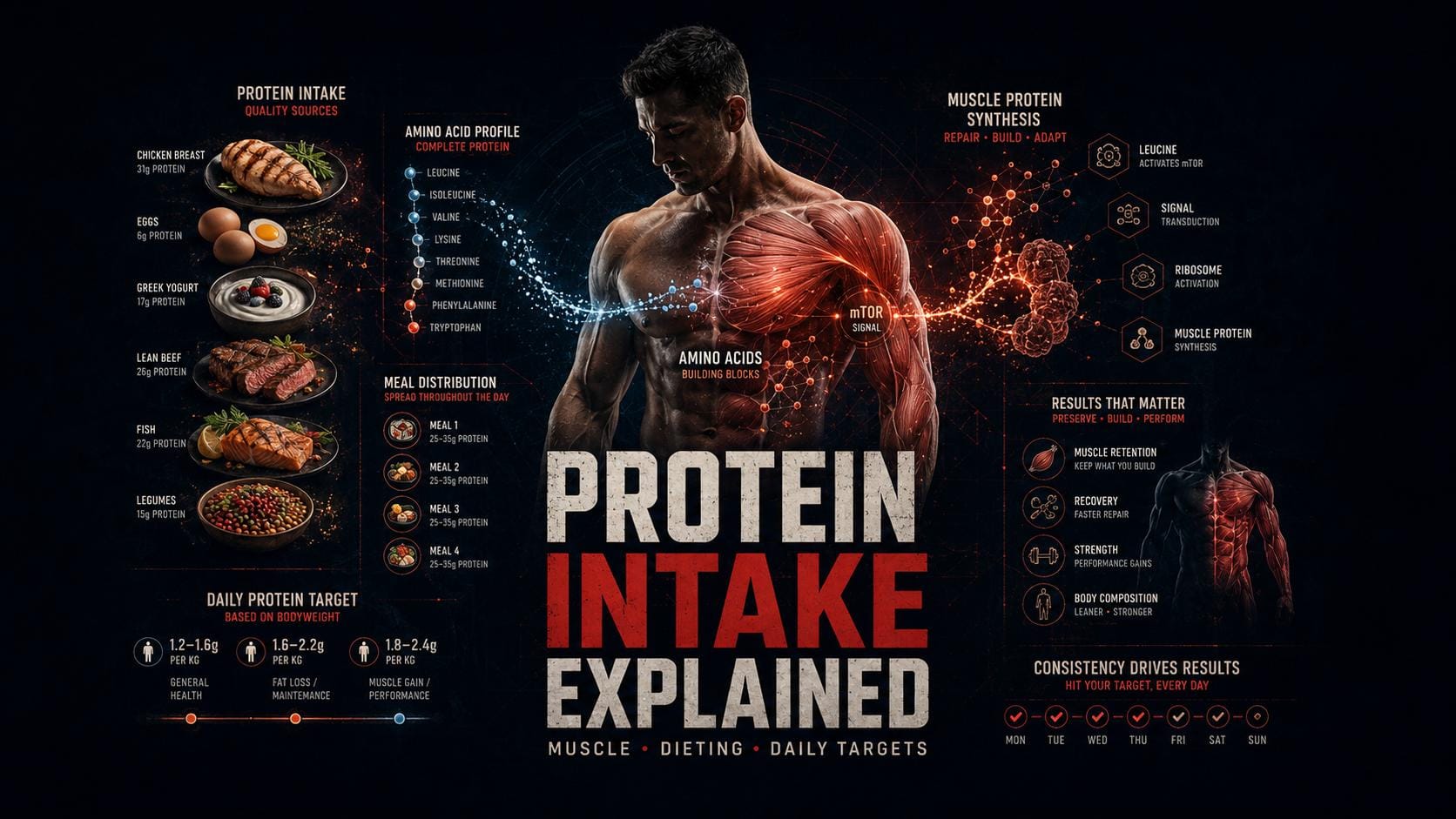
PROTEIN INTAKE EXPLAINED: HOW MUCH PROTEIN YOU ACTUALLY NEED
How much protein to build muscle is one of the few nutrition questions with a measured answer, and protein intake is the one part of a diet most lifters get wrong in both directions. Researchers pooled 49 trials with 1,863 people. Extra protein stopped adding muscle once total protein intake passed about 1.6 g per kilogram of bodyweight a day. The trained lifters in those trials gained the most from it (PMID 28698222). For an 80 kg lifter that is about 130 g a day, which is less than most gym advice and more than most people actually eat. Cutting changes the number, meals change how it is used, and the source changes how far each gram goes.
This page walks through protein intake the way a coach would at the whiteboard. The daily number and where it comes from. Your own number from a calculator. What changes in a cut, how much per meal, whether timing matters, which sources count for more, and whether a high protein intake is safe. Every figure comes from a PubMed abstract listed at the end. Calories come first and sit on calories and energy balance.
Protein intake in brief
Three numbers answer most of the how much protein to build muscle question. One protein intake for the day, one for a cut, one for each meal.
Protein supplements added strength (2.49 kg on a one-rep max) and fat-free mass (0.30 kg) on top of training, more so in trained lifters (0.75 kg). The gain in fat-free mass flattened once total protein intake passed 1.62 g per kg a day (PMID 28698222). The sports nutrition position stand puts most exercising people at 1.4 to 2.0 g/kg (PMID 28642676). For 80 kg, that is 112 to 160 g.
The number is per kilogram of fat-free mass, which means your bodyweight minus your fat, not your scale weight. The review scaled it up with how hard and how lean the diet was (PMID 24092765). For a 90 kg lifter at 15 percent body fat that is 176 to 237 g a day, not the 279 g you get from using scale weight.
Twenty grams of whey switched on muscle building fully in 80 kg trained men at rest and after leg training; 40 g added nothing to muscle but more was burned (PMID 24257722). After a whole-body session, 40 g beat 20 g (PMID 27511985). The review that pulled it together landed on 0.4 g per kg per meal across at least four meals (PMID 29497353).
Every figure on this page about protein intake is taken from a PubMed abstract listed at the end. Where a number is per kilogram of lean mass rather than bodyweight, the page says so each time, because the two give very different gram totals. Nothing here is a diet prescription; it is what the trials measured.
What this protein intake guide covers
How much protein to build muscle per day, where the 1.6 g/kg figure comes from, what the sports nutrition bodies say, and how much protein do I need to build muscle if I am older or more experienced.
Your own number: a calculator by bodyweight, body fat and goal, and a table of the ranges the trials used.
Protein intake in a cut, why the number switches to lean mass, how much per meal, whether timing matters, which sources count for more, and what a year above 3 g/kg did to blood work.
Not coveredTotal calories. Protein only makes sense inside a calorie target; set that first on calories and energy balance.
Carbs, fats and meal timing in depth. Those have their own pages: carbs for training, dietary fats and hormones and meal timing explained.
Which powder to buy. Formats and labels are compared on protein drinks to build muscle and in the supplements hub.
How much protein to build muscle: the daily number
Start with the biggest study on how much protein to build muscle. In 2018 a team pooled 49 randomised trials in which people lifted weights for at least six weeks and some of them got extra protein. That is 1,863 people. The extra protein helped: about 2.5 kg more on a one-rep max, 0.30 kg more fat-free mass, and bigger muscle fibres. Then they did the useful part. They lined up everyone by total protein intake and looked for the point where more protein stopped buying more muscle. That point was 1.62 g per kilogram of bodyweight a day (PMID 28698222).
Two details from the same paper matter for how much protein do I need to build muscle in your case. The effect of protein was larger in people who already trained: 0.75 kg of extra fat-free mass against 0.30 kg overall. So the lifter who has been at it for years is the one who should care most about protein intake for muscle gain. And the effect shrank with age, which means a 50 year old needs to be more careful about hitting the number than a 25 year old, not less (PMID 28698222).
The International Society of Sports Nutrition reads the same evidence and gives a range rather than a point. For most people who train, 1.4 to 2.0 g per kg a day is enough. While dieting, 2.3 to 3.1 g per kg may be needed to hold on to muscle (PMID 28642676). The top of the daily range, 2.2 g/kg, is the upper daily intake reported in the literature that the per-meal review built its arithmetic on (PMID 29497353). Nobody has shown that 2.5 g/kg builds more muscle than 2.0 in a calorie surplus.
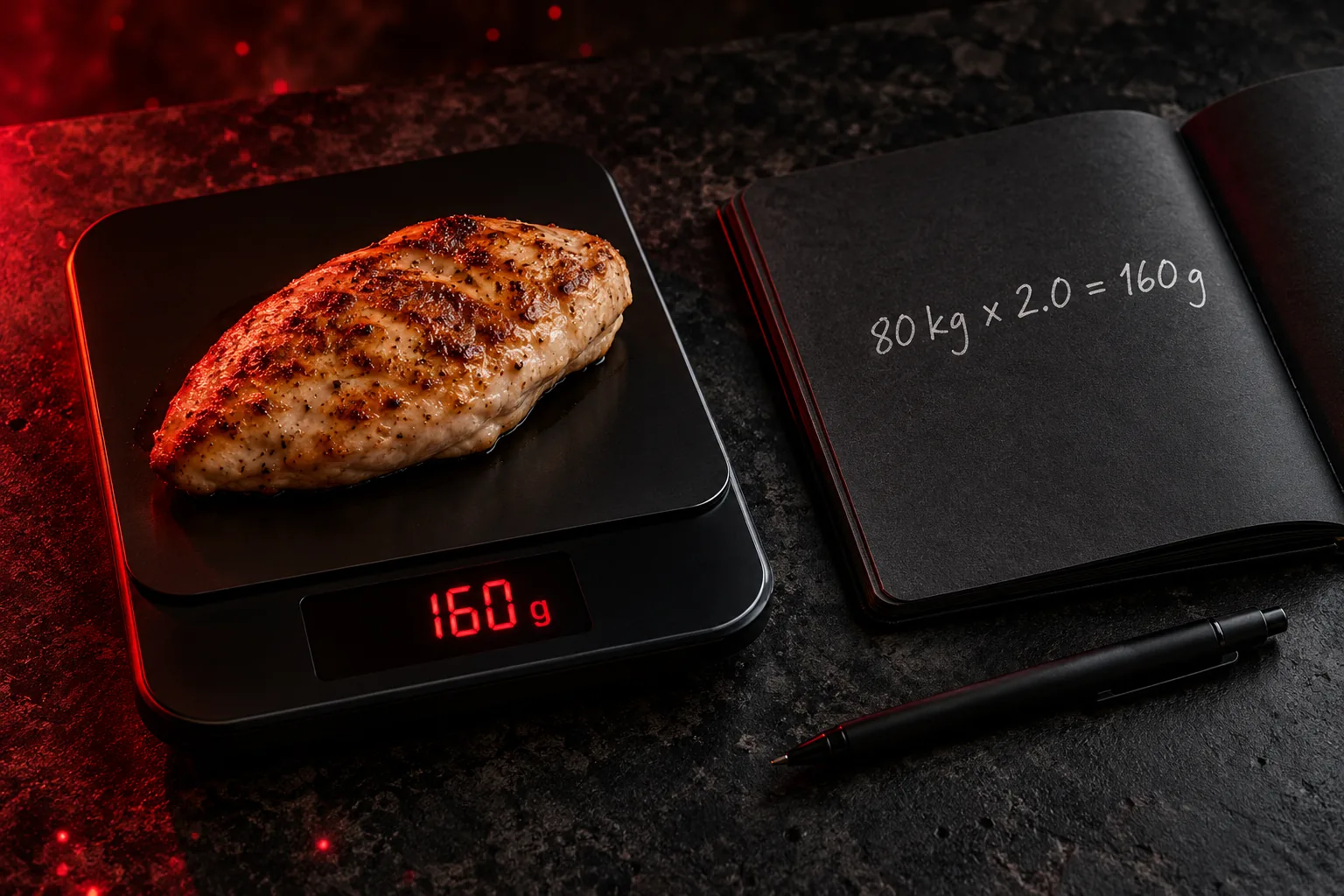
So the honest answer to how much protein to build muscle is a floor, not a ceiling, and protein for muscle gain is cheaper than the supplement aisle suggests. Eat at least 1.6 g per kg of bodyweight a day and you have covered what the trials could measure. Eat 2.0 to 2.2 and you have covered the uncertainty around that number. Eat 3.0 in a surplus and you are paying for protein that is mostly being burned as fuel, which is not harmful, just expensive.
Your protein intake number, by goal
Put your weight in and read your protein intake number. How much protein to build muscle depends on three things: what you weigh, how lean you are, and whether you are eating enough. The calculator uses the ranges the trials used and nothing else: bodyweight when you are eating enough, lean mass when you are not.
Protein intake calculator
Gain uses 1.6 to 2.2 g per kg of bodyweight (PMID 28698222, PMID 28642676). Cuts use 2.3 to 3.1 g per kg of fat-free mass, the lower half for a moderate deficit and the upper half for a hard cut in a lean person (PMID 24092765). Per meal uses 0.4 to 0.55 g per kg across four meals (PMID 29497353). Educational only, not a prescription.
The table is the same arithmetic written out. The last row is the one most guides get wrong, because the review behind it measured protein per kilogram of fat-free mass, and the numbers only make sense that way.
| Goal | Range | Example, 80 kg at 18 percent body fat | Source |
|---|---|---|---|
| Build muscle, maintenance or surplus | 1.6 to 2.2 g per kg bodyweight | 128 to 176 g | Breakpoint 1.62 g/kg across 49 trials (PMID 28698222); 1.4 to 2.0 position stand (PMID 28642676) |
| Just keep what you have, no training change | 1.4 to 1.6 g per kg bodyweight | 112 to 128 g | Bottom of the position stand range (PMID 28642676) |
| Moderate cut | 2.3 to 2.7 g per kg fat-free mass | 66 kg lean mass: 151 to 177 g | Lower half of the 2.3 to 3.1 range, scaled with deficit and leanness (PMID 24092765) |
| Hard cut, already lean | 2.7 to 3.1 g per kg fat-free mass | 66 kg lean mass: 177 to 205 g | Upper half of the same range, the leanest and most restricted groups (PMID 24092765, PMID 28642676) |
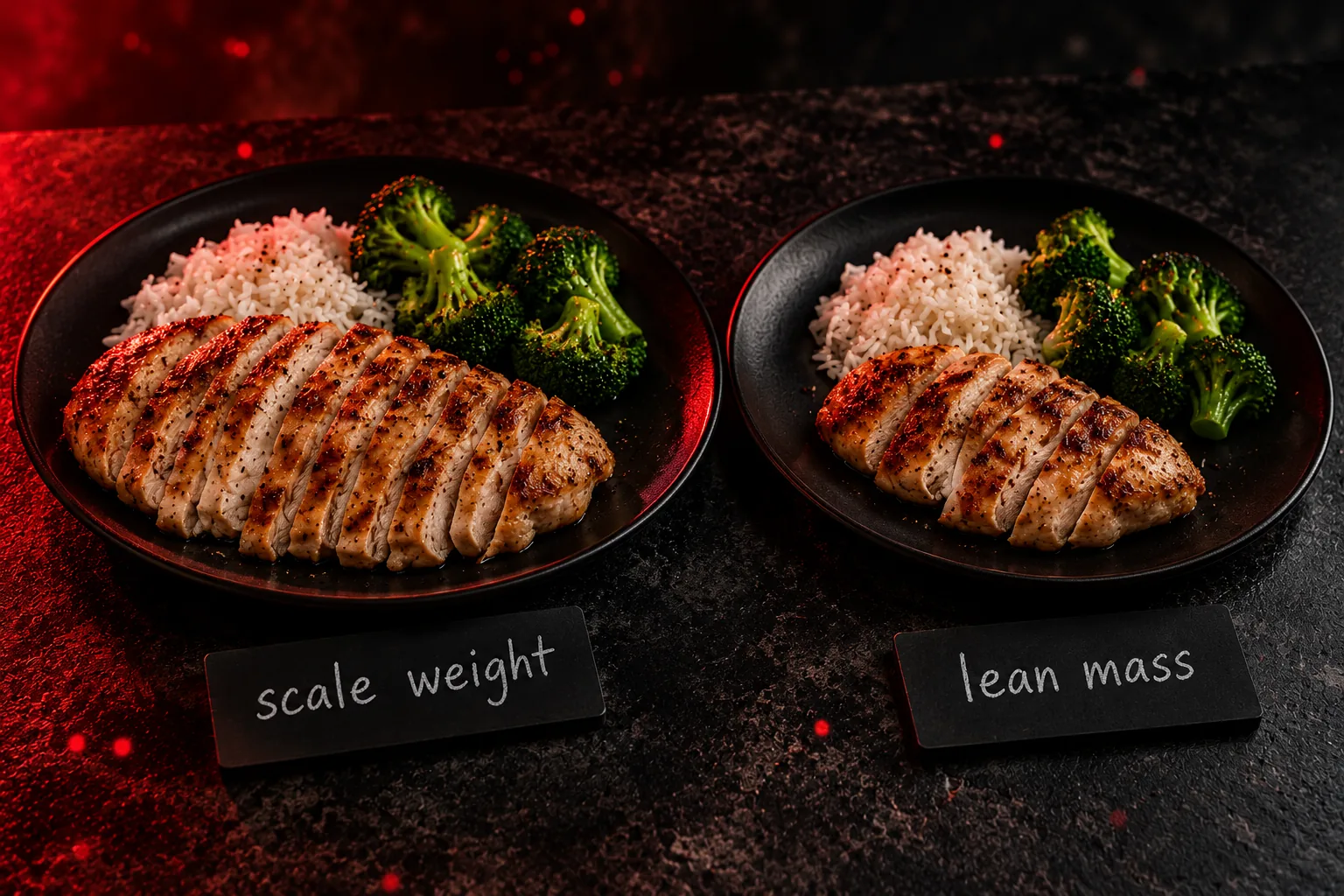
Notice what happens to protein intake at the bottom of the table. Scale weight times 3.1 would tell our 80 kg lifter to eat 248 g. Lean mass times 3.1 says 205 g. The 43 g gap is a whole meal, every day, for the length of the diet. If you carry more fat than 18 percent the gap is bigger, which is exactly why the review used lean mass: fat does not need protein to be maintained.
Protein intake in a cut: why the number goes up and changes units
A cut is where protein intake earns its reputation, and where the how much protein to build muscle answer changes. You are eating less than you burn, so the body looks for fuel, and muscle is a fuel it will use. The review that settled the number looked at six studies of lean, resistance-trained athletes dieting for a competition or a weight class, 13 groups in all. Body fat fell in every group. Fat-free mass fell in nine of the 13. Six groups kept or gained it, and five of those six were either not that lean, not dieting that hard, or doing a new kind of training that would build muscle anyway (PMID 24092765).
That leaves one group that was lean, was dieting hard, did not change its training, and still kept its muscle; it is the group that answers how much protein to build muscle while dieting. It had the highest protein intake in the whole review, 2.5 to 2.6 g per kg. From that pattern the authors concluded that dieting lifters likely need 2.3 to 3.1 g per kg of fat-free mass. The number rises as the deficit gets bigger and the person gets leaner (PMID 24092765). The position stand repeats the 2.3 to 3.1 range for keeping lean mass in a calorie deficit (PMID 28642676).
A smaller trial shows the mechanism. Forty overweight adults ate 750 kcal below maintenance for two weeks. The ones given whey protein, bringing them to 1.3 g per kg a day, lost only 9 percent of the muscle-building response to a meal. The ones on carbohydrate powder at 0.7 g per kg lost 31 percent of it (PMID 25644344). Low protein in a deficit does not just fail to build muscle; it blunts the response to the protein you do eat.
Protein also makes a diet easier to stay on. Across controlled feeding studies, higher-protein diets in a calorie deficit produced more fat loss and kept more lean mass than lower-protein diets at the same calories. Higher-protein meals also left people fuller, with higher satiety hormones, although that did not reliably cut how much they ate at the next meal (PMID 25926512). Protein also costs the most energy to digest of the three macronutrients, and a mixed diet spends 5 to 15 percent of daily energy on digestion, more on a high-protein diet (PMID 15507147).
How much protein per meal, and the 30 gram myth
Daily protein intake is the big lever; per-meal protein intake is the fine tuning. You have probably heard that the body can only use 30 g of protein at a time. Here is where that came from, and why it is only half true. In resistance-trained men of about 80 kg, 20 g of whey after leg training raised muscle protein synthesis, the process that builds new muscle, by 49 percent. Forty grams raised it by 56 percent, which was not a meaningful step up, but more of the extra protein was burned for energy (PMID 24257722). So for one muscle group, 20 g was close to the ceiling, the same 20 g at which egg protein maxed out muscle building after leg training in an earlier study (PMID 19056590).
Then the same lab trained the whole body instead of one leg. Now 40 g beat 20 g, and it did not matter whether the lifter had a lot of lean mass or a little (PMID 27511985). More muscle working means more muscle asking for protein. Both findings are about one drink of fast whey on its own; a steak with potatoes digests over hours and behaves differently.
The cleanest comparison of meal patterns gave trained men 80 g of whey over 12 hours after training in three ways: 8 doses of 10 g, 4 doses of 20 g, or 2 doses of 40 g. All three raised muscle protein synthesis, but 20 g every three hours beat both the small frequent doses and the two big ones by 31 to 48 percent (PMID 23459753). Four meals of a solid dose did more than eight snacks or two feasts.
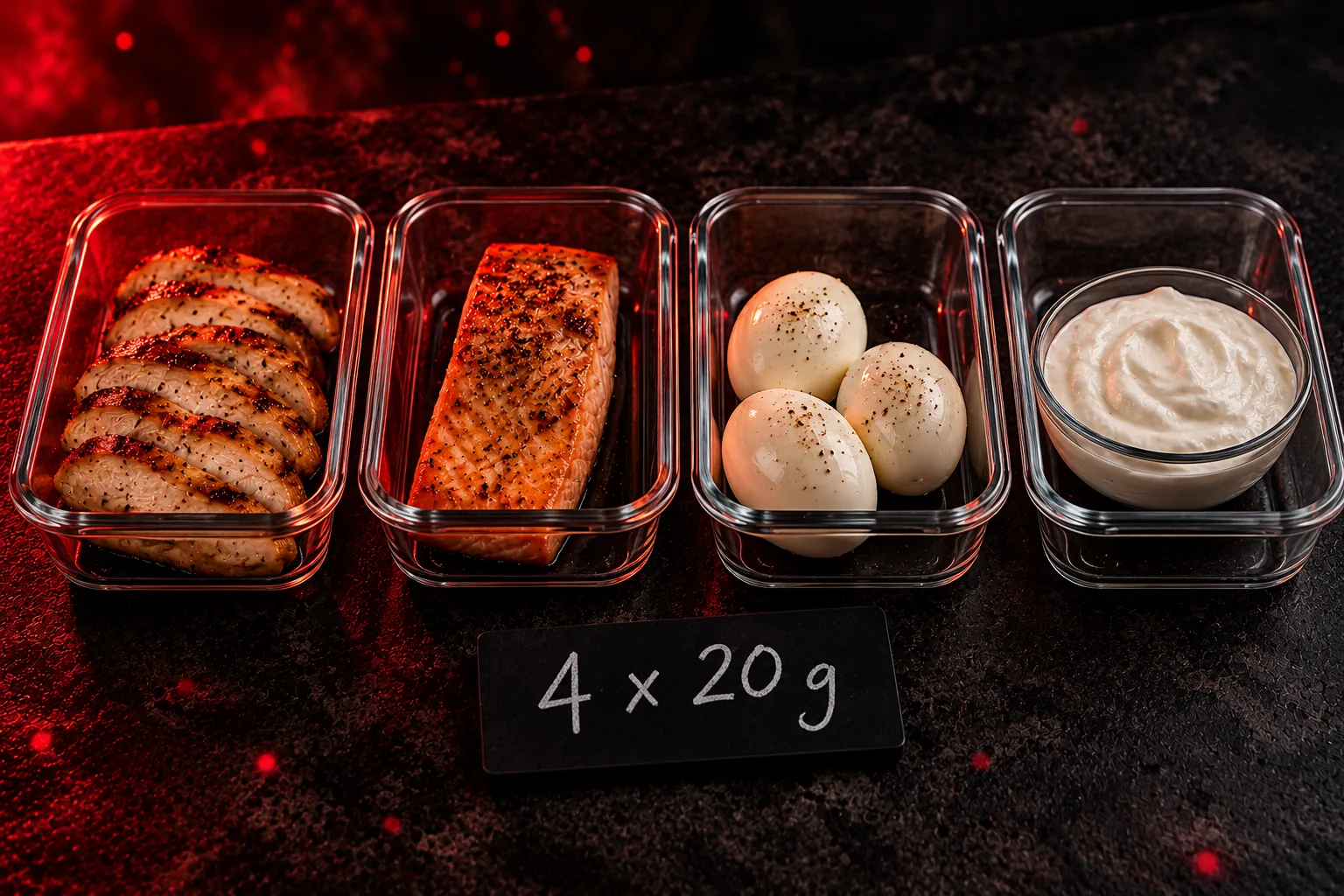
Now the other half of the story. In 2023 a Dutch group gave people 25 g or 100 g of milk protein after training and tracked it for 12 hours with four different tracers. The 100 g dose produced a bigger and longer muscle-building response, more of it ended up in muscle protein, and almost none of the extra was burned (PMID 38118410). So a big meal is not wasted. The body simply takes longer to use it. The 30 g limit was never a limit; it was the dose at which a single fast shake stops giving more in the next few hours.
One more protein intake slot is worth knowing. Sixteen young men trained in the evening and drank 40 g of casein 30 minutes before sleep. It was digested through the night, raised whole-body protein synthesis, and turned overnight protein balance from negative to positive (PMID 22330017). Cottage cheese or Greek yoghurt before bed does the same job as a casein shake.
Does protein timing around training matter?
Less than the shaker-bottle industry would like, and far less than total protein intake. The idea of a narrow anabolic window, a half hour after training when protein is magic, was reviewed in 2013 and did not hold up. The authors found that the importance, and even the existence, of a post-workout window depends on when you last ate, and that the evidence had directly challenged the classic view (PMID 23360586).
The reason is that training keeps muscle sensitive to protein for a long time. In young men, a protein feeding raised muscle protein synthesis more than usual a full 24 hours after a leg session. The condition was that the sets had been taken to failure; heavy or light weight did not matter (PMID 21289204). The window is a day wide. What fills it is your total protein intake and how it is spread, not the minute you drink the shake.
Where protein intake timing does matter is the empty-stomach case. If you trained fasted, or your last protein meal was five hours ago, the meal after training is simply your next meal, and it should carry a full dose. If you ate a proper meal an hour or two before, there is no evidence that rushing another one afterwards adds anything.
Protein sources: why 25 g of whey is not 25 g of lentils
The gram on the label is only part of the protein intake story. What muscle actually responds to is the essential amino acids inside the protein, and one of them in particular, leucine, which acts as the on switch for muscle building. Sources differ a lot in how much of each they carry. Whey protein is 43 percent essential amino acids by weight, milk protein 39, casein 34, egg 32, and your own muscle 38. Plant isolates such as oat, lupin and wheat are 21 to 22 percent (PMID 30167963).
Leucine follows the same pattern but with surprises. Milk protein is 9.0 percent leucine, egg 7.0, hemp only 5.1, while corn protein is 13.5 percent leucine but short of lysine (PMID 30167963). Lysine and methionine are the usual gaps in plant proteins. That is why two plant sources together, say pea with rice, cover each other. The researchers who measured all of this concluded that blends of plant proteins, or plant plus animal, can match the profile of animal protein (PMID 30167963).
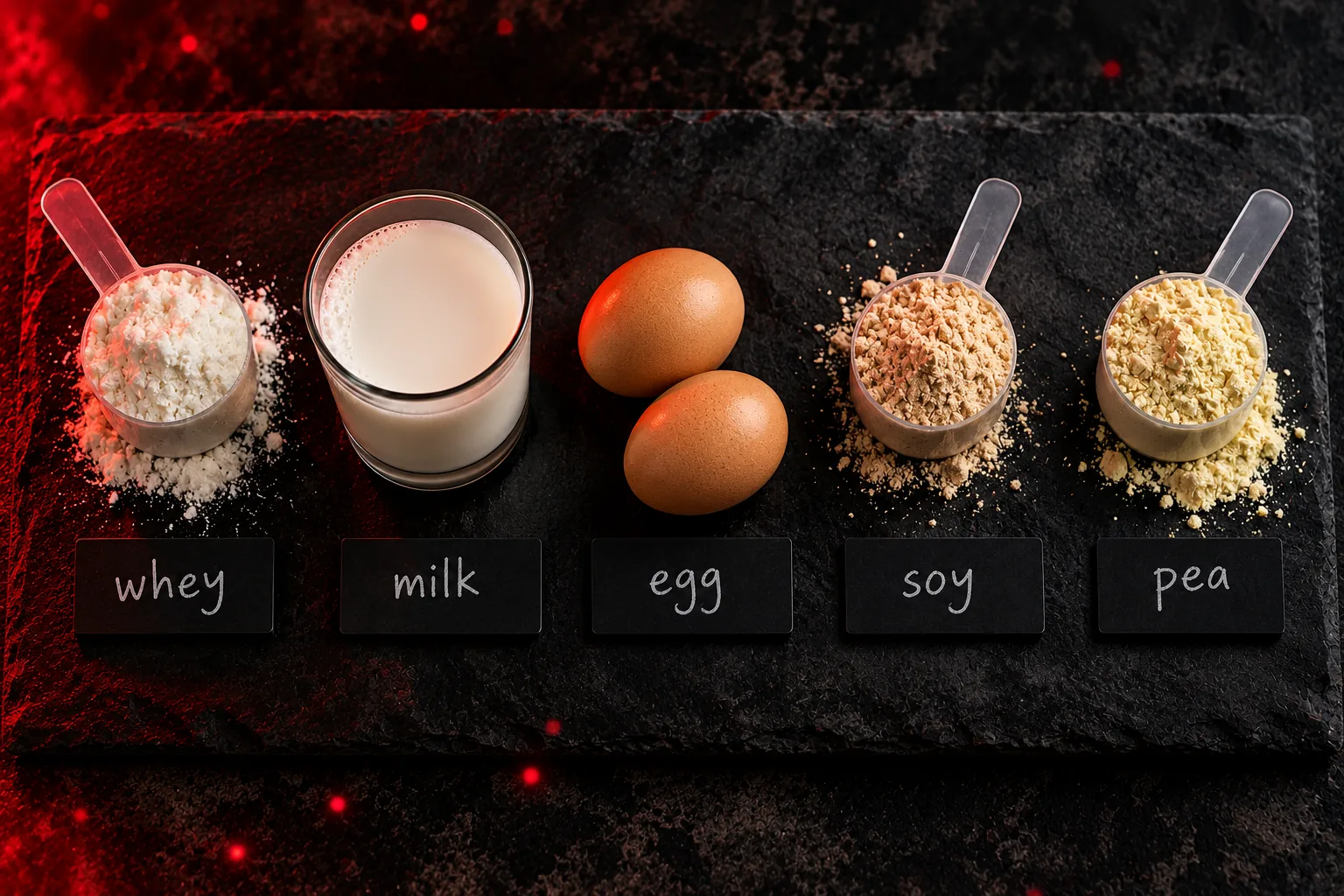
| Source | Essential amino acids, share of protein | Essential amino acids in 25 g | Leucine where measured |
|---|---|---|---|
| Whey | 43 percent | 10.8 g | Highest of the dairy proteins in the acute trials (PMID 19589961) |
| Milk | 39 percent | 9.8 g | 9.0 percent of protein, about 2.3 g in 25 g |
| Casein | 34 percent | 8.5 g | Slow digesting; lowest acute response of the three dairy proteins (PMID 19589961) |
| Egg | 32 percent | 8.0 g | 7.0 percent of protein, about 1.8 g in 25 g |
| Soy isolate | Lower than dairy; low in methionine | Not stated in the abstract | Raised muscle protein synthesis 18 percent less than whey at rest, 31 percent less after training, and beat casein (PMID 19589961) |
| Oat, lupin, wheat | 21 to 22 percent | 5.3 to 5.5 g | Hemp 5.1 percent leucine, corn 13.5 but low in lysine |
Does the source change how much protein to build muscle you need? In the acute trials, yes. Young men drank whey, soy or casein matched for 10 g of essential amino acids. Whey raised muscle protein synthesis 93 percent more than casein at rest and 122 percent more after leg training. Soy sat in between: 18 percent behind whey at rest and 31 percent behind after exercise (PMID 19589961). Over months of training the gap narrows if daily protein intake is high, which is the point of the 1.6 g/kg floor: enough total protein covers a lot of quality.
If you eat mostly plants, the review on the subject lists the fixes in order: add the missing amino acids, eat more of the plant protein, or mix sources so the gaps cancel out (PMID 26224750). The simplest version is the last one. Rice and beans, pea and rice protein, or tofu with grains, and aim for the top of your daily range rather than the bottom.
Is a high protein intake bad for your kidneys?
This is the question behind every "is 200 g of protein too much" search, and the protein intake safety data give a good answer. A 2018 meta-analysis pulled together 28 randomised trials in 1,358 adults without kidney disease. They compared higher protein, at least 1.5 g per kg or 20 percent of calories or 100 g a day, against lower protein. Kidney filtration rate, the number doctors use to judge kidney health, did not change differently between the groups (PMID 30383278). The one trivial difference went the other way: filtration was slightly higher after the high-protein diets, which is the kidney doing its job, not failing at it.
The longest test of a high protein intake in lifters ran a year. Fourteen resistance-trained men alternated their normal diet, already 2.5 g per kg, with a high-protein diet averaging 3.3 g per kg, for six months of each. Blood lipids, liver markers and kidney markers did not move. They also gained no fat on the higher-protein diet despite eating more calories (PMID 27807480). Fourteen men is a small study, but it is a year at a dose above anything on this page.
Five protein intake mistakes the trials expose
Each protein intake mistake comes from taking a number out of the study that produced it.
1. Using scale weight in a cut. The 2.3 to 3.1 figure is per kilogram of fat-free mass (PMID 24092765). Multiply it by scale weight and a 100 kg lifter at 25 percent fat is told to eat 310 g instead of 232. That is a daily chicken breast and a half of pure expense.
2. Chasing 3 g/kg while bulking. Fat-free mass gains flattened at 1.62 g/kg across 49 trials (PMID 28698222). In a surplus the extra protein intake is burned as fuel. Put those calories into carbohydrate that moves the bar.
3. Throwing away a big meal because of the 30 g rule. One hundred grams of protein in one sitting was used over more than 12 hours, with almost none burned off (PMID 38118410). Spread protein intake across meals when you can; do not fear the big meals you cannot.
4. Eating 1.2 g/kg and blaming timing. Training keeps muscle sensitive to protein for 24 hours (PMID 21289204). A perfectly timed shake on top of a low daily total is a perfectly timed shortfall.
5. Counting plant grams as dairy grams. Oat, lupin and wheat isolates carry half the essential amino acids of whey per gram (PMID 30167963). Eat more of them or mix them, and do not let the scoop size set your protein intake.
Verdict: how much protein to build muscle is a floor, a cut rule and a meal size
Read from the trials, how much protein to build muscle comes down to three protein intake rules. Eat at least 1.6 g per kilogram of bodyweight a day when you are training to build muscle, and up to 2.2 to be safe; beyond that the 49-trial pool found nothing extra (PMID 28698222). When you cut, switch to 2.3 to 3.1 g per kilogram of lean mass, higher the leaner and hungrier the diet (PMID 24092765). Split the total into three to five meals of at least 0.4 g per kg (PMID 29497353), because four doses of 20 g beat two of 40 and eight of 10 (PMID 23459753). Stop worrying about the clock, because the window after training is a day wide (PMID 21289204).
Source matters at the margins: whey beat soy and casein for the acute response (PMID 19589961), and plant isolates carry half the essential amino acids per gram (PMID 30167963), so plant-based lifters aim higher and mix. Safety is not the problem it is made out to be. Twenty-eight trials in healthy adults found no difference in kidney function from higher protein (PMID 30383278), and a year above 3 g/kg changed nothing in lifters' blood work (PMID 27807480).
For readers here the practical reading of protein intake for muscle gain is simple. Set calories first on calories and energy balance, then protein with the calculator above, then fill the rest with carbohydrate and fat. The biology of why protein builds muscle is on what builds muscle, the formats on protein drinks to build muscle, and the rest of the meal on meal timing explained.
Protein intake: frequently asked questions
How much protein do I need to build muscle?
At least 1.6 g per kilogram of bodyweight a day, and up to 2.2 g/kg to cover the uncertainty. That is the point where extra protein stopped adding fat-free mass across 49 trials and 1,863 people lifting weights (PMID 28698222). The sports nutrition position stand gives 1.4 to 2.0 g/kg for most exercising people (PMID 28642676). For an 80 kg lifter that is 128 to 176 g a day, split over three to five meals.
Is 200 g of protein a day too much?
For a 90 kg lifter in a cut, 200 g is 2.6 g per kg of lean mass at 15 percent body fat, which sits inside the 2.3 to 3.1 range the dieting review found (PMID 24092765). For a 70 kg person eating at maintenance, 200 g is 2.9 g/kg, well past the 1.62 g/kg where muscle gains flattened (PMID 28698222); not harmful, just unnecessary. A year averaging 3.3 g/kg did not change kidney or liver markers in 14 trained men (PMID 27807480).
Is 100 g of protein enough to keep muscle?
It depends on your weight. For a 60 kg person 100 g is 1.67 g/kg, which clears the 1.62 g/kg breakpoint for building muscle (PMID 28698222). For a 90 kg lifter it is 1.1 g/kg, below the 1.4 g/kg floor of the position stand (PMID 28642676). In a cut it is far below the 2.3 g per kg of lean mass that went with keeping muscle (PMID 24092765). In a two-week deficit, people at 0.7 g/kg lost 31 percent of their muscle-building response to a meal against 9 percent at 1.3 g/kg (PMID 25644344).
Is 3 eggs a day enough protein for muscle gain?
No, not on their own. A large egg carries about 6 g of protein on its label, so three eggs are roughly 18 g. That is under the 20 g of whey that fully switched on muscle building in 80 kg men (PMID 24257722) and under the 0.4 g per kg per meal target (PMID 29497353). Egg protein is high quality, 32 percent essential amino acids (PMID 30167963). Three eggs are a good start to a meal, not a full day of protein intake, which should reach 1.6 g/kg (PMID 28698222).
How much protein per meal to build muscle?
About 0.4 g per kilogram of bodyweight. The review set that as the per-meal dose across at least four meals to reach 1.6 g/kg a day; 0.55 g per kg per meal reaches 2.2 (PMID 29497353). In trained men, 20 g of whey maximised the response after leg training (PMID 24257722) and 40 g beat 20 g after a whole-body session (PMID 27511985). Four doses of 20 g every three hours beat two of 40 g and eight of 10 g (PMID 23459753). Bigger meals are not wasted; 100 g was used over more than 12 hours (PMID 38118410).
Does protein intake timing after a workout matter?
Very little if your daily total is right. The 2013 review found the post-workout anabolic window far less important than claimed and dependent on when you last ate (PMID 23360586). Muscle stays more sensitive to protein for 24 hours after a session taken to failure (PMID 21289204). The exception is training on an empty stomach, where the next meal should be a full dose. Before sleep, 40 g of casein turned overnight protein balance positive after evening training (PMID 22330017).
Sources and further reading
Every figure on this page about protein intake comes from one of the 20 papers below, each checked against its PubMed abstract on 17 October 2026. Where a number is given per kilogram of fat-free mass, that is how the paper reported it. Reference links are dofollow to support open science.
Keep reading
Four pages from the nutrition series: the calorie target that comes first, the drinks that deliver the grams, the biology behind the number, and where the meals go in the day.
Final Educational Note
This article is educational and is not medical or dietary advice. It reports what randomised trials, meta-analyses and reviews say about protein intake and how much protein to build muscle; the gram ranges appear only as the studies used them and are not a prescription for you. More guides sit on the nutrition hub.
Anyone with diagnosed kidney or liver disease, a history of kidney stones, gout, an eating disorder, or who is pregnant should take protein targets from a physician or registered dietitian, not from this page. Individual needs vary with age, training and health. Read more about how this site works on the about page and in the full disclaimer.