Best Protein Drinks to Build Muscle: Types, Sources, and What to Look For
How to pick a protein drink that actually works
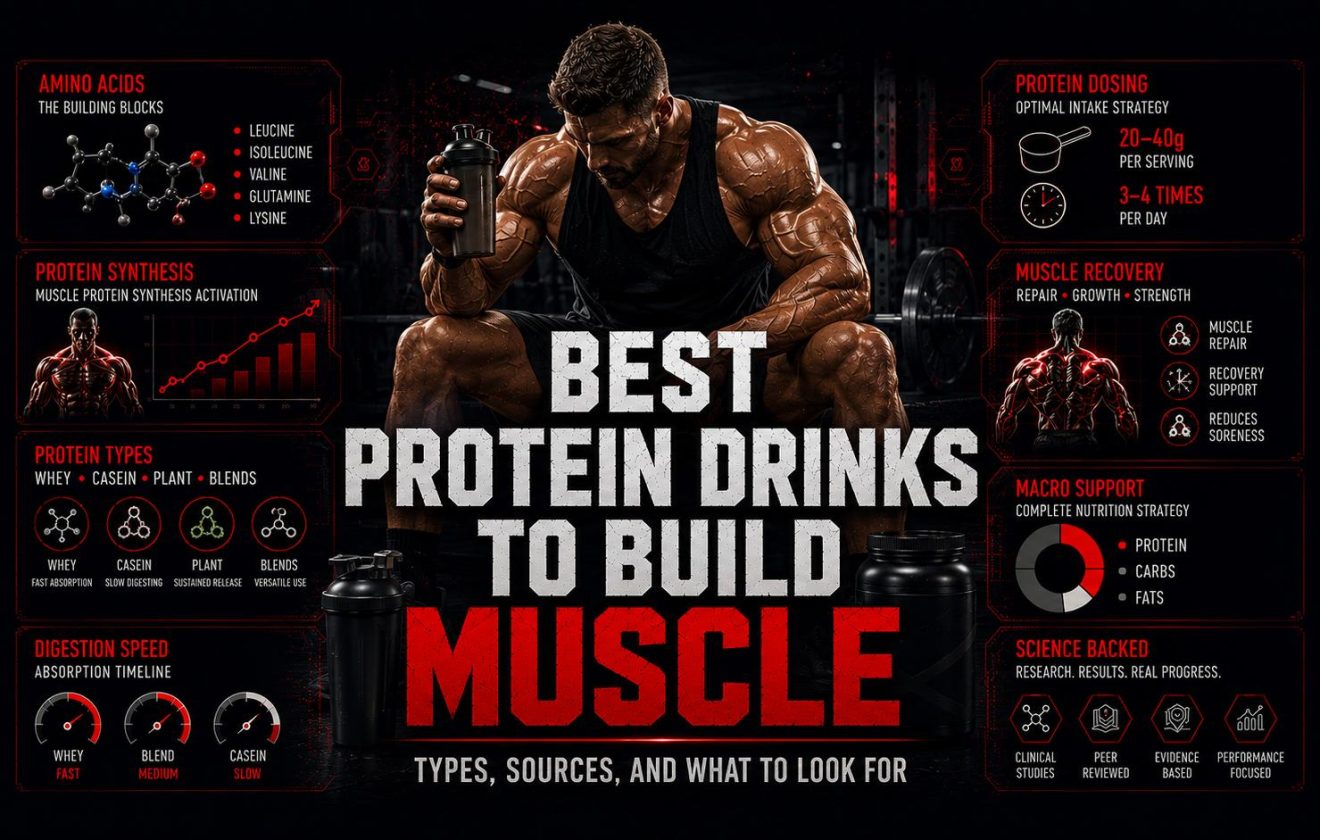
The best protein drinks to build muscle are those that consistently deliver 25–40 g of high-leucine protein per serving — enough to maximally stimulate muscle protein synthesis at each dose. Whether the format is whey powder, a plant-based blend, casein, or a ready-to-drink bottle, the criteria for evaluating protein drinks to build muscle are the same: protein dose per serving, leucine content of the protein source, amino acid completeness, and ingredient transparency on the label. This guide covers the main types of protein drinks for muscle building, what the research supports for each, and how to choose between them based on training goals and dietary context.
Best Protein Drinks to Build Muscle: Three Things to Know
Dose Per Serving Is the First Filter
The best protein drinks to build muscle deliver a minimum of 25 g of protein per serving — the threshold at which muscle protein synthesis is maximally stimulated in most adults. Protein drinks below 20 g per serving do not fully activate this response regardless of protein source quality or marketing claims. Checking the grams of protein on the supplement facts panel — not the front label — is the first step in evaluating any protein drink for muscle building.
Leucine Content Drives the Muscle Signal
Within a protein drink serving, leucine is the amino acid that triggers mTORC1 — the cellular switch for muscle protein synthesis. The best protein drinks to build muscle deliver at least 2–3 g of leucine per serving. Whey protein drinks meet this threshold at 25 g of total protein due to whey’s high leucine density of approximately 10–11% by weight. Plant-based protein drinks typically require 30–35 g of total protein per serving to deliver equivalent leucine, making per-serving dose more critical for plant-based options.
No Single Type Is Best for Every Context
Whey protein drinks produce the highest acute muscle protein synthesis response due to fast absorption and high leucine density — making them the best protein drinks to build muscle in most post-training contexts. Casein protein drinks are better suited to overnight or between-meal use where sustained amino acid release is the goal. Plant-based protein drinks to build muscle are a fully viable option when dose and source quality are adequate. RTD formats trade cost-efficiency for convenience. The best choice depends on the training context and dietary requirements.
What This Article Covers
Covered
- What makes a protein drink “best” for building muscle — 4 key criteria
- Whey protein drinks: concentrate vs isolate, best use cases, dosing
- Plant-based protein drinks: best sources, leucine correction dosing, pea+rice vs soy
- Casein protein drinks: when they outperform whey and when they don’t
- Ready-to-drink protein drinks: convenience vs cost-efficiency trade-off
- 6 key facts for selecting protein drinks to build muscle
- Common mistakes when choosing and using protein drinks
- External references from peer-reviewed research
Not Covered
- Specific brand rankings or purchase recommendations
- Meal replacement or weight loss shake products
- Protein requirements in medical or clinical populations
- PED or hormone interaction context
For specific protein drink product label breakdowns, see the MRE Protein Shake review, the ISO 100 review, and the CBUM Protein review. For the broader framework used to evaluate supplement evidence, see evidence-based supplements.
What Makes a Protein Drink Best for Building Muscle
Before comparing types of protein drinks to build muscle, establishing the criteria that actually determine effectiveness matters. Marketing language on protein drink packaging — “advanced formula,” “anabolic blend,” “ultra-lean” — does not predict muscle-building outcomes. Four measurable factors determine whether a protein drink is genuinely among the best options for muscle building.
1. Protein Dose Per Serving
Minimum 25 g per serving to maximally stimulate muscle protein synthesis in most adults. Older athletes or those with higher body mass may need 35–40 g. This is the non-negotiable baseline. Protein drinks below 20 g per serving are insufficient as standalone MPS triggers regardless of protein source quality.
2. Leucine Delivery Per Serving
Target 2–3 g of leucine per serving — the threshold for full mTORC1 activation. Whey protein drinks at 25 g deliver approximately 2.5–2.8 g. Plant-based protein drinks at 25 g may deliver only 1.8–2.1 g, requiring a larger dose. Leucine percentage by protein source: whey ~10–11%, casein ~9%, pea ~8%, rice ~7%.
3. Amino Acid Completeness
The best protein drinks to build muscle use complete protein sources — those containing all nine essential amino acids in adequate ratios. Whey, casein, egg white, soy, and pea+rice blends all qualify. Single-source plant protein drinks using rice protein alone (low lysine) or hemp protein alone (low leucine and lysine) are incomplete and should not be the primary protein drink for muscle building.
4. Label Transparency
The best protein drinks to build muscle list the protein source clearly as the first ingredient and disclose amino acid profiles without hiding doses inside proprietary blends. A protein drink that lists “Protein Blend (Whey Concentrate, Casein, Isolate)” without individual weights cannot be accurately evaluated for leucine content or protein source quality — a significant disadvantage compared to single-source protein drinks with full label transparency.
The best protein drinks to build muscle are tools for meeting a daily protein target — not replacements for it. Research supports 1.6–2.2 g of protein per kg of body weight per day for maximizing muscle hypertrophy in resistance-trained individuals. For an 80 kg athlete, this is 128–176 g per day. Protein drinks work best when distributed across 3–5 adequate-dose servings alongside whole food protein sources throughout the day, rather than consumed as one large single serving.
Best Whey Protein Drinks to Build Muscle: Concentrate vs Isolate
Whey protein drinks are the most extensively researched category of protein drinks to build muscle and produce the highest acute muscle protein synthesis response of any commercially available protein source. Whey is a byproduct of cheese manufacturing — a fast-digesting complete protein with a leucine content of approximately 10–11% by weight and a full essential amino acid profile. Among all protein drink options, whey consistently delivers the most efficient leucine dose per gram of total protein, making it the reference standard against which other protein drink sources are evaluated.
Whey Concentrate: Best Protein Drink for Value and Versatility
Whey concentrate protein drinks contain 70–80% protein by weight — the remainder is primarily fats and lactose remaining after initial ultrafiltration. At 25–30 g per serving, whey concentrate protein drinks reliably cross the 2.5 g leucine threshold for maximal MPS stimulation. The cost per gram of protein in whey concentrate protein drinks is the lowest of any quality protein drink format — making them the most cost-efficient option for athletes prioritizing total daily protein accumulation. Individuals with lactose intolerance may experience gastrointestinal discomfort at higher doses due to residual lactose content, which is the primary practical limitation of whey concentrate protein drinks compared to isolate.
Whey Isolate: Best Protein Drink for Lactose Sensitivity and Caloric Precision
Whey isolate protein drinks are further filtered to 90%+ protein by weight, removing most fats and lactose. This produces a protein drink with slightly higher leucine density per gram, fewer calories per gram of protein (approximately 4–4.5 kcal/g vs 4.5–5 kcal/g for concentrate), and significantly better tolerance for lactose-sensitive individuals. The practical trade-off is cost — whey isolate protein drinks are more expensive per serving than concentrate at matched protein doses. Athletes in caloric deficit phases or those requiring precise macronutrient tracking benefit most from the leaner profile of whey isolate protein drinks. For a label-level breakdown of a whey isolate hydrolysate product, see the ISO 100 review.
| Protein Drink Type | Protein % | Leucine / 25 g | Lactose | Best For |
|---|---|---|---|---|
| Whey Concentrate | 70–80% | ~2.5–2.6 g | Present | Best value protein drink for most athletes |
| Whey Isolate | 90%+ | ~2.7–2.8 g | Minimal | Best protein drink for lactose sensitivity, deficit phases |
| Whey Hydrolysate | 90%+ | ~2.7–2.8 g | Minimal | Fastest absorption — marginal MPS advantage over isolate |
| Casein | ~80% | ~2.2–2.4 g | Present | Best protein drink for overnight or between-meal use |
| Pea + Rice Blend | ~80% | ~2.0–2.1 g | None | Best plant-based protein drink — dose to 32–35 g |
| Soy Isolate | ~90% | ~2.0 g | None | Most complete single-source plant protein drink |
For how whey protein drinks interact with creatine supplementation in muscle-building stacks, see the creatine HMB guide. For the performance context in which protein drinks to build muscle are most effective, see performance supplements.
Best Plant-Based Protein Drinks to Build Muscle: Sources and Dosing
Plant-based protein drinks to build muscle are a viable option when protein source quality is adequate and serving sizes are calibrated to match leucine delivery from whey. The central challenge with plant-based protein drinks is leucine density — plant protein sources contain 7–8% leucine by weight versus 10–11% for whey, meaning a 25 g serving of a plant-based protein drink delivers approximately 1.8–2.1 g of leucine — potentially below the 2–3 g threshold for maximal MPS activation. The correction is straightforward: increase the serving size of plant-based protein drinks to 30–35 g of total protein to match whey’s leucine delivery at 25 g. This dosing adjustment is the most important practical consideration when selecting plant-based protein drinks to build muscle.
Pea + Rice Blend: The Best Plant-Based Protein Drink Combination
The best plant-based protein drinks to build muscle use a complementary pea and rice protein blend rather than a single plant source. Pea protein isolate is rich in lysine but low in methionine and cysteine. Rice protein concentrate is higher in methionine but lower in lysine. Combined in approximately a 70:30 pea-to-rice ratio, the two sources produce a more complete essential amino acid profile that better approximates whey’s muscle-building profile than either source alone. Studies comparing pea protein drinks to whey protein drinks at matched leucine-equivalent doses have shown comparable hypertrophy outcomes over 8–12 week resistance training protocols, confirming that the best plant-based protein drinks to build muscle can deliver equivalent long-term results to whey when correctly dosed.
Soy Isolate: The Most Complete Single-Source Plant Protein Drink
Soy protein isolate is the most researched single-source plant protein drink for muscle building and the only plant protein classified as a complete protein with an amino acid score comparable to animal sources. Soy protein drinks at 25–30 g per serving have demonstrated meaningful MPS responses in controlled trials, with results sitting between whey concentrate and casein in acute MPS comparisons. Soy protein drinks are appropriate for athletes requiring a complete plant-based protein drink without needing to blend multiple sources. Historical concerns about phytoestrogen content in soy protein drinks affecting testosterone levels in men are not supported by the current research at normal supplement doses — the available evidence does not show clinically meaningful hormone disruption from soy protein drinks at 25–50 g per day in healthy males.
Leucine-Corrected Serving Sizes for Muscle Building
To match the leucine delivery of 25 g whey protein (approximately 2.5–2.6 g leucine), use these adjusted serving sizes for plant-based protein drinks to build muscle:
- Pea protein isolate: 30–33 g per serving
- Pea + rice blend (70:30): 30–32 g per serving
- Soy protein isolate: 28–32 g per serving
- Hemp protein: Not recommended as primary protein drink — low leucine (~6%) and incomplete amino acid profile even at high doses
- Brown rice protein alone: Not recommended as primary protein drink — low lysine limits its use as a standalone muscle-building protein drink
For how plant-based protein drinks fit into broader recovery nutrition strategies, see recovery supplements. For a whole-food protein drink example with a complex ingredient profile, see the MRE Protein Shake review.
Casein and RTD Protein Drinks: When Each Is the Best Choice
Beyond whey and plant-based options, two additional protein drink formats serve specific muscle-building contexts: casein protein drinks for overnight and between-meal use, and ready-to-drink (RTD) protein drinks for convenience-driven situations where powder mixing is not practical.
Best Protein Drink for Overnight Muscle Protein Synthesis Support
Micellar casein forms a slow-digesting gel in the stomach that releases amino acids over 5–7 hours — in contrast to whey protein drinks, which peak in blood amino acids within 60–90 minutes and clear within 3–4 hours. This makes casein protein drinks the best option for two specific muscle-building contexts: pre-sleep supplementation and long gaps between meals where sustained amino acid availability is the goal. Research by Res et al. (2012) demonstrated that 40 g of casein consumed before sleep increased overnight muscle protein synthesis rates compared to placebo, suggesting a genuine role for casein protein drinks in supporting muscle building during the overnight fasting period. The acute MPS response of casein protein drinks is lower than whey at matched doses — casein is not the best protein drink for post-training use when rapid amino acid delivery matters most. The optimal strategy combines whey protein drinks post-training and casein protein drinks pre-sleep for athletes focused on maximizing 24-hour muscle protein balance.
Best used: pre-sleep or between long meal gaps — not optimal as post-training protein drinkBest Protein Drink Format for On-the-Go Convenience
Ready-to-drink protein drinks — canned or bottled, pre-mixed protein beverages — sacrifice cost efficiency for convenience. Most RTD protein drinks deliver 20–30 g of protein per bottle using whey concentrate, whey isolate, or milk protein blends. They are shelf-stable, require no mixing equipment, and are practical for travel, work, or post-training scenarios where powder is not accessible. The primary limitation of RTD protein drinks is cost per gram of protein — typically 3–4x the cost per gram of a powder-based protein drink at equivalent protein dose. For athletes whose primary constraint is convenience rather than budget, RTD protein drinks to build muscle are a legitimate option provided the protein dose per bottle reaches 25 g and the protein source quality meets the criteria above. Always verify the protein dose on the RTD label — some bottled protein drinks contain only 15–20 g and are marketed more as functional beverages than as muscle-building protein drinks.
Best used: travel or no-equipment scenarios — higher cost per gram than powder formats6 Key Facts About the Best Protein Drinks to Build Muscle
- 1
The Best Protein Drink to Build Muscle Is the One You Will Use Consistently at Adequate Dose
Adherence and consistent daily protein accumulation determine muscle building outcomes — not marginal differences between protein drink types at the same dose. A plant-based protein drink used consistently at 32 g per serving will produce better muscle building results than a premium whey isolate protein drink used sporadically at 20 g per serving. When choosing between protein drink types, palatability, digestive tolerance, dietary requirements, and cost sustainability are legitimate selection criteria alongside protein source quality — because the best protein drink to build muscle is the one that fits sustainably into a consistent daily protocol.
- 2
Protein Drinks to Build Muscle Are Most Effective When Total Daily Protein Is Below Target
The research on protein supplementation and muscle building consistently shows the largest benefits in individuals who are not meeting daily protein targets through diet alone. Athletes already consuming 1.6–2.2 g of protein per kg of body weight from whole food sources show smaller incremental gains from adding protein drinks compared to those who are significantly below their daily protein target. The best use of protein drinks to build muscle is closing a meaningful protein gap — not adding redundant protein on top of an already-adequate dietary intake. Auditing total daily protein from food before deciding how many protein drink servings to add is the most evidence-aligned approach.
- 3
Protein Drink Timing Matters Less Than Per-Meal Dose and Daily Total
The concept of a 30-minute post-workout anabolic window — within which protein drinks must be consumed to maximize muscle building — has been substantially revised by current research. While post-training protein intake supports muscle protein synthesis, the evidence indicates that consuming a protein drink within a few hours of training is sufficient. Missing an exact 30-minute window does not meaningfully impair muscle building outcomes when total daily protein intake meets targets and each protein drink serving delivers an adequate dose. Distributing protein drinks across 3–5 servings per day to maintain consistent amino acid availability matters more than precise post-workout timing.
- 4
Proprietary Blends in Protein Drinks Prevent Accurate Leucine Estimation
Some protein drinks list multiple protein sources within a proprietary blend without disclosing individual weights — for example, “Protein Matrix: Whey Concentrate, Whey Isolate, Casein, Egg White.” Without knowing the proportion of each source in the blend, it is impossible to accurately estimate the leucine content per serving or confirm whether the higher-quality isolate component is present in meaningful amounts. The best protein drinks to build muscle disclose protein source and dose transparently. When evaluating protein drinks with proprietary blends, treat the leucine estimate as uncertain and consider adding additional protein from clearer sources to ensure the threshold is met.
- 5
The Best Protein Drinks to Build Muscle Do Not Need Added Creatine, BCAAs, or Glutamine
Many protein drinks include additional ingredients — creatine, branched-chain amino acids (BCAAs), glutamine, digestive enzymes — marketed as muscle-building enhancements. For athletes already meeting daily protein targets with adequate leucine delivery, these additions provide marginal or no additional benefit. BCAAs in protein drinks are redundant when the protein source itself is complete and high-leucine. Glutamine supplementation does not enhance muscle protein synthesis in healthy individuals with adequate dietary protein. Creatine is a legitimate ergogenic compound but should be verified at its effective dose of 3–5 g per serving — many protein drinks with creatine deliver less than 2 g, which is below the threshold for phosphocreatine saturation. See the creatine HMB guide for dosing detail.
- 6
Protein Drinks to Build Muscle Have One of the Strongest Evidence Bases in Sports Nutrition
Unlike many supplement categories where evidence is limited or contested, the research on protein supplementation and muscle building is extensive, replicated across populations, and methodologically consistent. Multiple large meta-analyses confirm that protein drinks produce meaningful increases in lean mass and strength in individuals not already meeting protein targets through diet. This evidence holds across age groups, training experience levels, and protein sources at adequate doses. Athletes can use protein drinks to build muscle with high confidence in the intervention — the questions are about which type, dose, and timing fit their specific context, not whether protein drinks work for muscle building.
Common Mistakes When Choosing Protein Drinks to Build Muscle
Choosing a Protein Drink Based on Front-Label Claims Instead of the Supplement Facts Panel
Front-of-label language on protein drinks to build muscle — “anabolic,” “ultra-lean,” “muscle fuel” — is unregulated marketing copy that does not reflect protein dose or source quality. The supplement facts panel is the only label section that matters for evaluating a protein drink’s muscle-building potential. A protein drink with straightforward marketing delivering 30 g of whey concentrate per serving will outperform a premium-branded protein drink delivering 18 g of a proprietary blend at the same price point. Always check the protein grams per serving, the protein source in the ingredients list, and the serving size required to reach that dose before evaluating any protein drink for muscle building. The evidence-based supplements guide covers this label evaluation framework in detail.
Using Plant-Based Protein Drinks at the Same Dose as Whey Without Adjusting for Leucine
Matching grams of total protein between a plant-based protein drink and a whey protein drink does not produce equivalent leucine delivery or equivalent MPS stimulation. A plant-based protein drink at 25 g delivers approximately 1.8–2.1 g of leucine versus 2.5–2.8 g from whey at the same dose — a difference that can leave the MPS response submaximal. Athletes switching from whey protein drinks to plant-based protein drinks without increasing their serving size are systematically underdelivering leucine at each protein drink dose. The correction — increasing plant-based protein drink servings to 30–35 g — is straightforward once the leucine gap is understood. This is the most common technical error in plant-based protein drink protocols for muscle building.
Treating Protein Drinks as the Primary Muscle-Building Intervention Rather Than a Protein Gap Tool
Protein drinks to build muscle are most effective as precision tools for closing a gap between dietary protein intake and daily targets — not as the primary source of protein in a muscle-building diet. Athletes who structure their nutrition around protein drinks while underinvesting in whole food protein sources miss the micronutrient density, satiety, and bioactive compounds that whole food protein sources provide alongside their protein content. The best muscle-building protein strategy integrates protein drinks where they fill a genuine gap — around training, during travel, or between meals where whole food protein is impractical — rather than using protein drinks to replace meals that could deliver protein from whole foods. For bloodwork markers relevant to high-protein diets including kidney function indicators, see the bloodwork hub.
Research Sources
- Morton RW et al. “A systematic review, meta-analysis and meta-regression of the effect of protein supplementation on resistance training-induced gains in muscle mass and strength in healthy adults.” Br J Sports Med, 2018 — PubMed
- Tang JE et al. “Ingestion of whey hydrolysate, casein, or soy protein isolate: effects on mixed muscle protein synthesis at rest and following resistance exercise in young men.” J Appl Physiol, 2009 — PubMed
- Moore DR et al. “Ingested protein dose response of muscle and albumin protein synthesis after resistance exercise in young men.” Am J Clin Nutr, 2009 — PubMed
- Stokes T et al. “Recent perspectives regarding the role of dietary protein for the promotion of muscle hypertrophy with resistance exercise training.” Nutrients, 2018 — PubMed
- van Vliet S et al. “The Skeletal Muscle Anabolic Response to Plant- versus Animal-Based Protein Consumption.” J Nutr, 2015 — PubMed
- Phillips SM, Van Loon LJC. “Dietary protein for athletes: from requirements to optimum adaptation.” J Sports Sci, 2011 — PubMed
Best Protein Drinks to Build Muscle: What the Evidence Supports
The best protein drinks to build muscle are those that consistently deliver 25–40 g of complete, high-leucine protein per serving as part of a daily intake of 1.6–2.2 g of protein per kg of body weight. Whey protein drinks — concentrate or isolate — are the most efficient option for most athletes due to their leucine density, fast digestion, and extensive research base. Plant-based protein drinks to build muscle are equally effective when serving sizes are adjusted upward to 30–35 g to match whey’s leucine delivery, using complete sources like pea+rice blends or soy isolate. Casein protein drinks are the best choice specifically for overnight or between-meal use where sustained amino acid release is the priority. RTD protein drinks are a legitimate convenience format when powder mixing is not practical, provided the protein dose per bottle reaches 25 g.
Selecting between protein drink types matters less than ensuring the chosen protein drink is used consistently at an adequate dose. The research is clear: protein drinks to build muscle produce meaningful results when they close a genuine gap between dietary protein and daily targets. The best protein drink is the one that fits your dietary requirements, digestive tolerance, training schedule, and budget — and that you will use at the correct dose every day.
This article is published for educational purposes only. It presents an evidence-based guide to types of protein drinks used to build muscle, based on peer-reviewed research. Nothing here constitutes nutritional or medical advice, a product endorsement, or a purchase recommendation. MuscleScience.org does not sell, supply, or affiliate with any supplement brand.
Individual protein requirements vary by body weight, training status, age, and dietary context. The targets referenced — 1.6–2.2 g/kg/day, 25–40 g per serving, 2–3 g leucine threshold — represent population-average research findings and may not apply identically to every individual. Athletes with kidney conditions or other health factors relevant to high protein intake should consult a physician before significantly increasing dietary protein. Relevant bloodwork markers for athletes on high-protein protocols are covered at the bloodwork hub.
This contributor writes under a pseudonym. The photograph above is a stylized portrait, not a real image of the writer. See our About page for details on our editorial team and anonymity policy.