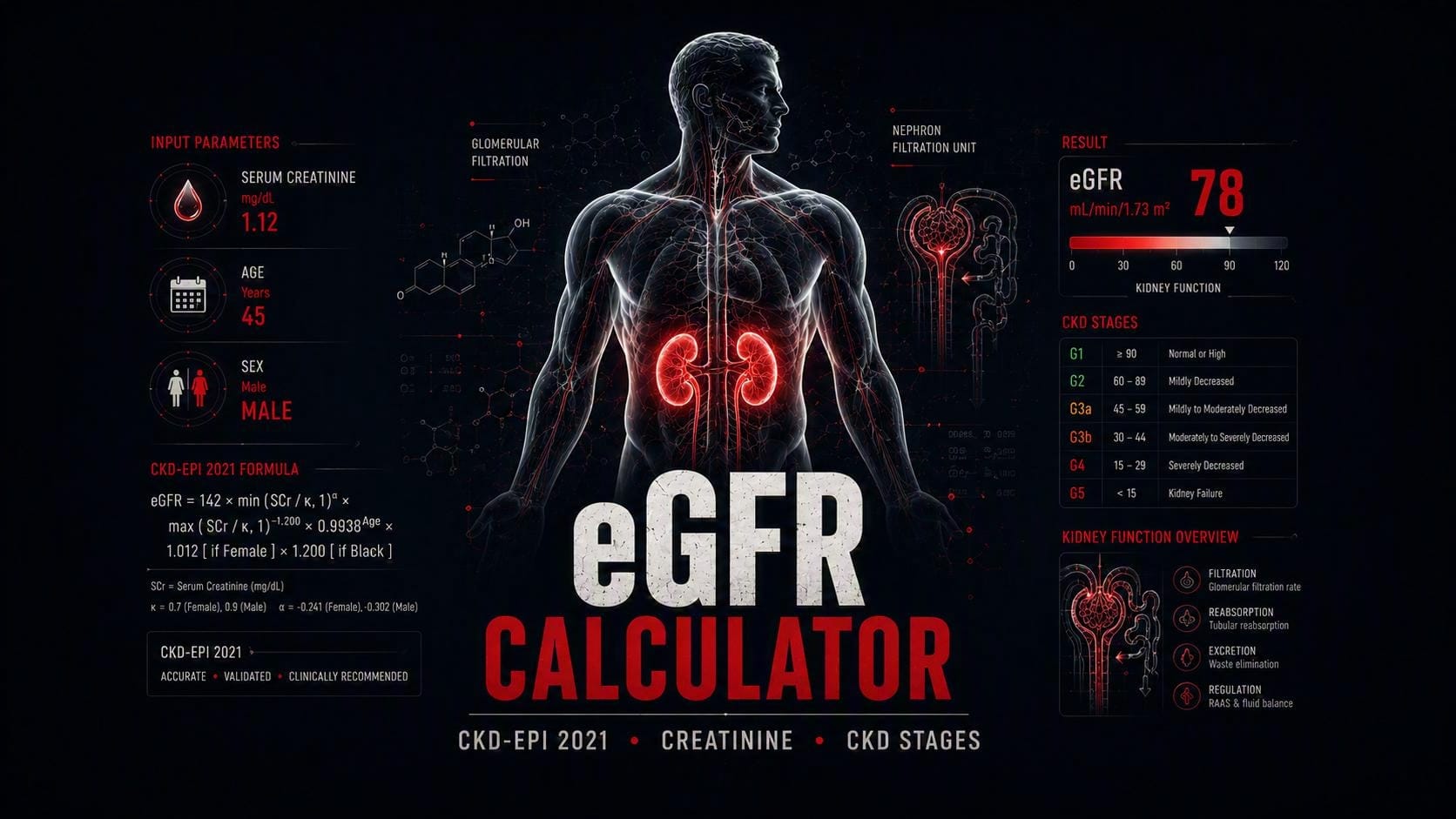
eGFR Calculator:
CKD-EPI 2021
Estimate your glomerular filtration rate using the CKD-EPI 2021 equation - the current clinical standard for kidney function assessment. Enter serum creatinine, age, and sex to get your eGFR in mL/min/1.73m² and CKD stage classification. Essential monitoring for steroid and PED users where renal stress is an ongoing concern. Whether you searched for a GFR calculator, an estimated GFR calculator or a quick eGFR calc, this is the same CKD-EPI estimate.
Estimate kidney filtration from serum creatinine using the race-free CKD-EPI 2021 equation. Drag any slider or type a value - the CKD stage updates live.
Typical: 0.7-1.3 mg/dL
CKD-EPI validated for adults 18+
Enter creatinine and age to see your estimated GFR and CKD stage.
CKD-EPI 2021 creatinine equation (race-free). Educational estimate - a single eGFR is not a diagnosis; muscle mass, hydration and creatine use all shift creatinine. Interpret trends with your physician.
How to use the eGFR calculator
- 1
Enter your serum creatinine
From a recent blood test, in mg/dL (or µmol/L). Draw it rested and well-hydrated for a clean reading.
- 2
Enter your age and sex
The CKD-EPI 2021 equation uses both - and, unlike older versions, no race input.
- 3
Read your eGFR and CKD stage
The tool returns your filtration rate in mL/min/1.73m² and places it on the staging scale.
- 4
Muscular? Check cystatin C
If it reads low and you carry serious muscle, confirm with a cystatin C test before you worry.
This eGFR calculator estimates how well your kidneys filter blood, using the CKD-EPI 2021 equation from your serum creatinine, age and sex. Over 90 is normal; under 60 for three months defines chronic kidney disease. The big catch for lifters: heavy muscle and creatine push creatinine up, so a creatinine-based eGFR calculator can read falsely low - which is where a cystatin C test comes in.
What this eGFR calculator covers
Your eGFR is the single best number for kidney function, and this eGFR calculator turns a routine creatinine result into it using the current CKD-EPI 2021 formula. Unlike a generic tool, this eGFR calculator is built for the lifter and PED user - the group most likely to see a scary-looking number that is really just big muscles and creatine inflating creatinine, not failing kidneys.
Kidney filtration rate, in mL/min/1.73m², from creatinine, age and sex.
Above 90 is normal; under 60 for 3+ months defines chronic kidney disease.
Muscle and creatine raise creatinine, so a creatinine eGFR can read falsely low.
What eGFR measures and why it matters
Your kidneys filter waste out of roughly 180 litres of blood a day. The glomerular filtration rate (GFR) is how fast that filtering happens, and because measuring it directly is impractical, labs estimate it - the “e” in eGFR - from a blood marker your muscles produce called creatinine. Higher creatinine implies slower filtering and a lower eGFR.
It matters because kidney disease is silent: you can lose half your function with no symptoms at all. A falling eGFR is often the first and only warning, which is why it belongs in every serious bloodwork panel - and why reading an eGFR calculator correctly, rather than panicking at one number, is a skill worth having.
The CKD-EPI 2021 equation and how the eGFR calculator works
This eGFR calculator uses the CKD-EPI 2021 creatinine equation, the current standard that notably removed the old race coefficient used in earlier versions. Enter your serum creatinine, age and sex, and the eGFR calculator returns your filtration rate in mL/min/1.73m² and places it on the CKD staging scale.
Accuracy depends on the inputs being clean: a recent, fasted-neutral creatinine drawn when you are well-hydrated and have not just trained hard or loaded creatine. Because the equation is driven almost entirely by creatinine, anything that moves creatinine for non-kidney reasons moves your eGFR with it - the theme of the sections below.
eGFR reference ranges and CKD staging
Kidney function is graded into stages by eGFR. Above 90 is normal (G1); the disease line is an eGFR under 60 that persists for three months or more. The full staging the eGFR calculator maps your result to:
| Stage | eGFR (mL/min/1.73m²) | Description | Clinical Action |
|---|---|---|---|
| G1 | ≥90 | Normal or High | Monitor annually if risk factors present |
| G2 | 60-89 | Mildly Decreased | Identify and address risk factors |
| G3a | 45-59 | Mildly to Moderately Decreased | Monitor every 6 months; nephrology referral if declining |
| G3b | 30-44 | Moderately to Severely Decreased | Nephrology referral; medication dose adjustments |
| G4 | 15-29 | Severely Decreased | Nephrology care; prepare for renal replacement therapy |
| G5 | <15 | Kidney Failure | Immediate nephrology evaluation; dialysis assessment |
CKD is defined by a low eGFR that persists for three months or more. A single dip - after a hard session, dehydration or creatine loading - is not chronic kidney disease. Repeat it under clean conditions before you worry.
eGFR by age - what is normal for you
eGFR drifts down naturally with age as filtering slowly declines, so a number that would flag concern in a 25-year-old can be perfectly normal at 65. Read your result from the eGFR calculator against your age band rather than a single universal cut-off:
| Age Group | Median eGFR (mL/min/1.73m²) | Lower Typical Limit |
|---|---|---|
| 20-29 | 116 | 94 |
| 30-39 | 107 | 87 |
| 40-49 | 99 | 76 |
| 50-59 | 93 | 68 |
| 60-69 | 85 | 60 |
| 70+ | 75 | 52 |
This age drift is also why a mildly reduced eGFR in an older lifter is often just biology, not damage - context that a bare number strips away and that this eGFR calculator is designed to give back.
The muscle and creatinine trap - a falsely low eGFR
Here is the single most important thing a lifter needs to know about any eGFR calculator: it is built on creatinine, and creatinine comes from muscle. A heavily muscled bodybuilder produces far more creatinine at baseline than the sedentary population the equation was calibrated on - so the eGFR calculator reads their filtration as lower than it truly is. Add a creatine supplement, which raises serum creatinine further, and a perfectly healthy athlete can post an eGFR that looks like early kidney disease.
Research backs this up: serum creatinine tracks with muscle mass while cystatin C does not, so cystatin C is the better kidney marker in muscular people (Baxmann, CJASN 2008). Creatine supplements raise creatinine the same way - but a 2026 meta-analysis of randomized trials found no significant change in eGFR or kidney function (Tsiaras, J Ren Nutr 2026).
“A jacked 100 kg bodybuilder on creatine can show an eGFR of 75 with completely healthy kidneys. The number is measuring his muscle, not his nephrons.”
MuscleScience editorial standard“My eGFR is 78, so my kidneys are failing.” Not necessarily. In a muscular, creatine-using athlete a mildly low creatinine-based eGFR is often an artefact of body composition - not chronic kidney disease. Confirm it before you panic.
Cystatin C - the eGFR that ignores your muscle
The clean way out of the creatinine trap is a second marker: cystatin C. It is produced by all your cells at a steady rate and is largely independent of muscle mass, so a cystatin C-based eGFR is not inflated by a bodybuilder’s physique or creatine use. When a creatinine eGFR and a cystatin C eGFR disagree, the cystatin C value is usually closer to the truth in a muscular athlete.
If a creatinine eGFR calculator flags you and you carry serious muscle, ask your doctor for a cystatin C test (or the combined creatinine-cystatin C eGFR). It is the standard way to tell a real problem from a muscle artefact - and it settles most false alarms.
None of this means a lifter can ignore their kidneys - it means you use the right tool. A cystatin C check turns a confusing creatinine eGFR into a clear answer.
How steroids and PEDs affect eGFR
There are two very different stories here, and confusing them is the classic mistake. The first is the artefact already covered: more muscle plus creatine raises creatinine and drops a creatinine-based eGFR without any real kidney harm. The second is a genuine risk: long-term, high-dose anabolic steroid use has been linked to real kidney injury - a pattern called focal segmental glomerulosclerosis - especially alongside the very high protein intakes, NSAIDs and dehydration common in the scene.
The practical rule is to separate the two. A mildly reduced creatinine eGFR in a lean, healthy lifter is usually the artefact; a steadily falling eGFR over time, protein in the urine, or high blood pressure points to something real. A good eGFR calculator gives you the number; a cystatin C test and your trend tell you which story you are in.
A worked eGFR example
Take a 30-year-old man with a serum creatinine of 1.3 mg/dL. In an average-build person the CKD-EPI 2021 equation puts his eGFR around 70 - a number the eGFR calculator would flag as mildly reduced (stage G2, bordering G3). On paper, a worry.
But he is 105 kg, lifts heavily and takes 5 g of creatine a day, all of which raise creatinine independently of kidney function. A cystatin C-based eGFR comes back at 100 - solidly normal. Same man, same day: the creatinine eGFR calculator saw his muscle, the cystatin C saw his kidneys. Reading only the first number would have started a needless workup.
Common mistakes when using an eGFR calculator
- Panicking at one reading. CKD needs a low eGFR sustained for 3+ months - one dip is not a diagnosis.
- Ignoring your muscle. A big, creatine-using athlete’s creatinine eGFR runs low by design - confirm with cystatin C.
- Testing right after training or creatine loading. Both spike creatinine; draw rested and well-hydrated.
- Missing a real downtrend. A steadily falling eGFR, or protein in the urine, is the pattern that matters.
- Using an old formula. Make sure it is CKD-EPI 2021 (race-free), not the outdated MDRD or race-based versions.
eGFR calculator FAQ
The questions lifters ask most before trusting an eGFR calculator result.
What is a normal eGFR?
Above 90 mL/min/1.73m² is normal (stage G1). Chronic kidney disease is defined as an eGFR under 60 that persists for three months or more. eGFR also declines gently with age, so read yours against your age band.
Why is my eGFR low if I feel fine and lift heavy?
Most often because you are muscular and use creatine, both of which raise the creatinine the eGFR calculator is built on - making filtration look lower than it is. A cystatin C-based eGFR, which ignores muscle, usually clears it up.
Does creatine supplementation lower my eGFR?
It raises serum creatinine, which mathematically lowers a creatinine-based eGFR - but that is a measurement effect, not kidney damage. Stop creatine for a couple of weeks before testing, or use cystatin C, for a truer reading.
Can steroids actually damage my kidneys?
Yes, separately from the creatinine artefact. Long-term high-dose anabolic use is linked to real kidney injury (focal segmental glomerulosclerosis), often with high protein intake, NSAIDs and dehydration. A falling trend, proteinuria or high blood pressure are the warning signs.
Which equation should the calculator use?
The current standard is CKD-EPI 2021, which removed the old race coefficient. Avoid the outdated MDRD and race-based formulas; this eGFR calculator uses CKD-EPI 2021.
Is this an eGFR calculator that uses the CKD-EPI equation?
Yes. This eGFR calculator runs the 2021 CKD-EPI creatinine equation (sometimes written CKD EPI) - the current standard that dropped the old race coefficient. It estimates eGFR from creatinine, age and sex, so you can calculate your eGFR from creatinine in seconds. If you also have a cystatin C value, the CKD-EPI creatinine-cystatin C version is more accurate - useful for lifters, whose higher muscle mass can push creatinine up and make eGFR read falsely low.
How is eGFR calculated? The formula in plain terms
The CKD-EPI 2021 eGFR calculation takes your serum creatinine, age and sex and feeds them into a two-slope power equation: eGFR = 142 x min(Scr/k, 1)^a x max(Scr/k, 1)^-1.200 x 0.9938^age x 1.012 if female, where k is 0.7 for women and 0.9 for men and a is -0.241 for women and -0.302 for men. The result is expressed in mL/min/1.73 m2. This eGFR calculator does that arithmetic for you; the manual eGFR calculation formula is here so you can check any lab report by hand.
CKD-EPI vs MDRD: which eGFR calculator is correct?
MDRD was the standard eGFR calculator from 1999 to about 2012 and still appears on older lab reports. It systematically underestimates GFR above 60, so healthy lifters with high creatinine often looked worse than they were. CKD-EPI 2009 improved that, and CKD-EPI 2021 removed the race coefficient entirely. If your lab still prints an MDRD eGFR, re-run the same creatinine through this CKD-EPI 2021 calculator; a difference of 5 to 10 points is expected and does not mean your kidneys changed.
eGFR calculator - key takeaways for bloodwork
An eGFR calculator is the best single read on kidney function, but for a muscular athlete it comes with an asterisk: because it is built on creatinine, heavy muscle and creatine can drag it down without any real kidney problem. Above 90 is normal, and a low value needs to persist for three months to mean chronic kidney disease.
Read the trend, not one number; if a creatinine eGFR flags you and you carry serious muscle, confirm with cystatin C before you worry. Track it beside blood pressure, urine protein and the rest of your panel. Resources below for the full kidney and bloodwork picture.
How to use your eGFR in practice
Turn the number into a decision with a simple routine:
- Draw creatinine rested and well-hydrated, ideally not right after heavy training or creatine loading.
- Enter it in the eGFR calculator (CKD-EPI 2021) and note the stage alongside your age.
- If it is low and you are muscular, add a cystatin C test before drawing any conclusions.
- Watch the trend across several draws - a steady fall matters far more than one value.
- Pair it with blood pressure and a urine protein check, and confirm anything real with your clinician.
References
Every PMID on this page is verified against the PubMed record (title, author, journal and year) before it is published.
Final educational note
This eGFR calculator and the content on this page are provided for educational purposes only. eGFR is an estimate of kidney function derived from a mathematical model (CKD-EPI 2021) and a single creatinine value - it is not a direct measurement of glomerular filtration and is affected by muscle mass, creatine intake, hydration and assay method.
A single eGFR result below any threshold is not a diagnosis of kidney disease. Interpretation requires repeat testing, confirmation with cystatin C where appropriate, urine studies, and evaluation by a qualified physician alongside your symptoms and history. Nothing on this page constitutes medical advice. See our full Disclaimer.
MuscleScience.org does not sell supplements, therapy programmes, or medical services. This is an educational publication only.