Cycle Design
How a steroid cycle is planned, monitored and ended, explained in plain language with numbers from real studies. This hub is about understanding the logic, not promoting use.
Every steroid cycle has the same three parts: before, during and after. Most problems come from skipping the first or the last.
Start With Your Question
Most men open this page with one planning question. Pick the line that fits and go straight to the guide that answers it.
Guides for Planning a Steroid Cycle
Cycles touch three other hubs: steroids, bloodwork and PCT. These are the guides from each one that matter most when planning.
Cards are ordered the way a cycle runs: what to know before, what to watch during, and how recovery works after. Dedicated cycle structure guides are listed under Coming Next.

Blood Tests Before Steroids
Seven markers to check before a steroid cycle: CBC, lipids, liver, kidney, glucose, hormones and blood pressure.

Injectable vs Oral Steroids
In the same 11 lifters, oral stanozolol cut HDL by 33% while injected testosterone cut it by 9%. Why the route matters.

Bulking vs Cutting Steroids
Which compounds suit mass phases and which suit cutting, and how to read the difference in bloodwork.

Bloodwork on a Cycle
In 100 men, pressure, lipids and hematocrit were back to baseline 3 months after the cycle. When to test and what to run.

Low Estrogen on Cycle
On anastrozole, spine bone density fell vs placebo in 69 older men. Why crashing estrogen on a cycle has a cost.

Testosterone Suppression
On testosterone, 88.4% of men in one fertility clinic were azoospermic. Why every steroid cycle shuts down your own production.

When to Start PCT
After one cypionate injection, testosterone was back to baseline by days 13 to 14. Why ester length sets PCT timing.

Hormonal Recovery
Years after stopping, 27% of former users still had testosterone below the reference limit. How recovery works.
Build Cycles by Logic, Not Guesswork
Cycle design should start with purpose, duration, compound behavior, bloodwork and recovery planning. A plan that looks good on paper becomes hard to read if too many variables are added at once.
Define the Goal
Mass, cutting, strength and contest prep carry different risks.
Keep It Interpretable
Too many compounds at once hide what caused a side effect.
Plan Bloodwork Early
Baseline, mid cycle and post cycle labs make decisions calmer.
Think Past the End Date
Suppression, fertility and PCT belong in the plan from day one.
Coming Next
These cycle guides are being written. Each one will appear in the library above when published.
What a Steroid Cycle Does, Step by Step
The best data on a real steroid cycle comes from a Dutch study that followed 100 men before, during and after. Here is what changed.
Measure your normal
Each man had blood pressure, lipids and hematocrit measured before the cycle, at the end, 3 months after and 1 year after the start.
Without that first visit, later numbers have nothing to compare against.
Expect markers to move
During the cycle, systolic pressure rose 6.87 mm Hg, LDL rose 0.45 mmol/L and HDL fell 0.40 mmol/L.
Mean hematocrit rose 0.03 L/L, about 3 points on most lab reports.
Recovery takes months
Three months after the cycle, those markers were back to baseline in the same men.
Hormones can take longer: in another study, 27% of former users still had low testosterone years later.
A cycle is not just the weeks on. Plan the months after it with the same care as the weeks on it.
Replacement or a Steroid Cycle
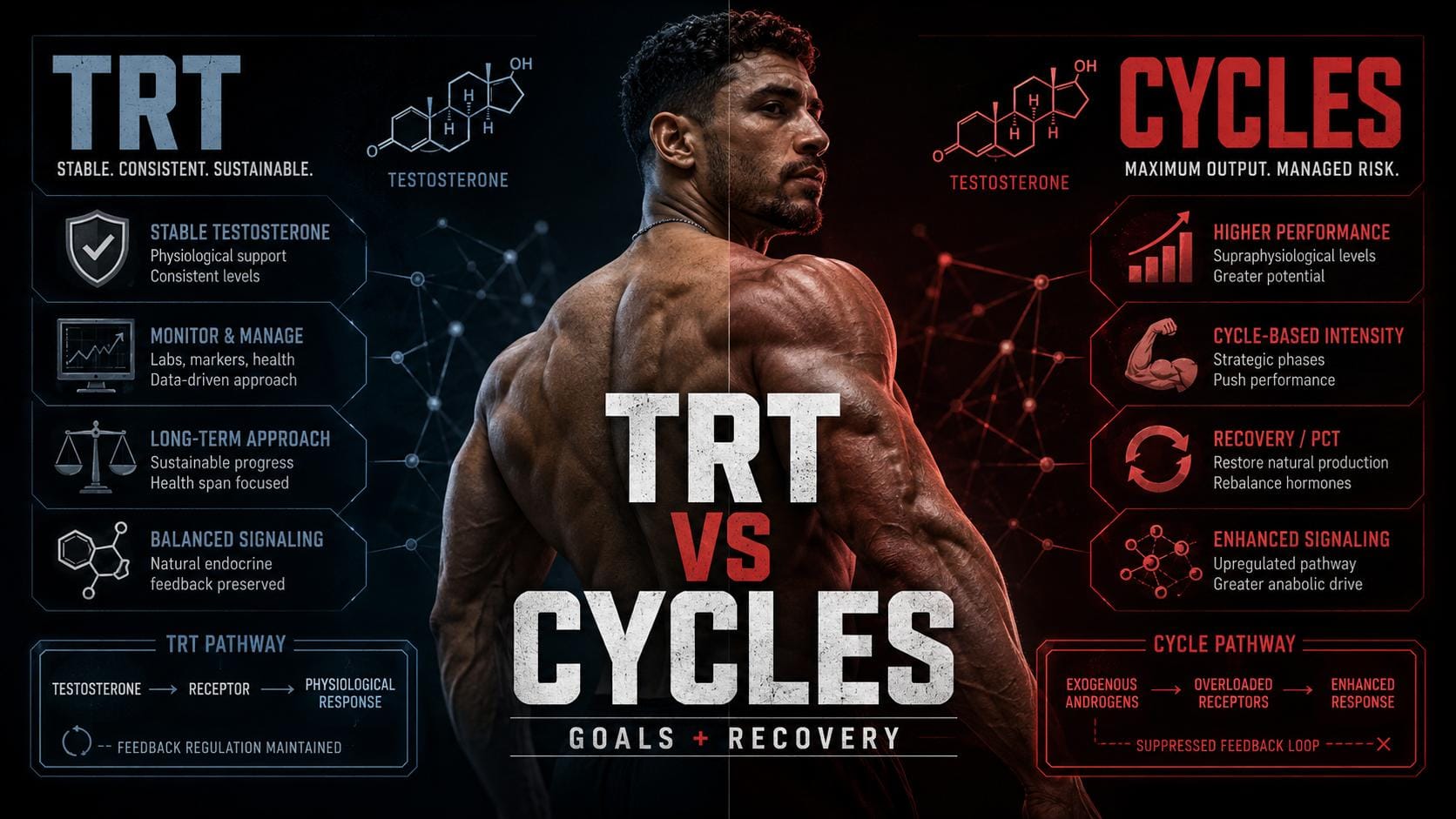
Both put testosterone into the body and both switch off your own production. The difference is the target, the length and the follow up.
TRT
Normal range. TRAVERSE kept men at 350 to 750 ng/dL.
Ongoing, with no planned end date.
Before starting, at 3 to 6 months, then yearly.
Not planned; production stays off while on it.
Cycle
Above the normal range, on purpose.
A set number of weeks, then off.
No standard schedule unless you plan one.
Has to restart on its own or with PCT.
If you are not sure which one you are doing, you are doing a cycle. Read the TRT hub if your goal is a normal range.
6 Numbers From This Hub
These figures come up again and again across the cycle guides. Each one is cited in the guide it comes from.
Rise in systolic pressure, mm Hg, during a cycle in 100 men.
Fall in HDL cholesterol, mmol/L, during the same cycles.
Time for pressure, lipids and hematocrit to return to baseline.
Former users with testosterone below the reference limit years later.
Men reporting decreased libido after the cycle ended.
Men who reported at least one negative effect during the cycle.
Dose and length did not predict side effects in the 100 man study. Individual response mattered more, which is why cycles need bloodwork.
Steroid Cycle: Frequently Asked Questions
Short answers to the questions men ask most when planning or ending a steroid cycle.
What is a steroid cycle?
A steroid cycle is a planned period of anabolic steroid use, usually aimed above the normal hormone range, followed by time off. It differs from TRT, which keeps testosterone in the normal range with regular blood work and no planned end.
How long is a steroid cycle?
There is no medical standard because steroid cycles are not a prescribed treatment. In the 100 man HAARLEM study, cycle length did not predict the type or severity of side effects. Recovery planning matters as much as the weeks on.
What blood tests do you need before a cycle?
A baseline panel covers a CBC with hematocrit, lipids, liver and kidney markers, glucose, hormones and blood pressure. Our guide to blood tests before steroids explains each one.
What changes in the blood during a cycle?
In 100 men, systolic pressure rose 6.87 mm Hg, LDL rose 0.45 mmol/L, HDL fell 0.40 mmol/L and hematocrit rose about 3 points during the cycle.
How long does recovery take after a cycle?
Blood pressure, lipids and hematocrit were back to baseline 3 months after the cycle in the same 100 men. Hormones can take longer: 27% of former users still had low testosterone years later.
Is a steroid cycle the same as TRT?
No. TRT is a medical treatment that keeps testosterone in the normal range. In the TRAVERSE trial, doses were adjusted to stay between 350 and 750 ng/dL. A cycle aims above that range.
Explore Other Hubs
Every topic on Muscle Science has its own hub. Move to the next one from here.
Testosterone therapy, labs and side effects.
Hub →Bloodwork & HealthHow to read every marker on your report.
Hub →PED Side EffectsWhat each compound does to the body.
Hub →SteroidsCompounds explained one by one.
How cycles are structured and why.
Recovery after a cycle.
Hub →PeptidesResearch peptides and what is known.
Hub →SupplementsEvidence on popular supplements.
Hub →TrainingPrograms and lifting technique.
Hub →NutritionDiet, protein and calories for muscle.