TRT vs Steroid Cycles: 7 Differences That Define Which One You Are Actually On
TRT vs Steroid Cycles: 7 Differences That Define Which One You Are Actually On
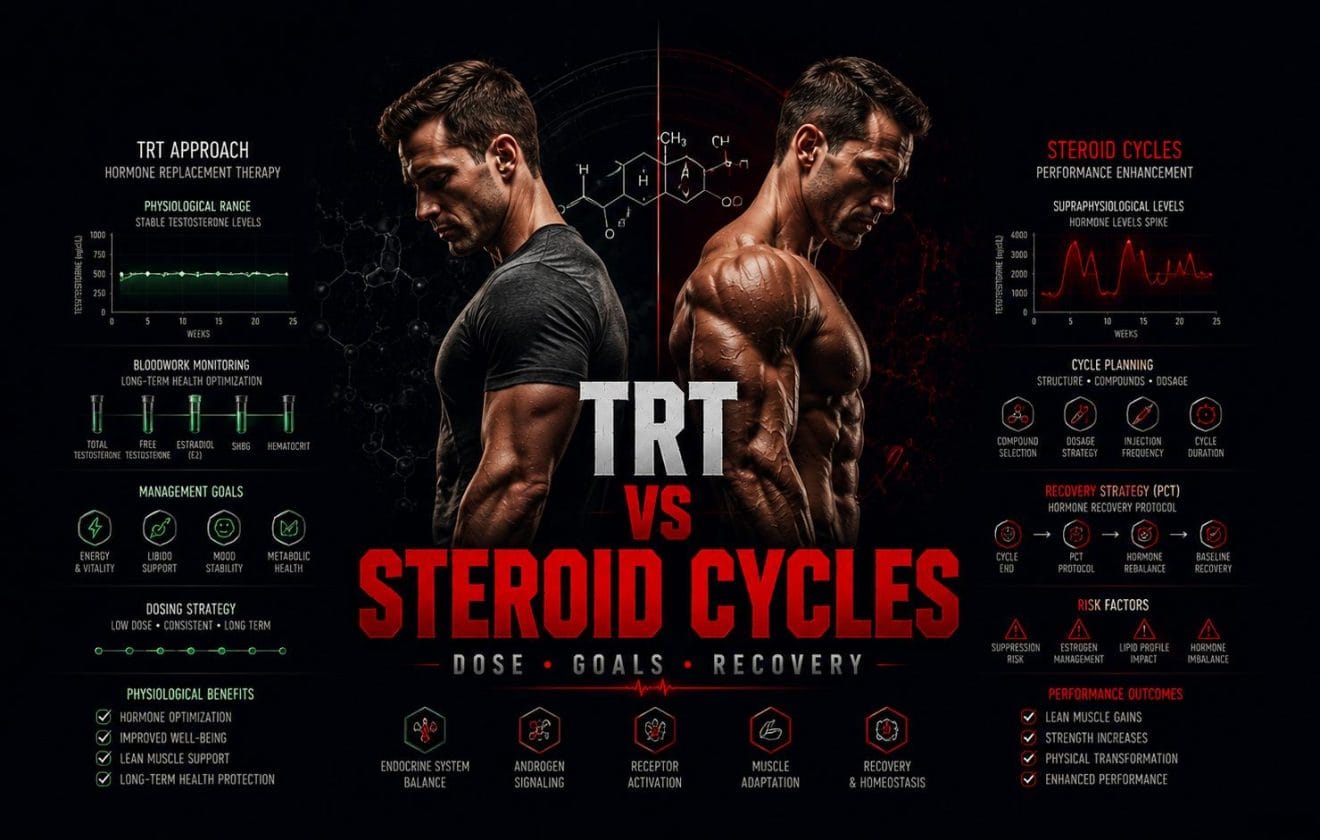
TRT and a steroid cycle can use the same molecule and still be different things. Testosterone replacement therapy restores a diagnosed deficiency to the normal range and continues indefinitely under a monitoring schedule. A steroid cycle pushes androgen levels several times above the normal ceiling for a fixed block of weeks and then has to rebuild a suppressed hormonal axis afterwards. Goal, dose, blood level, duration and exit plan all differ, and each difference changes what the bloodwork, the risks and the recovery look like. This TRT vs steroid cycles guide lays the two side by side with the trial data; "TRT vs steroids" is the same question asked with the same molecule.
Educational and harm-reduction content. MuscleScience does not prescribe, sell or supply testosterone or any other compound, and does not provide cycle protocols. Non-medical anabolic steroid use is illegal in most countries and carries real health risk.
TRT vs Steroid Cycles: 3 Numbers That Separate Them
The TRT vs steroid cycles argument is usually framed as legal versus illegal, or prescribed versus self-directed. Those are real differences, but they are consequences. The pharmacological line is drawn by three numbers.
The Endocrine Society lists testosterone enanthate or cypionate at 75 to 100 mg weekly (or 150 to 200 mg every two weeks) for replacement. The classic performance trial (Bhasin 1996) used 600 mg a week for 10 weeks: six to eight times the replacement dose, and a modest cycle by forum standards.
TRT aims for the middle of the 264 to 916 ng/dL harmonized normal range (AUA: 450 to 600). A cycle deliberately produces levels well above 916, often several thousand ng/dL. On TRT, a supraphysiological result is a dosing error; on a cycle it is the point.
TRT continues for life because the deficiency does not resolve. A cycle ends, and what it leaves behind is a suppressed but previously functional axis. In former long-term users, about 27 percent had total testosterone below the reference limit years later, versus none of the controls (Rasmussen 2016).
The word "TRT" is not a dose. 250 mg or 500 mg of testosterone a week does not become replacement because it is testosterone, and a clinic prescription does not turn a supraphysiological protocol into therapy. Both guidelines define TRT by the blood level it is meant to produce, and that level is inside the normal range.
What each protocol is: the guideline definition of TRT and the measured effects of a performance dose.
Seven parameters side by side: goal, dose, blood level, duration, suppression, recovery and monitoring.
Where the risks overlap and where they diverge: hematocrit, lipids, heart, estradiol and liver, with the magnitude at each dose.
Why suppression means different things in the two contexts, what recovery involves, and the five mistakes that come from confusing them.
What TRT Is, and What a Steroid Cycle Is
TRT is prescribed testosterone for men with confirmed hypogonadism: consistent symptoms plus two morning total testosterone results below the cutoff (264 ng/dL Endocrine Society, 300 ng/dL AUA), after reversible causes have been excluded. The dose is titrated to a mid-normal level at a timed blood draw, and the therapy is monitored at 3 to 12 months and then annually, with hematocrit and PSA on a fixed schedule. Because the man's own production had already failed, suppressing it further costs him nothing he still had. The full framework is in What Is TRT? and the panel in TRT bloodwork.
A steroid cycle is a planned block of anabolic-androgenic steroid use, usually 8 to 16 weeks, at doses chosen to exceed physiology, in a man whose own production was working. The effect is real and dose-dependent. In the Bhasin 1996 trial, 600 mg of testosterone enanthate a week for 10 weeks, with no training at all, added about 424 mm² to triceps cross-section and 607 mm² to quadriceps, and 9 kg to the bench press and 16 kg to the squat, while the placebo groups lost muscle or stayed flat; with training the fat-free mass gain was 6.1 kg. That is what supraphysiological exposure buys, and it is not available at replacement doses. Kicman's pharmacology review and the Endocrine Society scientific statement (Pope 2014) both describe the same trade: the anabolic effect scales with dose, and so does every adverse effect.

The chart is the honest version of "steroids work": measurable muscle and strength gains without training, in healthy men, in ten weeks. The rest of this guide is about what the same dose does to the systems the chart does not show.
A different view: what is left after cycles end. Former long-term anabolic steroid users versus matched controls, median total testosterone and share below the lower reference limit of 12.1 nmol/L (about 349 ng/dL), measured years after cessation (Rasmussen 2016).
This is the difference the label hides. A man on TRT was hypogonadal before he started. A share of men who ran cycles become hypogonadal because they started, and Kanayama's 2015 series describes that withdrawal hypogonadism as common, frequently prolonged and associated with substantial morbidity. Some of them end up on TRT for a deficiency the cycles created.
TRT vs Steroid Cycles: 7 Parameters Compared
Each row in the TRT vs steroid cycles table is a parameter that changes what the protocol is, not just how it is labelled. Status marks the parameter where the two are most often confused.
| Parameter | TRT | Steroid cycle | Status |
|---|---|---|---|
| Goal | Restore a diagnosed deficiency to normal and relieve its symptoms | Exceed normal physiology to gain muscle, strength or leanness beyond what training alone gives | ● Clear-cut |
| Weekly dose | 75 to 100 mg testosterone (or equivalent gel, pellet, undecanoate) | Typically 300 to 1,000 mg or more of testosterone, often with other compounds; the 1996 trial dose was 600 mg | ● Label misuse |
| Blood level | Mid-normal at a timed draw: about 450 to 600 ng/dL, never above 916 by design | Several times the upper limit; often 2,000 to 4,000 ng/dL or more depending on dose and ester | ● Label misuse |
| Duration | Indefinite; reviewed annually, continued while benefit outweighs harm | Time-limited, usually 8 to 16 weeks, then off; "blast and cruise" is continuous use and is not TRT | ● Clear-cut |
| HPTA suppression | Complete; accepted, because the axis was already failing | Complete; imposed on a working axis that now has to recover | ● Same mechanism |
| Recovery phase | None; stopping returns the man to his deficient baseline | Required; post-cycle therapy exists to restart LH, FSH and testicular output, and does not always succeed fully | ● Clear-cut |
| Monitoring | Baseline, 3 to 12 months, then yearly: testosterone, CBC, PSA, lipids, symptoms | Baseline, mid-cycle at 4 to 8 weeks, post-cycle after PCT: CBC, lipids, liver, estradiol, blood pressure, then LH, FSH and testosterone for recovery | ● Same tests, different schedule |
Two rows of the TRT vs steroid cycles comparison deserve a note. "Blast and cruise", where the off-cycle period is replaced by a testosterone "cruise" at 150 to 250 mg a week, is sometimes called TRT because the dose sounds moderate. It usually produces levels above the normal range, it has no diagnosis behind it, and there is no recovery phase, which makes it continuous steroid use with a lower floor, not therapy. And a prescription does not settle the question either: a clinic that titrates to 1,200 ng/dL is prescribing outside both guidelines.
TRT vs Steroid Cycles Risk: Where They Overlap and Where They Diverge
In TRT vs steroid cycles the same organ systems are affected in both contexts, because the mechanism is the same androgen. What differs is magnitude, and magnitude is what turns a monitored side effect into a disease.
Hematocrit: slow drift on TRT, fast climb on a cycle
Erythrocytosis is the most common lab abnormality on TRT (Ohlander 2018); it is dose-dependent and the guidelines act at a hematocrit above 54 percent. On a cycle the same stimulus is several times larger, so hematocrit that would take a year to drift on TRT can cross the threshold in weeks, and compounds such as boldenone add to it. That is why mid-cycle bloodwork at 4 to 8 weeks is not optional. See hematocrit and hemoglobin.
Heart and lipids: the divergence is largest here
Replacement-dose testosterone has a modest effect on HDL and, in the TRAVERSE trial, did not increase major cardiovascular events in high-risk men. Supraphysiological use is a different picture. In Baggish's 2017 study of long-term users, left ventricular ejection fraction averaged 52 percent versus 63 percent in non-users (49 versus 58 percent in current users), with worse diastolic function and more coronary plaque. Oral 17-alpha-alkylated steroids added to a cycle depress HDL far more than injectable testosterone. See the lipid panel guide.
Estradiol: proportional to the testosterone, so proportional to the dose
On TRT, estradiol rises with the dose and neither guideline recommends routine aromatase inhibitors; the usual fix for estrogenic symptoms is a lower or more frequent dose. On a cycle, aromatization scales with a testosterone level several times higher, and management becomes a real problem rather than a rare one. Applying cycle-level inhibitor doses to TRT is a common way to crash estradiol; applying TRT logic to a cycle is a common way to end up with gynecomastia. See estradiol on TRT.
Liver: not a TRT issue, a real one with oral steroids
Injectable and transdermal testosterone at replacement doses have no meaningful liver toxicity; there is no first-pass exposure. Oral 17-alpha-alkylated compounds do, and cholestasis, peliosis and hepatic tumours are described in the Endocrine Society scientific statement (Pope 2014). Liver enzymes belong on every mid-cycle panel when orals are involved, remembering that AST and ALT also rise after hard training.
The Same Suppression, Two Different Meanings
The TRT vs steroid cycles distinction does not exist at the level of mechanism. Any exogenous androgen, at any dose, switches off the hypothalamic-pituitary-testicular axis. GnRH pulses slow, LH and FSH fall to near zero, the testes stop making testosterone and sperm, and they shrink. This is identical on 100 mg a week and on 1,000 mg a week; a replacement dose does not "suppress less". The mechanism is covered in why steroids cause testosterone suppression.
What differs in TRT vs steroid cycles is what the suppression costs. The TRT patient's axis was already producing too little; replacing its output loses nothing he still had, which is why the guidelines accept lifelong suppression as part of the treatment. The cycle user's axis was working. When the cycle ends, that axis has to restart, and the restart is neither automatic nor guaranteed. LH and FSH must rise from zero, the testes must respond, and spermatogenesis must resume. Post-cycle therapy with a SERM such as clomiphene or tamoxifen exists to accelerate that, by blocking estrogen feedback at the hypothalamus. How long it takes and how completely it works are covered in hormonal recovery after steroids, the PCT recovery timeline and what post-cycle therapy is.
Both contexts shut down sperm production. In a fertility-clinic series, 88 percent of men taking testosterone were azoospermic, and about 65 percent recovered sperm within six months of stopping, meaning about a third had not (Samplaski 2014). TRT handles this by planning ahead: men who want children are steered to hCG or clomiphene instead. A cycle handles it, if at all, with PCT afterwards. Neither context should be entered without a semen analysis if future fertility matters. See fertility and suppression on steroids.
TRT vs Steroid Cycle Bloodwork: Same Tests, Different Calendar
In TRT vs steroid cycles the lab panels overlap almost completely. The schedules do not, because the two protocols change the body at different speeds.
| Checkpoint | TRT | Steroid cycle | Status |
|---|---|---|---|
| Baseline | Two morning total T, LH, FSH, SHBG, CBC, PSA from 40, lipids, CMP, HbA1c, blood pressure; semen analysis if fertility matters | Same panel plus liver enzymes and estradiol, before the first dose; this is the only clean reference point the user will ever have | ● Both |
| Early check | 3 to 6 months: timed testosterone, CBC; PSA at 3 to 12 months | Week 4 to 8: CBC, lipids, liver, estradiol, blood pressure; testosterone level is expected to be far above range and is not the question | ● Cycle: practice |
| End of block | Not applicable; annual review instead | After ester clearance and PCT: LH, FSH, total testosterone, estradiol, CBC, lipids, to confirm the axis restarted and markers returned toward baseline | ● Cycle: practice |
| Long term | Annually: testosterone, CBC, PSA per screening, lipids, CMP, symptoms | Between cycles: whether LH, FSH and testosterone have returned to the pre-cycle baseline decides whether the axis is still recoverable | ● TRT: guideline |
For the TRT vs steroid cycles bloodwork in detail, the pre-cycle panel is laid out in blood tests before steroids, the recovery panel in PCT bloodwork, and the timing question in when to start PCT. For reading a testosterone result in either context, total vs free testosterone explains why the same number can mean different things.
5 Mistakes That Come From Confusing TRT With a Cycle
1. Calling a cycle dose "TRT". The most common TRT vs steroid cycles error. 500 mg a week of testosterone is a cycle whatever it is called. The physiology responds to the blood level, not the label, and the label is usually chosen to make the risk feel smaller.
2. Assuming TRT suppresses less. It suppresses completely. The difference is that the TRT patient had nothing left to lose, and the cycle user did.
3. Ending a cycle the way TRT is stopped. Stopping TRT returns a man to his known baseline. Stopping a cycle without a recovery plan leaves a suppressed axis to restart on its own, which it may do slowly, partially or, in a minority, not at all.
4. Monitoring a cycle on a TRT calendar. Six-monthly labs are right for stable replacement and wrong for supraphysiological exposure, where hematocrit, lipids and liver enzymes can move in weeks.
5. Importing estradiol logic in either direction. Cycle-strength aromatase inhibitor use on TRT crashes estradiol; TRT-style restraint on a heavy aromatizing cycle under-treats it. Each context needs its own calibration, and on TRT that calibration is usually the testosterone dose itself.
TRT vs Steroids: Common Questions
Is TRT the same as taking steroids?
No. TRT vs steroid cycles is a difference of dose and purpose, not molecule. TRT uses testosterone at a dose that keeps blood levels inside the normal range to treat a diagnosed deficiency, indefinitely and under monitoring. A steroid cycle uses testosterone or other anabolic steroids at doses that push levels several times above normal for a fixed period, in someone whose own production was working. Same molecule, different dose, goal, duration and aftermath.
What dose of testosterone counts as TRT?
The Endocrine Society lists 75 to 100 mg of enanthate or cypionate a week, or 150 to 200 mg every two weeks, titrated to a mid-normal blood level. A dose that produces levels above the normal range, whatever the milligrams, is not replacement.
Does TRT shut down natural testosterone like steroids do?
Yes, completely. Any external androgen suppresses LH and FSH. The difference is that the TRT patient's production was already inadequate, so nothing functional is lost, whereas a cycle suppresses an axis that was working and has to recover afterwards.
Is blast and cruise the same as TRT?
No. A "cruise" of 150 to 250 mg a week usually produces levels above the normal range, follows no diagnosis, and is continuous use between cycles rather than treatment for a deficiency. It is steroid use with a lower floor, not therapy.
Can steroid cycles cause a need for TRT?
They can. In a study of former long-term users, 27 percent had total testosterone below the reference limit years after stopping, versus none of the controls, and withdrawal hypogonadism is described as common and often prolonged. Some former users end up on lifelong TRT for a deficiency the cycles caused.
Do you need PCT after TRT?
No. TRT is indefinite because the deficiency does not resolve; stopping it returns the man to his deficient baseline, which PCT cannot fix. PCT is a cycle concept, designed to restart a previously functional axis.
Is TRT safer than a steroid cycle?
In TRT vs steroid cycles the risk gap is about magnitude. At replacement doses in properly selected men, testosterone did not increase major cardiovascular events in the TRAVERSE trial, and its risks are monitored on a schedule. Supraphysiological use is associated with reduced heart function, more coronary plaque, worse lipids, faster hematocrit rises and lasting hypogonadism. The risks overlap in kind and differ by an order of magnitude.
How does bloodwork differ between TRT and a cycle?
In TRT vs steroid cycles the tests are largely the same. TRT is checked at baseline, 3 to 12 months and then yearly. A cycle needs a baseline before the first dose, a mid-cycle check at 4 to 8 weeks for hematocrit, lipids, liver and estradiol, and a post-PCT check of LH, FSH and testosterone to confirm recovery.
References
Related Guides
Final Educational Note
This TRT vs steroid cycles article compares two uses of the same class of drug for educational and harm-reduction purposes. It is not medical advice and does not describe or endorse any cycle protocol. Testosterone replacement therapy is a prescription treatment whose indications, dose and monitoring belong with a licensed clinician; non-medical anabolic steroid use is illegal in most jurisdictions.
MuscleScience does not sell or supply any compound. For the wider series, start at the cycle design hub and the TRT guide. Author names are pseudonyms; see the About page and Disclaimer.