How Hormonal Recovery Works After Steroids: Timelines, Predictors and Limits
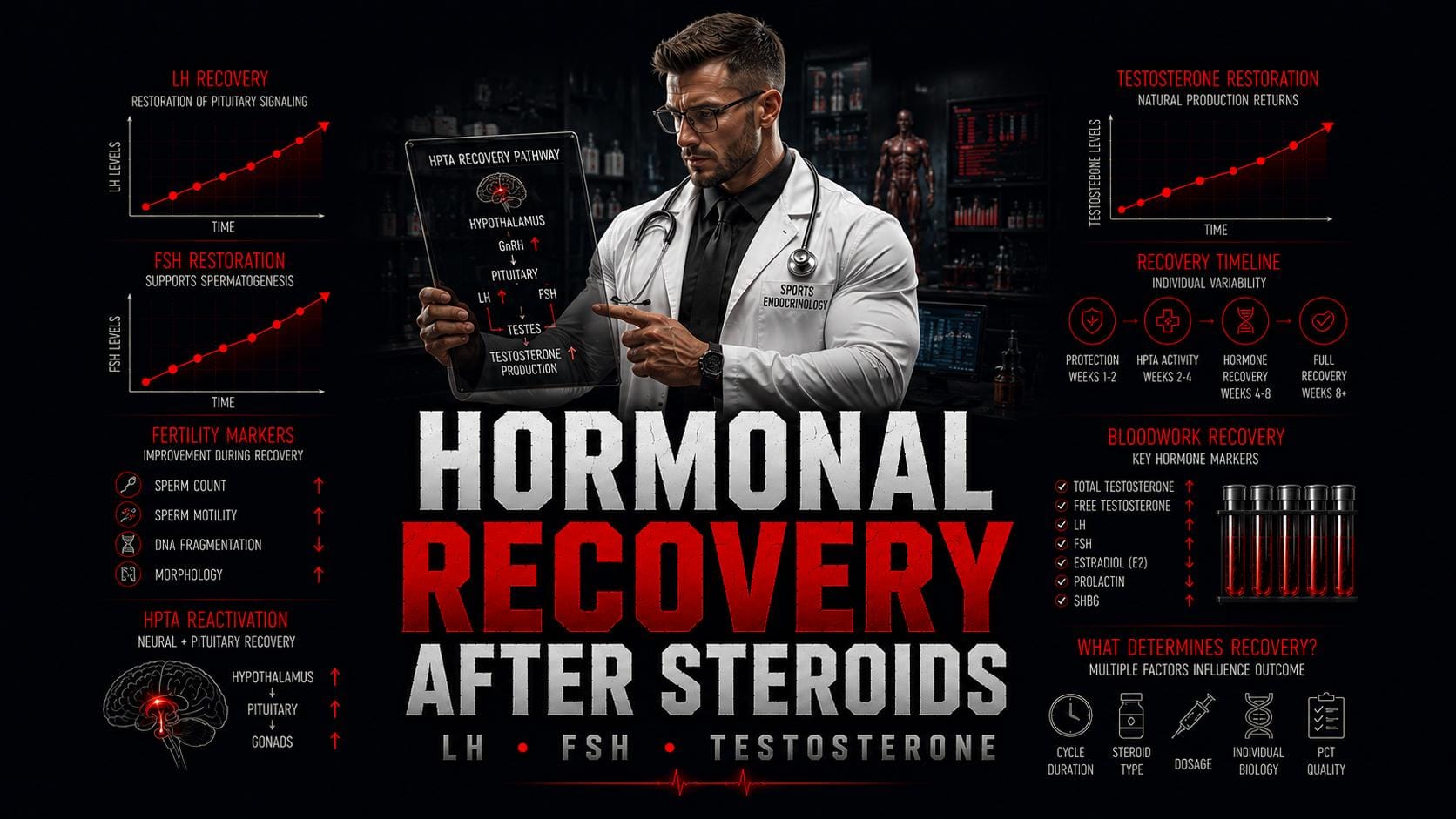
How Hormonal Recovery Works After Steroids: What the Research Shows
Hormonal recovery after steroids follows the same HPG axis that testosterone suppression on steroids shuts down, and how completely it recovers depends on how long and how deep that suppression went before the cycle ended.
What Hormonal Recovery After Steroids Cohorts Actually Found
Low LH (under 1.24 IU/L) fell from 84% of men during use to 4.5% at follow-up after stopping androgenic anabolic steroids.
Low testosterone (under 3.4 ng/mL) was still present in 20.5% of men at follow-up, even after LH had largely normalized.
5 of 19 men (26%) remained under 200 ng/dL testosterone somewhere between 3 and 26 months after their last cycle.
These figures come from three separate cohorts (details and citations below). They describe averages in specific groups of men who used AAS outside medical supervision, not a guarantee for any individual course, and each cohort used its own follow-up window, so the numbers are best read as evidence that recovery is real but incomplete for a meaningful minority, rather than as a single timeline.
What This Guide Covers
What "hormonal recovery" means physiologically: the return of pituitary LH/FSH pulses and testicular testosterone and sperm output after androgen withdrawal, not just a testosterone number in range.
Which factors the research links to slower or incomplete recovery: cycle duration, cumulative dose, compound and ester choice, and age.
How SERM- or hCG-assisted recovery differs from spontaneous recovery: what these drugs can and cannot accelerate.
When the data says to involve an endocrinologist rather than wait out a self-directed timeline.
What Predicts Slower Hormonal Recovery After Steroids
Not every man who stops using AAS has the same hormonal recovery timeline, and the cohort data gives some indication of why. The clearest signal comes from a 2020 study that tracked 44 men after they stopped androgenic anabolic steroids and correlated several exposure variables with how far their LH and testosterone were from normal at follow-up. Cycle duration, total dose and compound choice all showed meaningful negative correlations with recovery, meaning the more of each a man had accumulated, the further his hormones tended to be from baseline when re-checked. None of these correlations is a guarantee for an individual case, but together they describe a dose-response relationship between exposure and how hard the axis has to work to reset itself.
| Factor | What the research shows | Status |
|---|---|---|
| Cycle duration | Longer cumulative time on AAS correlated strongly with slower HPG axis recovery (r=-0.857) in a cohort of 44 men tracked after cessation. | ● Unfavorable |
| Cumulative dose | Higher total dose across a cycle also correlated with worse recovery (r=-0.7825), independent of duration alone. | ● Unfavorable |
| Compound / ester type | Which specific compounds and esters were used correlated with recovery outcome (r=-0.698), though the mechanism (aromatization, receptor affinity, clearance) is not isolated by this data alone. | ● Mixed evidence |
| Age | Scoping reviews of AAS-induced hypogonadism note older men are represented disproportionately among cases of prolonged, treatment-resistant suppression, without an isolated dose-response figure. | ● Mixed evidence |
| Spontaneous recovery over time | Most cohorts show LH and testosterone trending toward baseline over weeks to months without drug intervention, but "trending toward" is not the same as fully normalized for every man. | ● Favorable |
Three Stages of Hormonal Recovery After Steroids

On cycle, suppressed: exogenous androgens block GnRH and LH. Low LH in 84 percent of men, low testosterone in 47.7 percent.
Early post-cycle, partial signal: LH pulses resume, often erratic. Testosterone still catches up to the signal. SERM or hCG can bridge here.
Recovered, axis autonomous: low LH in 4.5 percent, low testosterone still in 20.5 percent. The testes answer with their own testosterone.
Source: Lykhonosov et al. 2020, 44 men tracked after stopping androgenic anabolic steroids. About 1 in 5 still had low T after LH normalized.
Hormonal recovery is not a single event; it is a gradual return of pulsatile GnRH and LH signalling. On cycle, exogenous androgens suppress GnRH and LH through negative feedback, and testicular testosterone production falls toward zero. In the early post-cycle window, LH begins to reappear but is often erratic and testosterone lags behind it, which is why a testosterone reading alone can look better or worse than the axis truly is. In men who reach full recovery, LH and FSH pulse normally again and the testes respond with their own testosterone, independent of any drug still being present. The Lykhonosov cohort captured the middle two stages directly: at the time men used AAS, 84% had LH below 1.24 IU/L; at follow-up, only 4.5% still did, showing the pituitary signal itself usually returns. Testosterone told a different story: 47.7% were below 3.4 ng/mL on cycle, and 20.5% still were at follow-up, meaning roughly one in five testicular responses had not caught up to the recovered signal.
This gap between the two numbers, 4.5% versus 20.5%, is the single most useful figure in this dataset for interpreting hormonal recovery after steroids from your own bloodwork. It means that a normalized LH is a necessary but not sufficient sign of recovery, and that testosterone should be read on its own terms rather than assumed to follow automatically once LH looks normal. It also means the "early post-cycle" stage in the diagram above is not a fixed number of weeks; it is defined by where a given man's LH and testosterone sit relative to these reference points, which only bloodwork, not a calendar, can establish.
When Hormonal Recovery After Steroids Does Not Resolve on Its Own
Selected findings from two independent cohorts of men who used AAS without medical supervision:
The 100-man HAARLEM cohort found 77% had sperm concentrations under 40 million/mL while actively using AAS, consistent with the well-documented suppression of spermatogenesis by exogenous testosterone. That cohort followed the same men prospectively for a year, comparing hormone and semen values during use against repeated checks after stopping, which is part of why its recovery figures are considered some of the more reliable ones available for this population. By six months after stopping, 11% still had testosterone below the normal range, down from a much larger share during use, which is the encouraging part of that dataset, though it also means roughly 1 in 9 men had not fully normalized within the year the study covered.
Separately, a smaller cohort of 19 men followed for 3 to 26 months after their last cycle found 26% (5 of 19) still had testosterone under 200 ng/dL, and 29% reported a depressive episode during the withdrawal period, an association reviewers have linked to the hypogonadal state itself rather than treating it as a separate diagnosis. The wide follow-up window in that cohort (3 to 26 months) is itself informative: it shows that "still low" cases were not confined to the earliest weeks after stopping, but kept appearing well beyond the point most self-directed timelines assume recovery is complete.
Testosterone Recovery and Sperm Recovery Move on Different Timelines
A recurring point in the review literature on exogenous testosterone and AAS is that testosterone recovery and spermatogenesis recovery are not the same clock, even though both are downstream of the same suppressed HPG axis. Testosterone production depends mainly on Leydig cells responding to LH, while sperm production in the seminiferous tubules depends on both LH-driven testosterone locally in the testis and FSH acting on Sertoli cells, a more complex signalling requirement that can take longer to fully re-establish.
Reviews on testosterone replacement therapy and spermatogenesis describe this gap directly: men can show a testosterone value back in range on standard bloodwork while sperm concentration is still markedly suppressed, because intratesticular testosterone (the concentration that matters for spermatogenesis) recovers on a different schedule than the testosterone measured in a venous blood draw. This is also why a exogenous testosterone dose that normalizes serum testosterone does not equal a normalized sperm count, and why fertility-focused recovery protocols track semen parameters separately rather than inferring them from a hormone panel alone.
For most men who stop AAS or discontinue supraphysiologic testosterone, spontaneous recovery of both axes eventually occurs, but the practical implication of "two clocks" is that hormonal recovery after steroids should still be assessed with the specific goal in mind: a man optimizing for testosterone in range on bloodwork and a man optimizing for return of fertility may reach their respective endpoints at different times, even starting from the same suppressed baseline.
What SERMs and hCG Change About Hormonal Recovery After Steroids, and What They Do Not
SERMs (clomiphene, tamoxifen) block estrogen's negative feedback at the hypothalamus and pituitary, which can restart LH and FSH pulses faster than waiting alone. hCG mimics LH directly at the testes, which is useful as a bridge after long cycles but does not itself restart pituitary signalling and is suppressive to LH while it is being used. In practice, some protocols combine the two: hCG to keep the testes responsive during the highest-risk window, followed by a SERM once the goal shifts to restarting the pituitary's own signal rather than substituting for it.
Reviews of AAS-induced hypogonadism converge on the same message: these drugs can shorten the time to a working signal, but they do not repair receptor sensitivity or reverse structural change, and confirmation still requires bloodwork drawn after the drug itself has cleared, not while it is active. A testosterone or LH value measured while hCG or a SERM is still on board reflects the drug's own effect, not the axis's underlying capacity, which is exactly why the recovery-confirming panel is timed for after the assisting drug has washed out.
It is also worth being explicit about what neither drug class does: neither SERMs nor hCG have been shown to reverse the structural or receptor-level changes associated with prolonged suppression, and neither is a substitute for addressing the underlying exposure (duration, dose, compound choice) that predicted slower recovery in the first place. They shorten a timeline that would likely resolve on its own for most men; they do not rewrite the biology behind cases that do not.
See an endocrinologist if testosterone remains below the reference range with LH and FSH also low three to four months after stopping (suggesting the signal has not restarted), or if LH and FSH are elevated with testosterone still low (suggesting the testes themselves are not responding) - both patterns fall outside what SERM or hCG-assisted recovery alone is expected to fix.

Common Ways Hormonal Recovery After Steroids Gets Misjudged
Because hormonal recovery after steroids is judged from bloodwork rather than from how a person feels, it is easy to misread the data even with a genuine cohort of numbers in hand. The mistakes below come up repeatedly in how men interpret their own recovery panels.
1. Treating one normal testosterone reading as proof of recovery. A single value drawn at the wrong time, or while any residual drug or ester is still clearing, does not confirm the axis itself is signalling on its own.
2. Ignoring LH and FSH and looking only at testosterone. The Lykhonosov data shows LH can normalize well before testosterone does; reading testosterone in isolation misses which part of the axis is actually still lagging.
3. Assuming recovery is linear. Cohorts show wide individual variation; some men track the group average, some take longer, and a small share do not fully resolve within the follow-up window studied.
4. Waiting indefinitely without a re-check. If testosterone and gonadotropins have not moved in the expected direction by three to four months, that itself is a finding, not a reason to keep waiting without new bloodwork.
5. Not accounting for mood and libido changes as part of the same picture. The depressive-episode association reported in withdrawal cohorts tracked alongside the hormonal picture, not separately from it, which is one reason clinicians managing recovery ask about both.
6. Judging fertility recovery from a testosterone panel alone. Because sperm production depends on FSH and intratesticular testosterone rather than the testosterone measured in serum, a man can see his blood testosterone normalize well before, or well after, his sperm concentration does. Semen analysis, not a hormone panel, is what actually answers a fertility-specific question.
Frequently Asked Questions
How long does hormonal recovery after steroids take?
It varies by individual and by cycle history, and there is no single number that applies to everyone. Pituitary LH signalling tends to return within weeks to a few months for most men, but testosterone can lag behind that signal, and a meaningful minority still have low testosterone at three to six months or later. Sperm recovery can take longer still, since it depends on both LH and FSH acting on different testicular cell types. Follow-up bloodwork rather than a fixed calendar date is what actually confirms recovery, whichever endpoint (testosterone, fertility, or both) matters most to the individual.
What predicts whether recovery will be slow?
Cohort data links longer cycle duration, higher cumulative dose, and specific compound or ester choices to slower axis recovery. Age is also flagged in review literature as associated with more difficult cases, though it has not been isolated as a standalone predictor with its own dose-response curve.
Does a normal testosterone level mean the axis has recovered?
Not by itself. LH and FSH can lag or lead testosterone depending on the stage of recovery, so a single testosterone value without gonadotropins can be misleading in either direction. A full panel drawn after any drug has cleared is what actually distinguishes a recovered axis from one that is still catching up.
Do SERMs or hCG speed up hormonal recovery after steroids?
For hormonal recovery specifically, they can shorten the time to a working LH signal or stimulate testicular output directly, which is why they are used as a bridge after long or high-dose cycles. Neither repairs the axis structurally, and both still require bloodwork after the drug clears to confirm the recovery is real rather than drug-driven.
Can hormonal recovery after steroids fail to complete?
In most cohort follow-up, no; the majority of men show LH and testosterone trending back toward baseline over the follow-up periods studied. But a documented minority, on the order of a quarter in one small cohort followed for 3 to 26 months, still had low testosterone well after their last cycle. Whether that represents "permanent" suppression or simply a longer recovery than the study window captured is not fully settled by the available data, which is exactly why those cases are referred to endocrinology for individualized evaluation rather than assumed to be temporary indefinitely.
Why does testosterone lag behind LH during recovery?
LH reflects the pituitary signal restarting, while testosterone reflects the testes actually responding to that signal. After prolonged suppression the testicular response can take longer to catch up than the signal itself, which is exactly the gap the Lykhonosov data shows between LH normalization (95.5%) and testosterone normalization (79.5%) at the same follow-up point.
Are mood changes part of hormonal recovery after steroids?
Research on AAS withdrawal has reported depressive episodes alongside biochemical hypogonadism in a meaningful share of men, and clinicians managing recovery generally track both together rather than treating mood as unrelated to the hormonal picture.
When should I see a doctor instead of waiting it out?
If testosterone is still below range at three to four months post-cycle, whichever direction the gonadotropins point - low with low LH/FSH, or low with elevated LH/FSH - that pattern is outside typical spontaneous recovery and is a reason for an endocrinology referral rather than more waiting.
References
All citations are peer-reviewed studies verified via PubMed. Reference links are dofollow to support open science. The recovery timelines and reversibility findings cited in this article are sourced directly from the primary publications below.
Related PCT Guides
All guides are evidence-based, PMID-verified, and written for people navigating post-cycle therapy and hormonal recovery.
Final Educational Note
This hormonal recovery after steroids guide summarizes published research, for educational and harm-reduction purposes. It is not medical advice, not a prediction for any individual, and does not replace bloodwork interpreted by a physician or endocrinologist.
MuscleScience does not sell or supply any compound. For the wider series, start at the PCT hub and the steroids hub. Author names are pseudonyms; see the About page and Disclaimer.