PCT Recovery Timeline: How Long LH, Testosterone and Sperm Take to Come Back
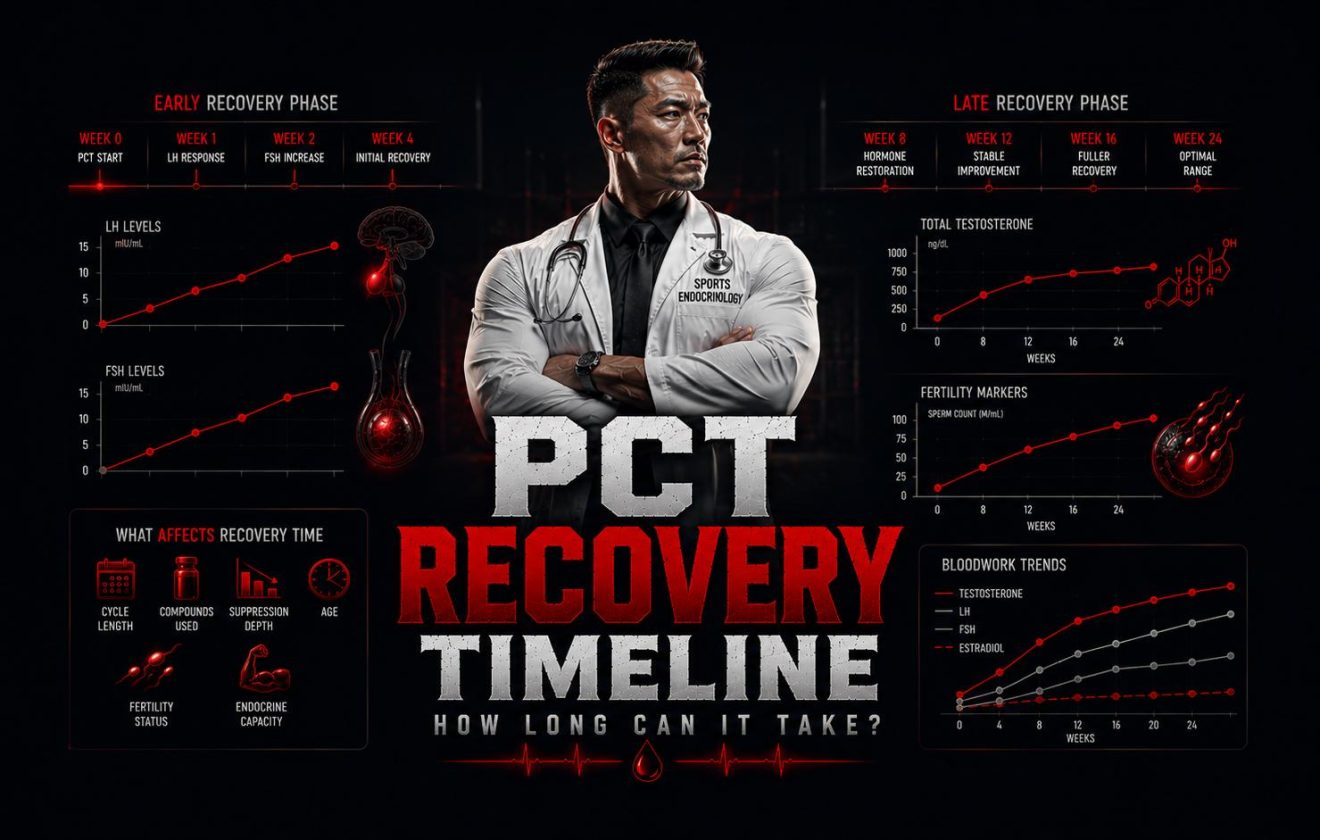
PCT Recovery Timeline: How Long LH, Testosterone and Sperm Take to Come Back
The PCT recovery timeline runs on three clocks, not one. LH and FSH come back first, over weeks; testosterone follows over one to several months; sperm production is last and can take a year or more. Feeling normal is not one of the clocks. This guide puts measured numbers on each stage, from the prospective cohorts that followed cycle users through recovery, shows the ranges by cycle type, and explains why roughly one man in five is still low three months after stopping and what to do about it.
Educational and harm-reduction content. MuscleScience does not sell or supply any compound and does not provide PCT drug protocols. Non-medical anabolic steroid use is illegal in most countries; persistent hypogonadism after stopping is a medical condition that belongs with an endocrinologist.
PCT Recovery Timeline: 3 Numbers From the Cohorts
The PCT recovery timeline has been measured prospectively in men who were tested before, during and after use. Three findings anchor everything else in this guide.
In 44 men followed after about six months of steroid use, median LH rose from 0.2 to 4.1 mIU/mL three months after stopping, but 20.5 percent still had total testosterone below 3.4 ng/mL (340 ng/dL). Recovery correlated strongly with duration of use, dose and compound type (Lykhonosov 2020).
In the HAARLEM cohort of 100 cycle users, average testosterone was back at baseline three months after the cycle, while total sperm count was still 61.7 million lower, and 29.7 million lower at the end of the one-year study (Smit 2021).
Pooled data from 1,549 men in testosterone contraceptive trials put the median time for sperm to recover to 20 million/mL at 3.4 months; recovery was slower with longer use and longer esters (Liu 2006). In former long-term users, 27 percent were still below the testosterone reference limit years later (Rasmussen 2016).
The word "recovered" therefore has three meanings, and a hormone panel only checks two of them. LH and FSH in range is stage one. Testosterone at the pre-cycle baseline is stage two. A semen analysis showing normal count and motility is stage three, and it is the only one that answers the fertility question.
The three endpoints and why they recover in a fixed order: hypothalamus, pituitary, testes.
Measured timelines from the Lykhonosov, HAARLEM and contraceptive-trial cohorts, and the practical ranges by cycle intensity.
Six factors that move a man's timeline: compound, duration, dose, depth of suppression, age, and fertility goals.
Poor responders: how common they are, how to spot one on bloodwork, and the five mistakes that turn a slow recovery into a stalled one.
Why the PCT Recovery Timeline Runs Top-Down
The PCT recovery timeline runs top-down because exogenous androgens shut the axis down from the top. The hypothalamus reads a high androgen and estrogen signal and slows GnRH pulses; the pituitary stops releasing LH and FSH; the Leydig cells, without LH, stop making testosterone; the Sertoli cells, without FSH and intratesticular testosterone, stop supporting sperm production. Recovery reverses the same chain in the same order, and each link has its own speed. The mechanism is detailed in why steroids cause testosterone suppression and the step-by-step restart in hormonal recovery after steroids.
Gonadotropins first. Once the androgen has cleared, GnRH pulses resume and LH and FSH rise within weeks; SERMs such as clomiphene and tamoxifen accelerate this by blocking estrogen feedback at the hypothalamus and pituitary. In the Lykhonosov cohort, 84 percent of men had LH below 1.24 mIU/mL during use and only 4.5 percent still did three months after stopping. Testosterone second. Leydig cells need weeks to rebuild steroidogenic capacity after months of silence, so testosterone lags the LH rise. Sperm last. A full spermatogenic cycle takes about 74 days plus transit, and it cannot start until FSH and intratesticular testosterone are back, which is why sperm counts stay depressed long after the hormone panel looks normal.

The chart is the PCT recovery timeline order made visible. LH is almost universally suppressed during use and almost universally back three months later. Testosterone, one step further down the chain, is back in four men out of five. Every study of the third stage finds the same again: the HAARLEM men had normal testosterone at three months and a sperm count still 61.7 million below baseline.
A different view: how much of each endpoint has recovered about three months after stopping, across the cohorts. Three clocks, three speeds.
PCT Recovery Timeline Ranges by Cycle Intensity
The cohorts give a PCT recovery timeline in averages; the ranges below translate them into the practical pattern by cycle profile. They describe the hormonal timeline measured from the start of PCT, with the sperm column added as its own clock. They are orientation, not prediction; the six factors in the next section move any individual earlier or later, and only sequential bloodwork shows where a man actually is.
| Cycle profile | LH and FSH | Total testosterone | Sperm count | Status |
|---|---|---|---|---|
| Mild testosterone only, 8 to 10 weeks | 4 to 6 weeks into PCT | 8 to 14 weeks | 3 to 6 months | ● Months |
| Moderate testosterone plus an oral, 12 to 16 weeks | 6 to 10 weeks into PCT | 14 to 22 weeks | 6 to 12 months | ● Monitor |
| Heavy 19-nor based (nandrolone, trenbolone), 16 to 20 or more weeks | 10 to 18 weeks into PCT | 4 to 7 months | 12 to 18 months or more | ● Monitor |
| Repeated or long-term use years, short breaks, unconfirmed recoveries | Variable; may recover while testosterone does not | 27 percent of former long-term users still below the reference limit years later (Rasmussen 2016); 5 of 19 untreated former users below 200 ng/dL at 3 to 26 months (Kanayama 2015) | Unpredictable; count may never return to baseline | ● Medical care |
| Poor responders any profile, about 1 in 5 | Usually recover (95 percent at 3 months) | Still low at 3 months in 20.5 percent (Lykhonosov 2020); 11 percent still below normal at one year (Smit 2021) | Follows testosterone, with a further lag | ● Refer |
The first three rows are the pattern seen in practice and in the scoping review by Solanki 2023, which describes hormonal and physical recovery over months and spermatogenesis over months to years, both dependent on age and degree of use. The last two rows are the measured tail. The timing of the first PCT dose is a separate variable that sits in front of all of these and is covered in when to start PCT.
6 Factors That Set Your PCT Recovery Timeline
Two men on the same protocol have different PCT recovery timelines for identifiable reasons. Lykhonosov's cohort quantified some of them: the correlation between duration of use and testosterone recovery was minus 0.86, between dose and recovery minus 0.78, between compound type and recovery minus 0.70. Duration is the strongest single predictor.
Compound: 19-nors suppress hardest
Testosterone-only cycles suppress through androgen and estrogen feedback and the axis responds relatively well once the ester clears. Nandrolone and trenbolone add progestogenic activity and suppress LH and FSH more deeply and for longer; a nandrolone-based cycle routinely doubles or triples the hormonal timeline of a comparable testosterone cycle. Compound type was the third-strongest predictor in the Russian cohort.
Duration: the strongest predictor
Each week of silence lets the Leydig cells drift further from readiness. A correlation of minus 0.86 between months of use and testosterone recovery means duration explained most of the difference between the men who were back at three months and the men who were not. Eight weeks and twenty weeks are different recoveries even at the same dose.
Dose and depth of suppression
Higher doses drive LH and FSH closer to zero and keep them there. A man whose LH never fell below 1 mIU/mL during a cycle has a shorter road than one whose axis was flat for months; the pre-PCT panel records which of the two he is. Dose correlated with recovery at minus 0.78.
Age
Solanki's scoping review names age alongside degree of use as the two determinants of recovery. Leydig cell reserve declines with age, so a 42-year-old with baseline testosterone already drifting down has less to recover to and recovers more slowly than a 24-year-old, and pre-existing subclinical hypogonadism masked by the cycle only becomes visible afterwards.
Prior cycles and unconfirmed recoveries
Every cycle started before the last recovery was confirmed on bloodwork adds to a cumulative suppression burden. The long-term users in Rasmussen's and Kanayama's cohorts are what that burden looks like years later: lower testosterone, smaller testicular volume, and a quarter of them below the reference limit. This is how a temporary suppression becomes the anabolic steroid-induced hypogonadism described by Rahnema 2014.
Fertility goals change the endpoint
If the goal is a normal hormone panel the timeline is weeks to months. If the goal is a child, the timeline is set by sperm, which lagged testosterone by many months in HAARLEM and took a median of 3.4 months to reach 20 million/mL in the contraceptive data, longer after long use. McBride and Coward's review and Desai 2022 describe hCG and FSH as the tools clinicians use when spermatogenesis does not restart on its own. See fertility and suppression on steroids.
The One in Five: Spotting a Stalled Recovery Early
The 20 percent figure in every PCT recovery timeline discussion is not folklore. It is the share of Lykhonosov's cohort still below 3.4 ng/mL at three months, and it sits alongside 11 percent below normal at one year in HAARLEM, 5 of 19 untreated former users below 200 ng/dL at 3 to 26 months in Kanayama's series, and 27 percent below the reference limit years later in Rasmussen's. The pattern on bloodwork tells the two kinds of stalled recovery apart.
LH and FSH near zero with low testosterone, weeks after the PCT drugs have cleared, is a secondary stall: the signal has not restarted. LH and FSH above the normal range with low testosterone is a primary stall: the pituitary is signalling and the testes are not answering, which is the pattern most likely after long or repeated use. Neither responds to another self-managed round of SERMs. Grant's 2023 survey of endocrinologists managing anabolic steroid-induced hypogonadism found wide variation in how it is treated, but agreement that it is treated: with hCG, SERMs under supervision, or, where the testes have not recovered, replacement. The case report by Vilar Neto 2018 shows that even short-term use can leave the axis disordered in a susceptible man.
Testosterone still low with absent or very high gonadotropins at 3 to 4 months post-cycle, confirmed on a repeat draw under proper conditions, is the point to see an endocrinologist with every panel in hand. What to draw, and how to read the patterns, is in PCT bloodwork.
5 Mistakes That Extend the PCT Recovery Timeline
1. Using how you feel as the endpoint. Mood, libido and energy improve on a SERM within two or three weeks because of the drug, and adrenal androgens keep a man functional while the axis is still suppressed. Bloodwork after the drugs have cleared is the only endpoint.
2. Treating hormone recovery as fertility recovery. Normal LH, FSH and testosterone say nothing about sperm count. The HAARLEM men had both a normal testosterone and a count 61.7 million below baseline on the same day. A semen analysis at about three months post-PCT is the fertility endpoint.
3. Starting the next cycle before the last recovery was confirmed. Cumulative suppression is how a 20-percent-at-three-months problem becomes a 27-percent-years-later problem. Confirm the baseline is back before adding to the burden.
4. Cutting PCT short because early symptoms improved. The early lift is pharmacological. Stopping the SERM before the axis sustains itself drops the hormones again and resets the clock.
5. No suppression baseline before PCT. Without LH, FSH and testosterone measured at the end of washout, there is no starting point, no way to tell a slow recovery from a stalled one, and no finish line. The pre-cycle panel that anchors all of it is in blood tests before steroids.
PCT Recovery Timeline: Common Questions
How long does it take to recover after a steroid cycle?
The PCT recovery timeline has three stages: LH and FSH usually recover within weeks, testosterone within one to several months, and sperm production over months to more than a year. After a mild testosterone-only cycle, testosterone is typically back in 8 to 14 weeks from the start of PCT; after a heavy 19-nor cycle, 4 to 7 months. About one man in five is still low at three months.
How long does PCT recovery take for testosterone specifically?
In a cohort of 44 men after about six months of use, median testosterone was back in range three months after stopping, but 20.5 percent were still below 3.4 ng/mL. In the HAARLEM cohort, average testosterone had returned to baseline three months after the cycle, with 11 percent still below normal at one year.
How long until sperm count recovers after steroids?
Longer than testosterone; it is the last stage of the PCT recovery timeline. Pooled contraceptive-trial data give a median of 3.4 months to reach 20 million/mL, slower after longer use and longer esters. The HAARLEM cohort still had sperm counts 29.7 million below baseline at the end of a one-year study. Only a semen analysis confirms this stage.
Why do LH and FSH recover before testosterone?
Because the axis restarts from the top. GnRH pulses and pituitary output resume first once the androgen has cleared; the Leydig cells then need weeks to rebuild their capacity to make testosterone in response to LH. Rising LH and FSH with still-low testosterone is a recovering axis, not a failed one.
What percentage of steroid users do not recover?
About 20 percent were still low three months after stopping in the Lykhonosov cohort, 11 percent at one year in HAARLEM, and 27 percent of former long-term users were below the reference limit years later in Rasmussen's study. Longer use, higher doses and 19-nor compounds raise the risk.
Does feeling normal mean I have recovered?
No. Libido, mood and energy improve on SERMs because of the drug, and can be acceptable while testosterone is still below baseline. Recovery is confirmed by LH, FSH and testosterone measured 4 to 6 weeks after the last PCT dose, and by a semen analysis if fertility matters.
What makes PCT recovery take longer?
Duration of use is the strongest predictor of the PCT recovery timeline, then dose and compound type, with 19-nor compounds the slowest. Age, prior cycles with unconfirmed recovery, and the depth of suppression during the cycle all extend the timeline.
When should I see a doctor about slow recovery?
If testosterone is still low with LH and FSH either near zero or above the normal range at 3 to 4 months post-cycle, confirmed on a repeat draw, see an endocrinologist with all your panels. Another self-managed round of PCT does not fix a stalled axis.
References
Related PCT Guides
Final Educational Note
This PCT recovery timeline article discusses hormonal and reproductive recovery after anabolic steroid use for educational and harm-reduction purposes. It is not medical advice, does not describe drug protocols, and does not replace consultation with a physician or endocrinologist. Cohort figures are group results; an individual's recovery is known only from his own sequential bloodwork.
MuscleScience does not sell or supply any compound. For the wider series, start at the PCT hub and the bloodwork and health hub. Author names are pseudonyms; see the About page and Disclaimer.