Fertility and Suppression on Steroids: What Actually Happens to Sperm Production
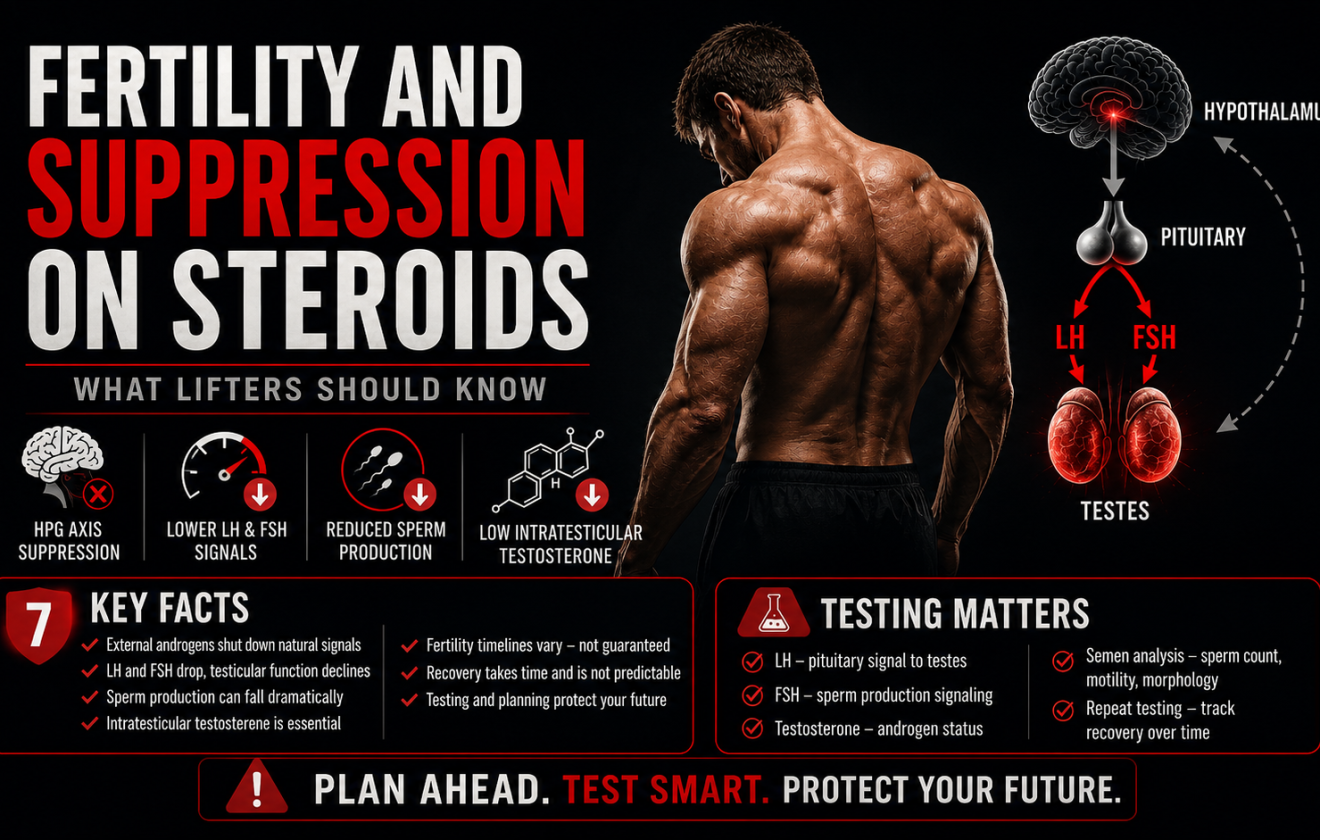
Fertility and Suppression on Steroids: What Actually Happens to Sperm Production
Fertility and suppression on steroids are directly linked because the same hormonal shutdown that lowers natural testosterone production also removes the LH and FSH signals that sperm production depends on, so a man can feel stronger and more androgenic while his sperm count falls toward zero.
What Fertility and Suppression on Steroids Looks Like in the Data
88.4% of men were azoospermic, meaning no sperm was seen in the ejaculate at all, while taking exogenous testosterone in a fertility-clinic cohort.
65% of infertile men using testosterone recovered measurable spermatogenesis within 6 months of stopping, with no other known cause of azoospermia identified.
95.9% of men treated with hCG-based combination therapy for testosterone-related azoospermia or severe oligospermia recovered sperm production, at an average of 4.6 months.
These figures describe fertility and suppression on steroids as it is actually measured in fertility-clinic cohorts and treatment case series, not a theoretical worst case.
What This Fertility and Suppression on Steroids Guide Covers
The mechanism connecting fertility and suppression on steroids: how exogenous androgens suppress LH, FSH and intratesticular testosterone, the three inputs sperm production actually depends on.
Why a testosterone number does not prove fertility status, and why libido, erections and gym performance prove even less about sperm production.
How complete suppression gets while a cycle is running, and how ester length, compound choice and duration change how long it lasts.
What the recovery data actually shows, including unassisted recovery, hCG-assisted recovery, and when a fertility specialist is the right next step.
Where Sperm Production Breaks Down Along the Axis

Fertility and suppression on steroids trace back to the same hypothalamic-pituitary-gonadal (HPG) axis that governs testosterone production, but sperm production needs two separate signals working together, not one. The hypothalamus releases GnRH in pulses, which tells the pituitary to release both LH and FSH. LH drives Leydig cells to make testosterone, and a portion of that testosterone stays inside the testes at a concentration many times higher than in blood, called intratesticular testosterone, which is what actually drives sperm development. FSH separately supports the Sertoli cells that nurse developing sperm through their maturation cycle. Losing either signal can impair sperm production even if the other looks fine.
Exogenous androgens suppress this whole system from the top down. The hypothalamus and pituitary read circulating testosterone or another androgen the same way regardless of its source, so a high enough external dose reads as "already enough" and GnRH pulses fall. Less GnRH means less LH and FSH together, which means Leydig cells stop being told to produce testosterone and Sertoli cells stop being told to support sperm development at the same time. This is why fertility and suppression on steroids move together in most men rather than one showing up without the other.
The part that trips up most lifters is intratesticular testosterone. A blood panel measures testosterone in serum, and exogenous use can push that number into a normal or high range. But intratesticular testosterone depends on local LH stimulation of Leydig cells, not on how much androgen is circulating in the bloodstream from an injection or oral dose. When LH is suppressed, intratesticular testosterone can fall sharply even while serum testosterone looks unremarkable or elevated, which is the core reason a normal blood test cannot rule out suppressed sperm production.
Why a Normal Testosterone Reading Does Not Prove Fertility
Fertility and suppression on steroids get confused constantly because lifters assume one lab value tells the whole story. It does not. Each marker below answers a different question, and only one of them confirms fertility status directly.
| Marker | What It Shows | Status |
|---|---|---|
| Serum testosterone | Circulating androgen level, which exogenous use can raise regardless of what the testes are doing on their own. | ● Does not confirm |
| LH | Whether the pituitary is signaling Leydig cells to produce testosterone; suppressed LH points toward suppressed sperm support, but is indirect. | ● Partial signal |
| FSH | Whether the pituitary is signaling Sertoli cells to support spermatogenesis; low FSH is a warning sign, not a diagnosis on its own. | ● Partial signal |
| Intratesticular testosterone | The local androgen concentration that actually drives sperm development; the best mechanistic marker, but not part of routine clinical bloodwork. | ● Not routinely measured |
| Semen analysis | Direct measurement of sperm concentration, motility and morphology; the only test on this list that confirms fertility status. | ● Confirms fertility |
How Complete Is Suppression While a Cycle Is Running
Selected findings on fertility and suppression on steroids from independent cohorts and controlled trials:
The first two rows show how fast and how complete suppression gets: close to 9 in 10 men in a fertility-clinic cohort were azoospermic while using exogenous testosterone, and a controlled trial combining a GnRH antagonist with testosterone drove 7 of 8 healthy men to azoospermia within 6 to 10 weeks while their libido and sexual function stayed intact, which is direct evidence that feeling fine sexually says nothing about sperm production. The last two rows show why the recovery conversation cannot stop at "suppression is reversible." Two thirds of men recovered spermatogenesis on their own within roughly half a year, which is the outcome most people expect. But a separate systematic review of long-term AAS-induced hypogonadism found that among the smaller subset of cases with fully documented outcomes, only about 1 in 10 showed complete HPG axis reversibility, a much lower figure than the unassisted-recovery number above.
Fertility and suppression on steroids therefore is not one fixed outcome; it depends heavily on which population and which timeframe a given statistic comes from. Short-term testosterone-only use in a fertility clinic setting recovers well for most men within months. Longer-term, higher-dose, non-medical AAS use, tracked over a longer horizon, shows a meaningfully worse picture in the subset of cases doctors actually follow to a known outcome, which is exactly the population that matters most for men planning to have children after stopping.
Why Ester Length Changes Fertility Suppression, Not Just Testosterone Suppression
Fertility and suppression on steroids are tied to ester length in the same way testosterone suppression is. Studies tracking hormone kinetics after intramuscular testosterone cypionate show blood androgen levels rising and falling over roughly two to three weeks per injection, which means negative feedback on the HPG axis, and therefore on LH, FSH and sperm production, stays active for that entire window after each dose, not just on injection day.
Longer esters extend this further. Testosterone undecanoate formulations, studied specifically because they allow extended dosing intervals of roughly ten to fourteen weeks between injections, keep circulating androgen elevated and negative feedback engaged for months at a stretch by design, which is useful for steady testosterone replacement but means the axis, and sperm production with it, has no real window to resume signaling until the drug clears. A man using a long-acting ester for an extended cycle is, mechanically, keeping fertility and suppression on steroids linked for far longer than the calendar length of the cycle itself, because the drug is still suppressing the axis for weeks to months after the last injection.
This is the practical reason fertility timelines cannot be estimated from "days since the last dose" alone. A short-ester compound clears in days, and the axis can begin resuming signal within a similar window. A long-ester compound can still be actively suppressing LH and FSH ten or more weeks after the last injection, which pushes any meaningful recovery in sperm parameters out by a comparable amount, on top of the time spermatogenesis itself needs to complete a full production cycle once the signal returns.
What Makes Fertility Recovery Slower or Less Certain
Long-acting esters and extended cycle duration
Compounds designed to keep androgen levels elevated for weeks between doses keep the HPG axis suppressed the longest, extending how long fertility and suppression on steroids stay linked well past the point dosing stops.
Repeated or back-to-back cycles without real recovery time
Starting a new cycle before LH, FSH and sperm parameters have actually normalized does not give the axis a chance to reset, and can compound suppression across cycles rather than resetting it each time.
Pre-existing subfertility or baseline low sperm parameters
A history of varicocele, testicular injury, or a baseline semen analysis that was already borderline gives suppression less reserve to work against, which is a strong argument for testing fertility status before, not after, using a compound that suppresses the axis.
Age 35 and older combined with stacked or high-dose compounds
Baseline fertility naturally declines with age independent of steroid use, so stacking multiple compounds or running higher doses on top of an older baseline narrows the margin for a fast, complete recovery.
What Can Be Done to Preserve or Restore Fertility
Men presenting to fertility clinics with testosterone-related azoospermia or severe oligospermia have been treated with hCG-based combination therapy, restarting a signal similar to LH directly at the testes rather than waiting for the pituitary to resume on its own; in one case series 95.9% recovered measurable sperm production at an average of 4.6 months, with a mean first sperm density of 22.6 million per milliliter once recovery began.
SERMs such as clomiphene citrate work differently: they block estrogen's negative feedback at the pituitary, which raises the body's own LH and FSH output rather than suppressing it, and treatment-outcome data on long-term clomiphene use for hypogonadism specifically notes it is not typically offered as a first-line option in men who do not want to preserve fertility, precisely because, unlike exogenous testosterone, it does not shut down the axis it is meant to support.
The practical takeaway: fertility and suppression on steroids is not an all-or-nothing outcome. A baseline semen analysis before use, avoiding unnecessary long-acting or stacked exposure when fertility is a near-term priority, and using hCG or a SERM under medical supervision when recovery is slow are the options the literature actually supports, not a guarantee, but a meaningfully better position than guessing.
Common Mistakes About Fertility and Suppression on Steroids
1. Assuming strong libido or training performance proves fertility is fine. A controlled trial that drove 7 of 8 men to azoospermia found libido and sexual function stayed intact throughout, which is direct evidence that feeling "on" proves nothing about sperm production.
2. Assuming stopping the compound reverses suppression immediately. Fertility and suppression on steroids do not uncouple on the day dosing stops; ester clearance, axis restart, and a full spermatogenesis cycle all take additional time on top of each other.
3. Ignoring FSH and semen analysis while watching testosterone and estradiol. Testosterone and estradiol numbers say nothing about FSH or actual sperm counts, and a fertility conversation without a semen analysis is incomplete.
4. Waiting until actively trying to conceive before testing anything. Baseline and follow-up semen analysis takes time to arrange and interpret; starting that process only after months of failed conception attempts wastes time that matters for a couple trying to plan.
5. Assuming every compound and ester suppresses fertility equally. Longer-acting esters and higher total doses keep the axis suppressed longer than shorter esters at moderate doses, which changes the realistic recovery timeline, not just the theoretical one.
6. Assuming an aromatase inhibitor or "on-cycle support" supplement protects fertility. Neither addresses the androgen-driven suppression of LH and FSH at the pituitary, which is the actual mechanism behind fertility and suppression on steroids; only stopping the suppressing compound, time, or a targeted intervention like hCG or a SERM address that mechanism directly.
Frequently Asked Questions
How are fertility and suppression on steroids connected?
Exogenous androgens suppress the same GnRH-LH-FSH signal that drives both testosterone production and sperm development, so the two are suppressed by the same mechanism at the same time rather than being separate problems.
Can steroids cause infertility even if testosterone looks normal on bloodwork?
Yes. Serum testosterone can look normal or high from exogenous use while LH-driven intratesticular testosterone and FSH-driven Sertoli-cell support are both suppressed, which is why a semen analysis, not a testosterone reading, is what actually confirms sperm production.
How common is azoospermia while using testosterone or steroids?
High. In a fertility-clinic cohort, 88.4% of men were azoospermic while actively taking exogenous testosterone, and a controlled trial reached azoospermia in 7 of 8 men within 6 to 10 weeks of combined GnRH antagonist and testosterone treatment.
Does fertility recover on its own after stopping steroids?
Often, but not always on a predictable timeline. About 65% of men recovered spermatogenesis unassisted within 6 months in one cohort, while a separate long-term review of AAS-induced hypogonadism found complete axis reversibility in only about 1 in 10 of the cases it could fully track, so unassisted recovery is common but not guaranteed for every man.
Does hCG help restore fertility after steroid-induced suppression?
In a case series of men treated for testosterone-related azoospermia or severe oligospermia, hCG-based combination therapy was associated with a 95.9% recovery of measurable sperm production, at an average of 4.6 months, though this describes a treated clinical population rather than a guarantee for every case.
Do SERMs like clomiphene affect fertility differently than testosterone does?
Yes. SERMs raise the body's own LH and FSH output by blocking estrogen feedback at the pituitary rather than suppressing it, which is why they are used in men who want to preserve fertility, unlike exogenous testosterone, which suppresses that same signal.
Does ester length change how long fertility stays suppressed?
Yes. Longer-acting esters, such as testosterone undecanoate formulations dosed every ten to fourteen weeks, keep circulating androgen and negative feedback active for months at a time, which extends how long fertility and suppression on steroids stay linked well past the last injection.
When should a man see a fertility specialist about steroid-related suppression?
Before conception attempts stall for months, ideally with a baseline semen analysis before starting a compound and follow-up testing if a couple has been trying to conceive for six months to a year without success, or sooner if testicular shrinkage or other symptoms are present.
References
All citations are peer-reviewed studies verified via PubMed. Reference links are dofollow to support open science. The azoospermia, recovery and hormone-kinetics figures cited in this article on fertility and suppression on steroids are sourced directly from the primary publications below.
Related PCT and Steroid Guides
All guides are evidence-based, PMID-verified, and written for people navigating steroid side effects, PCT and hormonal recovery.
Final Educational Note
This guide explains why fertility and suppression on steroids are linked and what the research says about how complete suppression gets and how reliably it recovers, for educational and harm-reduction purposes. It is not medical advice and does not replace a semen analysis or fertility evaluation from a qualified physician, urologist or endocrinologist.
MuscleScience does not sell or supply any compound. For the wider series, start at the PCT hub and the steroids hub. Author names are pseudonyms; see the About page and Disclaimer.