SHBG Levels Explained: 6 Facts About Free Testosterone
What SHBG is and why it matters
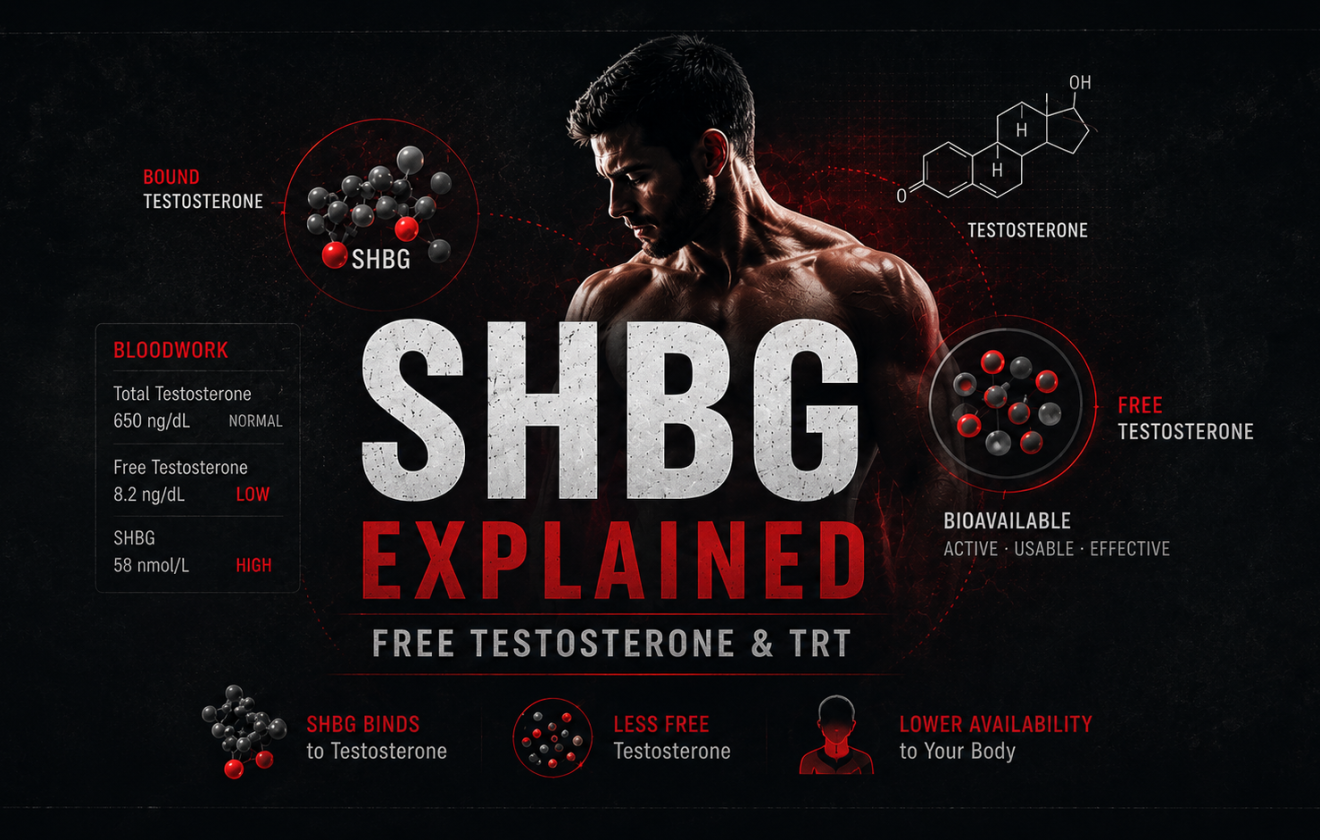
SHBG (sex hormone binding globulin) is a protein made mostly by your liver that grabs onto testosterone and estrogen and carries them through the bloodstream. Testosterone bound to SHBG is held tightly and cannot act on your tissues, so SHBG effectively decides how much of your testosterone is actually available. That makes SHBG one of the most important and most ignored numbers on a hormone panel.
Here is why it matters in one sentence: two men with an identical total testosterone can feel completely different because one has high SHBG levels locking most of it away and the other has low SHBG levels leaving far more of it free. This guide explains what SHBG does, what high and low levels mean, what moves it, and includes a live tool that classifies your SHBG and shows the free testosterone it leaves behind.
What SHBG actually does
Think of SHBG as a fleet of taxis for your sex hormones. Testosterone that is riding in an SHBG taxi is locked in the back seat - it is in your blood, it counts toward your total, but it cannot get out and act on muscle, brain or libido. Only testosterone that is not bound to SHBG can do anything, which is why SHBG is the gatekeeper of your hormonal status.
In a typical man, roughly 40 to 60 percent of total testosterone is bound to SHBG, another 40-ish percent is loosely bound to albumin, and only about 1 to 3 percent is truly free. Because albumin's grip is weak, free plus albumin-bound testosterone together make up your bioavailable testosterone. The SHBG-bound share is the part that is genuinely out of reach, so the more SHBG you have, the smaller your usable dose from the same total.
SHBG also binds estrogen, though less tightly than testosterone, which is why the picture is not purely about one hormone. When SHBG rises it tends to lower free testosterone more than free estrogen, subtly tilting the balance between the two. That interaction is part of why SHBG is worth watching alongside estradiol rather than in isolation, and why it quietly shapes so much of how a hormone panel actually plays out in the body.
How SHBG changes free testosterone
This is the whole reason SHBG matters clinically. Because SHBG binds testosterone tightly, your SHBG level largely sets your free fraction. Hold total testosterone fixed and change SHBG, and free testosterone swings dramatically - no change in production required.
The chart makes it concrete. At a fixed total of 600 ng/dL, a man with low SHBG of 15 nmol/L carries roughly 183 pg/mL of free testosterone, while a man with high SHBG of 90 nmol/L has only about 62 pg/mL. Same total, roughly three times the usable testosterone, purely because of SHBG. That is why a total testosterone result read without SHBG is only half the story.

What is a normal SHBG level
SHBG is measured in nmol/L. For adult men a common reference range is roughly 18 to 57 nmol/L, and for women it is higher, often around 40 to 120 nmol/L, because estrogen raises SHBG. As always, ranges differ between labs and assays, so read your result against your own lab's stated range rather than a number from the internet.
The bigger point is that “normal” is a wide band, and where you sit inside it changes your free testosterone a lot. An SHBG at the bottom of the range and one at the top are not interchangeable even though both are technically normal. Your age, body composition, thyroid status and medications all shift where you land, as the ranges chart shows.

Interpret your own SHBG
Enter your numbers below. The tool classifies your SHBG levels as low, normal or high for an adult man and, using the Vermeulen equation, shows the free testosterone that SHBG leaves you with.
SHBG Interpreter
Drag the sliders (or type) to enter your SHBG and total testosterone. It classifies your SHBG and estimates the free testosterone it leaves you (Vermeulen equation).
Try holding total testosterone fixed and moving SHBG up and down - watch how much your free testosterone changes. That single interaction is the reason SHBG levels belong on every panel. For unit toggles, sliders and a zone gauge, use the full free testosterone calculator.
What raises and lowers SHBG
SHBG is not fixed - it responds to your body and your habits, which is what makes it a lever rather than just a lab value. It rises with ageing, an overactive thyroid, higher estrogen (including oral estrogen), very low body fat and aggressive fasting, and liver disease. When SHBG rises, free testosterone falls even if your testes are producing exactly the same amount.
It falls with insulin resistance, obesity and type 2 diabetes, an underactive thyroid, growth hormone and high insulin, and any form of androgen use including TRT and anabolic steroids. A crashed SHBG is why metabolic problems and androgen use both raise the free fraction. The diverging chart ranks the common movers on each side.

High vs low SHBG levels at a glance
High and low SHBG levels pull your free testosterone in opposite directions and come from different causes. Here is the practical comparison:
| Aspect | High SHBG | Low SHBG |
|---|---|---|
| Free testosterone | Pushed DOWN (more bound) | Pushed UP (less bound) |
| Common causes | Ageing, hyperthyroidism, estrogen, very low body fat, liver disease | Insulin resistance, obesity, type 2 diabetes, androgens, hypothyroidism |
| What it can feel like | Low-T symptoms despite a normal total | Strong effects (or side effects) at a modest total |
| Total testosterone reads | Can look normal or high while free is low | Can look low-normal while free is adequate |
| The fix to consider | Address the driver; judge status by free T | Address metabolic health; watch estradiol |
Neither extreme is automatically good or bad - what matters is interpreting your total testosterone in light of where your SHBG sits.
What high SHBG can mean
High SHBG binds up more of your testosterone, so it leaves you with a low free fraction even when your total looks perfectly normal. This is the single most common reason for the frustrating “my testosterone is normal but I feel hypogonadal” picture - low libido, fatigue, poor recovery and low mood sitting on top of a total that a doctor calls fine.
High SHBG is often driven by ageing, an overactive thyroid, elevated estrogen or a period of very low body fat and hard dieting. It can also be genetic. The key move is not to panic about the number itself but to calculate free testosterone, look for the driver, and judge symptoms against the free and bioavailable numbers rather than the total alone.
What low SHBG can mean
Low SHBG does the opposite: it frees up more testosterone, so your free fraction runs high relative to your total. That can sound desirable, but low SHBG is usually a red flag for what is causing it. The most common driver is insulin resistance and excess body fat, so a low SHBG level often travels with metabolic problems that matter far more than the SHBG reading itself.
Low SHBG is also expected on TRT and anabolic steroids, because androgens suppress it. That is part of why people on testosterone can feel strong effects at a total that would look unremarkable in a natural man. If your SHBG is low and you are not using androgens, treat it as a nudge to check fasting glucose, insulin and body composition rather than something to celebrate.
There is a useful research angle here too: low SHBG has been linked in large studies to a higher risk of developing type 2 diabetes, likely because it travels with the same insulin resistance that drives it. In other words, a low SHBG can be an early flag worth acting on for your metabolic health, not just a footnote on a testosterone panel.
SHBG on TRT and steroids
For anyone on testosterone, SHBG is central to reading bloodwork correctly. Exogenous androgens push SHBG down, which means a larger share of your total becomes free. A man on TRT can therefore feel meaningful effects at a total that looks ordinary, and free or bioavailable testosterone tracks the experience far better than total does on treatment.
It also explains dosing quirks. Someone with naturally high SHBG levels may need a higher total on TRT to land a normal free level, while someone with already-low SHBG level reaches a strong free fraction on a modest dose. Watching SHBG alongside estradiol tells you which way your free testosterone is being pushed, and helps you avoid chasing a total number that does not reflect how you actually feel.
The practical rule is consistent with everything above: on or off treatment, interpret testosterone through the lens of SHBG, and dose to free and bioavailable levels rather than to the headline total.
Can you actually change your SHBG levels?
Yes, within limits - and this is where most explainers stop short. SHBG responds to real, controllable inputs, so if your level is working against you it is often movable. Here is what actually shifts it, roughly in order of impact.
- 1
Fix insulin resistance to lower high SHBG
Improving insulin sensitivity through fat loss, strength training and cutting refined carbohydrate is one of the most reliable ways to bring high SHBG levels down. Metabolic health and SHBG move together, so this is the highest-value lever for most people.
- 2
Check your thyroid
An overactive thyroid pushes SHBG up and an underactive one pulls it down. If your SHBG is unexpectedly high or low, a thyroid panel is worth ordering before you blame anything else.
- 3
Mind extreme dieting and very low body fat
Aggressive calorie restriction and very low body fat raise SHBG, which can quietly drop free testosterone during a hard cut. Easing the deficit often lets SHBG settle back down.
- 4
Review medications and estrogen
Oral estrogen and some other drugs raise SHBG, while androgens lower it. Never start or stop a medication for this reason on your own - but it is worth discussing with a doctor if a drug is driving your SHBG levels the wrong way.
The theme is the same throughout: treat the driver behind an abnormal SHBG levels rather than chasing the number, and re-test after a real change before drawing conclusions.
How to test your SHBG levels properly
An SHBG result is only as useful as the panel around it. On its own the number means little; paired with total testosterone and albumin it lets you calculate free and bioavailable testosterone, which is the point. Always order SHBG levels together with total testosterone and albumin, not in isolation, and draw the sample in the morning when testosterone peaks.
Because SHBG shifts with metabolic and thyroid status, a single reading during a crash diet or an illness can mislead. If a result looks surprising, repeat it under normal conditions before acting, and keep to the same lab where you can, since SHBG assays vary between them. Interpreting a lone SHBG level without total testosterone is one of the most common mistakes people make.
Frequently asked questions
What is SHBG in simple terms?
SHBG, or sex hormone binding globulin, is a liver-made protein that binds testosterone and estrogen and carries them in the blood. Testosterone bound to SHBG is inactive, so SHBG controls how much of your testosterone is actually available to your body.
Is high or low SHBG levels better?
Neither is automatically better. High SHBG levels lowers your free testosterone and can cause low-T symptoms despite a normal total. Low SHBG levels raises free testosterone but often signals insulin resistance or excess body fat. What matters is the cause and your free testosterone, not the SHBG number alone.
What is a normal SHBG level for a man?
Roughly 18 to 57 nmol/L for adult men, though ranges are lab-dependent. Women run higher, often around 40 to 120 nmol/L. Always compare against your own lab's reference range.
How does SHBG affect free testosterone?
SHBG binds testosterone tightly, so more SHBG means less free testosterone. At the same total, a man with high SHBG can have less than half the free testosterone of a man with low SHBG, which is why SHBG belongs on every panel.
How can I lower or raise my SHBG?
SHBG tends to fall with improved insulin sensitivity, higher body fat, more carbohydrate and androgen use, and rise with weight loss, low-fat or high-fibre eating, thyroid overactivity and ageing. Address the underlying driver rather than chasing the number, and involve a doctor for any treatment decision.
Does TRT lower SHBG?
Yes. Testosterone and other androgens suppress SHBG, so a larger share of your total becomes free. That is why people on TRT should interpret bloodwork using free and bioavailable testosterone alongside SHBG and estradiol.
References
- Vermeulen A, Verdonck L, Kaufman JM. A critical evaluation of simple methods for the estimation of free testosterone in serum. J Clin Endocrinol Metab, 1999 - the SHBG-based free-testosterone calculation used here.
- Goldman AL et al. A reappraisal of testosterone's binding in circulation: physiological and clinical implications. Endocrine Reviews, 2017 - how SHBG and albumin binding set the free fraction.
- Ding EL et al. Sex hormone-binding globulin and risk of type 2 diabetes in women and men. New England Journal of Medicine, 2009 - low SHBG and metabolic risk.
- Bhasin S et al. Testosterone therapy in men with hypogonadism: an Endocrine Society guideline. J Clin Endocrinol Metab, 2018 - interpreting testosterone and SHBG.
SHBG decides how much of your testosterone actually counts
SHBG is the protein that sets your free testosterone, so it is impossible to read a testosterone result properly without it. High SHBG can hide low free testosterone behind a normal total; low SHBG frees up more testosterone but often flags a metabolic problem underneath. Always test SHBG alongside total testosterone and albumin, judge your status by free and bioavailable testosterone, and treat the driver behind an abnormal SHBG levels rather than the number itself. Related tool: free androgen index calculator.