Signs of Electrolyte Imbalance: 7 Critical Symptoms
Signs of Electrolyte Imbalance: 7 Critical Symptoms
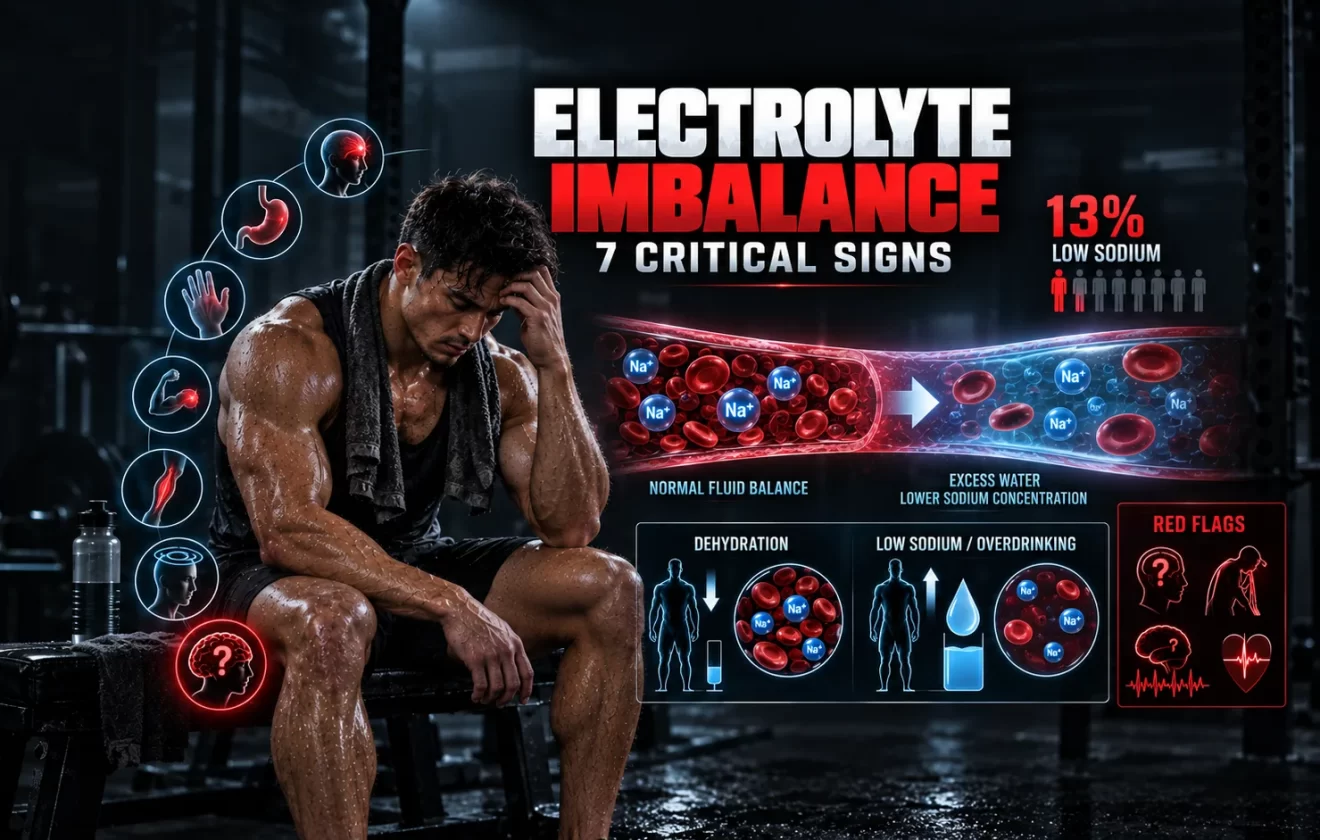
The signs of electrolyte imbalance that matter most in sport point to sodium, and the dangerous version usually comes from drinking too much, not from sweating too much. In a study of Boston Marathon finishers, 13 percent had low blood sodium, and the strongest predictor was weight gained during the race. The common symptoms of electrolyte imbalance are headache, nausea, bloating, unusual fatigue, muscle weakness, confusion and seizures. Cramps are the most asked about, and research has not tied them to low potassium or sodium in the blood. This guide covers the symptoms of low electrolyte imbalance, what they get confused with, and when the right answer is a doctor and not a powder.
Educational content only. This page summarises published research and consensus statements. It is not medical advice and cannot diagnose anything. Confusion, repeated vomiting, seizures, fainting or chest symptoms after exercise are an emergency. Call your local emergency number.
Supplements Editor · Updated September 2026
Three numbers that frame electrolyte imbalance
Of 488 runners tested at the finish line, 13 percent had hyponatremia. Weight gain during the race raised the odds about fourfold.
In Baker and colleagues' data set of 506 athletes, whole body sweat sodium ranged about fourfold between people, which is why one person needs salt in the bottle and another does not.
Ironman triathletes who cramped had no clinically meaningful difference in serum electrolytes from those who did not.
Study figures come from the published abstracts and consensus statements, retrieved in September 2026.
What this guide covers
The seven signs. What each symptom can mean in an active adult and when it becomes urgent.
Low sodium in athletes. Exercise associated hyponatremia, who gets it, and why more water makes it worse.
Cramps and the potassium myth. What studies of cramping athletes found in their blood, and what a banana does.
Dehydration, doctors and sodium limits. How to tell the pictures apart, red flags, and how not to overshoot with salt.
Signs of electrolyte imbalance and what each one can mean
Electrolytes are charged minerals, mainly sodium, potassium, magnesium, calcium and chloride, that control fluid balance, nerve signals and muscle contraction. An electrolyte imbalance means a blood level outside its normal range. Every symptom below has more common and less serious explanations, so the table is a guide to thinking, not a diagnosis.
| Sign | What it can point to in an active adult | When it is urgent |
|---|---|---|
| Headache during or after long exercise | Dehydration, heat, low blood sugar, or low sodium from overdrinking | With vomiting, confusion or swelling |
| Nausea or vomiting | Heat strain, gut distress, or falling blood sodium | Repeated vomiting after an event |
| Bloating, puffy hands, tight rings or watch | Fluid retention. A warning sign of overdrinking | With headache or confusion |
| Unusual fatigue or weakness | Low energy intake, heat, poor sleep, or low sodium or potassium | If sudden, severe or with palpitations |
| Muscle cramps | Usually neuromuscular fatigue. Rarely an electrolyte imbalance | If widespread, prolonged or with dark urine |
| Dizziness on standing | Dehydration or a blood pressure drop after stopping | With fainting or chest symptoms |
| Confusion, disorientation, seizure | Severe hyponatremia or heat stroke until proven otherwise | Always. Call emergency services |
Outside sport, the usual causes of a true electrolyte imbalance are medical: vomiting and diarrhoea, diuretics and some blood pressure medicines, kidney disease, and uncontrolled diabetes. If you take one of those medicines or have one of those conditions, symptoms from this list belong with your clinician, not with a supplement.
Symptoms of low electrolyte imbalance: sodium and overdrinking
The most dangerous electrolyte imbalance in endurance sport is exercise associated hyponatremia, defined as blood sodium below 135 mmol per litre during or within 24 hours of exercise. The international consensus statement led by Hew-Butler is clear about the main cause: drinking more fluid than the body loses, so that blood sodium is diluted. Heavy sodium loss in sweat can contribute, but it is rarely the whole story.
Almond and colleagues measured blood sodium in 488 Boston Marathon finishers. Thirteen percent had hyponatremia and 0.6 percent had critical values of 120 mmol per litre or below. The independent risk factors were weight gain during the race, a finishing time over four hours and extremes of body mass index. Drinking more than three litres and drinking at every mile were also associated with low sodium. Runners who gained weight had drunk more than they sweated.
Boston Marathon finishers with low blood sodium, percent of 488 tested
The early symptoms of this electrolyte imbalance are vague: bloating, puffiness, nausea, headache. They overlap with dehydration, which tempts people to drink more and makes matters worse. The practical rule from the consensus statement is to drink to thirst during long events. A sports drink does not protect against overdrinking, because every commercial drink is far more dilute than blood.
Do cramps mean low potassium? What the studies found
Cramps are the symptom most often blamed on an electrolyte imbalance, and the evidence for that link is weak. Schwellnus and colleagues compared ultra distance runners who cramped with those who did not and found that serum electrolytes and hydration status were not associated with cramping. Sulzer and colleagues repeated the comparison in Ironman triathletes. The cramping group had no greater body mass loss and no clinically significant difference in blood electrolytes, while electrical activity in the cramping muscles was raised. A later prospective study from the same group found that faster racing pace and a history of cramps predicted cramping, and dehydration or serum sodium did not.
These findings support what Schwellnus called the altered neuromuscular control theory: a fatigued muscle, working in a shortened position, fires uncontrollably. The reviews by Miller and colleagues and by Maughan and Shirreffs keep the door open for a subgroup of heavy, salty sweaters whose cramps do respond to sodium, but both note that the evidence is observational.
The banana deserves its own paragraph. Miller tested it directly. After an hour of cycling in the heat, volunteers ate none, one or two servings of banana. Plasma potassium rose only marginally, stayed within the normal range, and took 30 to 60 minutes to change at all. The conclusion was that bananas are unlikely to relieve cramps by raising blood potassium, and certainly not quickly enough to treat one.
A medium banana of 118 g holds about 420 mg of potassium, based on the USDA FoodData Central value of 358 mg per 100 g. Lara and colleagues measured sweat potassium in marathon runners at an average of 6.0 mmol per litre, about 235 mg, with a range of 3.1 to 8.0 mmol. One banana therefore covers the potassium in just under two litres of sweat, so ordinary food easily replaces the loss.
Dehydration or electrolyte imbalance? How to tell them apart
Dehydration and an electrolyte imbalance such as low sodium share early symptoms and need opposite responses, which is why telling them apart matters.
| Clue | Points toward dehydration | Points toward low sodium from overdrinking |
|---|---|---|
| Body weight after exercise | Lower than before | Same or higher than before |
| Thirst | Strong | Often absent |
| Urine | Little, dark | Frequent, clear during the event |
| Hands, rings, watch strap | Normal or loose | Puffy, tight |
| Drinking pattern | Little access to fluid | Drinking on a schedule, beyond thirst |
| Right response | Fluids and food | Stop drinking plain fluid. Seek medical help if symptoms progress |
The ACSM position stand on fluid replacement sets two boundaries: avoid losing more than about 2 percent of body weight during exercise, and avoid gaining weight. Shirreffs and Sawka make the same point for recovery, and add that sodium taken with fluid after exercise helps the body retain it. Weighing yourself before and after a few long sessions is the simplest way to learn which side of the line you tend to fall on.
Electrolyte imbalance red flags: when the answer is a doctor
Electrolyte powders are for replacing routine sweat losses in healthy people. They are not a treatment for a suspected electrolyte imbalance. The list below is general clinical guidance rather than the result of one study. The emergency items follow the hyponatremia consensus statement led by Hew-Butler, and the medication and disease triggers are standard reasons for a blood electrolyte test.
Immediately. Confusion, seizure, fainting, severe headache with vomiting, chest pain, or a racing or irregular heartbeat after exercise.
The same day. Vomiting or diarrhoea lasting more than a day with weakness, very dark urine with muscle pain after hard exercise, or swelling with breathlessness.
Soon. Recurring cramps, fatigue or palpitations if you take diuretics, blood pressure medicine, lithium or laxatives, or have kidney, heart or thyroid disease.
For a blood test. Persistent symptoms with no clear cause. A basic metabolic panel measures sodium, potassium, chloride, bicarbonate, calcium and kidney function.
A symptom list on a website cannot tell an electrolyte imbalance from a heart rhythm problem. A blood test can, and it is inexpensive.
Avoiding an electrolyte imbalance without overdoing sodium
The numbers below come from the normative data set published by Baker and colleagues, who compiled sweat tests from 506 athletes. Predicted whole body sweat sodium averaged 35.9 mmol per litre, about 830 mg, and ranged from 18.2 to 70.8 mmol, roughly 420 to 1,630 mg per litre. Whole body sweating rate averaged 1.21 litres an hour with a range from 0.26 to 5.73. Put together, one person can lose under 300 mg of sodium in a gym session while another loses several grams in a long run in the heat. The calculator shows where a session sits.
Estimate your sodium loss for a session
The marker shows 1,000 mg. Weighing before and after exercise gives your sweat rate: one kilogram lost is about one litre. Educational estimate only.
For most lifters the numbers are small, and an electrolyte imbalance from a gym session is unlikely. A strength session in a cool gym often produces less than a litre of sweat, and a salted meal afterwards replaces it. Most adults already eat more sodium than health guidelines advise, so adding 1,000 mg sticks to short indoor workouts is rarely necessary and is a poor idea for anyone with high blood pressure. Our guide on how to read supplement labels explains how to find the sodium per serving quickly. If you do decide you need one, our guides to sugar free electrolyte powder and the best electrolyte supplement by scenario cover what to look for.
Seven critical symptoms of electrolyte imbalance, ranked by urgency
Confusion, disorientation or seizure
EmergencyAfter long exercise this is severe hyponatremia or heat stroke until proven otherwise. Call emergency services and do not give large volumes of plain water.
Repeated vomiting with headache
UrgentA classic pairing in worsening hyponatremia, especially with weight gain or puffiness after an event.
Palpitations or an irregular heartbeat
UrgentPotassium and magnesium problems can disturb heart rhythm. This needs an ECG and a blood test, not a supplement.
Swelling of hands, feet or face
WarningTight rings and a tight watch strap during a long event suggest you are drinking more than you are losing.
Profound weakness or fatigue
WarningOut of proportion to the session, or persisting for days. More often an energy or sleep problem, but worth a blood test for electrolyte imbalance if it lasts.
Dizziness on standing
CommonUsually mild dehydration or blood pooling after you stop. Sit down, drink to thirst and eat something salty.
Muscle cramps
CommonMostly a fatigue problem. Stretch the muscle and ease the pace. An electrolyte imbalance is rarely the cause.
So, how should an active person use this?
The symptoms of electrolyte imbalance are real but non specific, and in healthy people who train they are far more often explained by heat, fatigue, low food intake or too much plain water than by a true electrolyte imbalance. The serious presentations involve the brain and the heart, and those need emergency care.
- You exercise longer than about 90 minutes, especially in heat
- You finish with salt crusts on skin or clothing
- You lose more than 2 percent of body weight in sessions
- You follow a very low carbohydrate or low salt diet and train hard
- Symptoms appear at rest or without heavy sweating
- You take diuretics, blood pressure medicine or lithium
- You have kidney, heart or thyroid disease
- Cramps, fatigue or palpitations keep returning
The most useful habits cost nothing: drink to thirst, weigh yourself before and after a few long sessions, salt your food if you sweat heavily, and treat confusion or vomiting after an event as an emergency.
Common questions
What are the first signs of electrolyte imbalance?
Early signs are vague: headache, nausea, unusual fatigue, bloating or puffiness, light headedness and muscle weakness. They overlap with dehydration and heat strain, so context such as how much you drank and whether you gained weight matters.
What are 4 signs of an electrolyte imbalance?
Four commonly listed signs are headache, nausea or vomiting, muscle weakness or cramps, and confusion. Confusion is the serious one and needs emergency care.
Do muscle cramps mean low potassium?
Usually not. Studies of cramping endurance athletes found no meaningful difference in blood potassium, sodium or hydration compared with athletes who did not cramp. Fatigue and pace predicted cramps better.
Can you drink too much water?
Yes. Drinking more than you lose dilutes blood sodium and causes exercise associated hyponatremia, the most dangerous electrolyte imbalance in sport. In one marathon study 13 percent of finishers had low sodium, and weight gain during the race was the main risk factor.
Will a banana stop a cramp?
Unlikely. In a controlled study, eating up to two servings of banana raised blood potassium only slightly and only after 30 to 60 minutes. Stretching the cramping muscle works faster.
How is an electrolyte imbalance diagnosed?
With a blood test, usually a basic metabolic panel that measures sodium, potassium, chloride, bicarbonate, calcium and kidney function. Symptoms alone cannot confirm an electrolyte imbalance.
What causes electrolyte imbalance outside of exercise?
Vomiting and diarrhoea, diuretics and some other medicines, kidney disease, uncontrolled diabetes, heavy alcohol use and eating disorders are the common causes. These need medical management.
Do lifters need electrolyte supplements?
Most do not, because an electrolyte imbalance from gym training is rare. Gym sessions produce modest sweat losses that normal salted food replaces. Electrolyte drinks are more useful for long sessions, heat, and very low carbohydrate diets.
References
More on supplements and labels
Final Educational Note
This article is for educational purposes and does not constitute medical advice. It cannot diagnose an electrolyte imbalance. Confusion, seizures, fainting, chest pain, palpitations or repeated vomiting are medical emergencies. Do not start or change supplementation based solely on general guidance from any website, including this one. If you have a medical condition or take prescription medication, a clinician should guide your fluid and sodium intake.
MuscleScience does not sell electrolyte products, supplements or medical services. We have no financial relationship with any brand. The goal of this article is to set out what the published research and consensus statements say so you can recognise when self care is enough and when it is not. For more breakdowns, see the supplements hub.