Tasty Gains Creatine Gummies: 7 Honest Label Facts
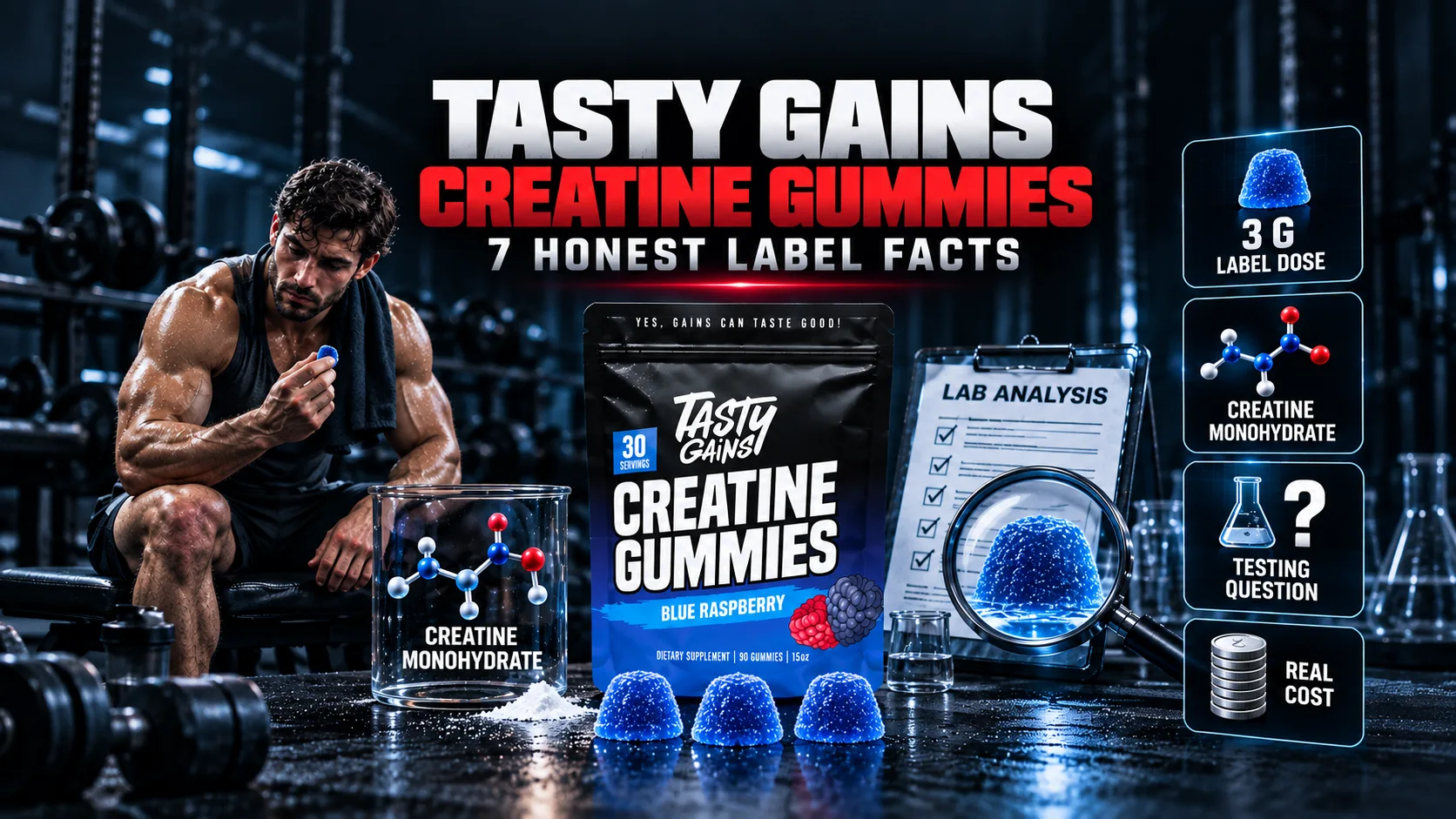
Tasty Gains Creatine Gummies: 7 Honest Label Facts
Tasty Gains creatine gummies claim 1 g of creatine monohydrate per gummy and a serving of three, so the label dose is 3 g a day. That is a real research dose, but it is not the 5 g most people assume, and reaching 5 g takes five gummies and empties the bag in 18 days. The brand says Tasty Gains is third party tested, yet we could not find a published lab report, and this creatine gummies review found no independent test of it either. We also set it against Omni creatine gummies and two certified rivals. We did not lab test the product, so every product figure below is a label claim by the manufacturer.
Educational content only. This page reads manufacturer labels and list prices against published research. It is not medical advice. If you have kidney disease or take medication that affects kidney function, talk to your clinician before using creatine in any form.
Supplements Editor · Updated September 2026
Three numbers that decide it
Three Tasty Gains gummies claim 3 g of creatine monohydrate. Hultman and colleagues showed that 3 g a day fills muscle stores in about 28 days, so the dose is legitimate, just slower than 5 g.
At the $40 list price, 90 g of creatine costs 44 cents a gram. Five grams is $2.22. A budget monohydrate tub works out to about 17 cents for the same 5 g.
In the SuppCo lab round of June 2025, four of six creatine gummies failed, two with no detectable creatine. Tasty Gains was not in that round, which means nobody has shown it fails, or that it passes. Our creatine gummies guide shows how to check a jar before you buy and how many gummies make a real dose.
Label and price figures were read from the Tasty Gains and Omni product pages in September 2026. Neither page showed a Supplement Facts panel as text, so calories and sugar per serving are not quoted.
What this creatine gummies review covers
The label. Creatine per gummy, serving size, ingredients and what the page claims about testing.
The dose. Whether 3 g is enough, how many Tasty Gains gummies equal 5 g, and how long a bag really lasts.
The testing question. What third party tested means when no report is published, and which gummies have passed independent checks.
Cost and rivals. Tasty Gains against Omni creatine gummies, Create, Force Factor and plain powder.
Tasty Gains creatine gummies label, line by line
The product page describes a 90 g bag: 90 gummies with 1 g of creatine monohydrate each. The suggested serving is three gummies a day. The ingredient list reads creatine monohydrate, tapioca syrup, cane sugar, water, pectin, citric acid, sodium citrate and natural flavors. Flavours listed were Blue Raspberry, Pineapple Mango, Strawberry Creamsicle and Sour Watermelon.
| Line | What the page says | What it means | Status |
|---|---|---|---|
| Creatine form | Creatine monohydrate | The form behind nearly all creatine research | ● clear |
| Dose | 1 g per gummy, 3 gummies a day | 3 g a day, a slow but valid research dose | ● clear |
| Bag size | 90 gummies, 30 servings | 30 days at 3 g, 18 days at 5 g | ● clear |
| Base | Pectin, tapioca syrup, cane sugar | Vegan gummy base with real sugar. Amount per serving not given in text | ● partial |
| Acidifier | Citric acid, sodium citrate | Standard for flavour. Acid and water are what degrade creatine over time | ● partial |
| Testing | Third party tested, lab tested | No lab name, report or certification shown on the page | ● not shown |
| Other claims | No melt formula, vegan, gluten free, made in the USA | Manufacturer statements we cannot verify | ● partial |
Nothing on the Tasty Gains label is unusual for the category, and the use of plain monohydrate is the right call. The gap is evidence. For a broader look at how the format compares with a tub, see our guide to creatine gummies vs powder.
Is 3 g enough, and how many Tasty Gains gummies equal 5 g
Most creatine advice says 3 to 5 g a day, and that range comes straight from the research. The ISSN position stand by Kreider and colleagues describes it as the maintenance dose. Hultman and colleagues measured muscle creatine directly and found that 3 g a day for 28 days reached the same level as a six day loading protocol. Rawson and colleagues even saw better fatigue resistance from about 2.3 g a day over six weeks.
So the three gummy serving is not a trick. It is the low end of a valid range, and it suits smaller people best. Larger lifters, and anyone who wants stores filled faster, usually take 5 g. With Tasty Gains that is five gummies a day, and the bag that is sold as a month lasts 18 days. Our guide to the creatine loading phase covers the faster protocols, which are impractical with any gummy.
On safety the picture is reassuring. Harris and colleagues first showed that repeated 5 g doses raise muscle creatine, and decades of follow up have not found harm in healthy people. The meta analysis by de Souza e Silva and colleagues found no significant effect on kidney function markers, Antonio and colleagues work through the common myths, and Ostojic and Ahmetovic saw stomach upset mainly with single 10 g doses, far above any gummy serving.
Days one 90 gummy bag lasts, by daily dose
What your daily dose costs per month
Assumes 1 g of creatine per gummy and 90 gummies per bag, as the label claims. The marker sits at about $5, what 30 days of 5 g from a budget monohydrate tub costs. Educational estimate only.
Are Tasty Gains creatine gummies tested
The product page says third party tested and lab tested. It does not name the lab, link a certificate of analysis or show a certification mark such as NSF Certified for Sport or Informed Sport. That does not mean the claim is false. It means a buyer has no way to check it, and in this category checking matters more than in any other.
Two published test rounds explain why. In February 2024 the supplement maker NOW tested 12 brands of creatine gummies bought online and reported that half failed to meet their label claim, with creatinine, the breakdown product of creatine, in the failures. In June 2025 SuppCo sent six gummies to an ISO 17025 accredited lab and reported that four failed, two of them with no detectable creatine. The two that passed, Force Factor and Create, both state NSF Certified for Sport on their pages.
Tasty Gains was in neither round, so there is no independent evidence either way. If the label is accurate, the product does what 3 g of creatine does. The honest position for a creatine gummies review is that a manufacturer statement is weaker than a named certificate, and the brand could close that gap by publishing one.
The no melt claim and what actually threatens a creatine gummy
Tasty Gains advertises a no melt formula, which addresses a real annoyance: pectin gummies can fuse in a hot delivery van. Melting is not the main risk to the creatine, though. The chemistry that matters is water and acid. In solution, creatine slowly converts to creatinine, which does nothing for muscle, and the conversion is faster in warm and acidic conditions. Ganguly and colleagues measured 90 percent degradation of creatine in a solution kept at room temperature for 45 days.
A gummy is not a solution, but this one lists water and citric acid, like most of its rivals. NOW made the same point in its report: water is used to make gummies, so it can be difficult to get the correct dosage of creatine. Reviews of creatine forms by Jager and colleagues and by Kreider and colleagues describe dry monohydrate powder as stable, and every powder in the SuppCo round passed.
Buy fresh. Check the best before date and avoid stock that has sat in a hot warehouse or mailbox.
Store cool and dry. A cupboard, not a car or a gym bag in summer.
Close the bag. Moisture is the enemy of creatine, so reseal it every time.
Do not stockpile. A three bag bundle is cheaper per gummy, but the last bag will be months older when you open it.
Tasty Gains cost per 5 g against powder and other gummies
Labels use different serving sizes, so the only fair comparison scales every product to the same 5 g of creatine at list price. On that basis Tasty Gains sits in the upper half of the gummy range and far above powder.
The three gummy serving makes the daily price look modest at $1.33, the same as a 5 g serving of Force Factor. The difference is that the Force Factor figure buys 5 g and carries an NSF Certified for Sport claim, while the Tasty Gains figure buys 3 g. Scaled to 5 g, Tasty Gains costs about two thirds more.
Tasty Gains vs Omni creatine gummies and two certified rivals
Tasty Gains and Omni are close cousins on paper: both claim 1 g of creatine monohydrate per gummy and a three gummy serving. They differ in price and in how much they say about testing.
Tasty Gains
Manufacturer page, September 2026.
Omni
Manufacturer page, September 2026. Subscription price is $42 a month.
Omni creatine gummies cost more but say more: the page names two independent labs and states that every batch is screened for banned substances, heavy metals and contaminants. Naming a lab is a step up from a bare claim, although neither brand published a certificate of analysis on the pages we read. SuppCo lists Omni with a high trust score while noting that it has not run its own lab test on the product.
| Product | Creatine per serving | Gummies for 5 g | Cost per 5 g | Testing on record | Status |
|---|---|---|---|---|---|
| Force Factor | 5 g per 5 gummies | 5 | $1.33 | NSF Certified for Sport claimed. Passed the SuppCo round at 6.3 g | ● certified |
| Create | 4.5 g per 3 gummies | 3 to 4 | $2.22 | NSF Certified for Sport claimed. Passed the SuppCo round at 4.59 g | ● certified |
| Omni | 3 g per 3 gummies | 5 | $3.72 | Brand names Eurofins and Light Labs. No independent result found | ● lab named |
| Tasty Gains | 3 g per 3 gummies | 5 | $2.22 | Third party tested claimed. No lab named, no independent result found | ● claim only |
| Budget monohydrate powder | 5 g per scoop | 1 scoop | About $0.17 | All five powders passed the SuppCo round | ● tested format |
Seven honest facts about Tasty Gains
It uses the right creatine
MonohydrateTasty Gains lists creatine monohydrate, the form used in nearly every trial, with no blends or exotic salts.
The serving is 3 g, not 5 g
3 gThree grams a day works, as Hultman and colleagues showed, but it takes about four weeks to fill muscle stores and may be low for bigger lifters.
Five grams empties the bag in 18 days
18 daysNinety gummies at five a day is 18 days. Budget for nearly two bags a month if 5 g is your dose.
The testing claim cannot be checked
No reportThe page says third party tested without naming a lab or showing a certificate. In a category where four of six products failed a lab round, that is the weakest point of the offer.
It contains real sugar
Cane sugarTapioca syrup and cane sugar are the second and third ingredients. The amount per serving was not given in text, so count a few grams of sugar a day.
No melt is not the same as stable
Water + acidThe recipe includes water and citric acid, the two things that turn creatine into creatinine over time. Freshness and storage matter.
It is 13 times the price of powder
$2.22Per 5 g at list price. That premium buys convenience and taste, nothing else.
Whatever format you choose, timing is a detail. Our review of creatine before or after a workout shows the daily total is what counts.
So, are Tasty Gains creatine gummies worth the price
If the label is accurate, Tasty Gains delivers a valid 3 g dose of the right form of creatine in a format people actually remember to take. The two problems are both about proof and price: there is no published test behind the third party tested claim, and at 5 g a day it costs about thirteen times what powder does.
- You have tried powder and keep skipping it
- You are smaller framed and happy with 3 g a day
- You want a vegan, pectin based gummy
- You are willing to ask the brand for a certificate of analysis
- You compete in a tested sport and need NSF or Informed Sport certification
- You want 5 g a day and care about monthly cost
- You are limiting added sugar
- You are comfortable stirring a scoop into a drink
The research caveat is the same for every gummy. No trial has tested creatine from a gummy, and the only absorption data on solid creatine, from Harris and colleagues and from Deldicque and colleagues, suggest it is absorbed more slowly but still works. The open question is never the gut. It is whether the dose on the bag is in the gummy.
Common questions
How many Tasty Gains gummies equal 5 g?
Five. The label claims 1 g of creatine monohydrate per gummy and a serving of three, which is 3 g. At five a day a 90 gummy bag lasts 18 days instead of 30.
Are Tasty Gains creatine gummies tested?
The brand says they are third party tested, but the product page we read names no lab and shows no certificate. Tasty Gains was not included in the NOW test round of 2024 or the SuppCo round of 2025, so there is no independent result either way.
Are Tasty Gains creatine gummies worth the price?
Only if convenience is what keeps you consistent. At list price 5 g of creatine costs about $2.22 from Tasty Gains against about $0.17 from a monohydrate tub. For the same money as Tasty Gains, Force Factor and Create offer NSF Certified for Sport claims.
Is 3 g of creatine a day enough?
For most people, yes, given time. Hultman and colleagues showed that 3 g a day filled muscle creatine stores in about 28 days. Larger lifters and people who want faster results usually take 5 g.
Are Omni creatine gummies better than Tasty Gains?
They claim the same 1 g per gummy. Omni costs more, $67 one time against $40, but names the independent labs it uses. Neither brand published a certificate on the pages we read, and neither has an independent published test result.
Do Tasty Gains gummies have sugar?
Yes. Tapioca syrup and cane sugar are the second and third ingredients. The product page did not give grams per serving in text, so check the panel on the bag if you are tracking added sugar.
Do creatine gummies actually contain creatine?
Some do and some do not. In a 2025 lab round reported by SuppCo, four of six gummies failed and two had no detectable creatine, while Force Factor and Create passed. Certification is the only reliable signal a buyer has.
When should I take creatine gummies?
Whenever you will remember them every day. Creatine works by saturating muscle over weeks, so timing around training makes little difference. Taking them with a meal is a simple habit that also suits the stomach.
References
More on creatine
Final Educational Note
This article is for educational purposes and does not constitute medical advice. Creatine needs depend on body weight, diet, training and medical history, and product formulas and prices change without notice. Do not start or change supplementation based solely on general guidance from any website, including this one. If you have kidney disease or take medication that affects kidney function, a clinician should make the call.
MuscleScience does not sell creatine, supplements or medical services. We have no financial relationship with Tasty Gains, Omni or any other brand or testing organisation named on this page. The goal of this article is to give you the label claims, the published test results and the research so you can decide for yourself. For more breakdowns, see the supplements hub.