Types of Peptides: GH Secretagogues, Healing, Metabolic and Cosmetic Classes
The main classes, sorted out
The types of peptides studied in health and performance research are not a single category. GH secretagogues, healing compounds, metabolic agents, and cosmetic peptides each operate through different receptor systems, have different evidence bases, and carry different evaluation criteria. Understanding which types of peptides belong to which class is the prerequisite for interpreting any specific research claim accurately.
Types of Peptides: Three Core Distinctions
Before examining each class, three distinctions define how the types of peptides in research differ from each other. Every common error in interpreting peptide research traces back to ignoring one of these three points.
Receptor Class Determines Function
The types of peptides are differentiated primarily by receptor class — GPCRs, receptor tyrosine kinases, or extracellular matrix receptors. Two compounds may both be called peptides while targeting entirely different receptor systems, producing different downstream effects, and carrying different risk profiles. Shared chemical structure does not mean shared biological function.
Evidence Quality Varies Widely
The types of peptides in performance research span an enormous range of evidence quality — from FDA-approved drugs with years of RCT data to compounds tested only in rodent injury models. Treating all categories as equally supported by research is one of the most common errors in how peptide claims are presented and evaluated online.
Classification Is Not Endorsement
Describing the types of peptides and how they work is not an endorsement of any compound for human use. Several classes discussed in this guide are not approved for human use, and most research-only compounds lack the human clinical data required to draw conclusions about safety or efficacy. Classification is an analytical framework, not a recommendation.
What This Guide Covers
Covered in This Guide
- Why types of peptides are classified by receptor target and function
- How evidence tier determines how each class should be evaluated
- The four main classes: GH secretagogues, healing, metabolic, cosmetic
- Key compounds within each class and their studied mechanisms
- How the types of peptides differ from anabolic steroids mechanically
- 5 common mistakes in how peptide categories are described
Not Covered Here
- Individual compound profiles — covered in dedicated guides
- Peptide dosing and reconstitution — see the Peptide Dosage Calculator
- Stacking, protocol design, or sourcing
- Molecular biology of peptide synthesis — see the What Are Peptides guide
- Legality or regulatory status by country
Prerequisites. This guide builds on the foundational What Are Peptides guide. For dosing math, see the Peptide Dosage Calculator. For study design context, see the Research hub.
This guide covers six topics on the types of peptides in research and how to evaluate them. Use the links below to navigate directly.
Why the Types of Peptides Differ at a Receptor Level
The types of peptides are most usefully classified by the receptor class they engage — not by their claimed benefit or marketing category. Two compounds both described as “recovery peptides” may bind completely different receptor families, activate different intracellular pathways, and produce effects in entirely different tissues. Receptor class is the first fact to establish before evaluating any claim.
The largest category of types of peptides in performance research acts through G protein-coupled receptors (GPCRs). GH secretagogues bind the ghrelin receptor (GHS-R1a) or the GHRH receptor, both of which are GPCRs. When a peptide binds its cognate GPCR, it activates a second messenger cascade — cAMP, calcium, or phospholipid signaling — that ultimately changes gene expression or enzyme activity downstream. The effects are tissue-specific and highly dependent on local receptor density.
A second category of types of peptides acts through receptor tyrosine kinases (RTKs). Insulin, IGF-1, and growth hormone all engage RTKs, which autophosphorylate upon binding and initiate mTOR-connected signaling relevant to protein synthesis. The downstream effects of RTK-binding peptides are structurally different from GPCR-mediated cascades — which is why GH secretagogues and insulin analogs cannot be evaluated using the same framework despite both being peptides.
A third category operates at extracellular matrix receptors and integrin systems. Healing peptides such as BPC-157 and TB-500 are primarily studied for effects on angiogenesis, fibroblast activation, and ECM remodeling through integrin-linked kinase pathways. These types of peptides do not engage the HPG axis through any documented mechanism, which is one reason they are classified separately from GH secretagogues in research literature.
GH Secretagogues
These types of peptides bind the ghrelin receptor (GHS-R1a) or GHRH receptor at the pituitary and hypothalamus. Activation triggers a GH pulse — the peptide does not provide exogenous GH but signals endogenous production. Receptor density at the pituitary and somatostatin tone both influence the magnitude of the GH response to any GHS-class compound.
Metabolic Peptides
GLP-1 receptor agonists — including semaglutide and tirzepatide — bind RTK-adjacent receptors that couple to both adenylyl cyclase and phospholipase cascades. Insulin and IGF-1 bind classical RTKs directly. These types of peptides are the most thoroughly characterized in human clinical trials, with RCT data in tens of thousands of participants across multiple therapeutic areas.
Healing Peptides
BPC-157 and TB-500 are the most referenced healing compounds in performance research. Their studied mechanisms involve integrin-linked kinase activation, PI3K/Akt signaling, and nitric oxide modulation — pathways associated with angiogenesis and tissue repair. Most data comes from rodent injury models; human clinical trial data for these specific types of peptides remains very limited.
Cosmetic Peptides
Short-chain peptides — tripeptides and pentapeptides — studied for topical skin effects act primarily through TGF-beta signaling and collagen synthesis pathways in dermal fibroblasts. The fundamental constraint on these types of peptides is skin penetration: intact stratum corneum limits absorption of charged, hydrophilic molecules. In vitro fibroblast data does not automatically predict clinical outcomes from topical formulations.
Why receptor class matters for evaluation. The appropriate monitoring framework, the relevant evidence base, and the plausible risk profile all differ by receptor class. Applying the evaluation criteria appropriate for GH-axis peptides to a healing peptide, or vice versa, produces systematically incorrect conclusions. The types of peptides each require the evaluation framework matching their receptor biology — not a generic one.
Types of Peptides by Evidence Tier: How to Evaluate Research Claims
Across all types of peptides in health and performance literature, evidence quality ranges from multi-year randomized controlled trials in humans to single animal studies conducted under acute experimental conditions. Understanding which evidence tier a given compound belongs to is as important as understanding its mechanism — because the two are not always aligned in how compounds are discussed online.
The highest-evidence tier of types of peptides includes compounds with FDA approval or large-scale RCT data in humans. GLP-1 receptor agonists — semaglutide, tirzepatide, liraglutide — represent this tier. These types of peptides have been studied in Phase III trials enrolling thousands of participants, with multi-year safety data, dose-response characterization, and defined adverse event profiles. Conclusions drawn from this tier are supported by the strongest standard of clinical evidence available.
The middle tier includes types of peptides that have entered human clinical trials but not achieved regulatory approval for the indications discussed in performance contexts. Tesamorelin has FDA approval specifically for HIV-associated lipodystrophy — not for general body composition enhancement. Sermorelin has been used in clinical settings for GH deficiency. These types of peptides have human data, but the available evidence does not support extrapolation to healthy adults using them for performance purposes.
The lowest-evidence tier includes types of peptides studied almost exclusively in animal models — primarily rodent injury, disease, or acute dosing studies. BPC-157 and TB-500 sit in this tier. Rodent studies can generate mechanistic hypotheses, but they do not constitute evidence of human efficacy or safety. The gap between a positive finding in a rat tendon model and a reproducible outcome in a human with normal immune function and gut peptidase activity is substantial and documented.
RCT-Supported Compounds
GLP-1 agonists (semaglutide, tirzepatide, liraglutide), insulin analogs, and IGF-1 analogs. These types of peptides have randomized controlled trial data in human populations, defined safety profiles, and regulatory approval. They are the standard against which all other peptide evidence should be measured — not a different category of compound.
Limited Human Trial Data
Tesamorelin (approved for specific indications), sermorelin (used clinically for GH deficiency), and some GHRP compounds with small human pharmacokinetic studies. These types of peptides have human data but limited to specific populations or narrow indications. Extrapolation to general performance use is not supported by the available evidence base.
Animal Model Data Only
BPC-157, TB-500, ipamorelin, CJC-1295, and most research-only GH secretagogues. These types of peptides have data primarily from rodent studies — often acute models in healthy animals. The absence of human clinical trials is not an administrative gap; it reflects the fact that safety and efficacy in humans remain unestablished. Positive rodent findings generate hypotheses, not conclusions.
The tier determines the claim strength. A Tier 1 compound supports outcome claims based on replicated human data. A Tier 3 compound supports only mechanistic hypotheses. When sources treat all types of peptides as equally supported by research, they are systematically misrepresenting evidence quality — and the practical consequence is that readers cannot accurately assess what is known versus what is speculated about any given compound.
4 Main Types of Peptides in Health and Performance Research
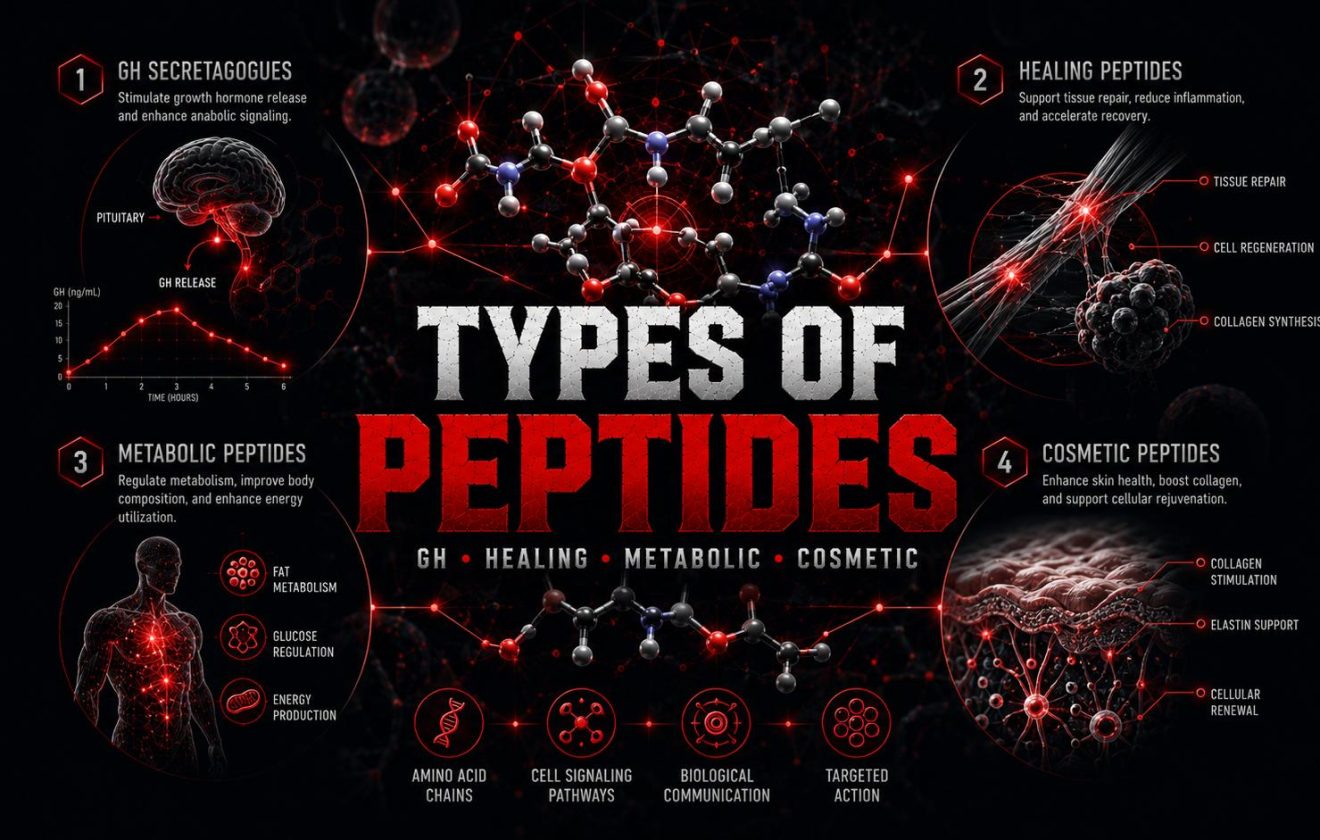
The types of peptides that appear most frequently in health and performance research fall into four categories. These categories are defined by receptor target and primary studied function — not by benefit claims or marketing language. Each class has a different evidence base, different risk considerations, and a different analytical framework appropriate to evaluating it.
The types of peptides within each class are not interchangeable. Ipamorelin and BPC-157 are both peptides, but they target different receptor systems, have different studied mechanisms, and belong to different evidence tiers. The fact that they appear in the same research community context does not make them comparable compounds.
GH Secretagogues
These types of peptides stimulate endogenous GH release by acting on the ghrelin receptor (GHS-R1a) or the GHRH receptor at the pituitary and hypothalamus. They do not supply exogenous GH — they signal the pituitary to release more of its own. The class includes two subgroups: GHRH analogs (CJC-1295, sermorelin, tesamorelin) that mimic the GHRH signal, and GHRPs (GHRP-2, GHRP-6, ipamorelin, hexarelin) that act as ghrelin mimetics at GHS-R1a. Human pharmacokinetic data exists for several compounds in this class, but evidence supporting use in healthy adults for performance is limited.
Healing and Repair Peptides
These types of peptides are studied for effects on tissue repair, angiogenesis, and inflammation modulation. BPC-157 — a synthetic partial sequence of body protection compound, originally derived from gastric juice research — is the most referenced compound in this class. TB-500, a synthetic fragment of thymosin beta-4, is also widely discussed for tendon and muscle repair contexts. Both are studied primarily in rodent injury models. The evidence for human outcomes in either compound remains limited to extrapolation from animal data, and neither is approved for human use by any major regulatory agency.
Metabolic Peptides
These types of peptides influence energy balance, insulin signaling, appetite regulation, and fat metabolism. GLP-1 receptor agonists — semaglutide, tirzepatide, liraglutide — are peptide-based drugs with extensive Phase III RCT data in humans and FDA approval for specific indications. They represent the highest evidence tier within any types of peptides discussed in this context. Older research compounds in this class, such as GH fragment 176-191 (AOD-9604), have primarily animal and small phase II data. The evidence gap within this class is significant — GLP-1 agonists and research-only metabolic peptides should not be evaluated as equivalent.
Cosmetic and Skin Peptides
These types of peptides are short chains — typically two to five amino acids — studied for topical effects on collagen synthesis, skin elasticity, and wound healing. Palmitoyl pentapeptide-4 (Matrixyl), GHK-Cu, and argireline are among the most referenced in cosmetic formulation research. The primary constraint on these types of peptides is delivery: intact skin limits absorption of charged, water-soluble molecules. Cell culture data showing collagen stimulation in fibroblasts does not directly translate to topical product performance, and clinical evidence for most cosmetic peptide formulations is limited to small, manufacturer-sponsored studies.
Class does not imply endorsement. Describing the types of peptides in each class is an analytical exercise, not a recommendation for use. Classes 1 and 2 consist predominantly of compounds not approved for human use. Class 3 includes both approved drugs and unapproved research compounds — they are not equivalent. Class 4 compounds face fundamental delivery limitations that most product marketing does not acknowledge.
How the Types of Peptides Compare Across Key Dimensions
The types of peptides in each class differ substantially across receptor target, evidence tier, half-life, and documented human outcomes. Placing them side by side clarifies why the same evaluation framework cannot apply across all classes — and where the largest evidence gaps exist.
The table below compares the four main types of peptides across dimensions most relevant to reading research claims accurately. Route of administration reflects how compounds are studied in research, not a recommendation. Evidence tier uses the three-tier framework defined earlier in this guide.
| Class | Primary Receptor | Evidence Tier | Half-Life Range | Human RCT Data |
|---|---|---|---|---|
| GH Secretagogues | GHS-R1a / GHRH-R (GPCR) | Tier 2–3 | Minutes to hours | Limited — small studies, specific populations |
| Healing Peptides | Integrin / PI3K-Akt pathway | Tier 3 | Minutes (estimated) | None published for BPC-157 or TB-500 |
| Metabolic Peptides | GLP-1R / GIPR / RTK | Tier 1–2 | Hours to days | Extensive — Phase III, tens of thousands of participants |
| Cosmetic Peptides | TGF-beta / collagen synthesis | Tier 2–3 | N/A (topical) | Small, mostly manufacturer-sponsored |
Half-life estimates for Tier 3 compounds are extrapolated from animal pharmacokinetic data. Human pharmacokinetic studies for most research-only peptides have not been published. Swipe to scroll on mobile.
The evidence gap within types of peptides is not uniform. GLP-1 agonists have more robust human data than almost any drug class approved in the past decade. BPC-157 has zero published human clinical trials. Treating these as comparable because both are peptides misrepresents the evidence landscape by several orders of magnitude. The types of peptides each require evaluation against their own evidence base.
5 Mistakes in How Types of Peptides Are Described
These five mistakes appear consistently in how types of peptides are categorized and discussed outside of peer-reviewed research contexts.
- Mistake 1
Treating All Types of Peptides as Equally Researched
The types of peptides discussed in performance contexts span three evidence tiers. GLP-1 agonists have multi-year RCT data in humans. Most GH secretagogues and all healing peptides have data primarily from animal studies. Presenting all types of peptides in a single list without distinguishing evidence quality creates the false impression that compounds like ipamorelin and semaglutide are supported by comparable levels of human evidence — they are not.
- Mistake 2
Applying Steroid-Cycle Logic to Peptide Protocols
Anabolic steroids and the types of peptides discussed in performance contexts operate through fundamentally different mechanisms. Steroids are lipid-soluble molecules that bind intracellular androgen receptors and directly suppress the HPG axis through a predictable, well-characterized mechanism. Most peptides are water-soluble, bind surface receptors, and have short half-lives measured in minutes or hours. Applying ester-clearance timing, suppression protocols, or PCT logic to peptide compounds produces systematically incorrect conclusions because the pharmacokinetic framework does not transfer. See the anabolic steroids guide for the steroid-specific framework.
- Mistake 3
Conflating GHRH Analogs and GHRPs into One Category
Within the GH secretagogue class, GHRH analogs (CJC-1295, sermorelin) and GHRPs (ipamorelin, GHRP-2, GHRP-6) bind different receptors and produce GH release through different mechanisms. GHRH analogs act at the GHRH receptor on somatotroph cells; GHRPs act at the ghrelin receptor at both the pituitary and hypothalamus. Combining them into a single category — without noting receptor distinction — obscures why they are often combined in research protocols and why the rationale for that combination is based on receptor complementarity, not redundancy.
- Mistake 4
Using In Vitro Data as Evidence for Topical Cosmetic Efficacy
Cosmetic peptide types of peptides are frequently marketed with references to in vitro studies showing collagen stimulation in fibroblast cell cultures. Cell culture experiments cannot account for the skin penetration barrier — the primary reason topically applied peptides may not reach the dermal fibroblasts they are supposed to stimulate. A positive result in a cell culture well, where the peptide has direct access to the cell, tells us almost nothing about whether the same peptide, applied in a cream to intact skin, reaches the target cell at a biologically meaningful concentration.
- Mistake 5
Treating Unapproved Status as Equivalent to Proven Safety
Several types of peptides in performance contexts are described as safer than anabolic steroids on the basis that they are “natural” analogs of endogenous molecules or because no major adverse events have been publicly reported. Neither of these is a safety argument. Endogenous origin does not guarantee safety at supraphysiological doses delivered by injection. The absence of a documented adverse event record for unapproved compounds reflects the absence of systematic monitoring — not the absence of risk. For compounds in Tier 3, the honest position is that safety in humans is unknown, not established as acceptable.
Primary Research Sources
Peer-reviewed references from PubMed used to verify receptor classification, evidence tier characterization, and pharmacological distinctions described in this guide.
- Muttenthaler M, King GF, Adams DJ, Alewood PF. Trends in peptide drug discovery. Nat Rev Drug Discov. 2021;20(4):309–325. PMID 33536635
- Camanni F, Ghigo E, Arvat E. Growth hormone-releasing peptides and their analogs. Front Neuroendocrinol. 1998;19(1):47–72. PMID 9465289
- Ghigo E, Arvat E, Camanni F. Orally active growth hormone secretagogues: state of the art and clinical perspectives. Ann Med. 1998;30(2):159–168. PMID 9667794
- Rahman OF, et al. Therapeutic peptides in orthopaedics: applications, challenges, and future directions. J Orthop Surg Res. 2026. PMID 41490200
- Pickart L, Margolina A. Regenerative and protective actions of the GHK-Cu peptide in the light of the new gene data. Int J Mol Sci. 2018;19(7):1987. PMID 29986520
- Drucker DJ. Mechanisms of action and therapeutic application of glucagon-like peptide-1. Cell Metab. 2018;27(4):740–756. PMID 29617641
- Lee C, et al. The mitochondrial-derived peptide MOTS-c promotes metabolic homeostasis and reduces obesity and insulin resistance. Cell Metab. 2015;21(3):443–454. PMID 25738459
- Gorouhi F, Maibach HI. Role of topical peptides in preventing or treating aged skin. Int J Cosmet Sci. 2009;31(5):327–345. PMID 19570099
- Pickart L. The human tri-peptide GHK and tissue remodeling. J Biomater Sci Polym Ed. 2008;19(8):969–988. PMID 18644225
Types of Peptides: Applying the Classification Framework
The types of peptides in health and performance research are not a single category and cannot be evaluated with a single framework. GH secretagogues, healing peptides, metabolic agents, and cosmetic peptides each target different receptor systems, are supported by different levels of evidence, and require different analytical criteria. Understanding which class a compound belongs to is the first step — not the last — in evaluating any specific claim about it.
The types of peptides with the strongest human evidence are FDA-approved metabolic drugs like GLP-1 receptor agonists. The types of peptides most discussed in performance research — GH secretagogues and healing peptides — have the weakest human evidence base of any class. This inversion is important: the compounds discussed most frequently are not the ones with the most established outcomes in humans. That discrepancy between popularity and evidence quality should inform how any claim about these compounds is read.
The guides in the Peptides hub apply this classification to individual compounds. Each guide identifies the receptor target, the evidence tier, and the specific gap between what animal data shows and what human clinical data confirms. Understanding the foundational What Are Peptides guide alongside this classification framework provides the analytical basis for evaluating any compound in the Research hub.
For Educational Purposes Only
This guide is produced for educational and harm-reduction purposes. MuscleScience.org does not sell, recommend, or endorse any compound. All content reflects a summary of published research and does not constitute medical advice.
Several compounds discussed in this guide are not approved for human use by regulatory agencies. Purity, sterility, and concentration in research-market peptides are not independently verified. Consult a licensed physician before making any decisions about hormones or pharmacological compounds.
All author names are editorial pseudonyms. See the full site disclaimer and about page for editorial policy and anonymity disclosure.