Best Protein Drinks for Muscle Gain: 8 Proven Rules
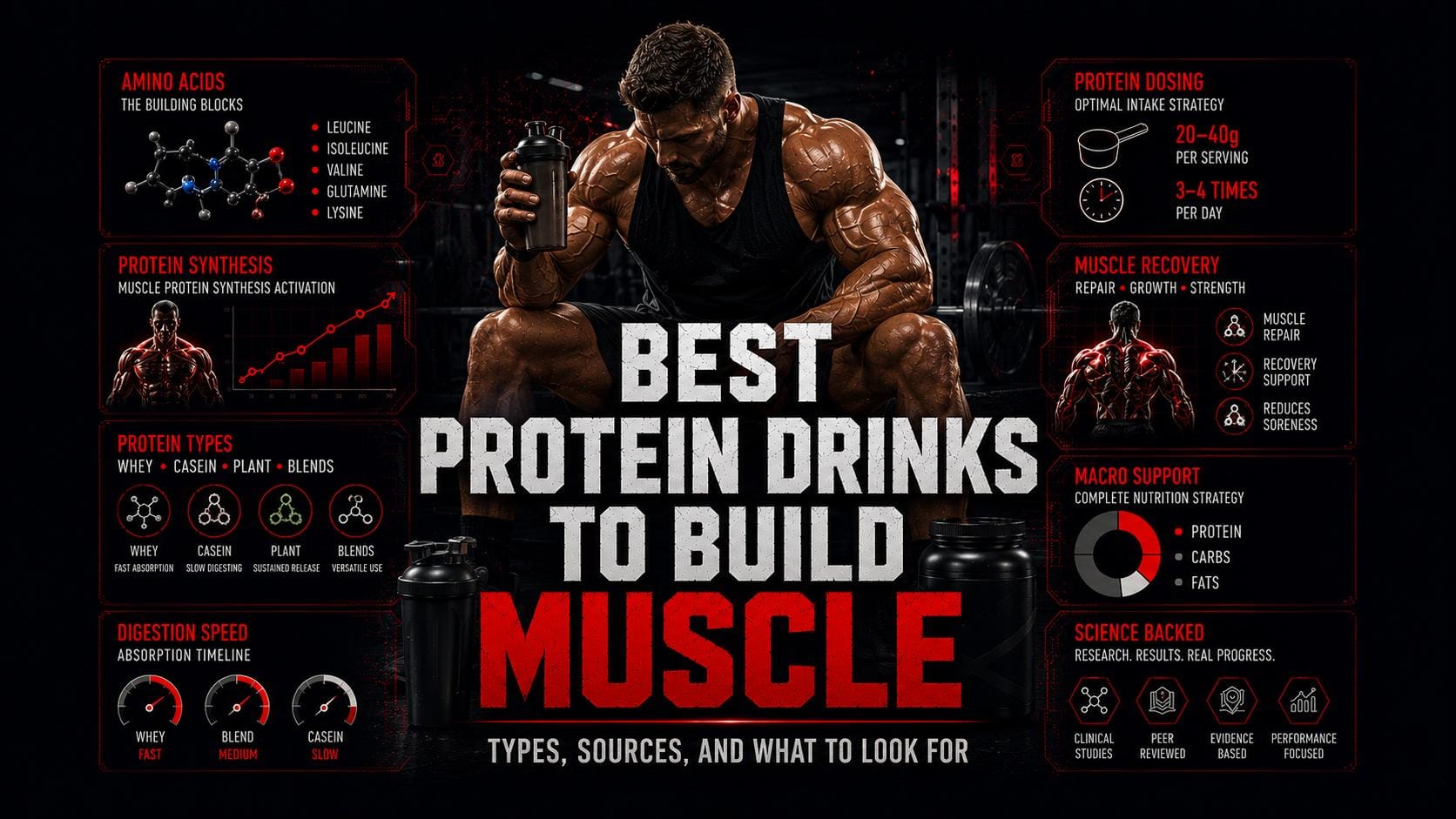
BEST PROTEIN DRINKS FOR MUSCLE GAIN: 8 PROVEN RULES
Protein drinks are a convenient way to carry a nutrient you could just as easily eat, and every controlled trial points the same direction: the amount you get in a day decides your muscle gain, while the format decides your convenience and your bill. This page compares the main protein drinks on leucine, dose, speed and cost so you can pick one on evidence instead of packaging, and if you are not sure how much you already eat, read our guide to daily protein intake first.
Three Numbers That Decide Everything Else
The point where adding more protein stopped adding muscle in a meta-analysis of 49 trials and 1,863 people. Past that total, protein drinks buy you nothing extra.
Whey at 20 g raised myofibrillar protein synthesis by 49 percent in roughly 80 kg men. Doubling it to 40 g raised it by 56 percent, so the curve flattens fast.
The per meal target that reaches 1.6 g/kg/day across four meals. For an 80 kg lifter that is 32 g, more than most protein drinks put in one scoop.
Everything else on this page is detail hanging off those three numbers. The comparison below ranks protein drinks honestly, but the ranking only matters once the daily total is already in range.
What This Comparison Covers
The formats. Eight kinds of protein drinks: whey concentrate, isolate, hydrolysate, micellar casein, whey and casein blends, plant blends, plain milk and ready to drink bottles.
The numbers. Protein per serving, leucine per serving, digestion speed and cost per 25 g of protein.
The evidence. Twelve peer reviewed papers on protein drinks, from acute synthesis trials to a meta-analysis of 49 training studies.
A ranking. Which protein drinks are worth the money for muscle gain, which are situational and which are processing you will never feel.
Brand reviews. Individual products are reviewed separately. This page compares categories of protein drinks, so any brand can be judged against its own type.
Medical nutrition. Kidney disease, liver disease and pregnancy change protein needs and belong with a clinician.
Mass gainers. Those are calorie products rather than protein drinks, and they are judged on different questions.
Shortcuts. No protein drinks substitute for training volume, sleep or a calorie surplus when the goal is muscle gain.
What Actually Builds Muscle When You Drink Protein
A serving of protein raises blood amino acids, and the rise in leucine in particular switches on muscle protein synthesis for a few hours. Resistance training makes that switch more sensitive and keeps it sensitive for roughly a day. Muscle is gained when the sum of those synthesis periods across weeks outweighs breakdown. That is the entire mechanism. It explains why protein drinks work, and why arguments about which of the protein drinks is best are usually arguments about a rounding error.
The International Society of Sports Nutrition position stand puts the useful daily range at 1.4 to 2.0 g per kilogram of bodyweight, with 2.3 to 3.1 g/kg reserved for holding lean mass in a deficit. The Morton meta-analysis narrows it further: across 49 trials, extra protein stopped adding fat free mass once total intake passed 1.62 g/kg/day. Protein drinks are simply the cheapest portable way to close that gap, which is the whole of their job.
Why leucine separates protein drinks
Leucine is the amino acid that carries the signal, and the response behaves like a switch rather than a dial. Most acute studies use around 2.5 g of leucine per serving to flip it. Whey delivers roughly 11 percent of its protein as leucine, milk protein about 9 percent, soy and pea about 8 percent and hemp about 5 percent, so a 25 g serving of whey clears the mark comfortably while 25 g of hemp does not come close. That is the one honest reason to prefer dairy based protein drinks, and a bigger plant serving fixes it. For the best known ready to drink option, see our full Premier Protein label review.
Dose per serving beats daily arithmetic
Schoenfeld and Aragon concluded that 0.4 g per kilogram per meal across a minimum of four meals is the practical route to 1.6 g/kg/day, with 0.55 g/kg/meal if you are aiming at the 2.2 g/kg ceiling. Witard and colleagues had shown why: 20 g of whey lifted myofibrillar synthesis 49 percent, 40 g lifted it 56 percent, and the extra went mostly to oxidation and urea. Under dosing protein drinks costs you more than overdosing them.
Protein Drinks Compared On Five Measures
Every row is a category of protein drinks, not a brand. Protein per serving assumes a standard scoop, leucine comes from typical amino acid profiles, and cost is what 25 g of protein runs at United States retail in 2026. The status column judges value for muscle gain, not taste.
| Drink type | Protein per serving | Leucine per serving | Digestion speed | Cost per 25 g protein | Best use | Status |
|---|---|---|---|---|---|---|
| Whey concentrate | 24 g per 30 g scoop | about 2.6 g | Fast, 60 to 90 min | $0.70 to $1.00 | Default choice around training | ● Best value |
| Whey isolate | 25 g per 28 g scoop | about 2.75 g | Fast, 60 to 90 min | $1.00 to $1.50 | Lactose sensitivity, tight calories | ● Strong |
| Whey hydrolysate | 25 g per 30 g scoop | about 2.7 g | Fastest, 45 to 75 min | $1.60 to $2.40 | No proven edge for hypertrophy | ● Overpriced |
| Casein (micellar) | 24 g per 33 g scoop | about 2.3 g | Slow, 5 to 7 h | $1.10 to $1.60 | Long gaps and before sleep | ● Situational |
| Whey and casein blends | 24 g per 32 g scoop | about 2.5 g | Mixed, 2 to 5 h | $0.90 to $1.30 | One tub for all uses | ● Solid |
| Plant blends (pea and rice) | 22 g per 33 g scoop | about 2.0 g | Moderate, 90 to 150 min | $0.90 to $1.40 | Dairy free, use a larger scoop | ● Dose up |
| Milk (skimmed, 500 ml) | 17 g per 500 ml | about 1.5 g | Mixed, 2 to 4 h | $0.55 to $0.85 | Cheapest real option, bulky | ● Underrated |
| Ready to drink shakes | 20 to 30 g per bottle | 1.8 to 2.7 g | Fast to mixed | $2.00 to $3.50 | Travel and no kitchen access | ● Convenience tax |
Read this as a value ranking, not a quality ranking. At matched protein and leucine doses the first six kinds of protein drinks produce a similar training outcome, and what separates them is price, tolerance and arrival time.
Leucine And Amino Acid Content By Source
The chart shows how much leucine 25 g of protein delivers from each source, against the 2.5 g line most acute trials use as the trigger dose. It is the clearest picture of why whey based protein drinks dominate short term studies, and why one scoop of hemp does not.
Different measure, same question: essential amino acids as a share of total protein, measured by Gorissen and colleagues. Human muscle protein sits at 38 percent for comparison.
Leucine and total essential amino acid content are related but not identical. Corn protein is high in leucine yet poor in lysine, which is why plant protein drinks built from a blend outperform any single plant isolate.
Where The Differences Between Protein Drinks Are Real
Six findings do most of the work here. Together they explain why the ranking of protein drinks above puts cheap dairy at the top and expensive processing at the bottom.
Total daily intake is the only variable with meta-analytic support
Morton and colleagues pooled 49 trials and 1,863 participants. Supplementing protein added 0.30 kg of fat free mass and 2.49 kg to one repetition maximum on average, and the benefit disappeared once total intake passed 1.62 g per kilogram per day. That number reframes the category: protein drinks are a delivery method for reaching a total, and once the total is reached the method stops mattering.
Leucine per serving explains most acute differences between sources
Whey carries roughly 11 percent of its protein as leucine, milk protein about 9 percent, soy and pea about 8 percent, and hemp about 5 percent. That is why a 25 g serving of whey clears the commonly used 2.5 g leucine mark while the same weight of hemp does not. It is also why the fix for plant protein drinks is a larger scoop rather than a different philosophy.
Digestion speed changes the shape of the response, not its size
Tang and colleagues measured muscle protein synthesis after whey hydrolysate, casein and soy. Whey beat casein by about 93 percent at rest and about 122 percent after exercise, and beat soy by about 31 percent after exercise. Those are acute measurements over hours. Across weeks of training, matched intakes narrow the gap sharply, which is why slow protein drinks still build muscle perfectly well.
Matched doses erase most of the plant versus dairy gap
Pinckaers and colleagues fed 30 g of pea protein or 30 g of milk protein and found identical muscle protein synthesis rates of 0.053 percent per hour, despite milk producing a much higher rise in blood essential amino acids. van Vliet and colleagues put the residual gap down to digestibility and splanchnic extraction, both of which a bigger serving of plant protein drinks compensates for.
Whole food is not the poor relation
Hartman and colleagues had novice lifters drink fat free milk, soy or carbohydrate after training for 12 weeks. The milk group gained the most fat and bone free mass and the most type II fibre area. Burd and colleagues argue the food matrix itself may support the response. Protein drinks win on portability and cost per gram, not on biology.
Price per gram of protein varies more than quality does
At 2026 retail, whey concentrate runs roughly 70 cents to a dollar per 25 g of protein, hydrolysate reaches $2.40, and ready to drink bottles reach $3.50. The measured difference in muscle gain between those options at matched doses is close to zero. The honest ranking of protein drinks for muscle gain is led by the cheapest source you tolerate, not the most processed one.
How Much To Put In The Shaker
Scoops are sized for marketing, not for your bodyweight. This table turns the 0.4 g/kg per meal target into what protein drinks actually need to deliver at the counter, and shows where a standard 24 g scoop quietly under doses the serving.
| Bodyweight | Per meal (0.4 g/kg) | Daily at 1.6 g/kg | Daily at 2.2 g/kg | What that means at the shaker | Status |
|---|---|---|---|---|---|
| 60 kg (132 lb) | 24 g | 96 g | 132 g | One scoop covers a full meal dose | ● One scoop |
| 70 kg (154 lb) | 28 g | 112 g | 154 g | One generous scoop, or a scoop in milk | ● One scoop |
| 80 kg (176 lb) | 32 g | 128 g | 176 g | One scoop plus milk, or 1.3 scoops | ● Scoop plus |
| 90 kg (198 lb) | 36 g | 144 g | 198 g | 1.5 scoops, or a scoop plus food | ● Scoop plus |
| 100 kg (220 lb) | 40 g | 160 g | 220 g | Most single scoops fall short here | ● Two servings |
When to drink them matters less than you think
The old anabolic window has not survived scrutiny. Training raises muscle sensitivity to protein for about 24 hours, so protein drinks taken within a few hours of lifting are fine. What does hold up is the long gap. Res and colleagues gave 40 g of casein before sleep and measured overnight muscle protein synthesis about 22 percent higher than placebo, with whole body protein balance turning positive. Slow protein drinks earn their place around gaps, not around the workout.
Milk is the quiet winner on cost. Half a litre of skimmed milk gives about 17 g of protein for well under a dollar, in a natural whey and casein mix, and it belongs in any honest list of protein drinks. Hartman and colleagues found novice lifters drinking milk after training gained more fat and bone free mass over 12 weeks than those drinking soy or carbohydrate.
Calories still count. Ready to drink protein drinks carrying 30 g of added sugar are 400 calorie drinks. In a surplus that may be welcome. In a cut it is a problem hiding behind a protein claim.
Five Errors That Waste The Money
1. Buying on percentage rather than grams per serving. A label boasting 90 percent protein by weight means nothing if the scoop is 20 g. Judge protein drinks on the gram figure per serving against your 0.4 g/kg target.
2. Treating them as extra rather than as part of the total. Protein drinks work by closing a gap. If you already eat 2 g per kilogram from food, protein drinks add calories and cost while adding nothing measurable, because the Morton plateau has already been passed.
3. Using half scoops. Half a scoop of most protein drinks lands near 12 g of protein and well under 1.5 g of leucine, below the trigger dose in essentially every acute study. The serving does far less than a full one for slightly more than half the price.
4. Paying for hydrolysis. Faster absorption is real and measurable in blood, yet it has never produced more muscle in a training trial at a matched dose. Among protein drinks, that premium buys a curve shape, not a result.
5. Ignoring the ingredient panel. Collagen and proprietary blends inflate the stated protein number in bottled protein drinks without supplying usable leucine or lysine. Our guide on reading supplement labels shows how to spot both in thirty seconds.
For the same logic applied to named protein drinks, the reviews of ISO100, CBUM protein and the MRE protein shake work through real labels rather than categories.
Frequently Asked Questions
Which type of shake builds the most muscle?
None of them wins on type alone. When the dose of protein and leucine is matched, whey, casein, milk and well formulated plant blends all support hypertrophy, and the meta analysis by Morton and colleagues found the benefit tracks total daily intake rather than the source. Whey has a small edge in acute muscle protein synthesis because it digests fast and carries more leucine per gram, but that edge shrinks once weekly intake is adequate. Choose on cost and tolerance.
How much protein should one serving have?
Aim for 0.4 g per kilogram of bodyweight in the serving, which is 28 g for a 70 kg lifter and 40 g for a 100 kg lifter. Witard and colleagues showed 20 g of whey raised myofibrillar synthesis by 49 percent and 40 g by only 56 percent in roughly 80 kg men, so the curve flattens but does not stop. Under dosing is the more common error, because most scoops hold 24 g.
Is whey isolate worth the extra cost over concentrate?
For most people, no. Isolate removes lactose and most of the fat, so it helps if dairy sugar upsets your stomach or if every calorie is being counted during a cut. Leucine per gram of protein is only marginally higher, and no training study has shown a hypertrophy advantage for isolate over concentrate at matched doses. If concentrate sits well with you, the saving of 30 to 50 cents per serving is the only difference you will notice. Isolate filtered until it mixes clear is its own category, covered in our clear whey protein guide.
Does a hydrolysate build muscle faster?
It empties from the stomach faster and raises blood amino acids a little sooner, but that has not translated into more muscle in training trials. The rate limiting step for hypertrophy is total intake and training stimulus, not twenty minutes saved on absorption. Hydrolysates also taste bitter and cost two to three times as much per 25 g of protein.
Can plant blends match whey for muscle gain?
Yes, if you dose them up. Pinckaers and colleagues gave 30 g of pea protein or 30 g of milk protein and measured identical muscle protein synthesis rates, even though the milk raised blood amino acids higher. Single plant isolates carry fewer essential amino acids per gram, so a pea and rice blend at 25 to 30 g per serving is the practical fix. Hemp alone is weakest, at roughly half the leucine of whey.
Is casein only useful before sleep?
That is its best documented use but not its only one. Res and colleagues gave 40 g of casein before bed and measured a 22 percent higher rate of muscle protein synthesis overnight alongside a positive whole body protein balance. The same slow release helps before any long gap, such as a workday with no chance to eat. After training a faster source reaches the muscle sooner.
Do ready to drink bottles have a downside?
Three of them. They cost two to four times as much per 25 g of protein, some carry 15 to 30 g of added sugar that you would not add to a home made shake, and a handful use cheap collagen or a proprietary blend to inflate the label number. Read the panel, not the front of the bottle. As a travel option with no kitchen they are genuinely useful, and that is the whole of their case.
Can whole food replace a shake entirely?
Completely. Milk, yoghurt, eggs, fish, poultry and lean meat all deliver the same amino acids, and Burd and colleagues argue that the whole food matrix may even help. The powder exists because it is portable, cheap per gram and easy to measure, not because it is biologically superior. If you already hit 1.6 to 2.2 g per kilogram from food across four meals, it adds convenience and nothing else.
Sources & Further Reading
All citations are peer-reviewed studies verified via PubMed. Reference links are dofollow to support open science. The protein doses, leucine contents, synthesis rates and training outcomes used to rank protein drinks on this page are sourced directly from the primary publications below.
Related Guides
All guides are evidence-based, PMID-verified, and written for people choosing protein drinks and other supplements on data rather than packaging.
Final Educational Note
This article is educational and is not nutritional or medical advice. Protein needs change with bodyweight, training load, age and health status, and any kidney or liver condition changes them again. Nothing here replaces a conversation with a registered dietitian or physician. More category guides sit on the supplements hub, and our editorial standards are described on the about page.
Prices and formulations of protein drinks change constantly, so treat every cost figure here as a 2026 snapshot rather than a quote. If you are building a wider plan, the pages on evidence-based supplements, recovery supplements and protein intake cover the surrounding decisions. Full terms are on the disclaimer page.