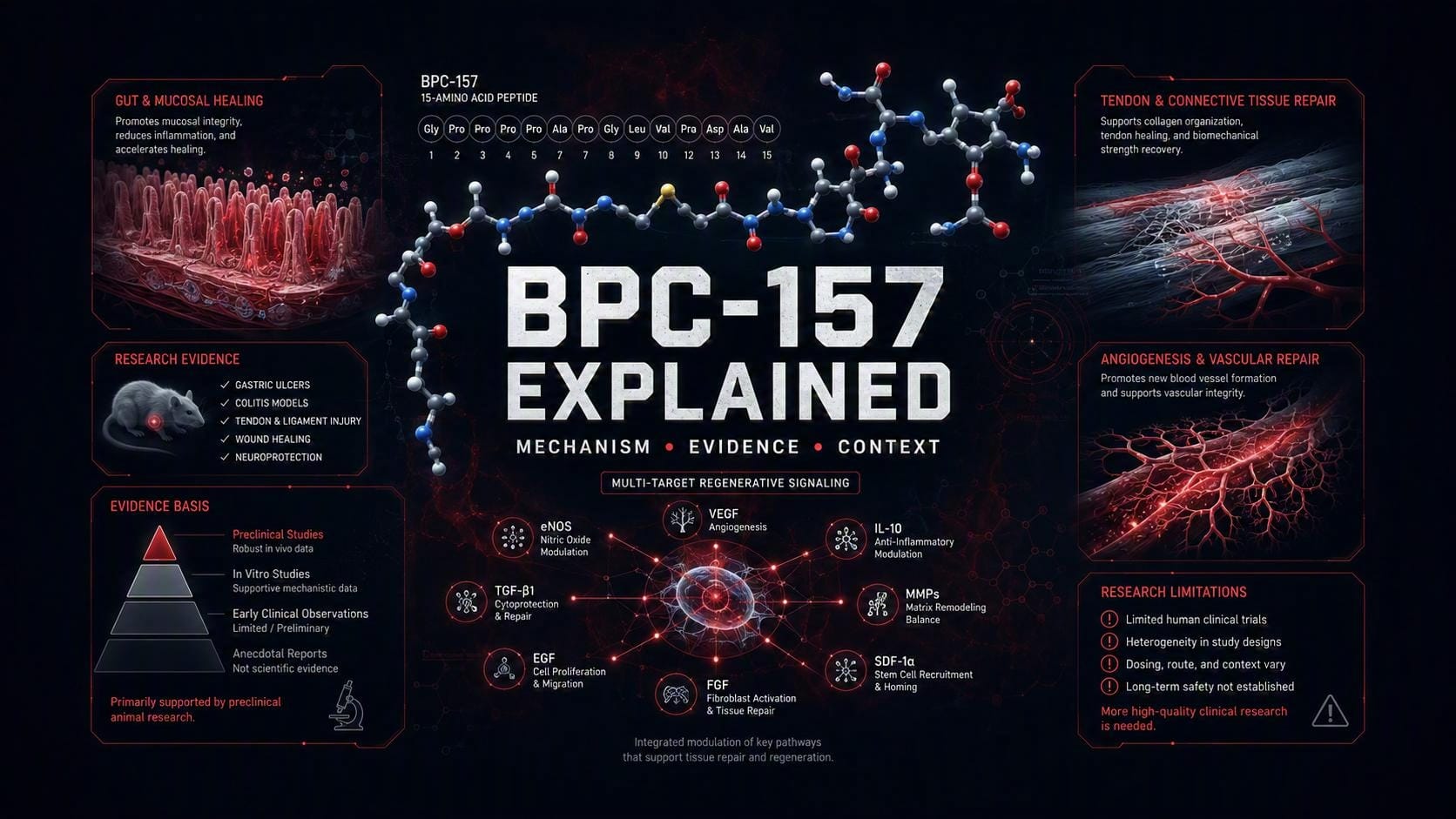
BPC-157 Explained: Mechanism, Research Evidence, and Use Context
BPC-157 DOSAGE: WHAT HAS BEEN MEASURED, AND WHAT PEOPLE ACTUALLY USE
BPC-157 is a 15 amino acid peptide copied from a protein in human stomach juice. In rats it speeds up healing of tendons, ligaments, muscle and gut, and it has done so in dozens of studies over 30 years. In people, the whole published record is three small studies with 30 patients between them, none of them a proper trial (PMID 42885452). So when you search for a BPC-157 dosage, you are asking a question that no human study has answered. This page gives you what has actually been measured, in rats and in those 30 people, how the rat doses translate on paper, and where the numbers you see on forums and vendor sites really come from.
The page is written the way a coach would explain it: plain words, every number from a PubMed abstract or a regulator page, and a clear line between measured and repeated. It covers the dosage data, the routes people use, the BPC-157 and TB-500 combination, what the animal benefits are, and the safety and legal position in 2026. Units for your own vial are on the peptide calculator.
BPC-157 dosage in brief
Three numbers set the frame. How many people have ever been studied, what dose the rats got, and how many controlled trials exist.
Every published human study of BPC-157 put together, as of a 2026 systematic review
Three studies met the inclusion criteria: 16 patients with knee pain who had the peptide injected into the joint, a pilot in 12 women with bladder pain, and one small safety study. All three were rated poor quality and the certainty of the evidence was rated very low (PMID 42885452). That is the entire human record.
The injection dose used in most of the healing studies, once a day, with 10 ng/kg also working
In the Achilles tendon studies, rats got 10 micrograms, 10 nanograms or 10 picograms per kilogram into the belly cavity once a day (PMID 14554208, PMID 16583442). On paper that scales to about 1.6 µg/kg in a person, or roughly 130 µg a day for 80 kg. That is a calculation, not a tested dose.
No randomised, placebo controlled trial of BPC-157 has been published for any use
A 2025 review found only three pilot studies in humans, with no adverse events reported in them. It also found no trial able to show that the peptide works or is safe at any dose (PMID 40789979). The FDA has flagged immunogenicity and impurity concerns, and USADA lists it as prohibited for athletes.
Every figure on this page about BPC-157 comes from a PubMed abstract or a regulator page listed at the end. Doses that people use outside studies are reported as what they are: numbers from vendor guides and forum posts, not measurements. Nothing here is a recommendation to use BPC-157.
What this BPC-157 guide covers
The dosage question answered honestly: the doses measured in rats and in the three human studies, how rat doses convert on paper, and what the 250 to 500 mcg forum figures are based on.
Routes: injection under the skin, near the injury, into a joint, by mouth, as capsules and as nasal spray, and which of those has any data behind it.
BPC-157 and TB-500 together, the animal benefits by tissue, and the safety and legal position: FDA, USADA, contamination risk.
Not covered
Where to buy it. This site does not sell or source peptides and does not link to sellers.
A dosing protocol for you. There is no human dose. The page explains why, and then shows you the arithmetic for units on a syringe on the peptide calculator.
Other healing peptides. TB-500 has its own page: TB-500 explained. The group is covered on healing peptides.
What BPC-157 is, in plain words
Your stomach makes a protein that protects its own lining from acid. BPC-157 is a short piece of that protein, 15 amino acids long, made in a lab. The letters stand for Body Protection Compound, and the papers usually write it BPC 157 without the hyphen. A Croatian research group led by Predrag Sikiric has studied it since the early 1990s, almost always in rats, and has published most of the papers that exist. In those papers it is described as stable in stomach acid, active without a carrier, and free of toxicity in the limit tests they ran (PMID 22300085).
How it is thought to work matters for the dosage question. In tendon cells it does not make cells multiply faster. It makes them survive stress better and move faster into the gap in the tissue, through a signalling path called FAK-paxillin (PMID 21030672). In blood vessels it pushes on nitric oxide and VEGF signalling, which is the growth-of-new-vessels system (PMID 40789979). Both effects showed up across a wide range of doses, micrograms down to picograms per kilogram, which is one reason the rat data does not give a clean dose response curve to copy.
What BPC-157 is not: an approved drug anywhere. It went into early clinical testing for inflammatory bowel disease under the codes PL 14736 and PLD-116 around 2003, and those trials never produced a published result (PMID 14554208, PMID 40005999). Everything sold today is sold as a research chemical.
BPC-157 dosage: what has actually been measured
Here is the full dosage record, rats and people, in one table. Read the right hand column first. Every rat row is a controlled experiment with a saline group to compare against. Neither human row is.
| Study | Who or what | Dose and route | What happened | Source |
|---|---|---|---|---|
| Staresinic 2003 | Rats, cut Achilles tendon | 10 µg, 10 ng or 10 pg per kg, injected into the belly cavity, once a day | Tendon healed with better strength and function at all three doses | PMID 14554208 |
| Krivic 2006 | Rats, Achilles torn off the bone | Same three doses, same route, daily | Tendon to bone healing that controls did not achieve; reversed the harm of a corticosteroid | PMID 16583442 |
| Cerovecki 2010 | Rats, cut knee ligament | 10 µg or 10 ng per kg injected; 0.16 µg/ml in drinking water; 1 µg/g in cream on the skin | All three routes improved healing over 90 days | PMID 20225319 |
| Pevec 2010 | Rats, crushed calf muscle | Injection or cream, once or daily | Faster healing, full function back, even with a corticosteroid on board | PMID 20190676 |
| Lee 2021 | 16 people with knee pain | Injected into the knee joint, dose not reported in the abstract, follow up by phone | 14 of 16 said the pain improved; no scales, no control group | PMID 34324435 |
| Lee 2024 | 12 women with bladder pain | 10 mg total injected into the bladder wall once | 10 of 12 reported full relief; no control group, no adverse events | PMID 39325560 |
| Poolton 2026 | Review of all human studies | Three studies, 30 people | Poor quality, very low certainty, should not be used outside regulated trials | PMID 42885452 |
How the rat dose converts, and why that is still not a dose
The standard way to turn an animal dose into a first human dose is the body surface area method in the FDA guidance for starting doses in trials. For rats the rule is to divide the mg/kg dose by 6.2. Applied to the 10 µg/kg rat dose, you get about 1.6 µg/kg, which is about 130 µg a day for an 80 kg person. Applied to the 10 ng/kg dose, which also worked in the tendon studies, you get a tenth of a microgram.
| Rat dose | Human equivalent per kg | For a 60 kg person | For an 80 kg person | For a 100 kg person |
|---|---|---|---|---|
| 10 µg/kg | about 1.6 µg/kg | about 97 µg a day | about 129 µg a day | about 161 µg a day |
| 10 ng/kg | about 1.6 ng/kg | about 0.1 µg a day | about 0.13 µg a day | about 0.16 µg a day |
| 10 pg/kg | about 1.6 pg/kg | about 0.0001 µg | about 0.00013 µg | about 0.00016 µg |
Two things stop this from being a dose. First, the FDA method gives a safe starting point for a trial, not a working dose, and the trial then finds the real one. No trial has. Second, the rat studies found healing at 10 µg/kg and at 10 ng/kg, a thousand fold apart, with no clear winner (PMID 14554208, PMID 16583442). A compound that works the same across a thousand fold range in rats does not tell you where the human dose sits. It tells you the rat model is not sensitive to dose, which is a different finding.
What people actually use, and where those numbers come from
Search for a BPC-157 dosage and you will see the same figures everywhere: 250 mcg, 500 mcg, twice a day, for four to eight weeks. They appear on vendor sites, on clinic blogs and in forum threads, and they agree with each other closely enough to look like a standard. They are not. They are the rat conversion, rounded up to a number that is easy to draw on a syringe, and then copied from site to site until it looked settled.
| Figure you will see | Where it comes from | What it is based on | Measured? |
|---|---|---|---|
| 250 mcg once or twice a day | Vendor guides, forum posts, clinic blogs | Rough rounding of the rat conversion and copying between sites | No |
| 500 mcg a day, split in two | Vendor guides, forum posts | Same, doubled for larger people or worse injuries | No |
| 2 to 10 mcg per kg | Forum posts, some clinic blogs | The rat 10 µg/kg figure used directly, without the surface area conversion | No |
| 4 to 8 weeks, then a break | Forum posts | Habit from other peptide protocols; the rat studies ran 14 to 90 days | No |
| 500 mg capsules by mouth | Supplement sellers | Marketing. Oral stability in rats is real, but no human oral dose has been studied | No |
| 10 mg into the bladder, once | One pilot study | The only human dose with a published number, for one indication, 12 patients, no control group | Reported, not controlled (PMID 39325560) |
There is a reason 250 mcg stuck. A 5 mg vial reconstituted with 2 ml of water gives 2.5 mg per ml, so 250 mcg is exactly 10 units on a U-100 insulin syringe. It is a convenient number, not a measured one. The one human dose with a published figure is 10 mg injected into the bladder wall in one go. That is forty times the forum daily dose, for a completely different problem (PMID 39325560).
Injection, oral, capsules, nasal spray: what each route has behind it
People ask whether BPC-157 works by mouth, whether capsules are as good as injections, and whether the spray does anything. The honest table is short. In rats, injection, drinking water and skin cream all worked. In people, two injection routes have been tried, into a knee and into a bladder, and nothing else has.
| Route | Measured in rats | Measured in people | Note |
|---|---|---|---|
| Injection under the skin or into the belly | Yes, most studies, 10 µg/kg and 10 ng/kg daily (PMID 14554208) | No | The route almost everyone outside studies uses. Zero human data. |
| Injection near the injury | Local cream and local injection both worked in rats (PMID 20225319) | No | The rat data does not show local beats systemic; both worked. |
| Injection into a joint | No | Knee pain, 16 people, pain reported by phone (PMID 34324435) | Only human musculoskeletal data, and it is a chart review. |
| Injection into the bladder wall | No | 12 women, 10 mg once (PMID 39325560) | Not relevant to injury use. |
| By mouth, in water | Yes, 0.16 µg/ml in drinking water healed ligaments (PMID 20225319) | No | The peptide survives stomach acid in rats. That is all that is known. |
| Capsules | No | No | Sold widely. No study of any capsule product. |
| Nasal spray | No | No | Sold widely. No study. |
| Cream on the skin | Yes, 1 µg/g for ligament and muscle (PMID 20225319, PMID 20190676) | No | Rat skin is not human skin; absorption untested. |
The oral question deserves one more sentence because it drives a lot of sales. BPC-157 is unusual among peptides in that it is stable in gastric juice, which is where it was found in the first place. Rats healed ligaments when it was simply added to their drinking water (PMID 20225319). That makes oral use plausible in a way it is not for most peptides. Plausible is not shown. No human has been studied taking it by mouth, and no capsule or spray product has ever been tested.
BPC-157 and TB-500 together
The pairing is the most searched BPC-157 question after dosage. TB-500 is a piece of thymosin beta 4, a protein involved in cell movement and new blood vessels. The logic for stacking is that the two act through different paths, so they should add up. It is a reasonable guess. It has been tested once, in the knee pain chart review. Four of the 16 patients got both peptides and 3 of those 4 reported relief, against 11 of 12 on BPC-157 alone (PMID 34324435). Four people, no scales, no control. That is the entire evidence for the combination.
Blends sold as one vial, usually 5 mg of each or 10 mg total, are a vendor product, not a studied one. The same arithmetic applies: the concentration follows from what is in the vial and how much water you add, and the amount is a guess. If you want the full picture on the second peptide, it is on TB-500 explained.
BPC-157 benefits: what the animal data shows, tissue by tissue
The benefits people list for BPC-157 are mostly true for rats. That is not a small thing. The tendon, ligament and muscle results are consistent, controlled and repeated across 20 years. The problem is only that the step from rat to person has not been taken.
| Tissue | What the rats showed | Human data | Source |
|---|---|---|---|
| Tendon | Cut Achilles healed with normal strength; torn off the bone it reattached | None | PMID 14554208, PMID 16583442 |
| Ligament | Cut knee ligament healed over 90 days by injection, mouth or cream | None | PMID 20225319 |
| Muscle | Crushed calf muscle healed to full function, even on corticosteroids | None | PMID 20190676 |
| Gut | Protects the stomach lining from alcohol and anti inflammatory drugs; heals gut wounds | Early IBD trials in the 2000s, no published results | PMID 22300085 |
| Skin and wounds | Faster closing of cuts, burns and diabetic wounds | None | PMID 34267654 |
| Blood vessels | Less damage when blood flow is cut off and restored | None; 2026 review calls it hypothesis generating only | PMID 42794771 |
| Joints | None | 16 people with knee pain, 14 better by phone survey | PMID 34324435 |
The wound healing review from the Sikiric group puts the breadth of this plainly. The same dose range and the same routes worked across skin, gut, tendon, muscle, bone, nerve and blood vessels in rats (PMID 34267654). A 2026 critical review of the blood flow studies agrees that the effects are real in rodents. It then lists what is missing: independent blinded replication, dose response studies, pharmacokinetics, toxicology and controlled human trials (PMID 42794771). Almost all of the literature comes from one group, which is the other reason outside reviewers want replication.
Is BPC-157 safe, and is it legal?
Safe is the wrong question to ask of a compound with 30 human subjects. The accurate statement is that no harm has been reported in the three small studies. Absence of a reported problem in 30 people followed up by phone is not evidence of safety (PMID 42885452). Rats tolerated huge doses in the limit tests, with no LD1 reached (PMID 22300085). Rats also do not buy their peptides from unlicensed websites.
| Question | Answer | Source |
|---|---|---|
| Approved as a medicine anywhere? | No | PMID 40005999 |
| Serious side effects in the three human studies? | None reported, in 30 people, with no control groups and short follow up | PMID 40789979, PMID 42885452 |
| FDA position | Placed in category 2 for compounding in 2023, meaning significant safety risks: immunogenicity, peptide impurities, poor API characterisation, no safety data for the routes proposed. The nomination was later withdrawn, so it is on no permitted list | FDA bulk substances page |
| Can a US pharmacy compound it? | No legal basis, according to USADA, since it is on no 503A or 503B list | USADA |
| Sport | Prohibited under S0, non approved substances, in and out of competition | USADA |
| Main real world risks | Contamination and impurities from unregulated sources, inaccurate dosing, and the theoretical risk of pushing blood vessel growth in the wrong place | PMID 42757290 |
The practical risk is not the molecule. It is the supply. BPC-157 is sold as a research chemical with no manufacturing oversight, so the vial may contain less than stated, more than stated, or peptide fragments and endotoxin that were never tested for. A 2026 review of unregulated injectable peptides lists contamination, impurities and inaccurate dosing as the first three hazards, ahead of anything the peptide itself does (PMID 42757290). The theoretical concern the reviewers raise about the molecule is that a compound which grows new blood vessels in a healing tendon could do the same in a tumour. That has not been shown. It also has not been ruled out, because the studies that would rule it out have not been run.
Five mistakes people make with BPC-157 dosage
1. Reading 250 mcg as a studied dose
It is the rat dose, converted and rounded to 10 units on a syringe. No human study has used it (PMID 42885452).
2. Using the rat mg/kg figure directly
Taking 10 µg/kg from the rat papers and applying it to your own weight skips the body surface area conversion and lands six times higher than the FDA method would. Neither number is tested, but one is at least the standard conversion.
3. Assuming more is better
In rats, 10 ng/kg healed tendons about as well as 10 µg/kg (PMID 14554208). Nothing in the data says a bigger dose does more.
4. Trusting the label on the vial
Research chemical vials are not tested for content or purity. The concentration you calculate is only as good as the milligram figure printed on it (PMID 42757290).
5. Calling the knee study a trial
Sixteen people, phone survey, no scales, no control group, dose not reported (PMID 34324435). It is a reason to run a trial, not a result of one.
Verdict: the dosage question has a rat answer and no human one
BPC-157 heals tendon, ligament, muscle and gut injuries in rats at doses from 10 µg/kg down to 10 ng/kg, by injection, by mouth and on the skin. That record is real and it is why the compound is interesting. In people, there are 30 patients across three uncontrolled studies, one published dose for a bladder problem, and no trial. The 250 to 500 mcg figures you will see everywhere are the rat dose converted, rounded and repeated. The FDA has flagged safety unknowns, USADA prohibits it, and the vials are unregulated.
Units for whatever is in your vial are on the peptide calculator. The second half of the usual pairing is on TB-500 explained. How the whole class is marketed against what is measured is on peptide research vs human use.
BPC-157 dosage: frequently asked questions
What is the BPC-157 dosage used in studies?
In rats, 10 micrograms per kilogram a day by injection, with 10 nanograms per kilogram working about as well (PMID 14554208). Rats also healed with 0.16 µg/ml in drinking water and 1 µg/g in a skin cream (PMID 20225319). In people, the only published dose is 10 mg injected once into the bladder wall for bladder pain (PMID 39325560). The knee pain study did not report its dose. No human dose for injury healing has been studied.
Is there a BPC-157 dosage chart?
Not one based on human data. Charts online show 250 to 500 mcg a day. That is the rat dose converted with the FDA body surface area formula, about 130 mcg a day for 80 kg, rounded up to a convenient 10 or 20 units on an insulin syringe. The conversion table on this page shows the arithmetic. It is an estimate for a trial starting point, not a tested dose.
How many units of BPC-157 is 250 mcg?
It depends on the vial and the water. With a 5 mg vial and 2 ml of bacteriostatic water, the concentration is 2.5 mg/ml, each unit on a U-100 syringe holds 25 mcg, and 250 mcg is 10 units. With 1 ml of water it is 5 units. The peptide calculator does the arithmetic for any vial. It does not tell you how much to take, because that has not been measured.
Does oral BPC-157 work?
In rats, yes: the peptide is stable in stomach acid and rats healed a cut knee ligament when it was added to their drinking water (PMID 20225319). In people it has never been studied by mouth, and no capsule or nasal spray product has been tested at all. Oral use is more plausible for BPC-157 than for most peptides, but plausible is not shown.
Can you take BPC-157 and TB-500 together?
People do, and vendors sell blends. The only data is four patients in a knee pain chart review who got both and reported slightly less relief than the twelve who got BPC-157 alone (PMID 34324435). There is no controlled study of the combination in animals or people. Stacking does not make either peptide better studied.
Is BPC-157 safe?
Unknown. No adverse events were reported in the three human studies, but they covered 30 people with no control groups and short follow up (PMID 40789979, PMID 42885452). The FDA flagged immunogenicity, impurity and characterisation concerns when it reviewed the compound for compounding. The clearest real world risk is the unregulated supply: contamination and inaccurate dosing (PMID 42757290).
Is BPC-157 legal?
It is not an approved medicine in any country and cannot lawfully be compounded by a US pharmacy, since it is on no permitted bulk substance list. It is sold as a research chemical. For athletes it is prohibited under the WADA S0 category of non approved substances, in and out of competition, according to USADA.
How long does a BPC-157 cycle last?
There is no studied cycle length in people. The rat studies ran from 14 days for tendon to 90 days for ligament (PMID 14554208, PMID 20225319). The four to eight week figures online are habit carried over from other peptide protocols, not a finding.
Sources and further reading
Every figure on this page about BPC-157 comes from one of the 18 sources below. Fifteen are papers checked against their PubMed abstracts on 24 October 2026, and three are regulator documents from the FDA and USADA. Doses that circulate outside the literature are labelled as vendor or forum figures in the text. Reference links are dofollow to support open science.
Verified
Verified
Verified
Verified
Verified
Verified
Verified
Verified
Verified
Verified
Verified
Verified
Verified
Verified
Regulator
Regulator
Regulator
Verified
Keep reading
Four pages that finish the picture: the other half of the usual stack, the whole healing peptide group, the units arithmetic, and how peptide marketing compares with what is measured.
Final Educational Note
This article is educational and is not medical advice, a dosing recommendation or an endorsement of BPC-157. It reports what animal studies, three small human studies, two systematic and narrative reviews and two regulators say, and it labels every dose that circulates outside the literature as unmeasured. BPC-157 is not an approved medicine anywhere and is prohibited in tested sport. More guides sit on the peptides hub.
Anyone considering any unapproved compound should talk to a physician first, particularly anyone with a history of cancer, given the unanswered questions about blood vessel growth, and anyone subject to anti doping rules. Read more about how this site works on the about page and in the full disclaimer.