Healing Peptides: BPC-157, TB-500 and What Tissue Repair Research Actually Shows
What tissue-repair research actually shows
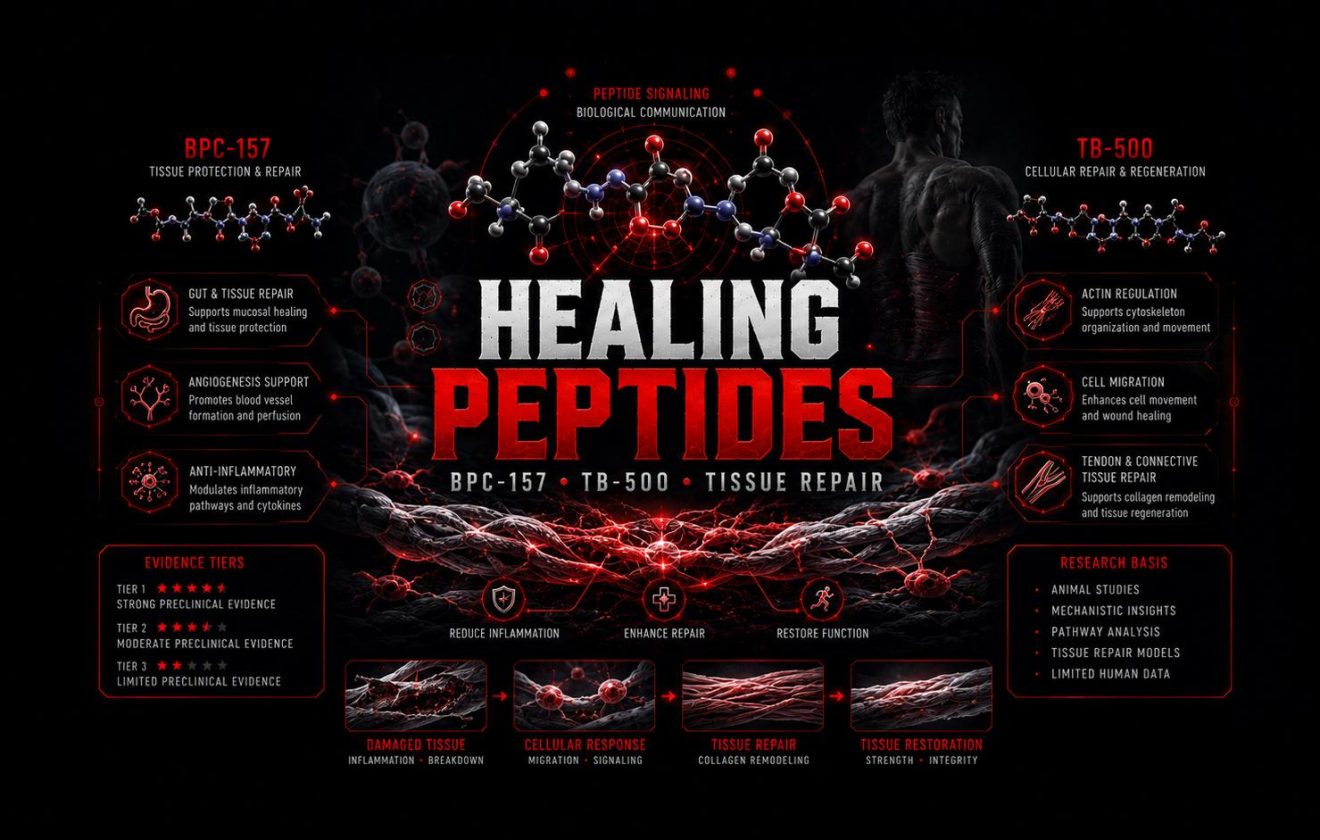
Healing peptides are compounds studied for effects on tissue repair, inflammation modulation, and recovery from musculoskeletal injury. BPC-157 and TB-500 are the most referenced healing peptides in performance and harm-reduction research. Understanding what the evidence base for each compound actually contains - and where it stops - is the starting point for reading any claim about this compound class accurately.
Healing Peptides: Three Facts Before Reading Any Claim
These three facts define the current state of research on healing peptides. Every claim about BPC-157, TB-500, or related compounds connects back to one or more of these points.
Preclinical Evidence Only
The healing peptides most discussed in performance research - BPC-157 and TB-500 - have no published human clinical trials. All controlled evidence comes from rodent injury models: tendon transection, muscle crush, bone fracture, gastric ulcer, and peripheral nerve injury. Extrapolating rodent tissue repair data to human outcomes involves assumptions about dose scaling, receptor homology, and injury context that have not been validated in human subjects.
Different Mechanisms, Different Evidence
BPC-157 and TB-500 are studied through distinct mechanistic pathways. BPC-157 is a synthetic partial sequence of a gastric protein; its proposed mechanisms include nitric oxide pathway modulation, growth factor receptor upregulation, and angiogenesis promotion. TB-500 is a synthetic fragment of thymosin beta-4, an endogenous actin-sequestering protein. Their biological targets overlap in outcome - tissue repair - but the molecular routes differ, and neither mechanism has been fully characterized in humans. Treating healing peptides as a single uniform class obscures these differences.
Regulatory Status Is Unapproved
Neither BPC-157 nor TB-500 is approved for human use by any major regulatory agency. Both are classified as research compounds. Thymosin beta-4 itself - the endogenous protein from which the TB-500 fragment is derived - has been investigated in Phase II clinical trials for wound healing and cardiac repair, but TB-500 as a synthetic fragment is not an approved pharmaceutical. Healing peptides in this class are sold as research chemicals; purity, sterility, and concentration in research-market products are not independently verified.
What This Guide Covers
Covered in This Guide
- The biological cascade that healing peptides are proposed to target
- BPC-157 mechanism: origin, studied pathways, and animal evidence summary
- TB-500 mechanism: thymosin beta-4 biology, actin regulation, and repair context
- What human data exists - and why there is so little of it
- Evidence boundaries: what healing peptides cannot claim based on current research
- 5 common mistakes in how BPC-157 and TB-500 are described
Not Covered Here
- GH secretagogues - covered in the Growth Hormone Peptides guide
- Dosing, reconstitution, or injection protocols for any compound
- Non-peptide anti-inflammatory compounds (NSAIDs, corticosteroids)
- PRP (platelet-rich plasma) or stem cell approaches to tissue repair
- Full thymosin beta-4 clinical trial data - only the TB-500 fragment is covered
Prerequisites. This guide builds on the What Are Peptides guide and the Types of Peptides classification framework. Healing peptides are a Tier 3 compound class by the evidence tier system defined there - meaning evidence is primarily animal-based with no published human clinical trials.
Six topics on healing peptides and how to evaluate the research behind them.
The Injury Repair Cascade and Where Healing Peptides Act
Tissue repair is not a single biological event - it is a staged cascade that unfolds over days to weeks depending on tissue type and injury severity. Understanding where healing peptides are proposed to intervene within this cascade is necessary for evaluating whether the proposed mechanisms are plausible, whether the animal models used to study them are relevant, and where the gaps in current evidence are largest.
The repair cascade begins at the moment of injury with hemostasis and platelet activation, followed by an acute inflammatory phase driven by neutrophil and macrophage infiltration. This inflammatory phase is not simply a problem to suppress - it is a required signal that initiates the subsequent proliferative phase, during which fibroblasts deposit new extracellular matrix, angiogenesis restores vascular supply, and new tissue architecture begins to form. The final remodeling phase can extend for months, particularly in dense connective tissue such as tendon or ligament, where collagen fiber alignment and cross-linking determine ultimate tensile strength.
Healing peptides are proposed to act primarily during the inflammatory and proliferative phases. BPC-157 is hypothesized to modulate nitric oxide synthesis, upregulate growth factor receptors including VEGF and EGF receptor expression, and promote angiogenesis. TB-500 - as a fragment of thymosin beta-4 - acts through actin sequestration and cell migration promotion, facilitating the movement of fibroblasts and endothelial cells into the injury site during the proliferative phase. These mechanisms are not mutually exclusive; both could theoretically accelerate the same cascade through different molecular entry points.
The challenge in translating these mechanisms from preclinical to clinical contexts is tissue type specificity. Healing peptides have been studied across gastric ulcer models, tendon transection models, muscle crush models, bone fracture models, and peripheral nerve injury models - often in the same compound, with results that vary substantially across tissue types. A compound that accelerates gastric ulcer healing in rats does not necessarily accelerate tendon repair in the same animal or in humans. The evidence must be evaluated per tissue type and per species, not as a uniform "healing" outcome.
Hemostasis and Inflammation
Immediately after injury, platelets aggregate and release growth factors including PDGF and TGF-beta. Neutrophils clear debris; macrophages arrive and polarize between pro-inflammatory (M1) and pro-repair (M2) phenotypes. This phase is essential - suppressing it too aggressively impairs subsequent repair. Healing peptides proposed to act here include BPC-157, which has shown anti-inflammatory effects in rodent models without complete suppression of the inflammatory response.
Proliferation and Angiogenesis
Fibroblasts proliferate and deposit collagen type III (initially) and later type I. Angiogenesis restores blood supply through endothelial cell migration and tubulogenesis. Both BPC-157 and TB-500 are hypothesized to act primarily here: BPC-157 through VEGF upregulation and nitric oxide pathway modulation; TB-500 through the actin-G/F sequestration mechanism that drives endothelial and fibroblast cell migration. This phase is the primary target of healing peptides in most preclinical injury models.
Remodeling
Disorganized collagen type III is gradually replaced by aligned collagen type I through matrix metalloproteinase activity. Tensile strength increases over weeks to months. Tendon and ligament remodeling is the slowest - full functional recovery in a transected tendon model in rodents takes 8-12 weeks. Most healing peptide studies end their observation window before this phase is complete, meaning the long-term structural quality of repaired tissue under treatment is rarely evaluated.
Rodent Model Limitations
Healing peptides are tested almost exclusively in rodent injury models. Rats and mice have a higher baseline metabolic rate and faster tissue turnover than humans, which affects how quickly repair cascades proceed and how compounds influence them. Vascularization of rodent tendon differs from human tendon; the innate immune response kinetics differ; body weight scaling for dose is unreliable across species. None of these limitations disqualify animal data - they define what the data can and cannot support when claims are made about human healing.
Injury model specificity matters. A 2025 review of BPC-157 noted that the compound shows variable results across different tissue types and injury models - positive findings in gastric and tendon models do not uniformly replicate in bone or peripheral nerve models. When reading any study on healing peptides, the specific injury model used is as important as the outcome measured. "BPC-157 accelerates healing" is not a general statement the evidence supports - it is a claim that requires a specific tissue type, a specific species, and a specific injury model to be accurately interpreted.
BPC-157 vs TB-500: Mechanisms and Evidence Compared
BPC-157 and TB-500 are the two healing peptides referenced most frequently in performance research. They share a common outcome focus - accelerated tissue repair - but have different molecular origins, different primary mechanisms, and different evidence bases. Placing them side by side clarifies where the research is strongest, where it is absent, and why they are sometimes combined in research-community protocols.
BPC-157 is a synthetic 15-amino acid partial sequence derived from a protein found in human gastric juice - body protection compound. It is not identical to any naturally occurring peptide but is partially homologous to sequences found in the stomach protein BPC. Decades of rodent research, primarily from a single research group at the University of Zagreb, have documented effects across gastric, tendon, muscle, bone, and neural injury models. TB-500 is a synthetic fragment corresponding to amino acids 17-23 of thymosin beta-4, an endogenous 43-amino acid protein found at high concentrations in platelets, wound fluid, and regenerating tissue. The fragment retains the actin-binding region of the full protein and its cell-migration-promoting activity.
Gastric Origin / Multi-Tissue Evidence
Origin: synthetic partial sequence of human gastric BPC protein. Primary studied mechanisms: nitric oxide synthase modulation, VEGF receptor upregulation, EGR-1 transcription factor activation, angiogenesis promotion. Animal evidence: extensive rodent data across tendon transection, muscle crush, bone fracture, gastric ulcer, and peripheral nerve injury models - primarily from one research institution. Human data: none published in peer-reviewed literature. Route in research: both systemic injection and oral administration have been studied in rodents, with oral activity reported in some gastric models. Regulatory status: unapproved research compound. Key limitation for healing peptides claims: almost all evidence is from a single research group; independent replication in other institutions is limited.
Thymosin Beta-4 Fragment / Cell Migration Focus
Origin: synthetic fragment (aa 17-23) of endogenous thymosin beta-4. Primary studied mechanism: G-actin sequestration that promotes cell migration of fibroblasts and endothelial cells into the injury site; secondary effects on anti-inflammatory cytokine modulation. Animal evidence: rodent wound healing, cardiac injury, and tendon models. The full thymosin beta-4 protein has been studied in Phase II human clinical trials for wound healing and cardiac repair - TB-500 as an isolated fragment has not. Human data: none published for TB-500 specifically. Regulatory status: unapproved research compound. Key distinction among healing peptides: TB-500's parent molecule has legitimate Phase II clinical context; the fragment itself does not share that evidence base by default.
Why they are often combined. BPC-157 and TB-500 target different phases of the repair cascade through different mechanisms - BPC-157 primarily through vascular and growth factor pathways, TB-500 primarily through cell migration. The rationale for combining healing peptides from both classes follows the same logic as combining GHRH analogs and GHRPs: receptor and pathway complementarity rather than redundancy. This rationale is mechanistically plausible but has not been tested in any controlled study - combined administration data for these healing peptides exists only as anecdotal reports, not as published research.
The Human Evidence Gap: Why No Clinical Trials Exist for Healing Peptides
The absence of published human clinical trials for BPC-157 and TB-500 is not an oversight - it reflects a combination of regulatory, commercial, and scientific barriers that prevent healing peptides in this class from advancing through formal clinical development. Understanding why that gap exists is as important as understanding what animal research shows.
Clinical trial development for healing peptides requires an Investigational New Drug (IND) application with the FDA or equivalent application with European regulatory bodies. Filing an IND requires preclinical safety data - toxicology, pharmacokinetics, and dose-ranging studies in at least two species - that meets current Good Laboratory Practice standards. Most BPC-157 research was conducted in university laboratory settings rather than GLP-compliant facilities, meaning the existing data cannot be submitted directly to regulators to support a clinical trial application. Repeating this work in GLP-compliant settings requires significant investment that pharmaceutical sponsors are unlikely to make for compounds they cannot patent.
BPC-157 is a synthetic sequence derived from a protein found in the human body, which significantly limits its patentability in most jurisdictions. Without patent protection, a pharmaceutical company cannot recoup the cost of Phase II and Phase III trials - typically hundreds of millions of dollars - through exclusive market rights. This commercial barrier explains why healing peptides with plausible preclinical mechanisms and no documented safety signals in animal studies can still remain in a permanent state of research-only status. The evidence gap is not purely scientific; it is partly structural.
Thymosin beta-4 - the parent molecule of TB-500 - has been studied in Phase II human clinical trials by RegeneRx Biopharmaceuticals for wound healing and cardiac repair. These trials established that systemic administration of full-length thymosin beta-4 in humans is tolerated at studied doses. However, TB-500 is a synthetic fragment, not the full molecule. The Phase II data from full thymosin beta-4 trials does not automatically transfer to the fragment. The actin-binding domain fragment may have different pharmacokinetics, receptor interactions, and systemic distribution than the intact protein. Citing thymosin beta-4 clinical trial data as evidence for TB-500 is a common error among healing peptides discussions that conflates two distinct molecular entities.
GLP Compliance Gap
Most existing preclinical safety data for BPC-157 was generated in non-GLP academic settings. Regulatory agencies require GLP-compliant toxicology data to support a human trial application. The existing data volume - over 100 published rodent studies - does not substitute for GLP compliance. To enter human trials, healing peptides like BPC-157 would require a full GLP preclinical program to be run from scratch at substantial cost.
Patentability Constraint
Sequences derived from endogenous human proteins face narrow patentability in most jurisdictions. Without composition-of-matter patent protection, a sponsor investing in Phase III trials for healing peptides cannot prevent competitors from selling the same compound at lower cost after approval. This destroys the economic model for pharmaceutical development and explains why promising healing peptides remain in the preclinical research phase indefinitely despite years of animal data.
Single Research Group Concentration
The majority of BPC-157 animal research originates from one institution - the University of Zagreb, led by Predrag Sikiric. While prolific, this concentration means that independent replication of key findings is limited. Peer review and scientific consensus strengthen when multiple independent groups produce converging results. For healing peptides like BPC-157, the preclinical evidence base is broad in volume but narrow in source diversity, which limits the confidence that can be placed in the results before human trials.
Endpoint Selection for Trials
Designing a human clinical trial for healing peptides requires a specific, measurable primary endpoint acceptable to regulators. "Tissue repair" is not a single endpoint - it could mean time to full return of function, imaging-confirmed collagen density, subjective pain score, or re-injury rate. Selecting an endpoint that is measurable, clinically meaningful, and achievable within a trial timeline for a compound with unknown human pharmacokinetics is a significant design challenge that has not been publicly addressed for any unapproved healing peptide.
What "no clinical trials" actually means. The absence of human trials for healing peptides does not mean the compounds are ineffective - it means their effectiveness in humans has not been tested. These are genuinely different statements. A compound can have a plausible mechanism, robust animal data, and no documented human adverse events and still have completely unknown human efficacy. Unknown is not the same as zero, but it is also not the same as established.
What Healing Peptides Cannot Claim Based on Current Evidence
The table below maps five frequently made claims about healing peptides against what the evidence actually contains. Each boundary reflects the specific gap between animal data and human outcomes.
| Claim | What Preclinical Evidence Shows | What Human Evidence Shows |
|---|---|---|
| Accelerates tendon repair | BPC-157 reduces time to functional recovery in rodent Achilles tendon transection and crush models. Histology shows improved collagen organization at study endpoints. | No human controlled trial. No imaging or biomechanical data in humans. Tendon repair timelines in rodents are not directly comparable to humans due to vascularization and metabolic rate differences. |
| Reduces inflammation | BPC-157 shows anti-inflammatory effects in rodent models without full inflammatory suppression. Cytokine profiles shift toward repair-associated markers in some studies. | No human data. The clinical relevance of rodent cytokine modulation for human post-injury recovery has not been established for any healing peptide in this class. |
| Protects the gut on-cycle | BPC-157's most robust animal evidence is in gastric ulcer and GI mucosal protection models - the tissue from which it was originally derived. Effects are documented across multiple rodent GI injury models. | No human GI trial for BPC-157. Extrapolation from rodent GI data to human GI protection during NSAID or steroid use is mechanistically reasonable but clinically unverified. |
| TB-500 repairs muscle injury | Thymosin beta-4 (full protein) shows benefits in cardiac and skeletal muscle injury models. TB-500 fragment data specifically is more limited - most animal studies use the full protein. | No published human data for TB-500 fragment. Full thymosin beta-4 has Phase II wound healing data; this does not transfer directly to the synthetic fragment. |
| Safe for human use | No significant toxicity signals in rodent acute and subchronic dosing studies for either compound at studied doses. | Absence of toxicity signals in rodents is not equivalent to established human safety. Long-term effects, immunogenic potential, and dose-response in humans are unknown for all unapproved healing peptides. |
The strongest evidence is in the narrowest application. BPC-157's most replicated and robust animal evidence is in gastric and GI mucosal protection - the tissue context closest to its biological origin. The further healing peptide claims move from that original context - toward tendon, bone, neural, or systemic applications - the thinner and less independently replicated the evidence becomes.
5 Mistakes in How Healing Peptides Are Described
These five mistakes appear consistently in how healing peptides are discussed outside peer-reviewed research contexts.
- Mistake 1
Citing Thymosin Beta-4 Clinical Trials as Evidence for TB-500
Full-length thymosin beta-4 (43 amino acids) has been studied in Phase II human trials for wound healing and cardiac repair. TB-500 is a synthetic 7-amino acid fragment corresponding to positions 17-23 of that protein. The clinical data from full thymosin beta-4 trials does not establish the human efficacy or safety of the fragment. The fragment may have different pharmacokinetics, different receptor interactions, and different systemic distribution. Presenting thymosin beta-4 clinical trial results as evidence for healing peptides sold as TB-500 conflates two distinct molecular entities with separate - and very different - evidence bases.
- Mistake 2
Treating Volume of Animal Studies as Equivalent to Clinical Evidence
BPC-157 has over 100 published rodent studies - an unusually large preclinical evidence base for an unapproved compound. This volume is sometimes cited as if it constitutes strong evidence for human use. Quantity of animal studies does not substitute for human trials in establishing efficacy or safety. A compound with 100 positive rodent studies and no human trials is still a compound with no established human outcomes. The volume reflects research interest and the productivity of the primary research group, not the translation of findings to humans. For healing peptides, breadth of animal evidence and readiness for human use are separate questions.
- Mistake 3
Assuming Oral Bioavailability Based on Rodent GI Data
Some BPC-157 rodent studies demonstrate effects via oral administration - particularly in GI mucosal protection models where the compound acts locally in the gastrointestinal tract. This is sometimes generalized to claim that oral healing peptides are bioavailable and systemically active in humans. Local GI activity in rodents after oral administration does not establish systemic absorption. Peptides are susceptible to proteolytic degradation in the GI tract; the conditions under which BPC-157 reaches the bloodstream intact after oral dosing in humans have not been characterized. Claims about oral bioavailability of healing peptides for systemic tendon or muscle effects are not supported by available evidence.
- Mistake 4
Ignoring the Single Research Group Problem for BPC-157
Scientific reproducibility requires independent replication - the same finding demonstrated by different research groups using different equipment, animal stocks, and laboratory conditions. The majority of BPC-157 animal research comes from a single institution. Positive findings from one laboratory, however well-conducted, carry less evidential weight than findings independently replicated by multiple groups. Independent replication of BPC-157's core healing peptide claims in tendon, bone, and neural models is limited. This is not evidence of fraud or error - it is a structural feature of the evidence base that should inform how much confidence is placed in the results.
- Mistake 5
Combining BPC-157 and TB-500 Without Acknowledging the Evidence Basis
Combining healing peptides from the BPC-157 and TB-500 classes is frequently discussed in performance and harm-reduction communities on the basis that their mechanisms are complementary. The mechanistic rationale - different phases of the repair cascade, different molecular targets - is plausible. However, no published study has evaluated combined administration of these healing peptides in any controlled model, animal or human. The combination has been tested anecdotally, not scientifically. Presenting a mechanistic rationale for combination use is not the same as presenting evidence that the combination is more effective than either compound alone, or that it does not produce interactions not present with either compound individually.
Primary Research Sources
Peer-reviewed references from PubMed used to verify mechanisms, evidence tier characterization, and specific compound claims in this guide.
- Yuan C, et al. From Regeneration to Analgesia: The Role of BPC-157 in Tissue Repair and Pain Management. Int J Mol Sci. 2026;27(6):2876. PMID 41898733
- Vasireddi N, et al. Emerging Use of BPC-157 in Orthopaedic Sports Medicine: A Systematic Review. HSS J. 2025. PMID 40756949
- Gwyer D, et al. Gastric pentadecapeptide body protection compound BPC 157 and its role in accelerating musculoskeletal soft tissue healing. Cell Tissue Res. 2019;374(2):297-309. PMID 30915550
- Bock-Marquette I, et al. Thymosin beta4 activates integrin-linked kinase and promotes cardiac cell migration, survival and cardiac repair. Nature. 2004;432(7016):466-472. PMID 15565145
- Malinda KM, et al. Thymosin beta4 accelerates wound healing. J Invest Dermatol. 1999;113(3):364-368. PMID 10469335
Healing Peptides: Reading the Evidence on BPC-157 and TB-500
Healing peptides occupy a specific position in the peptide evidence landscape: a larger preclinical evidence base than most research compounds, zero published human clinical trials, and a regulatory pathway blocked by structural barriers that are unlikely to be resolved in the near term. BPC-157 has the most extensive animal data of any unapproved healing peptide - but that data is concentrated in one research institution and has not been independently replicated at scale. TB-500's parent molecule has legitimate Phase II human data; the synthetic fragment does not share that evidence base.
The mechanisms proposed for healing peptides are biologically plausible. The injury repair cascade is well-characterized, the proposed molecular targets within it are real, and the animal models used are appropriate for initial mechanistic investigation. None of this is in dispute. What is in dispute - or more accurately, what simply has not been tested - is whether these mechanisms translate to meaningful clinical outcomes in humans at achievable doses delivered by available routes. That question has not been answered because it has not been formally asked in a controlled human setting.
The full Peptides hub applies this evidence framework across the compound class. The Types of Peptides guide defines the Tier 3 classification that healing peptides occupy. The Growth Hormone Peptides guide covers the mechanistically separate GH secretagogue class. For research methodology relevant to evaluating these compounds, see the Research hub.
- Peptides Hub - All Guides
- What Are Peptides? - Molecular Basis and Signaling
- Types of Peptides - Classification and Evidence Tiers
- Growth Hormone Peptides - GH Secretagogue Guide
- Peptide Dosage Calculator
- Research Hub - Study Design and Mechanisms
- What Are Anabolic Steroids?
- Bloodwork and Health Hub
- About the Author - Ryan Hale
- Start Here - Site Navigation Guide
For Educational Purposes Only
This guide is produced for educational and harm-reduction purposes. MuscleScience.org does not sell, recommend, or endorse any compound. All content reflects a summary of published research and does not constitute medical advice.
BPC-157 and TB-500 are not approved for human use by any regulatory agency. They are research compounds. Purity, sterility, and concentration in research-market products are not independently verified. Consult a licensed physician before making any decisions related to peptide compounds or injury management.
All author names are editorial pseudonyms. See the full site disclaimer and about page for editorial policy and anonymity disclosure.