TB-500 Explained: Mechanism, Research Evidence, and Use Context
Mechanism and what the research shows
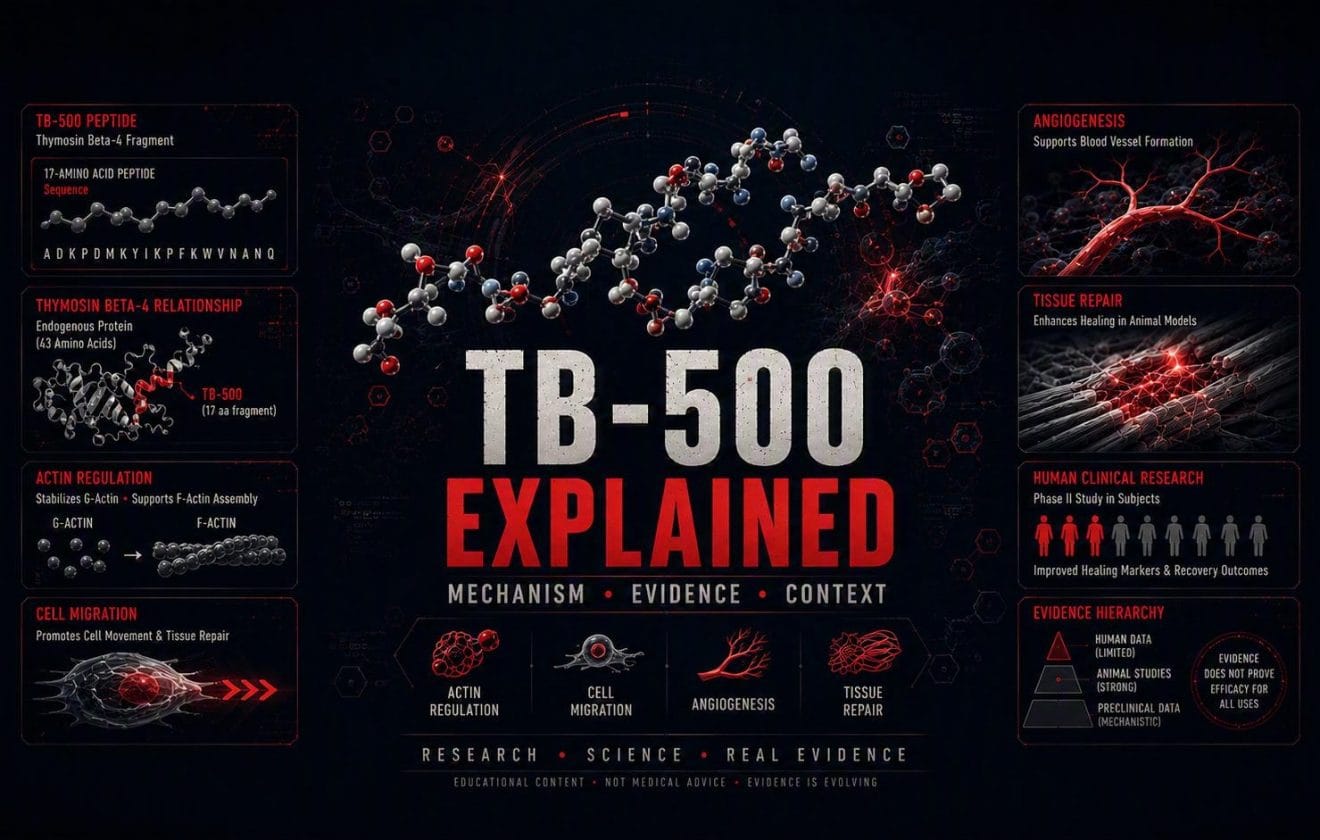
TB-500 is a synthetic peptide based on Thymosin Beta-4, an endogenous 43-amino acid protein found naturally in virtually every cell of the human body. Unlike most research peptides, Thymosin Beta-4 has advanced into human clinical trials - including a completed Phase II cardiac repair study. This guide covers the mechanism, what the research actually shows across animal and human data, and how TB-500 differs from BPC-157 at the molecular level.
TB-500: Three Things That Distinguish It from Most Research Peptides
It Is Based on an Endogenous Protein
TB-500 is a synthetic reproduction of Thymosin Beta-4 - a protein your body already produces and uses for wound healing, cell migration, and tissue repair. This endogenous origin distinguishes it mechanistically from BPC-157, which is derived from a gastric juice protein sequence.
Human Trials Have Been Conducted
Thymosin Beta-4 has completed Phase I safety trials and a Phase II cardiac repair study - something BPC-157 has not achieved. The human data shows a safety profile but did not replicate the efficacy seen in animal models, which is itself a critical data point.
The Mechanism Is Actin-Based, Not Angiogenic
TB-500 works primarily through actin sequestration and cell migration - a fundamentally different mechanism from BPC-157's VEGFR2-driven angiogenesis. These pathways are complementary, which explains why the two are frequently combined in community frameworks.
What This Guide Covers
Covered in This Guide
- What TB-500 is and how it relates to Thymosin Beta-4
- The fragment vs full-protein distinction
- Proposed mechanisms of action
- Animal and human research evidence
- Mechanistic comparison with BPC-157
- Administration routes discussed in the literature
- Common misinterpretations
Not Covered Here
- Specific dosing recommendations
- Sourcing or procurement guidance
- Legal status by jurisdiction
- Specific combination protocol design
- Clinical endorsement of any kind
Context: TB-500 and BPC-157 are the two most discussed healing peptides in the research community. This guide covers TB-500 in depth. For a direct comparison of both compounds across mechanism, evidence, and research status, see the dedicated comparison section below.
What Is TB-500
TB-500 is the research designation for a synthetic reproduction of Thymosin Beta-4 (Tβ4) - a naturally occurring protein first isolated from calf thymus tissue in 1966 by Allan Goldstein and Abraham White at the Albert Einstein College of Medicine. Thymosin Beta-4 is a 43-amino acid protein with a molecular weight of approximately 4,964 daltons - more than three times larger than BPC-157's 1,419 daltons. It is endogenous: produced by and present in virtually all mammalian cells except red blood cells.
Thymosin Beta-4 is not a rare or exotic compound in the body. It is found in measurable concentrations in most tissues, with particularly high concentrations in platelets - the blood cells central to wound response. When tissue injury occurs and platelets aggregate at the site, they release Thymosin Beta-4 into the local environment. This is understood to be part of the body's innate wound-repair signaling cascade. The synthetic reproduction sold as TB-500 is intended to replicate or amplify this endogenous response.
TB-500 vs the Active Fragment: A Critical Distinction
A significant source of confusion in TB-500 discussions is the relationship between the full 43-amino acid Thymosin Beta-4 protein and its active actin-binding fragment. Research has identified that the segment responsible for most of Thymosin Beta-4's tissue repair activity is a 7-amino acid sequence at positions 17-23: Ac-Lys-Lys-Thr-Glu-Thr-Gln (LKKTETQ), with a molecular weight of approximately 802 daltons. This fragment contains the core actin-sequestration domain.
Products sold as "TB-500" in the research chemical market may contain either the full 43-amino acid Thymosin Beta-4 protein or this shorter active fragment - or, in poorly manufactured products, neither. The pharmacological profiles of the full protein and the isolated fragment are not identical. The full protein has additional activities beyond actin binding; the fragment is more targeted but may have different bioavailability and stability characteristics. Most animal studies use the full protein, not the isolated fragment. When evaluating any specific research chemical product, the exact sequence being delivered matters and is frequently unstated by suppliers.
Why "TB-500" Rather Than "Thymosin Beta-4"
The "TB-500" designation emerged from early research chemical supply conventions rather than formal scientific nomenclature. In published academic literature, the compound is always referred to as Thymosin Beta-4 or Tβ4. "TB-500" is a market name that became standard in community use. This distinction is important when searching the scientific literature: searches for "TB-500" will return very few peer-reviewed results; searches for "Thymosin Beta-4" return the full body of research, which is substantially more developed than for most research peptides.
How TB-500 Is Thought to Work
Thymosin Beta-4 operates through mechanisms that are more precisely characterized than most research peptides - a consequence of its endogenous nature and the longer research history it carries. Three primary pathways are consistently identified across the literature.
Actin Sequestration
Thymosin Beta-4 binds monomeric G-actin in a 1:1 molar ratio, sequestering it from the actin filament pool. This regulates the balance between polymerized F-actin and unpolymerized G-actin within cells. Controlled actin polymerization at the leading edge of a migrating cell is the physical mechanism of cell movement. By buffering the G-actin pool, Tβ4 allows rapid mobilization of actin where healing-related cell migration is needed.
Cell Migration and ECM Remodeling
The downstream consequence of actin regulation is accelerated migration of fibroblasts, keratinocytes, and endothelial cells to the wound site - the three cell types most critical to tissue repair. Thymosin Beta-4 also upregulates matrix metalloproteinases (MMPs), enzymes that degrade and remodel the extracellular matrix (ECM). This clears structurally compromised tissue and creates the scaffold on which new tissue forms. Both effects are required for complete healing, not just initial closure.
Anti-Inflammatory Modulation
Thymosin Beta-4 downregulates NF-κB nuclear translocation - a master regulator of the inflammatory cascade. This reduces production of pro-inflammatory cytokines including IL-1β and TNF-α in injured tissue. In the context of healing, controlled inflammation is necessary; excessive or prolonged inflammation delays repair and increases fibrosis risk. Tβ4's anti-inflammatory action is proposed to optimize the inflammatory phase of healing rather than suppress it entirely, supporting faster transition to the proliferative and remodeling phases.
These three pathways - actin regulation, cell migration, and inflammation modulation - operate simultaneously rather than sequentially. The integrated effect is a compound influence on wound healing that addresses cell mobility, structural remodeling, and inflammatory timing in parallel. This mechanistic breadth is one reason Thymosin Beta-4 has attracted research attention across multiple tissue types.
What the Research Shows: Animal Data and Human Trial Results
The TB-500 evidence base is meaningfully different from BPC-157's in one critical respect: Thymosin Beta-4 has been tested in humans. This does not mean the human data is positive - it means the question has been asked under controlled conditions, which is a qualitatively different situation from compounds where human efficacy remains entirely theoretical.
| Research Area | Animal Evidence | Human Evidence |
|---|---|---|
| Wound and Skin Healing | Multiple rodent and rat studies show accelerated wound closure, increased collagen deposition, and reduced scarring. Effect is consistent across models including excisional wounds and diabetic wound models. | Phase I safety data: Thymosin Beta-4 administered IV in healthy volunteers showed no significant adverse events. Phase II studies for wound healing in progress as of 2026. |
| Cardiac Repair | Rat myocardial infarction (MI) models showed reduced infarct size, improved ejection fraction, and evidence of cardiac progenitor cell activation after Tβ4 administration. | REVERT trial (Phase II, n=44, 2015): randomized, placebo-controlled study in post-MI patients. Primary endpoint - change in LV ejection fraction at 12 months - showed no statistically significant difference vs placebo. Secondary endpoints suggested trends but were underpowered. |
| Corneal and Eye Repair | Consistent evidence of accelerated corneal epithelial healing in dry eye and abrasion models. One of the most reproducible effects across independent research groups. | Phase II dry eye study (FDA-reviewed): Thymosin Beta-4 eye drops showed statistically significant improvement in corneal surface healing vs placebo. Strongest human efficacy signal in the Tβ4 literature. |
| Tendon and Muscle Repair | Animal studies show improved tendon repair and reduced muscle fibrosis following injury. Effect sizes are moderate compared to wound healing models. | None published. |
| Neurological Effects | Neuroprotective effects in rodent stroke and traumatic brain injury models. Proposed mechanism involves Tβ4's anti-inflammatory activity and effect on neuronal migration. | None published. |
REVERT trial data: Tan JL et al., 2015. Corneal data: RegeneRx Phase II. Animal studies: multiple independent research groups.
What the REVERT Trial Means
The REVERT trial result deserves specific attention because it illustrates a pattern central to understanding research peptides. Rat myocardial infarction models showed clear benefit from Thymosin Beta-4 - reduced scar tissue, preserved cardiac function, evidence of new cardiomyocyte formation. The Phase II human trial, conducted under controlled conditions with real endpoints in real patients, did not replicate these effects on the primary measure. The compound was safe and well-tolerated, but the animal-to-human translation failed on efficacy for this indication. This is not a unique outcome in drug development - it is the typical outcome. Of all compounds that show efficacy in animal models, only a fraction demonstrate equivalent efficacy in human trials. TB-500 and Thymosin Beta-4 are no exception to this pattern.
TB-500 vs BPC-157: Key Differences at the Mechanistic Level
TB-500 and BPC-157 are the two most frequently discussed healing peptides and are often combined in community protocols on the assumption that their mechanisms are complementary. The mechanistic argument for combination has some basis - but understanding precisely how they differ is necessary before evaluating any claimed synergy. The four distinctions below represent the most pharmacologically significant differences between the two compounds.
Actin Regulation vs Angiogenesis
TB-500 works primarily through actin sequestration - regulating cell mobility and migration. BPC-157 works primarily through VEGFR2 upregulation - promoting formation of new blood vessels. Cell migration and vascularization are both required for complete tissue repair, but they are distinct biological processes targeting different aspects of healing. This is the mechanistic basis for the combination rationale.
Phase II Completed vs Zero Human Trials
Thymosin Beta-4 has completed Phase I safety trials and at least one Phase II efficacy trial (REVERT, cardiac). BPC-157 has no published human trials of any phase as of 2026. This is a meaningful distinction: TB-500 has been administered to humans under controlled conditions and its safety profile has been formally characterized. BPC-157's human safety profile is entirely unknown from a controlled-trial standpoint.
Independent Labs vs Single Lab Concentration
Thymosin Beta-4 research originates from multiple independent research groups across different institutions and countries. BPC-157's literature is predominantly from Predrag Sikiric's lab at the University of Zagreb. Independent replication is a core criterion of scientific validity. The Tβ4 evidence base is structurally broader, even where individual studies are less dramatic in reported effect sizes.
Injection Only vs Oral Plausibility
BPC-157 has established gastric stability, creating a pharmacological basis for discussing oral administration. Thymosin Beta-4, at 4,964 daltons, is more than three times larger. Peptides of this size face substantially greater barriers to intestinal absorption. Oral TB-500 is not discussed in the peer-reviewed literature as a viable administration route. All published research uses injectable delivery - subcutaneous or intravenous.
Routes of Administration Discussed in the Literature
Published Thymosin Beta-4 research uses two primary administration routes. Unlike BPC-157, oral administration is not discussed as a viable option for TB-500 due to the compound's molecular size. At approximately 4,964 daltons - more than three times the molecular weight of BPC-157 - Thymosin Beta-4 faces substantially greater barriers to intestinal absorption and is almost certainly degraded before reaching systemic circulation when taken orally.
Subcutaneous Injection
The most commonly discussed route in community use frameworks and the primary route used in most rodent studies. Subcutaneous administration delivers the peptide into the tissue layer beneath the skin for systemic absorption. Provides consistent bioavailability relative to local injection and is easier to self-administer than intravenous. Most of the animal efficacy data for tendon, muscle, and systemic healing uses subcutaneous delivery. Requires sterile technique and a clean reconstitution process from lyophilized powder.
Intravenous Administration
Used in the human clinical trials of Thymosin Beta-4, including the REVERT Phase II cardiac study and Phase I safety assessments. IV administration delivers the compound directly into systemic circulation, bypassing absorption variability. This route was chosen for clinical trials because it allows precise dose control and reliable pharmacokinetics - neither of which can be assumed from subcutaneous injection of a research chemical of variable purity. IV administration is not discussed in community frameworks and requires clinical setting and professional supervision.
Ocular / Topical Use
Thymosin Beta-4 eye drops were used in the Phase II corneal healing trials that produced the strongest human efficacy data in the Tβ4 literature. Topical application to the eye bypasses the systemic absorption problem by delivering the compound directly to the target tissue surface. This is pharmacologically distinct from systemic injection - corneal epithelial healing occurs at the tissue surface, not through vascular delivery. Topical skin application has been studied in wound healing animal models with variable results.
Local Injection
Local injection near a specific injury site is discussed in community frameworks for tendon and muscle applications, using the same rationale as for BPC-157: concentrating the compound at the target tissue rather than relying on systemic distribution. No published controlled studies have compared local versus systemic injection for Thymosin Beta-4 in musculoskeletal applications. The potential advantage of local delivery is theoretical in the context of TB-500's human use and has not been validated in clinical research.
For dosing calculation context, the Peptide Dosage Calculator provides a framework for understanding how unit-based dosing is structured across peptides - not as a recommendation for TB-500 use specifically.
5 Things TB-500 Research Does Not Confirm
The existence of human trial data for Thymosin Beta-4 is sometimes interpreted as confirmation of the compound's efficacy in the applications most commonly discussed in community contexts - tendon repair, muscle recovery, and soft tissue healing. The trial data does not support this interpretation. The following five points define where the evidence boundary sits for TB-500 specifically.
1. That the REVERT Trial Validates Community Use Claims
The REVERT Phase II trial is the most advanced human study in the Tβ4 literature and is frequently cited as evidence that "TB-500 works." What the trial actually showed is that Thymosin Beta-4, administered intravenously to post-MI patients under controlled clinical conditions, did not produce a statistically significant improvement in the primary endpoint - left ventricular ejection fraction at 12 months - compared to placebo. The trial confirmed safety. It did not confirm efficacy for cardiac repair in humans. This result cannot be reinterpreted as positive for tendon healing or soft tissue repair, which were not studied. Using a negative cardiac trial as evidence for musculoskeletal efficacy is a logical category error.
2. That Subcutaneous TB-500 Matches the Clinical Trial Pharmacokinetics
Human trials of Thymosin Beta-4 used intravenous administration - which delivers the full dose directly into circulation with known pharmacokinetics. Research chemical TB-500 is administered subcutaneously, with unknown absorption rates, unknown bioavailability, and variable purity. The pharmacokinetic profile of subcutaneous TB-500 from an unverified supplier is not equivalent to IV-administered pharmaceutical-grade Thymosin Beta-4 from a clinical trial. The human safety data from trials cannot be assumed to apply to subcutaneous research chemical use.
3. That Thymosin Beta-4 and the Active Fragment Are Interchangeable
The 7-amino acid active fragment of Thymosin Beta-4 (Ac-LKKTETQ, amino acids 17-23) is the actin-binding domain responsible for much of the tissue repair activity described in the literature. However, the full 43-amino acid protein has additional biological activities beyond actin sequestration - including effects on cardiac progenitor cells and systemic signaling - that the isolated fragment does not replicate. Products sold as "TB-500" may contain either the full protein or the fragment. These are not pharmacologically equivalent. Research chemical suppliers frequently do not specify which form is present, and the distinction is rarely addressed in community use frameworks.
4. That the Corneal Trial Results Apply to Musculoskeletal Healing
The strongest human efficacy signal for Thymosin Beta-4 comes from Phase II corneal healing trials, where topically applied Tβ4 eye drops showed statistically significant improvement in corneal surface repair. Corneal epithelial tissue and musculoskeletal tissue have profoundly different vascularization, cell turnover rates, and repair mechanisms. The corneal healing result is pharmacologically specific to that tissue type and administration route. It cannot be extended to support claims about tendon healing, muscle repair, or systemic recovery in healthy individuals performing resistance training or recovering from sports injuries.
5. That Stacking TB-500 with BPC-157 Has Additive Evidence
The mechanistic argument for combining TB-500 and BPC-157 - actin regulation from Tβ4, angiogenesis from BPC-157's VEGFR2 pathway - is pharmacologically coherent. But coherent mechanisms do not equal evidence of efficacy. No published study has examined the combination of Thymosin Beta-4 and BPC-157 in any species, in any tissue type, at any dose. The synergy claim is pure extrapolation from separate mechanistic studies, neither of which has demonstrated human efficacy independently. Two compounds without human efficacy data combined do not produce a compound with human efficacy data.
Common Mistakes in How TB-500 Is Interpreted
- Mistake 01
Treating "Endogenous" as a Safety Guarantee
Because Thymosin Beta-4 is produced naturally by the body, TB-500 is frequently described as "safe" or "natural." This reasoning is flawed. Many endogenous compounds cause serious harm when administered exogenously in non-physiological doses - insulin, cortisol, and growth hormone are well-documented examples. Endogenous origin does not determine the safety profile of supraphysiological exogenous administration. TB-500's human trial data confirms short-term safety under controlled IV administration at clinical doses. It says nothing about the safety of subcutaneous research chemical use at community-discussed doses over extended periods.
- Mistake 02
Citing Human Trials Without Reading the Outcomes
TB-500 is often presented as superior to BPC-157 on the basis of having human trial data. This is a legitimate structural distinction - human trial data does represent a higher level of evidence than no human data. However, the available human trial data for Thymosin Beta-4 did not demonstrate efficacy on its primary endpoint in the most advanced study (REVERT). Citing human trial existence as evidence of human efficacy misrepresents what the trials actually showed. The correct interpretation is: Thymosin Beta-4 has been tested in humans and shown to be safe, but has not demonstrated efficacy for cardiac repair in the one completed Phase II study.
- Mistake 03
Assuming Scientific Name Equivalence Confirms Product Identity
The peptide sold as "TB-500" by research chemical suppliers carries the same name as Thymosin Beta-4 studied in published research. This does not mean the product contains what the research studied. Research chemical manufacturing does not require regulatory compliance, third-party identity verification, or sequence confirmation. Mass spectrometry analysis of commercially available TB-500 products has found significant variation in peptide content, purity, and in some cases incorrect sequences. The scientific literature describes what pharmaceutical-grade Thymosin Beta-4 does under controlled conditions - not what an unverified research chemical of uncertain identity does.
- Mistake 04
Expecting Injury-Model Results in Healthy Tissue
Virtually all animal studies of Thymosin Beta-4 for wound healing, tendon repair, and cardiac recovery use injury models - animals that have been surgically or chemically injured before receiving Tβ4. The compound's effects are measured relative to injured controls, not relative to uninjured tissue. This study design cannot answer the question of whether TB-500 accelerates recovery in healthy trained individuals. An injured rat recovering faster with Tβ4 than a control injured rat does not mean a healthy human athlete recovers faster from exercise with TB-500 than without it. These are fundamentally different biological contexts.
- Mistake 05
Ignoring Molecular Weight When Discussing Oral Use
Community discussions sometimes reference oral TB-500 use, drawing an analogy from BPC-157's gastric stability. BPC-157 weighs 1,419 daltons. Thymosin Beta-4 weighs 4,964 daltons. This is not a minor difference. The general threshold above which intestinal absorption of intact peptides becomes negligible is approximately 500-1,000 daltons for most compounds, though the barrier is not absolute. Thymosin Beta-4 is nearly five times over this threshold. BPC-157's gastric stability is pharmacologically relevant because of its small size. TB-500's size makes the oral route implausible by the same pharmacological reasoning that makes most peptides injectable-only.
Published Research Cited in This Guide
- Malinda KM, Sidhu GS, Mani H, et al. Thymosin beta4 accelerates wound healing. Journal of Investigative Dermatology. 1999. PMID: 10469335.
- Shrivastava S, Srivastava D, Olson EN, DiMaio JM, Bock-Marquette I. Thymosin beta4 and cardiac repair. Annals of the New York Academy of Sciences. 2010. PMID: 20536454.
- Goldstein AL, Hannappel E, Kleinman HK. Thymosin β4: a multi-functional regenerative peptide. Basic properties and clinical applications. Expert Opinion on Biological Therapy. 2012. PMID: 22074294.
- Bollini S, Riley PR, Smart N. Thymosin β4: multiple functions in protection, repair and regeneration of the mammalian heart. Expert Opinion on Biological Therapy. 2015. PMID: 26094634.
- Zhang YQ, et al. A novel dimeric thymosin beta 4 with enhanced activities accelerates the rate of wound healing. Drug Design, Development and Therapy. 2014.
TB-500 in Context: What the Evidence Supports and Where It Ends
TB-500 has a more developed research foundation than most compounds discussed in the peptide research community. Thymosin Beta-4 is endogenous, its mechanism is well-characterized, its research base spans multiple independent groups, and it has been tested in humans. These are real advantages over compounds where the evidence base is narrower or entirely animal-based.
At the same time, the available human data does not support the efficacy claims most commonly associated with TB-500. The REVERT cardiac trial - the most rigorous human test of Thymosin Beta-4 - did not meet its primary endpoint. The strongest human efficacy signal exists in corneal healing via topical application, a context pharmacologically distant from the tendon repair and muscle recovery applications most discussed in performance contexts. Animal data on wound healing, tendon repair, and musculoskeletal recovery is consistent and mechanistically coherent - but the cardiac trial result is a reminder that consistent animal data does not guarantee equivalent human outcomes.
TB-500 is best understood as a compound with a legitimate mechanistic basis, a broader research foundation than most research peptides, and genuine uncertainty about human efficacy for the applications most commonly discussed. The combination with BPC-157 has pharmacological logic - two different mechanisms targeting different aspects of tissue repair - but no controlled evidence in any species. These distinctions matter for anyone evaluating the compound honestly rather than through the lens of community consensus.
- Peptides Hub - full overview of the peptides section and all published guides
- BPC-157 Explained - detailed mechanistic comparison compound covered in this guide
- Healing Peptides - research context for tissue repair and recovery peptides as a category
- What Are Peptides - foundational guide to peptide biochemistry and classification
- Types of Peptides - how different peptide categories are structured and differ from each other
- Peptide Side Effects - documented and proposed adverse effects across peptide categories
- Peptide Research vs Human Use - why animal evidence does not automatically equal human efficacy
- Growth Hormone Peptides - how GH secretagogues differ mechanistically from healing peptides
- Peptide Dosage Calculator - unit conversion tool for understanding research dosing frameworks
- Start Here - full editorial overview of MuscleScience.org content
For Educational Purposes Only
This article discusses TB-500 and Thymosin Beta-4 for educational and harm-reduction purposes. It does not constitute medical advice and is not a substitute for consultation with a qualified physician. The information provided reflects published research and is intended to support informed decision-making, not to encourage or facilitate the use of research chemicals or controlled substances.
MuscleScience.org does not sell any compounds, medications, or supplements. All author names are pseudonyms. Author photographs are stylized portraits, not images of real individuals. See our About page and Disclaimer for full disclosure on editorial policy and anonymity.