Peptide Side Effects: What Research Documents and What Remains Unknown
What research documents, and what it doesn't
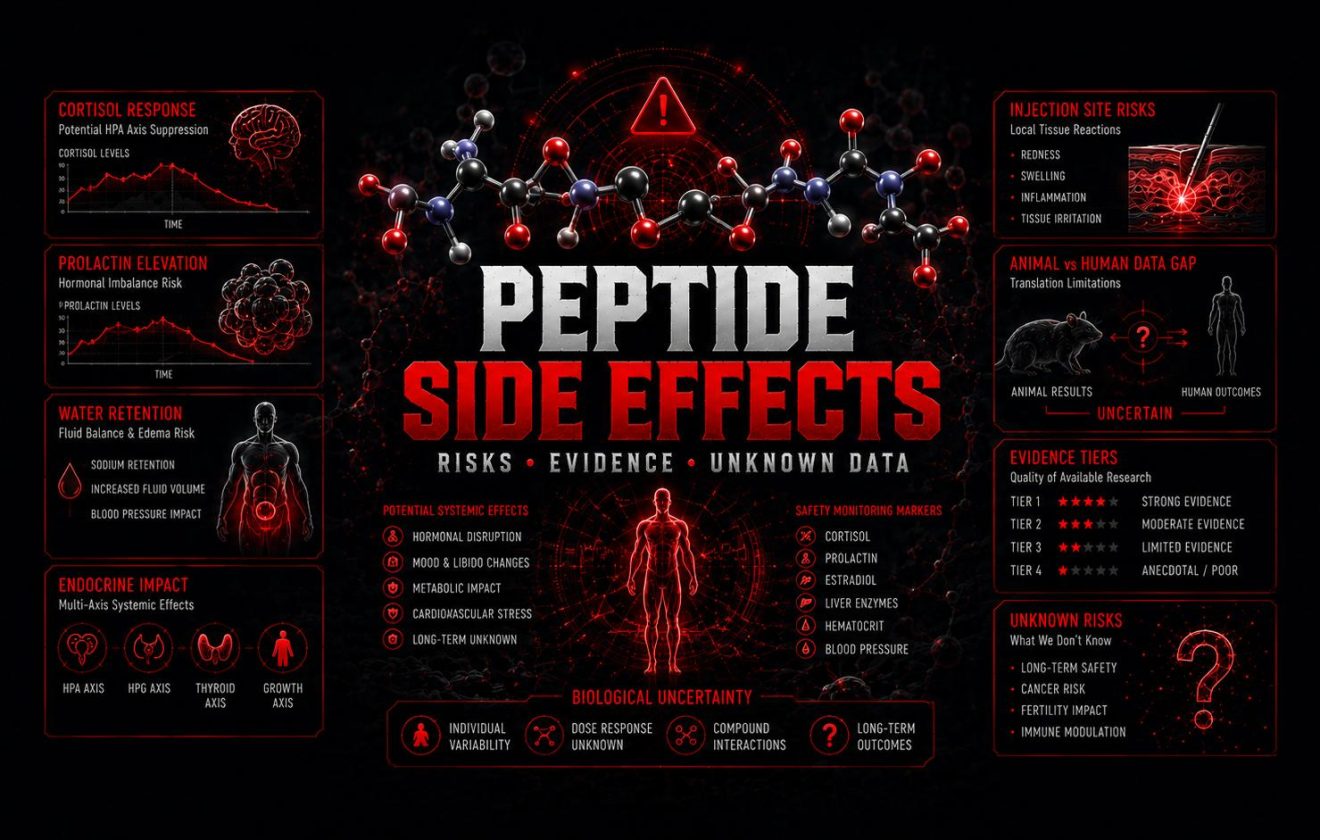
Peptide side effects are not uniform across compound classes. A GHRP that elevates cortisol has a different risk profile from a GHRH analog that causes water retention, which differs again from the injection-site and purity risks shared by all injectable research compounds. Understanding peptide side effects requires matching each documented effect to its specific compound, receptor mechanism, and evidence tier - not treating the class as a single entity with a single safety profile.
Peptide Side Effects: Three Principles for Accurate Evaluation
Evaluating peptide side effects accurately requires applying three principles before assessing any specific compound or report.
Class Determines Risk Profile
Peptide side effects are not shared across all compounds. GH secretagogue peptide side effects - cortisol elevation, water retention, tingling - are receptor-mediated and class-specific. Injection-site peptide side effects - pain, lipodystrophy, infection risk - apply to all injectable research compounds regardless of class. Healing peptides have essentially no documented human side effect data. Evaluating "peptide side effects" as a single category produces no useful safety information.
Human Data Is Narrow
Most documented peptide side effects in humans come from pharmacokinetic studies - small, short-term trials measuring GH and IGF-1 response, not long-term safety endpoints. Long-term peptide side effects from chronic use in healthy adults have not been studied in controlled settings for any unapproved research compound. The absence of a documented adverse event record does not mean the absence of risk - it reflects the absence of systematic monitoring.
Selectivity Matters Within Classes
Within the GHRP subclass, ipamorelin produces significantly fewer peptide side effects involving cortisol, prolactin, and ACTH than GHRP-2 or GHRP-6 at comparable doses. This selectivity - documented in the original 1998 characterization study - is the defining pharmacological distinction between GHRPs. Grouping all GHRPs together when discussing peptide side effects ignores the receptor pharmacology that makes ipamorelin a fundamentally different compound from GHRP-6 in terms of off-target hormonal effects.
What This Guide Covers
Covered in This Guide
- Why peptide side effects differ by compound class and receptor mechanism
- GH secretagogue side effects documented in human pharmacokinetic studies
- Cortisol, prolactin, and ACTH effects by GHRP selectivity
- Water retention, tingling, and glucose effects from GH/IGF-1 elevation
- Injection and purity risks common to all research-market injectable peptides
- A compound-class matrix mapping documented vs theoretical vs unknown effects
- 5 mistakes in how peptide side effects are described
Not Covered Here
- Side effects of exogenous GH (HGH) - different compound, different risk profile
- Anabolic steroid side effects - covered in the steroids section
- GLP-1 agonist side effects (nausea, GI effects) - approved drug class covered separately
- Peptide interactions with other compounds - insufficient data exists
- Dosing recommendations - this guide does not provide protocol guidance
Prerequisites. This guide assumes familiarity with the Types of Peptides classification guide and the Growth Hormone Peptides guide. Understanding which compound class is being evaluated is the prerequisite for evaluating its specific peptide side effects accurately.
Six topics covering how to evaluate peptide side effects by class, compound, and evidence tier.
Why Peptide Side Effects Differ by Compound Class
Peptide side effects are determined by three variables: the receptor the compound binds, the downstream signaling pathway that receptor activates, and the tissue distribution of that receptor throughout the body. A compound that binds GHS-R1a will produce effects at every tissue expressing that receptor - pituitary, hypothalamus, stomach, adrenal cortex - not only at the intended target. Understanding which receptor a compound binds is the starting point for predicting its peptide side effects beyond the primary GH-releasing endpoint.
GHRH analogs and GHRPs have different primary receptors and therefore different off-target effect profiles. GHRH receptor expression is largely restricted to pituitary somatotroph cells, which is why GHRH analogs produce relatively clean GH stimulation with minimal off-target peptide side effects at studied doses. GHS-R1a - the ghrelin receptor targeted by GHRPs - is expressed widely: at the pituitary, hypothalamus, adrenal cortex, and throughout the GI tract. This broad expression explains why non-selective GHRPs like GHRP-6 produce corticotroph stimulation (cortisol, ACTH), lactotroph stimulation (prolactin), and appetite stimulation as parallel peptide side effects rather than as dose-limiting toxicities.
Healing peptides present a different problem. Their receptor mechanisms are less fully characterized than GH secretagogues, their animal safety data was not generated under GLP conditions, and no systematic human safety monitoring has been conducted. The peptide side effects of BPC-157 and TB-500 in humans are effectively unknown - not because they have been studied and found absent, but because systematic collection of adverse event data in human subjects does not exist for either compound. This is a fundamentally different situation from GHRPs where specific peptide side effects have been documented in controlled human pharmacokinetic studies.
Receptor-Limited Side Effects
GHRH receptor expression is concentrated at the pituitary. Primary peptide side effects at studied doses: injection site reactions, transient tingling or flushing, water retention and edema from IGF-1-driven sodium retention. No cortisol, prolactin, or ACTH elevation documented at clinical doses. Long-term peptide side effects from chronic DAC formulation use - which produces non-pulsatile continuous GH elevation - are unstudied in healthy adults.
Broad GHS-R1a Expression Effects
GHS-R1a is expressed at multiple endocrine tissues. Non-selective GHRP peptide side effects include cortisol elevation, prolactin elevation, ACTH stimulation, and pronounced appetite stimulation. Ipamorelin is the exception - at studied doses it produces GH stimulation without significant co-stimulation of these pathways, which is the pharmacological basis for its "selective" classification. GHRP-2 and GHRP-6 produce these peptide side effects at doses used in research protocols.
Unknown Human Profile
Peptide side effects for BPC-157 and TB-500 in humans have not been characterized in any published controlled study. No systematic adverse event data exists. Animal acute toxicity studies show no significant signals at studied doses. The honest position on healing peptide side effects is that they are unknown - not established as absent, not established as present. This is categorically different from GH secretagogues where specific effects have been documented in human subjects.
The selectivity spectrum within GHRPs. Peptide side effects from corticotroph stimulation exist on a spectrum: hexarelin produces the largest cortisol and ACTH response; GHRP-2 and GHRP-6 produce moderate responses; ipamorelin produces minimal to none at studied doses. This spectrum reflects differences in GHS-R1a binding affinity and downstream coupling efficiency at non-somatotroph tissues - not simply differences in dose. Selecting a compound based on its selectivity profile is a pharmacologically informed choice about which peptide side effects are acceptable at a given level of GH stimulation.
GH Secretagogue Side Effects: What Human Research Documents
GH secretagogue peptide side effects that have been documented in human pharmacokinetic studies fall into two categories: those directly caused by the compound's receptor binding at non-somatotroph tissues, and those caused by the downstream GH and IGF-1 elevation the compound produces. Both categories represent real, receptor-mediated peptide side effects - but they operate through different mechanisms and have different onset timelines.
Direct receptor-mediated peptide side effects appear quickly, within minutes to hours of administration, because they follow the same kinetic profile as the GH response itself. Cortisol and ACTH elevation from non-selective GHRPs peaks within 30-60 minutes and resolves as the compound clears. Appetite stimulation from GHRP-6's GHS-R1a activity at the hypothalamus is similarly acute. These effects are compound-specific and class-specific - they are not shared by GHRH analogs and are minimal with ipamorelin.
IGF-1-mediated peptide side effects have a slower onset because they depend on the liver's IGF-1 synthesis in response to elevated GH - a process that takes hours. Water retention and peripheral edema from IGF-1-driven sodium reabsorption at the renal tubules, tingling or numbness in the hands and feet from fluid accumulation around peripheral nerves, and transient changes in glucose regulation from GH's insulin-antagonistic effects all fall into this category. These IGF-1-mediated peptide side effects are shared across GHRH analogs and GHRPs because both subclasses ultimately elevate GH and IGF-1 - the downstream pathway is the same regardless of which receptor initiated it.
Cortisol and ACTH Elevation
Non-selective GHRPs stimulate corticotroph cells via GHS-R1a expression in the adrenal axis. GHRP-6 and GHRP-2 produce measurable cortisol and ACTH elevation in parallel with GH response in human studies. This is a direct receptor-mediated effect, not a stress response. The magnitude is dose-dependent. Ipamorelin does not produce significant cortisol or ACTH elevation at studied doses - its selectivity profile was specifically characterized against this endpoint in its original 1998 publication. This peptide side effect is the primary pharmacological reason ipamorelin became the standard reference GHRP in subsequent research.
Prolactin Elevation
GHS-R1a expression at lactotroph cells in the pituitary means that non-selective GHRPs can stimulate prolactin release alongside GH. Prolactin elevation is documented for GHRP-2 and GHRP-6 in human pharmacokinetic studies. Chronic prolactin elevation can suppress testosterone production via dopamine inhibition - making this a relevant consideration when evaluating peptide side effects from non-selective GHRPs in a hormonal context. Ipamorelin again shows minimal prolactin stimulation compared to other GHRPs at equivalent GH-releasing doses, which is part of its documented selectivity advantage.
Water Retention and Edema
Elevated IGF-1 increases sodium reabsorption at the renal tubule, producing fluid retention. This is the same mechanism responsible for water retention with exogenous GH, occurring at lower magnitude with secretagogues due to the ceiling imposed by pituitary reserve and negative feedback. Peripheral edema - particularly in the hands and ankles - is the most commonly reported peptide side effect among individuals using GHRH analogs in anecdotal reports, consistent with the IGF-1-mediated sodium retention mechanism. It is typically dose-dependent and resolves on discontinuation.
Tingling and Carpal Tunnel Symptoms
Fluid accumulation in tight compartments - particularly the carpal tunnel - from IGF-1-driven sodium retention can compress peripheral nerves, producing tingling, numbness, or paresthesia in the hands and fingers. This peptide side effect is well-documented with exogenous GH therapy and reported anecdotally with GH secretagogues. Its onset is slower than direct receptor effects - appearing over days to weeks with sustained IGF-1 elevation - and it resolves as IGF-1 normalizes after discontinuation. It is a class-level peptide side effect of sustained GH/IGF-1 elevation, not specific to any single secretagogue compound.
Glucose and insulin sensitivity. GH has insulin-antagonistic effects - it promotes lipolysis and can transiently impair insulin signaling in peripheral tissues. This is a documented peptide side effect with exogenous GH at pharmacological doses and a theoretical concern with secretagogues at high doses or in individuals with pre-existing insulin resistance. Short-term human pharmacokinetic studies for GH secretagogues have not systematically measured glucose homeostasis as a primary endpoint. For individuals with impaired glucose tolerance or type 2 diabetes, the theoretical glucose impact of sustained GH/IGF-1 elevation from secretagogues is a relevant consideration that has not been formally characterized in controlled research.
Injection and Purity Risks Across All Peptide Classes
A category of peptide side effects exists independently of receptor class or compound mechanism - risks that arise from the injection process itself and from the quality of the compound being injected. These peptide side effects apply equally to GH secretagogues, healing peptides, and any other research compound administered via subcutaneous or intramuscular injection. They are the most practically significant risks for individuals using research-market peptides because they are not mitigated by choosing a "safer" compound - they are mitigated by injection practice and sourcing decisions.
Research-market peptides are sold as lyophilized powders for reconstitution. Unlike pharmaceutical-grade compounds, they are not manufactured under Current Good Manufacturing Practice regulations. Purity, sterility, and stated concentration are not independently verified by regulatory agencies. Studies of synthetic peptide drug impurities have documented that manufacturing process-related impurities - truncated sequences, oxidized residues, aggregated forms - can trigger immune responses including anti-drug antibody formation. In pharmaceutical development this is managed through rigorous quality control; in the research compound market, no equivalent quality assurance exists. This is a category of peptide side effects that has no parallel in approved pharmaceutical use.
Impurities and Immunogenicity
Synthetic peptide manufacturing generates process-related impurities: truncated sequences missing one or more amino acids, oxidized residues, dimers, and aggregates. These impurities are structurally distinct from the intended peptide and can be immunogenic - capable of triggering anti-peptide antibody formation. In pharmaceutical development, impurity thresholds are tightly regulated and immunogenicity is assessed in preclinical programs. Research-market peptides have no such controls. The peptide side effects from impurity-driven immunogenicity are unpredictable in type and severity because the impurity profile of unregulated products is unknown and variable between batches.
Infection and Contamination
Injectable peptide side effects from non-sterile products include local infection at the injection site, abscess formation, and - in severe cases - systemic infection. Research-market peptides are not manufactured in sterile facilities under pharmaceutical standards. Bacteriostatic water used for reconstitution provides partial protection against microbial growth after reconstitution, but the lyophilized powder itself may carry contamination. Injection site rotation, sterile technique, and appropriate reconstitution practices reduce but do not eliminate this category of peptide side effects from unverified research compounds.
Mislabeled Dosing and Overdose
Research-market peptides frequently have actual concentrations that deviate from stated label concentrations. Independent testing of commercially available research peptides has identified products with peptide content significantly above or below the labeled amount. Mislabeling creates a practical peptide side effect risk: an individual attempting to dose based on the label may receive substantially more or less compound than intended. At the high end, this can amplify receptor-mediated peptide side effects - larger cortisol spikes, more pronounced water retention, stronger appetite stimulation - in a dose-dependent manner that the user does not anticipate.
Injection Site Reactions
Local peptide side effects at the injection site - pain, redness, swelling, nodule formation - occur with any subcutaneous injection and are not compound-specific. They are influenced by injection technique, needle gauge, injection volume, rotation of sites, and the pH and osmolarity of the reconstituted solution. Lipodystrophy - localized fat loss or hypertrophy at repeated injection sites - is documented with repeated subcutaneous injections and is more likely with poor site rotation. These peptide side effects are preventable through technique, not through compound selection.
Bacteriostatic water vs sterile water. Peptides reconstituted in bacteriostatic water (containing 0.9% benzyl alcohol) remain stable and resistant to microbial growth for longer than those reconstituted in sterile water for injection. This is the standard reconstitution medium for multi-dose research peptide vials. Benzyl alcohol itself can cause injection site irritation as a peptide side effect at higher concentrations - this is a known pharmaceutical excipient effect, not a compound-specific response. Neither reconstitution medium addresses purity or contamination issues originating in the manufacturing process.
Peptide Side Effects by Compound Class: Evidence Status Matrix
The matrix below maps documented, theoretical, and absent peptide side effects across the five most referenced research compounds by compound class. Evidence status reflects the quality of the source: Documented = observed in controlled human studies or human pharmacokinetic data; Theoretical = mechanistically predicted from receptor pharmacology or animal data but not confirmed in humans; Not observed = absent in available studies at studied doses.
This matrix covers receptor-mediated and IGF-1-mediated peptide side effects only. Injection and purity risks apply to all compounds equally and are not repeated in the table - they are covered in the preceding section.
| Compound | Cortisol / ACTH | Prolactin | Water Retention | Appetite Increase | Glucose Impact |
|---|---|---|---|---|---|
| CJC-1295 (GHRH analog) | Not observed | Not observed | Documented | Not observed | Theoretical |
| Ipamorelin (selective GHRP) | Not observed | Not observed | Theoretical | Not observed | Theoretical |
| GHRP-6 (non-selective GHRP) | Documented | Documented | Theoretical | Documented | Theoretical |
| BPC-157 (healing peptide) | Unknown | Unknown | Unknown | Unknown | Unknown |
| TB-500 (healing peptide) | Unknown | Unknown | Unknown | Unknown | Unknown |
Unknown is not the same as safe. BPC-157 and TB-500 appear as "Unknown" across the matrix - not because peptide side effects have been studied and not found, but because no controlled human study has measured them. Unknown means the data does not exist. It is not evidence of safety. The absence of documented peptide side effects for healing peptides reflects the absence of systematic human monitoring, not the absence of risk.
5 Mistakes in How Peptide Side Effects Are Described
These five mistakes appear consistently in how peptide side effects are discussed outside of peer-reviewed research contexts.
- Mistake 1
Treating "No Reports" as "No Risk"
The absence of widely reported peptide side effects in online communities is sometimes cited as evidence of safety. This conflates absence of reporting with absence of risk. Research-market peptide users are not part of any pharmacovigilance system - their adverse experiences are not systematically collected, adjudicated, or published. Anecdotal reports in forums represent a self-selected, non-random subset of users who choose to post, and serious adverse events may be underreported due to the unregulated context of use. The absence of a pharmacovigilance database for research peptides means "no reports" is not a meaningful safety signal in either direction.
- Mistake 2
Applying Ipamorelin's Side Effect Profile to All GHRPs
Ipamorelin's selectivity - minimal cortisol, prolactin, and ACTH stimulation - is a specific pharmacological property of that compound at that receptor, not a property of GHRPs as a class. GHRP-2 and GHRP-6 produce documented cortisol and prolactin elevation in human studies. Citing ipamorelin's clean peptide side effect profile when discussing GHRPs in general, or assuming that all GHRPs share ipamorelin's selectivity, misrepresents the class. The selectivity distinction between ipamorelin and non-selective GHRPs is the central pharmacological fact about this subclass - dismissing it produces systematically wrong conclusions about GHRP peptide side effects.
- Mistake 3
Ignoring the Purity Variable When Evaluating Research Peptide Risks
Discussions of peptide side effects almost universally focus on receptor-mediated effects - cortisol, water retention, appetite - while ignoring that research-market compounds are unverified for purity, concentration, and sterility. A significant fraction of adverse effects attributed to specific peptide mechanisms may in fact result from impurities, mislabeling, or contamination in the product used. Without knowing the actual purity profile of the compound administered, attributing a specific adverse event to a receptor-mediated peptide side effect is uncertain. Purity risk is the most practically significant and most systematically ignored category of peptide side effects in non-clinical discussions.
- Mistake 4
Assuming Short-Term Tolerability Predicts Long-Term Safety
Short-term pharmacokinetic studies - typically 2-12 weeks - confirm that GH secretagogues produce measurable GH and IGF-1 elevation without acute adverse events in healthy adults at studied doses. This is sometimes generalized to claim that long-term use is safe. Short-term tolerability does not predict long-term safety for any compound. The peptide side effects of chronic non-pulsatile GH elevation from DAC-modified GHRH analogs, persistent IGF-1 elevation over months, or ongoing GHS-R1a stimulation have not been studied in healthy adults over periods longer than a few weeks. Long-term effects are not "likely safe" - they are unknown.
- Mistake 5
Comparing Peptide Side Effects to Anabolic Steroid Side Effects Directly
GH secretagogue peptide side effects are sometimes described as "much milder" than anabolic steroid side effects - and in terms of androgenic effects (virilization, HPG axis suppression, hepatotoxicity), this comparison is accurate. Peptides do not bind androgen receptors and do not suppress the HPG axis through the same mechanism as exogenous testosterone. However, this comparison does not establish that peptide side effects are mild in absolute terms - it only establishes they are different. Water retention, cortisol dysregulation, glucose sensitivity changes, and unknown long-term IGF-1 effects are real considerations that the steroid comparison does not address. The relevant benchmark for peptide side effects is the compound's own risk profile, not a different compound class.
Primary Research Sources
Peer-reviewed references from PubMed used to verify receptor selectivity data, documented human side effects, and peptide impurity characterization in this guide.
- Raun K, Hansen BS, Johansen NL, et al. Ipamorelin, the first selective growth hormone secretagogue. Eur J Endocrinol. 1998;139(5):552-561. PMID 9849822
- Gobburu JV, Agersø H, Jusko WJ, Ynddal L. Pharmacokinetic-pharmacodynamic modeling of ipamorelin, a growth hormone releasing peptide, in human volunteers. Pharm Res. 1999;16(9):1412-1416. PMID 10496658
- Beck DE, Sweeney WB, McCarter MD; Ipamorelin 201 Study Group. Prospective, randomized, controlled, proof-of-concept study of the ghrelin mimetic ipamorelin for the management of postoperative ileus in bowel resection patients. Int J Colorectal Dis. 2014;29(12):1527-1534. PMID 25331030
- Rudman D, Feller AG, Nagraj HS, et al. Effects of human growth hormone in men over 60 years old. N Engl J Med. 1990;323(1):1-6. PMID 2355952
- De Groot AS, Roberts BJ, Mattei A, Lelias S, Boyle C, Martin WD. Immunogenicity risk assessment of synthetic peptide drugs and their impurities. Drug Discov Today. 2023;28(10):103714. PMID 37467878
Peptide Side Effects: Reading Risk by Class, Not by Compound Name
Peptide side effects are compound-specific, receptor-mediated, and evidence-tiered. Non-selective GHRPs produce documented cortisol, prolactin, and appetite effects in humans. Ipamorelin does not - its selectivity is its defining pharmacological characteristic. GHRH analogs produce water retention and tingling via IGF-1-mediated sodium retention. Healing peptides have no documented human peptide side effects in any direction, because no controlled human studies exist to document them. Injection and purity risks apply universally across all research-market injectable compounds, independent of compound class or receptor mechanism.
The most significant blind spot in how peptide side effects are evaluated outside of clinical research is the purity variable. A compound with a clean receptor pharmacology profile can still produce unpredictable adverse effects from manufacturing impurities, contamination, or mislabeled concentration in research-market products. This risk is not mitigated by choosing a more selective compound - it is mitigated by understanding that research-market peptides are not manufactured under the quality controls that apply to pharmaceutical-grade drugs.
The broader peptide evidence framework - classification, mechanisms, human evidence gaps - is covered in the Peptides hub. The Growth Hormone Peptides guide covers the receptor mechanisms underlying GH secretagogue peptide side effects in detail. The Healing Peptides guide documents why human safety data for BPC-157 and TB-500 does not exist. For bloodwork monitoring relevant to individuals tracking hormonal status, see the Bloodwork and Health hub.
- Peptides Hub - All Guides
- What Are Peptides? - Molecular Basis and Signaling
- Types of Peptides - Classification and Evidence Tiers
- Growth Hormone Peptides - GH Secretagogue Guide
- Healing Peptides - BPC-157 and TB-500 Guide
- Peptide Dosage Calculator
- Bloodwork and Health Hub
- Research Hub - Study Design and Mechanisms
- About the Author - Ryan Hale
- Start Here - Site Navigation Guide
For Educational Purposes Only
This guide is produced for educational and harm-reduction purposes. MuscleScience.org does not sell, recommend, or endorse any compound. All content reflects a summary of published research and does not constitute medical advice.
All peptide compounds discussed in this guide that are not FDA-approved are research chemicals. Their peptide side effects in humans are incompletely characterized. Consult a licensed physician before making decisions about any pharmacological compound.
All author names are editorial pseudonyms. See the full site disclaimer and about page for editorial policy and anonymity disclosure.