BPC-157 Explained: Mechanism, Research Evidence, and Use Context
The healing-peptide claims, examined
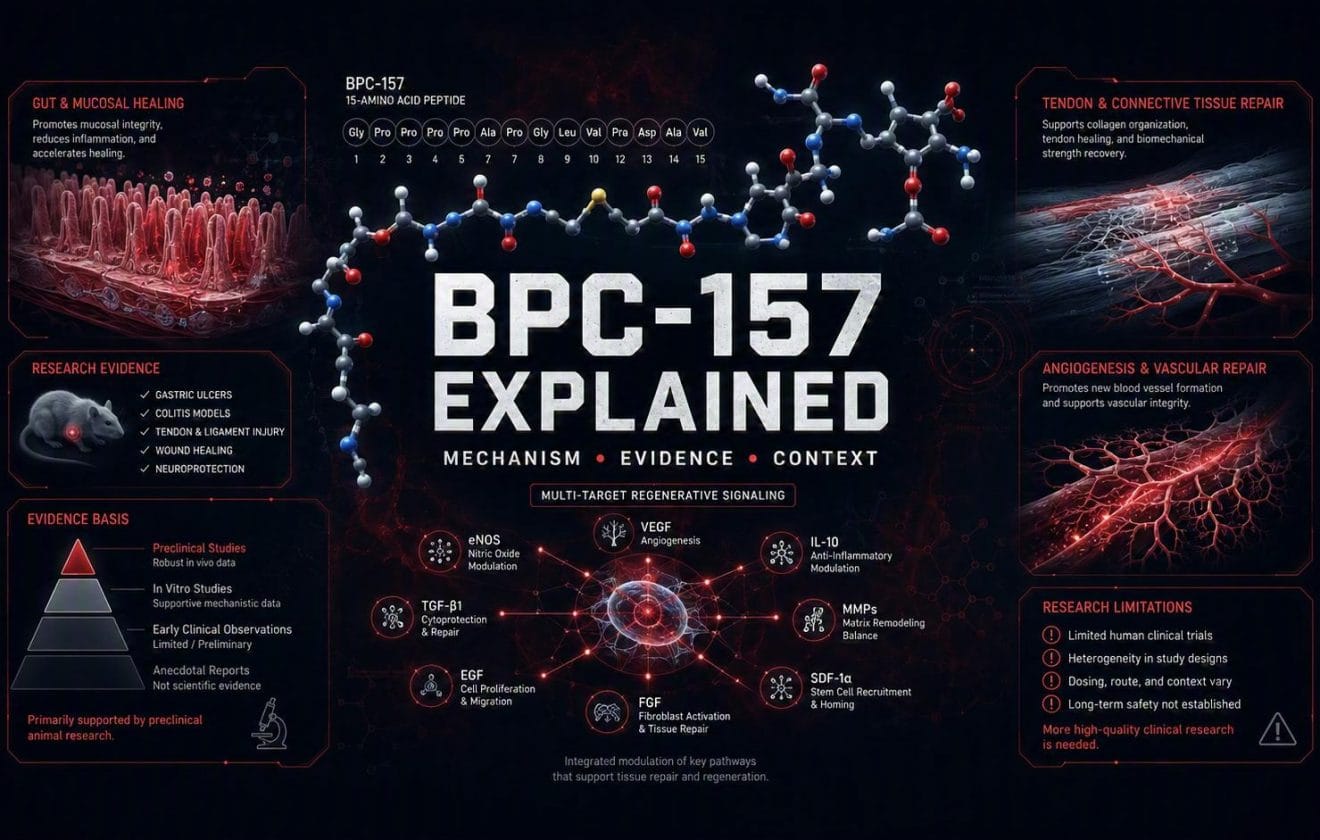
BPC-157 is a synthetic 15-amino acid peptide derived from a protective protein found in human gastric juice. It has been studied extensively in rodent models for tendon healing, gut repair, and bone recovery. No completed human clinical trials exist as of 2026. All existing efficacy evidence is animal-based. This guide covers the mechanism, what the animal research actually shows, and the critical limitations any rational evaluation must account for.
BPC-157: Three Things the Research Establishes
It Is a Research Peptide
BPC-157 is a synthetic reproduction of a 15-amino acid sequence from human gastric juice protein. It is not approved for human use in any country and exists only as a research chemical.
Animal Data Is Substantial
Multiple peer-reviewed rodent studies show accelerated tendon healing, gastroprotection, and bone repair. The breadth of animal evidence is real - but species translation to humans remains unvalidated.
No Human Efficacy Data Exists
As of 2026, no completed randomized controlled trials in humans have been published. Claims about human outcomes are extrapolated from animal models without pharmacokinetic or clinical validation.
What This Guide Covers
Covered in This Guide
- Origin and structure of BPC-157
- Proposed mechanisms of action
- Summary of animal research by area
- Key limitations of the evidence base
- Administration routes discussed in the literature
- Common misinterpretations of the data
Not Covered Here
- Specific dosing recommendations
- Sourcing or procurement guidance
- Legal status by jurisdiction
- Combination protocols with other peptides
- Clinical endorsement of any kind
Context: BPC-157 belongs to the category of research peptides with plausible mechanisms but absent human trial data. For a broader view of how research peptides differ from clinically validated compounds, see Peptide Research vs Human Use and What Are Peptides.
What Is BPC-157
BPC-157 stands for Body Protection Compound 157. The name comes from the protein from which it was originally isolated - a naturally occurring protective protein found in human gastric juice. BPC-157 itself is a synthetic reproduction of a specific 15-amino acid sequence within that protein. It is not extracted from human tissue. It is produced in a laboratory and sold as a research chemical.
The amino acid sequence of BPC-157 is: Gly-Glu-Pro-Pro-Pro-Gly-Lys-Pro-Ala-Asp-Asp-Ala-Gly-Leu-Val. Its molecular weight is approximately 1,419 daltons - small by protein standards, which contributes to its stability profile. Most peptides are rapidly degraded by proteolytic enzymes in the digestive tract, making oral administration generally ineffective. BPC-157 is an exception: research has shown it remains stable in gastric acid and resists degradation by gastric enzymes. This property is why oral administration is discussed alongside injection in the literature, though human bioavailability data via the oral route has not been established.
The compound was first described in the 1990s by Predrag Sikiric and colleagues at the University of Zagreb, Croatia. Sikiric's group has since become the dominant publisher of BPC-157 research, a point with implications for evaluating the evidence base. The peptide has never received regulatory approval in any jurisdiction and has not advanced beyond early-stage research in the clinical development pipeline.
Why Gastric Stability Matters
The majority of orally consumed peptides are broken apart by digestive proteases before reaching systemic circulation. This is why most therapeutic peptides - including insulin - must be injected. BPC-157's resistance to gastric degradation has led researchers to propose that oral administration may deliver systemic activity, not merely local gut effects. However, this inference depends on oral bioavailability data in humans, which does not currently exist. Stability in the stomach does not automatically confer meaningful systemic absorption - it is a necessary but not sufficient condition for oral efficacy.
How BPC-157 Is Thought to Work
Research has identified several pathways through which BPC-157 appears to exert its effects in animal models. Three mechanisms are most consistently described in the literature. These are proposed based on in vitro and rodent studies - their relevance to human physiology is plausible but not validated through clinical research.
Angiogenesis via VEGFR2
BPC-157 upregulates VEGFR2 (vascular endothelial growth factor receptor 2) expression in tendons and surrounding tissue. This promotes angiogenesis - the formation of new blood vessels. In tissue repair contexts, increased vascularization accelerates delivery of oxygen and growth factors to the injury site. This mechanism is supported by studies showing elevated VEGFR2 expression in BPC-157-treated rat tendons and faster tendon-to-bone healing outcomes.
Nitric Oxide Modulation
BPC-157 influences nitric oxide (NO) synthesis and signaling. NO plays a role in vasodilation, cellular signaling, and the inflammatory cascade. Research suggests BPC-157 can both stimulate and modulate NO pathways depending on tissue context. In gut injury models, this appears to contribute to mucosal protection and accelerated healing. The interaction with the NO system also partially explains proposed cardiovascular effects in rodent models.
GH Receptor Upregulation
In tendon fibroblasts, BPC-157 has been shown to upregulate growth hormone receptor (GHR) expression. This increases cellular sensitivity to growth hormone and downstream IGF-1 signaling, which drives collagen synthesis and extracellular matrix remodeling - the biological foundation of tendon repair. This pathway is proposed as the primary reason BPC-157 accelerates tendon healing in animal models at doses where systemic GH levels are not meaningfully altered.
These three pathways are not mutually exclusive. Current evidence suggests BPC-157 is pleiotropic - acting through multiple mechanisms simultaneously depending on the tissue type and injury context. This pleiotropic profile is part of what makes it difficult to model in humans: the compound does not have a single clean pharmacological target.
What the Animal Research Shows
The volume of animal research on BPC-157 is substantial compared to most research peptides. As of 2026, hundreds of rodent studies have been published across multiple research domains. The table below summarizes the state of evidence by area, distinguishing between the animal data that exists and the human data that does not.
| Research Area | Animal Evidence | Human Evidence |
|---|---|---|
| Tendon and Ligament Healing | Multiple rat studies show accelerated Achilles tendon transection healing, improved collagen organization, and faster tendon-to-bone attachment. VEGFR2 upregulation confirmed as a mechanism. | None. No human RCTs published. |
| Gastrointestinal Healing | Gastroprotective effects demonstrated in chemically induced ulcer models (ethanol, NSAID, stress-induced). Accelerated mucosal recovery and reduced inflammatory markers in IBD-like rodent models. | None. Phase 2 trials initiated but not completed as of 2026. |
| Bone and Cartilage Repair | Improved bone healing in rat femur fracture models. Some evidence of cartilage repair promotion in joint injury models. Effect size varies across studies. | None. |
| Neurological Effects | Neuroprotective effects observed in rodent traumatic brain injury models. Some evidence of dopaminergic modulation. Proposed relevance to mood and addiction - all animal data. | None. |
| Cardiovascular Effects | Blood pressure modulation and vascular protection observed in some rodent models. Mechanism attributed partly to NO pathway influence. | None. |
All animal studies conducted primarily in rats and mice. Effect sizes and mechanisms cannot be assumed to translate directly to human physiology.
The Sikiric Lab Concentration Problem
One structural issue with BPC-157's evidence base is the extreme concentration of research output from a single group. The majority of published BPC-157 studies originate from Predrag Sikiric's laboratory at the University of Zagreb. While this group's work is peer-reviewed and published in indexed journals, the absence of independent replication by unaffiliated research teams is a significant limitation. In pharmacological research, findings from a single lab - regardless of how extensive - carry substantially less weight than findings replicated across multiple independent groups. This does not invalidate the data, but it means the evidence base is narrower than the publication volume implies. As of 2026, broad independent replication of the key BPC-157 findings in tendon and gut healing has not occurred.
The Limits of the Evidence
Understanding what BPC-157 research does not establish is as important as understanding what it shows. Four structural limitations define how the evidence must be interpreted before any application to humans is considered.
The Species Translation Gap
Rodent models and human physiology differ significantly in tissue architecture, injury repair kinetics, vascularization patterns, and pharmacokinetics. Compounds that demonstrate clear efficacy in rat tendon healing studies have repeatedly failed to reproduce those effects in human clinical trials - this is a documented pattern across pharmaceutical development, not a theoretical concern. BPC-157 has not yet been tested in humans under controlled conditions. Its animal efficacy data cannot be used to predict human outcomes with confidence.
No Human Pharmacokinetic Data
Pharmacokinetics - how a compound is absorbed, distributed, metabolized, and eliminated - determines whether a dose produces any effect and what that effect is. For BPC-157, human pharmacokinetic data does not exist. The doses discussed in community frameworks are extrapolated from rat studies using standard body weight conversion formulas. These conversions are imprecise and do not account for metabolic differences between species. There is no validated human dose for any application.
Oral Bioavailability Is Assumed, Not Confirmed
BPC-157's gastric stability is real - it does not degrade in acid the way most peptides do. But gastric stability is not the same as bioavailability. Absorption across the gut epithelium, first-pass liver metabolism, and systemic distribution are all separate steps that determine whether an orally administered compound reaches target tissues at meaningful concentrations. None of these parameters have been measured in humans for BPC-157. Oral bioavailability in humans remains an assumption.
Research Chemical Purity Is Variable
BPC-157 is available as a research chemical from numerous suppliers. Unlike pharmaceutical-grade compounds, research chemicals are not subject to regulatory manufacturing standards in most countries. Independent third-party testing of commercially available BPC-157 has shown significant variation in purity, peptide content, and contaminant profiles across suppliers. A compound of unknown purity administered to a human body introduces risks entirely separate from the compound's own pharmacological profile. This is not a hypothetical risk - it is a known and documented reality in the research chemical market.
Research context: The gap between animal evidence and human application is a central theme in peptide science. For a broader explanation of how this gap is evaluated across peptide categories, see Peptide Research vs Human Use and Peptide Side Effects.
Routes of Administration Discussed in the Literature
Published research has examined BPC-157 through multiple routes of administration, each with a different evidence profile and practical context. The following describes what the literature discusses - not a clinical recommendation of any kind. Human pharmacokinetic data does not exist for any of these routes.
Subcutaneous Injection
The most common route in both animal studies and community use frameworks. Subcutaneous administration delivers the peptide into the tissue layer beneath the skin, from where it enters systemic circulation. Most of the tendon and systemic healing data in rodent models uses subcutaneous delivery. Provides consistent absorption relative to oral. Requires sterile technique and a clean reconstitution process.
Local / Intralesional Injection
Injection directly at or near the site of injury - used in some animal studies for tendon and joint applications. The rationale is that localized delivery concentrates the compound at the target tissue, potentially increasing efficacy relative to systemic dose. No human data exists on optimal injection site, depth, or volume. Local injection carries additional risk of tissue irritation relative to subcutaneous administration away from injury.
Oral Administration
Discussed on the basis of BPC-157's demonstrated resistance to gastric acid degradation. The argument is that stability in the stomach allows meaningful absorption. Some rodent studies used oral gavage with reported effects, supporting the plausibility of systemic activity via the oral route. However, human intestinal absorption, first-pass metabolism, and systemic bioavailability have not been measured. Oral administration may produce primarily local gut effects with uncertain systemic reach in humans.
Intramuscular Injection
Used in a smaller subset of rodent studies. IM delivery places the compound directly into muscle tissue, providing slightly different absorption kinetics than subcutaneous. Less commonly discussed in community frameworks relative to subcutaneous. The distinction between IM and subcutaneous is unlikely to be clinically meaningful given the absence of human pharmacokinetic benchmarks for either route.
For reference dosing information relevant to peptide research frameworks, the Peptide Dosage Calculator provides a tool for understanding how unit-based dosing calculations are structured - not as a recommendation for use.
5 Things BPC-157 Research Does Not Confirm
The volume of animal research on BPC-157 is sometimes interpreted as a proxy for established human efficacy. It is not. The following five points clarify where the evidence boundary sits - and why it matters before drawing conclusions about human application.
1. That Healing Acceleration Applies to Healthy Tissue
Nearly all BPC-157 tendon and tissue healing studies use injury models - Achilles tendon transection, chemically induced ulcers, surgical bone defects. The compound is administered to damaged tissue and assessed against an injured control group. This design answers the question: does BPC-157 accelerate recovery from a specific injury in rats? It does not answer whether BPC-157 produces any measurable benefit in uninjured tissue. The extrapolation from injury-model healing to general performance enhancement or recovery optimization in healthy individuals is not supported by the existing data.
2. That Oral and Injectable Routes Are Equivalent
Some rodent studies using oral gavage showed effects comparable to injection. This has led to the assumption that oral BPC-157 is interchangeable with injectable BPC-157 in humans. Rodent gut physiology, gut transit time, and intestinal absorption characteristics differ significantly from humans. The equivalence of oral and injectable routes - in terms of systemic exposure and target tissue concentration - has not been established in any human study. The routes should be considered pharmacologically distinct until proven otherwise.
3. That the Mechanism Is Fully Understood
VEGFR2 upregulation, nitric oxide modulation, and GH receptor sensitization are the most cited mechanisms. But BPC-157 appears to exert effects across multiple systems - musculoskeletal, gastrointestinal, neurological, and cardiovascular - through pathways that are not fully characterized. The breadth of proposed effects in the animal literature is unusual for a compound with such a clean mechanistic profile. This either suggests a genuinely pleiotropic mechanism or that some of the reported effects are artifacts of study design or publication concentration in a single research group. The mechanism is better described as partially proposed than established.
4. That Community Dosing Frameworks Are Evidence-Based
The most commonly discussed dose range - 200 to 500 micrograms per day - originates from body weight extrapolation from rat studies. Standard allometric scaling converts rat doses to human equivalents using body surface area formulas. These conversions introduce significant uncertainty even for simple small-molecule drugs. For a peptide with unknown human pharmacokinetics, unknown bioavailability, and no human PK/PD data, the resulting number is a starting estimate at best. Describing any BPC-157 dose as evidence-based for humans is not accurate given the current state of the literature.
5. That Long-Term Safety Has Been Assessed
The published animal studies focus on short-term efficacy outcomes - how fast a tendon heals, how much mucosal recovery occurs. Chronic toxicity, carcinogenicity, endocrine disruption, and long-term organ impact have not been systematically studied in the BPC-157 literature. The absence of reported adverse effects in short-duration animal studies is not equivalent to confirmed long-term safety. A compound can show clean short-term animal data and still present unforeseen problems in chronic human use - this is a well-documented pattern in drug development history.
Common Mistakes in How BPC-157 Is Interpreted
- Mistake 01
Treating Rodent Results as Human Outcomes
The most pervasive error in interpreting BPC-157 research is reading rat study outcomes as if they were human clinical trial results. "BPC-157 heals tendons" - stated without qualification - implies human evidence. The actual statement supported by the data is: "BPC-157 accelerates Achilles tendon healing in rats in a specific experimental injury model." These are not equivalent claims. The translation from rodent to human is the single largest unresolved question in BPC-157 research, and it cannot be answered by accumulating more rat studies.
- Mistake 02
Inferring Systemic Bioavailability from Gastric Stability
BPC-157's resistance to gastric acid is real and pharmacologically interesting. It does not, however, confirm that orally administered BPC-157 reaches systemic circulation in meaningful concentrations in humans. Gastric stability means the peptide survives the stomach. It says nothing about intestinal permeability, portal absorption, hepatic first-pass metabolism, or systemic distribution. Each of these steps represents a potential bioavailability barrier. Claiming oral equivalence to injection on the basis of gastric stability alone skips several critical steps in the pharmacokinetic argument.
- Mistake 03
Assuming BPC-157 and TB-500 Synergy Is Evidence-Based
BPC-157 and TB-500 are frequently combined in community protocols on the basis of claimed complementary mechanisms - BPC-157 for angiogenesis and GH receptor sensitization, TB-500 for actin regulation and cell migration. The idea is plausible mechanistically. However, no controlled study has examined this combination in any species. The concept of synergy between these compounds in human tissue repair is entirely theoretical. Combining two compounds with unknown human pharmacokinetics, based on proposed mechanisms from separate animal studies, compounds the uncertainty rather than resolving it.
- Mistake 04
Equating Research Volume with Evidence Quality
BPC-157 has hundreds of published papers - a volume that might suggest a robust evidence base. But evidence quality is not determined by the number of studies. When the majority of that literature originates from a single research group, uses the same animal model, and has not been independently replicated, the effective evidence base is narrower than the publication count implies. An evidence base built on one lab's animal studies is qualitatively different from one built on multiple independent human trials, regardless of how many papers appear in PubMed.
- Mistake 05
Purchasing Without Third-Party Purity Verification
Research chemicals are not subject to pharmaceutical manufacturing standards. BPC-157 from unverified suppliers may contain contaminants, incorrect peptide sequences, incorrect concentrations, or bacterial endotoxins from improper lyophilization. Independent third-party testing - via mass spectrometry and HPLC analysis - is the only way to confirm what is actually in a vial. Administering a compound of unknown purity introduces health risks that are entirely separate from BPC-157's own pharmacological profile. This risk is frequently understated in community discussions focused on mechanism and dosing.
Published Research Cited in This Guide
- Chang CH, Tsai WC, Hsu YM, Pang JH. The promoting effect of pentadecapeptide BPC 157 on tendon healing involves tendon outgrowth, cell survival, and cell migration. Journal of Applied Physiology. 2011. PMID: 21030672.
- Sikiric P, Seiwerth S, Rucman R, et al. Stable gastric pentadecapeptide BPC 157: novel therapy in gastrointestinal tract. Current Pharmaceutical Design. 2011. PMID: 22300085.
- Seiwerth S, Rucman R, Turkovic B, et al. Stable Gastric Pentadecapeptide BPC 157 and Wound Healing. Current Pharmaceutical Design. 2021. PMID: 34267654.
- Duzel A, Vlainic J, Antunovic M, et al. Stable gastric pentadecapeptide BPC 157 in the treatment of ischemia and vascular occlusion: experimental evidence and therapeutic implications. Biomedicines / review article (PMC).
- Seiwerth S, Rucman R, Turkovic B, et al. Stable Gastric Pentadecapeptide BPC 157 and Wound Healing. Biomedicines. 2021.
What BPC-157 Research Establishes and Where It Ends
BPC-157 occupies an unusual position in the research peptide space: the animal evidence is more substantial than for most compounds in its category, the proposed mechanisms are pharmacologically coherent, and the gastric stability profile creates a legitimate oral administration hypothesis. These are real attributes that distinguish BPC-157 from compounds with no mechanistic basis whatsoever.
At the same time, every claim about human efficacy - tendon healing, gut repair, bone recovery - remains extrapolated from rodent studies conducted predominantly by a single research group without independent replication. Human pharmacokinetics have not been measured. Human bioavailability by any route has not been established. Optimal human dosing does not exist in any evidence-based form. No completed randomized controlled trial has tested BPC-157 in any human population for any indication.
This is not a dismissal of the compound's potential. It is an accurate description of what the evidence currently supports. The appropriate response to a plausible but unvalidated research compound is informed awareness of both what is known and what is not - not premature certainty in either direction. BPC-157 remains a compound worth watching as the research develops, not one that can be evaluated as if the human trial phase has already occurred.
- Peptides Hub - full overview of the peptides section
- What Are Peptides - foundational guide to peptide biochemistry and classification
- Types of Peptides - how different peptide categories are structured and differ
- Healing Peptides - research context for tissue repair and recovery peptides
- Growth Hormone Peptides - how GH secretagogues differ mechanistically from BPC-157
- Peptide Side Effects - documented and proposed adverse effects across peptide categories
- Peptide Research vs Human Use - why animal evidence does not equal human validation
- Peptide Dosage Calculator - unit conversion tool for understanding research dosing frameworks
- Bloodwork and Health - baseline monitoring context for anyone using research compounds
- Start Here - full editorial overview of MuscleScience.org content
For Educational Purposes Only
This article discusses BPC-157 for educational and harm-reduction purposes. It does not constitute medical advice and is not a substitute for consultation with a qualified physician. The information provided reflects published research and is intended to support informed decision-making, not to encourage or facilitate the use of research chemicals or controlled substances.
MuscleScience.org does not sell any compounds, medications, or supplements. All author names are pseudonyms. Author photographs are stylized portraits, not images of real individuals. See our About page and Disclaimer for full disclosure on editorial policy and anonymity.