Peptide Research vs Human Use: Reading the Evidence Accurately
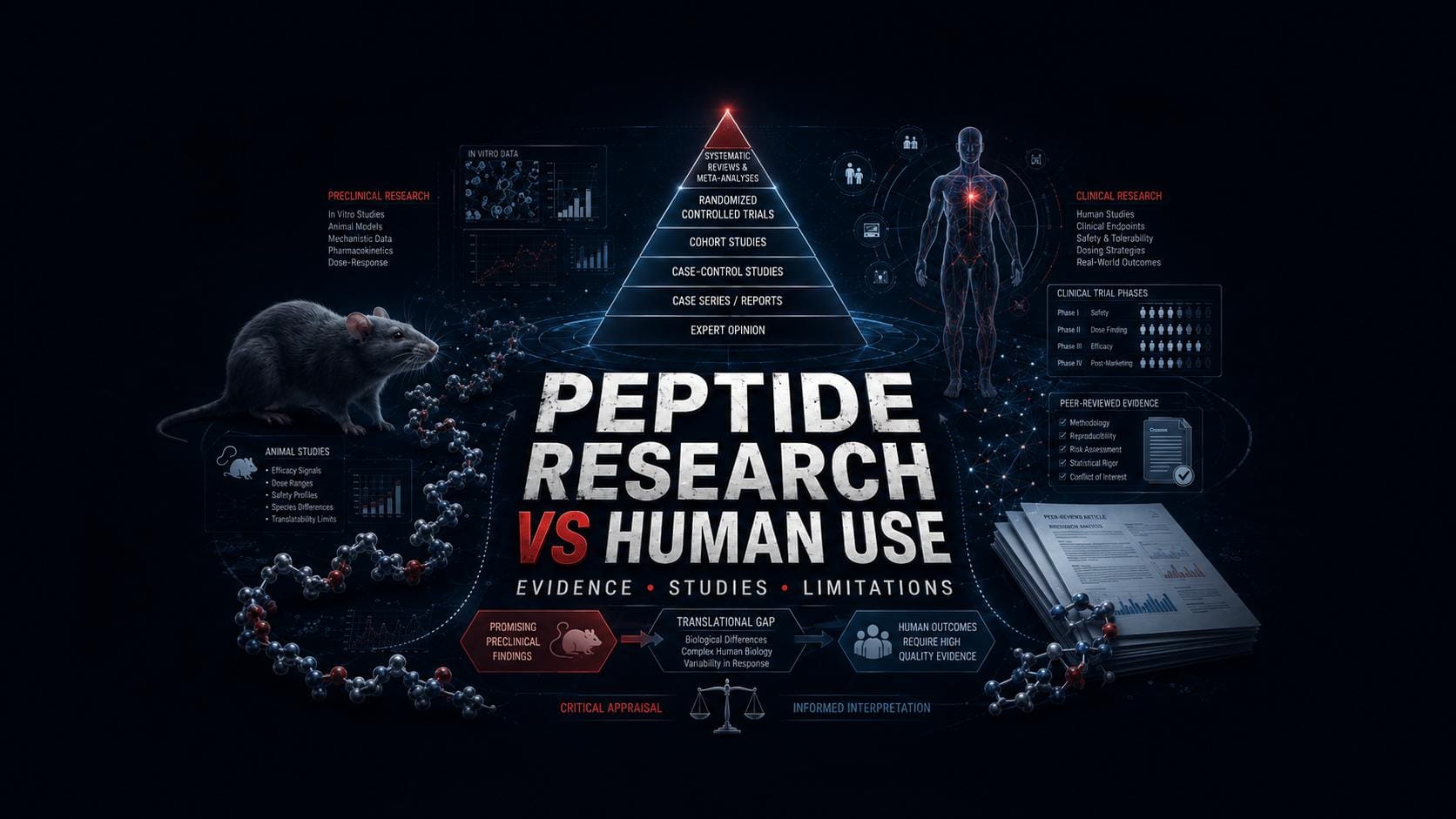
PEPTIDE RESEARCH VS HUMAN USE: READING THE EVIDENCE ACCURATELY
Research peptides are sold in small vials marked "for research use only" or "not for human consumption". Most buyers are not running a lab. The FDA says companies have sold weight loss peptides with that label straight to consumers, with dosing instructions, and calls the products of unknown quality (FDA). Lab tests of such vials found the wrong amount of drug, low purity and bacterial toxins (PMID 39509151, PMID 24771717).
This page explains, in plain words, what "research use only" really means, what is inside the vials, whether research peptides are safe or legal, and whether they work. It also gives you five questions to ask of any peptide claim. Every number comes from a PubMed abstract or an FDA page. The basics are on what are peptides.
Research peptides in brief
Three numbers sum up the gap between peptide research and human use. How often animal results become a medicine, what was really in an online vial, and what a seized black market looked like.
Of therapies tested in animals that went on to win approval for people
A 2024 review of 367 therapies found 50 percent reached any human study, 40 percent a randomised trial and 5 percent approval (PMID 38870090). Most research peptides sold online sit at step one.
The lowest amount of drug found in an online melanotan II vial sold as 10 mg
Vials from three online shops held 4.32 to 8.84 mg instead of 10 mg. Two shops also had unknown impurities of 4.1 to 5.9 percent (PMID 24771717).
Drugs on the sports banned list found among 67 ingredients in 337 black market products
A German anti-doping lab tested seized products from 2010 to 2013. Peptide hormones made up 12.8 percent, and several were fake or never approved (PMID 25168622).
Every figure on this page comes from a PubMed abstract or an FDA page listed at the end. No dose, schedule or source appears for any unapproved compound. This site does not sell peptides and does not recommend sellers.
What this guide covers
What "research use only" means, and how a research vial differs from a prescription peptide.
What lab tests found inside online peptide vials.
Whether research peptides are legal, safe and effective, with the evidence for each answer.
Five questions to ask of any peptide study or claim.
Not covered
Where to buy, which company to trust, or doses. We do not sell or recommend sellers, and give no dose for unapproved peptides.
Legal advice. Rules differ by country. This page describes US regulators and the sports banned list.
What "research use only" really means
A vial marked "research use only" is sold as a lab chemical. The label means it is meant for experiments in test tubes or animals, not for people. Nobody has checked that it is safe, clean or correctly dosed for a human body.
In practice, many of these vials are sold to people anyway. The FDA has warned companies that sold weight loss peptides falsely labeled "for research purposes" or "not for human consumption". The products were sold directly to consumers for human use, with dosing instructions. The FDA urges people not to buy them, because their quality is unknown (FDA).
"Research grade" is a seller's phrase, not a legal standard. It usually means the seller claims a purity number from their own test. As you will see below, that number can be very far from what is in the vial.
Prescription peptide vs research vial: who checks what
The difference between an approved peptide and a research vial is not the molecule. It is who checked it, and how.
| Question | Prescription peptide | Research vial |
|---|---|---|
| Tested in people for safety and effect? | Yes, in trials before approval | Usually not; often animal studies only |
| Factory inspected by a regulator? | Yes | No |
| Purity and dose checked by someone other than the seller? | Yes | Only if the seller pays a lab |
| Sterile, with no bacterial toxins? | Required | Not required, and not always the case (PMID 39509151) |
| Comes with a label of side effects and warnings? | Yes | No |
| Allowed to be sold for human use? | Yes, with a prescription | No (FDA) |
Take semaglutide. The approved pen comes with a long list of known side effects and a fixed dose, as covered on peptide side effects. The same molecule sold online as a research vial came with neither, and failed lab tests (PMID 39509151).
What lab tests found inside online peptide vials
Several labs have bought peptides online and tested them. The chart shows how far the contents were from the label.
Melanotan II. Vials from three online shops promised 10 mg. They held 4.32 to 8.84 mg, and two shops had unknown impurities of 4.1 to 5.9 percent (PMID 24771717).
Semaglutide. Researchers bought from illegal online pharmacies. Three pens never arrived. The three vials that did held 29 to 39 percent more drug than the label. Purity was 7.7 to 14.37 percent against 99 percent claimed. All three held bacterial endotoxin, which can cause fever and chills (PMID 39509151).
TB500. Lab tests found that products sold as TB500 did not consistently match their own description. A product called SGF1000 was mostly sheep tissue and blood proteins (PMID 36482504).
Black market peptides. A German anti-doping lab tested 337 seized products and found 67 active ingredients, 49 of them banned in sport (PMID 25168622). Another analysis found modified versions of three growth hormone peptides, each with an extra amino acid added (PMID 29864719).
Are research peptides legal?
This depends on where you live, and this is not legal advice. In the United States, the picture is this.
Selling them for human use is not allowed. The FDA has warned companies that sold peptides labeled "for research purposes" to consumers with dosing instructions, and calls these sales illegal (FDA).
Pharmacies are restricted too. The FDA lists many popular peptides as substances that may pose significant safety risks in compounded drugs. The list includes BPC-157, TB-500, CJC-1295, ipamorelin, melanotan II and injectable GHK-Cu. For most of them, the stated concern is immunogenicity: the immune system reacting to clumped peptide or impurities (FDA, Category 2).
Sport bans them. The World Anti-Doping Agency bans growth hormone releasing peptides, and BPC-157 falls under non-approved substances (WADA). A tested athlete can fail a test on a research peptide.
Do research peptides actually work?
Most research peptides have strong results in animals and little or nothing in people. That gap matters, because animal results often do not become medicines.
A 2024 review followed 367 therapies that were tested in animals. Half reached any human study, 40 percent reached a randomised trial, and 5 percent were approved. It took a median of 10 years from animal study to approval. When a human trial was run, results agreed with the animal results 86 percent of the time (PMID 38870090).
So animal results are a real signal, but most never get tested properly in people. BPC-157 has been given to 30 people in three small studies, none with a placebo group (PMID 42885452). TB-500 has no human trial. Their pages, BPC-157 and TB-500, go through every study.
Are research peptides safe?
Nobody can say they are, because they have not been tested for safety in people. The risks come from two places.
The product. Wrong amounts, low purity and bacterial toxins were found in online vials (PMID 24771717, PMID 39509151). Even a research supplier's own peptides held 20 and 43 percent of an undeclared filler, mannitol, in one lab check (PMID 31671336).
The peptide itself. A 2026 review lists possible risks of unapproved injectable peptides. They include contamination, impurities, wrong doses, unwanted blood vessel growth, cancer, heart strain and hormone overload (PMID 42757290). These are possible risks, not measured rates.
The user. A poison center reported people who injected ten times their intended dose of a compounded peptide, after mixing up milliliters, units and milligrams (PMID 37392810). The peptide calculator shows how these units connect.
Can a lab report make a research peptide safe?
Many sellers post a certificate of analysis, a lab report with a purity number. It helps, but less than people think.
First, the report usually comes from the seller, for one batch, and you cannot check that your vial is that batch. Second, a purity test does not see everything. The usual method can be blind to some fillers. In one check, a filler made up 20 and 43 percent of two research peptides, and only a different test caught it (PMID 31671336). Third, purity is not sterility. The semaglutide vials had no living bacteria, but all held bacterial endotoxin (PMID 39509151).
The authors of the filler study put it simply: testing beats trust, for pharmaceutical and research products alike (PMID 31671336).
Five questions to ask of any peptide claim
Most peptide marketing quotes real studies. The trick is in which studies. Ask these five questions and most claims sort themselves out.
1. Animals or people? A rat study can show a peptide heals a tendon. Only a human study shows it heals yours (PMID 38870090).
2. How many people? Thirty people cannot reveal a side effect that hits one in 300. BPC-157 has 30 in total (PMID 42885452).
3. Was there a placebo group? Without one, you cannot tell the peptide from time, rest or hope. None of the BPC-157 studies had one (PMID 42885452).
4. Same peptide, same dose, same route? Results for the full thymosin beta 4 protein do not apply to the TB-500 fragment. A drip in hospital does not equal a home injection.
5. Who is telling you? A seller, a forum or a review in a journal? Sellers have a reason to quote the best rat result and skip the rest.
5 mistakes people make with research peptides
1. Reading "research grade" as "pharmaceutical grade". One online semaglutide vial was 7.7 percent pure against 99 percent claimed (PMID 39509151).
2. Trusting the milligrams on the label. Melanotan II vials sold as 10 mg held 4.32 to 8.84 mg (PMID 24771717).
3. Treating a seller's lab report as proof. Standard purity tests can miss fillers, and purity is not sterility (PMID 31671336, PMID 39509151).
4. Reading rat studies as human results. Only 5 percent of animal-tested therapies reach approval (PMID 38870090).
5. Forgetting sport rules. Growth hormone releasing peptides and BPC-157 are on the WADA banned list (WADA).
Verdict: peptide research is not permission for human use
Research peptides are lab chemicals sold, often illegally, to people. The FDA warns against them and restricts many of them in pharmacies (FDA). Lab tests found vials with too little drug, too much drug, low purity and bacterial toxins (PMID 24771717, PMID 39509151). Most have animal data only, and only 5 percent of animal-tested therapies become approved medicines (PMID 38870090).
Peptide research is worth reading, and some of it may become medicine. Until then, the safest path is an approved peptide from a prescriber. Read the evidence with the five questions above, and use what are peptides, types of peptides and healing peptides for the details.
Research peptides: frequently asked questions
Are research peptides safe?
They are not proven safe, because they have not been tested for safety in people. Lab tests of online vials found wrong amounts, purity as low as 7.7 percent and bacterial endotoxin (PMID 24771717, PMID 39509151). A 2026 review lists contamination, wrong doses and cancer among possible risks (PMID 42757290).
Are research peptides legal?
In the US, selling them for human use is not. The FDA has warned companies that sold peptides labeled "for research purposes" to consumers with dosing instructions (FDA). Many are also restricted in pharmacies as Category 2 substances, and the sports banned list covers growth hormone releasing peptides and BPC-157 (WADA). Rules differ by country.
Do research peptides actually work?
Most work in animals, but few are tested in people. Of 367 animal-tested therapies, 40 percent reached a randomised trial and 5 percent were approved (PMID 38870090). BPC-157 has 30 human subjects and no placebo-controlled trial (PMID 42885452).
What does "research use only" mean on peptides?
It means the product is sold as a lab chemical for experiments, not for people. No regulator has checked it for human safety, purity or dose. The FDA says companies have used this label falsely while selling to consumers (FDA).
What are research grade peptides?
"Research grade" is a seller's term, not a legal standard. It usually means a purity claim from the seller's own test. Online semaglutide vials claiming 99 percent tested at 7.7 to 14.37 percent (PMID 39509151).
What is the downside of taking peptides?
For approved peptides, the known side effects on the label. For research peptides, unknown side effects plus product risks. Those include wrong dose, impurities and bacterial toxins (PMID 39509151), and ten fold dosing errors (PMID 37392810).
What is the most trustworthy peptide company?
For human use, none outside a licensed pharmacy, because no research peptide company is allowed to sell for that. This site does not recommend sellers. Even a research supplier's peptides contained an undeclared filler in one lab check (PMID 31671336).
Is a certificate of analysis enough?
No. It usually comes from the seller, covers one batch, and does not test sterility. The usual purity test can miss fillers: one made up 20 and 43 percent of two research peptides (PMID 31671336).
Sources and further reading
Every figure on this page comes from one of the 13 sources below. 10 are papers checked against their PubMed abstracts on 26 October 2026. The other 3 are FDA and WADA pages. Possible risks from reviews are labelled as possible, not as measured rates. Reference links are dofollow to support open science.
Regulator
Regulator
Regulator
Verified
Verified
Verified
Verified
Verified
Verified
Verified
Verified
Verified
Verified
Keep reading
Four pages that go deeper: the basics, the full map of peptide types, side effects by group, and the peptides sold for healing.
Final Educational Note
This article is educational and is not medical or legal advice. It reports what regulators, lab tests, trials and reviews say about peptides sold for research. It gives no dose, schedule or source for any unapproved compound, and does not recommend any seller or research chemical for any use. More guides sit on the peptides hub.
Used a research peptide and feel unwell? Fever, swelling, a rash or severe stomach pain need a doctor. Bring the vial with you. Read more about how this site works on the about page and in the full disclaimer.