Bulking vs Cutting: The Complete Nutrition Guide for Muscle Gain and Fat Loss
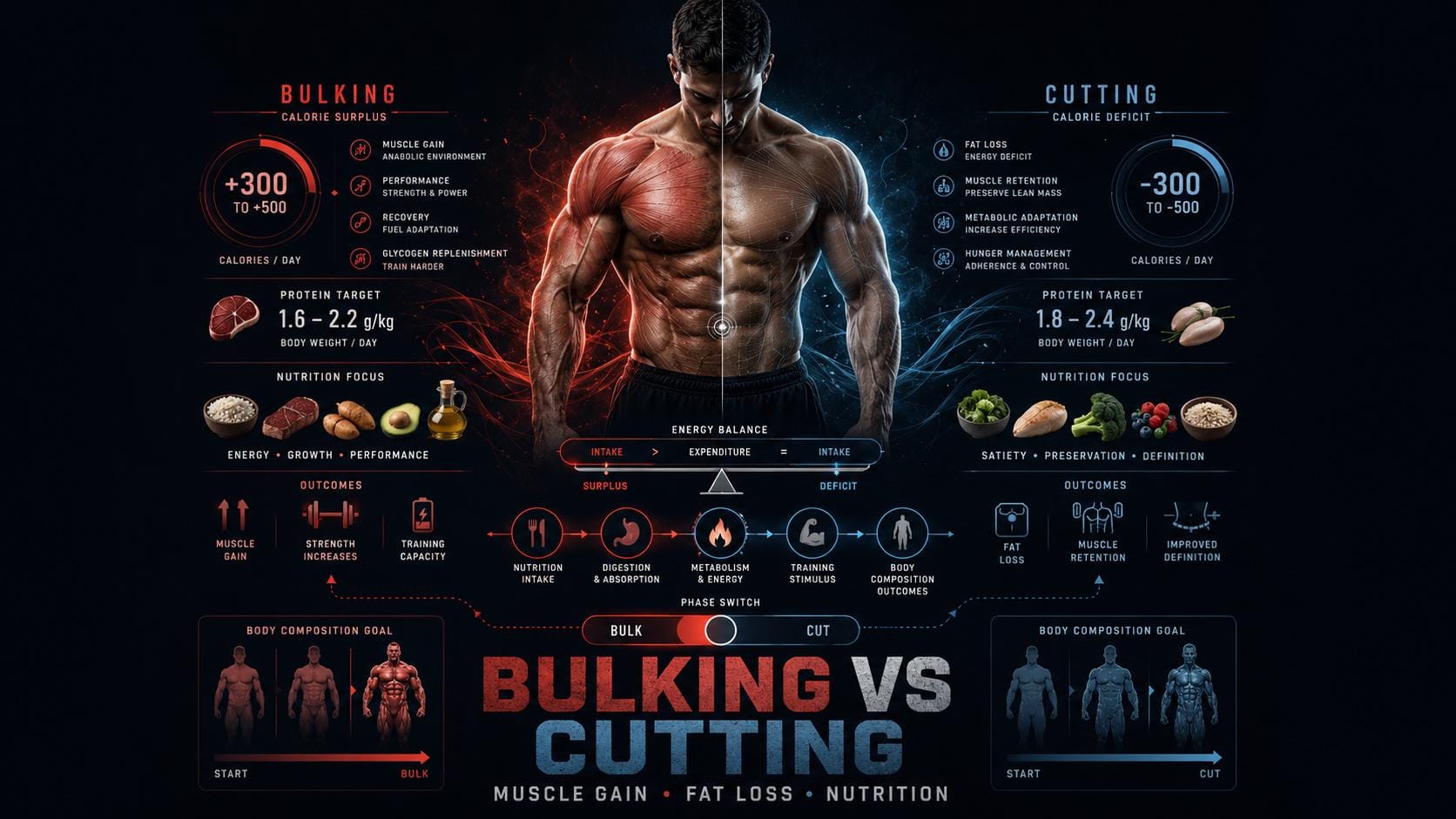
BULKING VS CUTTING: WHICH ONE FIRST, AND HOW TO EAT FOR EACH
Bulking means eating more than you burn so you can build muscle. Cutting means eating less than you burn so you can lose fat. That is the whole idea, and almost everything else people argue about is detail. The detail matters, though, because the size of the surplus or the deficit decides how much of what you gain is muscle and how much of what you lose is fat. In one trial, athletes who lost 0.7 percent of their body weight a week gained 2.1 percent lean mass while dieting. Athletes who lost 1 percent a week gained none (PMID 21558571). Same goal, different speed, different result.
This page explains bulking vs cutting the way a coach would across a kitchen table. What each phase does, how to tell if you should bulk or cut right now, how many calories and how much protein each phase needs, how long to run them, and when you can do both at once. There is a calculator that turns your weight and body fat into a phase, a calorie target and a protein target. Every number comes from a PubMed abstract listed at the end. How to train in each phase is on cutting vs bulking training.
Bulking vs cutting in brief
Three numbers carry most of this page. How fast to lose weight on a cut, how much protein stops being useful on a bulk, and how big a deficit stops muscle growth.
Slow cut: athletes lifting four times a week gained lean mass, the fast cut did not
Twenty four athletes dieted while lifting four times a week. The slow group lost 0.7 percent of body weight a week and gained 2.1 percent lean mass. The fast group lost 1 percent a week and gained nothing. Both lost about the same fat (PMID 21558571). For an 80 kg lifter, 0.7 percent is about 0.55 kg a week.
Protein a day where the extra gain stops on a bulk, review of 49 trials and 1 863 people
Protein helped people gain muscle and strength, but above about 1.62 g per kg of body weight a day there was no further gain (PMID 28698222). On a cut the number goes up: a review of lean, dieting lifters put it at 2.3 to 3.1 g per kg of lean mass (PMID 24092765). Fat loss raises your protein needs; muscle gain does not.
The deficit that stops muscle gain, meta analysis of lifting trials run in an energy deficit
Across trials of people lifting weights while eating less than they burned, lean mass gains were impaired compared with people at maintenance, while strength gains were about the same. The regression put the point where lean mass stops growing at a deficit of about 500 kcal a day (PMID 34623696). Cut harder than that and you are only preserving muscle, not building it.
Every figure on this page about bulking vs cutting comes from a PubMed abstract listed at the end. The body fat thresholds for choosing a phase and the example meal plans are coaching rules of thumb, and the page says so where they appear.
What this bulking vs cutting guide covers
What bulking and cutting mean in plain words, and the one fact most guides skip: a deficit over about 500 kcal a day stops muscle growth entirely (PMID 34623696).
How to tell if you should bulk or cut, with a body fat table, the skinny fat case, and a calculator that gives you a phase, a calorie target and a protein target.
How to eat in each phase: surplus and deficit size, protein, fat, carbs, rate of gain or loss, how long to run each one, body recomposition, women, and the five mistakes that waste a phase.
Not covered
How to train differently in each phase. That is on cutting vs bulking training.
Your exact maintenance calories. Use the calorie calculator and read calories and energy balance.
Protein in depth. Timing, sources and per meal doses are on protein intake explained.
What bulking and cutting actually mean
Your body needs a certain number of calories a day to stay the same weight. That is your maintenance. Eat more than that for weeks, and you gain weight. Eat less, and you lose it. Bulking is deliberately eating above maintenance while lifting, so the extra energy has a reason to become muscle. Cutting is deliberately eating below maintenance while lifting, so the body burns fat and keeps the muscle. Neither is a diet in the usual sense. They are phases, and most people who lift for years alternate between them.
What is bulking and cutting for, if you could just eat at maintenance? Because muscle is expensive to build and fat is easy to gain. Lifting in a surplus gives the body spare energy and raw material, and the research shows a surplus does help growth even on its own (PMID 31482093). But the body does not put every extra calorie into muscle. In 39 elite athletes on an 8 to 12 week gain phase, the group eating about 600 kcal a day more gained 3.9 percent body weight against 1.5 percent, yet the extra was mostly fat. Lean mass gain was the same in both groups (PMID 23679146). That is the reason cutting exists: to remove the fat that came with the muscle.
Here is the example lifter for this page. Meet Jordan. Jordan is 80 kg, about 15 percent body fat, has lifted for two years, and eats about 2 600 kcal a day to stay at 80 kg. Jordan wants to look leaner and be bigger, and is not sure which to do first. Everything below is worked out for Jordan.
The difference between bulking and cutting, in one table
| Bulking | Cutting | |
|---|---|---|
| Goal | Build muscle, accept a little fat | Lose fat, keep the muscle |
| Calories | Maintenance plus 10 to 20 percent (PMID 31247944) | Maintenance minus up to 500 kcal (PMID 34623696) |
| Weekly change | Gain 0.25 to 0.5 percent of body weight (PMID 31247944) | Lose 0.5 to 1 percent, nearer 0.7 (PMID 24864135, PMID 21558571) |
| Protein | 1.6 to 2.2 g per kg body weight (PMID 31247944) | 2.3 to 3.1 g per kg lean mass (PMID 24092765) |
| Fat | 0.5 to 1.5 g per kg | 15 to 30 percent of calories |
| Carbs | The rest, at least 3 to 5 g per kg | The rest |
| Typical length | 12 to 24 weeks | 6 to 12 weeks |
| Jordan, 80 kg, 2 600 kcal maintenance | About 2 900 to 3 100 kcal, gain 0.2 to 0.4 kg a week | About 2 100 to 2 200 kcal, lose about 0.55 kg a week |
Should I bulk or cut first? How to tell
Bulk vs cut is the question most people actually have, and the answer is simpler than the forums make it. Look at two things: how much fat you carry now, and how long you have been lifting. The fatter you are, the more a cut gives back, because a surplus from a high starting point mostly adds fat. The leaner you are, the better a bulk works, because you have room to gain before you look soft. Beginners are a special case covered below.
| Where you are | Men, body fat | Women, body fat | Usual call | Why |
|---|---|---|---|---|
| Lean | Under 12 percent | Under 20 percent | Bulk | You have room to gain. A cut from here costs muscle and energy. |
| Normal | 12 to 17 percent | 20 to 27 percent | Bulk, usually | A 12 to 24 week bulk followed by a short cut gives the most muscle per year. |
| Soft | 17 to 22 percent | 27 to 32 percent | Either, or a short cut first | A 6 to 8 week cut gets you to a cleaner start. Or bulk slowly if you are new to lifting. |
| Higher | Over 22 percent | Over 32 percent | Cut | Fat loss will improve how you look faster than muscle gain, and a surplus adds fat quickly from here. |
| Skinny fat, any level | Little muscle, soft middle | Little muscle, soft middle | Eat at maintenance and lift | Beginners gain muscle and lose fat at the same time. Pick a phase after six months. |
How do you know your body fat without a scan? Rough guides are fine here. A man around 12 percent has visible abs in good light. Around 17 percent has a flat stomach but no definition. Over 22 percent has a soft layer you can grab. For women, add about 8 to 10 points to each of those. The exact number matters less than which row you are in. If you want a number, the BMI calculator is a start, and a cheap caliper or a smart scale will put you in the right row even if the decimal is wrong.
If you are skinny fat: bulk or cut?
Skinny fat means not much muscle and a soft middle, which usually comes from very little lifting. If that is you and you have under six months of training, the answer is neither. Eat at maintenance with high protein and lift three or four days a week. New lifters build muscle and lose fat at the same time, and a formal phase is not needed yet. After six months, use the table. Most skinny fat lifters end up in the Soft row and do best with a short cut followed by a long, slow bulk.
Bulk or cut first, if you are new?
In the first year, lifting itself does most of the work. In a 4 week study, 20 young men ate 40 percent below maintenance at 2.4 g of protein per kg. They still gained 1.2 kg of lean mass and lost 4.8 kg of fat, because the training was new and the protein was high (PMID 26817506). That does not happen to someone with five years of training. So beginners should set calories at maintenance or a small deficit, eat plenty of protein, and let the training sort it out. Intermediate lifters pick a phase.

Bulking nutrition: how to gain muscle without gaining a belly
The job of a bulk is to gain weight slowly enough that most of it is muscle. The review of off season bodybuilding nutrition puts the surplus at about 10 to 20 percent above maintenance. The target gain is 0.25 to 0.5 percent of body weight a week for new and intermediate lifters, and slower for advanced lifters (PMID 31247944). For Jordan that is 260 to 520 extra calories a day and 0.2 to 0.4 kg a week. That is slow. It is also the point.
Why not eat more and grow faster? Because the trials say the extra does not become muscle. In the elite athlete study, the group fed a planned surplus gained more than twice the weight of the group eating freely. Lean mass gain was the same. Fat gain was five times higher, 15 percent against 3 percent (PMID 23679146). In 11 bodybuilders, the high energy group did gain more muscle, 2.7 percent against 1.1 percent in 4 weeks, but also gained 7.4 percent body fat against 0.8 percent (PMID 31915482). More calories buy a little more muscle and a lot more fat.
| Target | Number for Jordan | Where it comes from |
|---|---|---|
| Calories | 2 900 to 3 100 kcal a day (maintenance plus 10 to 20 percent) | PMID 31247944 |
| Weekly gain | 0.2 to 0.4 kg a week (0.25 to 0.5 percent of body weight) | PMID 31247944 |
| Protein | 130 to 175 g a day (1.6 to 2.2 g per kg) | PMID 28698222, PMID 31247944 |
| Fat | 40 to 120 g a day (0.5 to 1.5 g per kg) | PMID 31247944 |
| Carbs | The rest, at least 240 to 400 g (3 to 5 g per kg) | PMID 31247944 |
| What that looks like | 4 meals: oats and eggs; chicken, rice and oil; yoghurt and fruit; beef, potatoes and vegetables | Coaching example |
| When to adjust | Scale average flat for 2 weeks: add 150 kcal. Up more than 0.5 kg a week for 2 weeks: remove 150 kcal | Coaching rule of thumb |
Protein on a bulk
This is the number people get wrong in the expensive direction. In the review of 49 trials, protein helped, but above about 1.6 g per kg a day there was no further gain in lean mass (PMID 28698222). The off season review allows up to 2.2 g per kg as a buffer (PMID 31247944). For Jordan that is 130 to 175 g a day. Eating 250 g a day on a bulk is not harmful, but it is money and stomach space that could go to carbohydrate, which is what fuels the training that builds the muscle.
Clean bulk, dirty bulk, lean bulk
These are not scientific terms, so here is how coaches use them. A dirty bulk is eating anything to get the scale up fast. It works for weight and fails for body composition, exactly as in the trials above. A clean bulk is the same calories from mostly whole food. A lean bulk is the slow 10 to 20 percent surplus described here. The names matter less than the weekly number on the scale. If it is going up more than 0.5 percent a week, you are gaining fat whatever you call it.
Cutting nutrition: how to lose fat and keep the muscle
The job of a cut is to lose fat slowly enough that the muscle stays. Two numbers set the pace. The contest prep review recommends losing 0.5 to 1 percent of body weight a week to keep muscle (PMID 24864135). The slow versus fast trial shows why the lower end is better. Athletes losing 0.7 percent a week gained 2.1 percent lean mass and improved their lifts. Athletes losing 1 percent a week held lean mass flat (PMID 21558571). For Jordan, 0.7 percent is about 0.55 kg a week.
The second number is the deficit itself. The meta analysis of lifting trials in a deficit found that lean mass gains were impaired compared with lifters at maintenance. The regression put the point where growth stops at about 500 kcal a day below maintenance. Strength gains were not affected (PMID 34623696). So a cut of up to 500 kcal lets you keep, and sometimes still add, muscle. A cut of 800 or 1 000 kcal does not, however much protein you eat.
| Target | Number for Jordan | Where it comes from |
|---|---|---|
| Calories | 2 100 to 2 200 kcal a day (400 to 500 below maintenance) | PMID 34623696 |
| Weekly loss | About 0.55 kg a week (0.7 percent of body weight), no more than 0.8 kg | PMID 21558571, PMID 24864135 |
| Protein | 155 to 210 g a day (2.3 to 3.1 g per kg of lean mass) | PMID 24092765 |
| Fat | 35 to 70 g a day (15 to 30 percent of calories) | PMID 24864135 |
| Carbs | The rest, about 150 to 220 g | PMID 24864135 |
| What that looks like | 4 meals: egg whites and oats; chicken, rice and vegetables; yoghurt and berries; fish, potatoes and salad | Coaching example |
| When to adjust | Average flat for 2 weeks: remove 150 kcal or add 2 000 steps a day. Down more than 1 percent a week: add 150 kcal | Coaching rule of thumb |
Protein on a cut goes up, not down
When calories drop, protein needs rise. The review of lean, dieting, resistance trained athletes concluded that 2.3 to 3.1 g per kg of lean mass a day is likely needed, with the higher end for leaner people and harder diets (PMID 24092765). The clearest trial is the one on 40 young men eating 40 percent below maintenance for 4 weeks while training six days a week. The group at 2.4 g per kg of body weight gained 1.2 kg of lean mass and lost 4.8 kg of fat. The group at 1.2 g per kg gained 0.1 kg of lean mass and lost 3.5 kg of fat (PMID 26817506). Double the protein, more fat lost, muscle gained instead of held.
Why the cut slows down
After a few weeks of dieting, the same calories stop producing the same loss. Part of that is simple: you weigh less, so you burn less. Part of it is adaptation. Hormones, movement and resting metabolism all drop a little more than the weight loss alone explains (PMID 24571926). The extreme example is the Biggest Loser study, where resting metabolism was about 500 kcal a day lower than body size predicted six years later (PMID 27136388). That was after losing 58 kg in 30 weeks, so it is not what happens on an 8 week cut. But it is the reason a cut should be short, moderate and followed by a return to maintenance, not pushed for months.
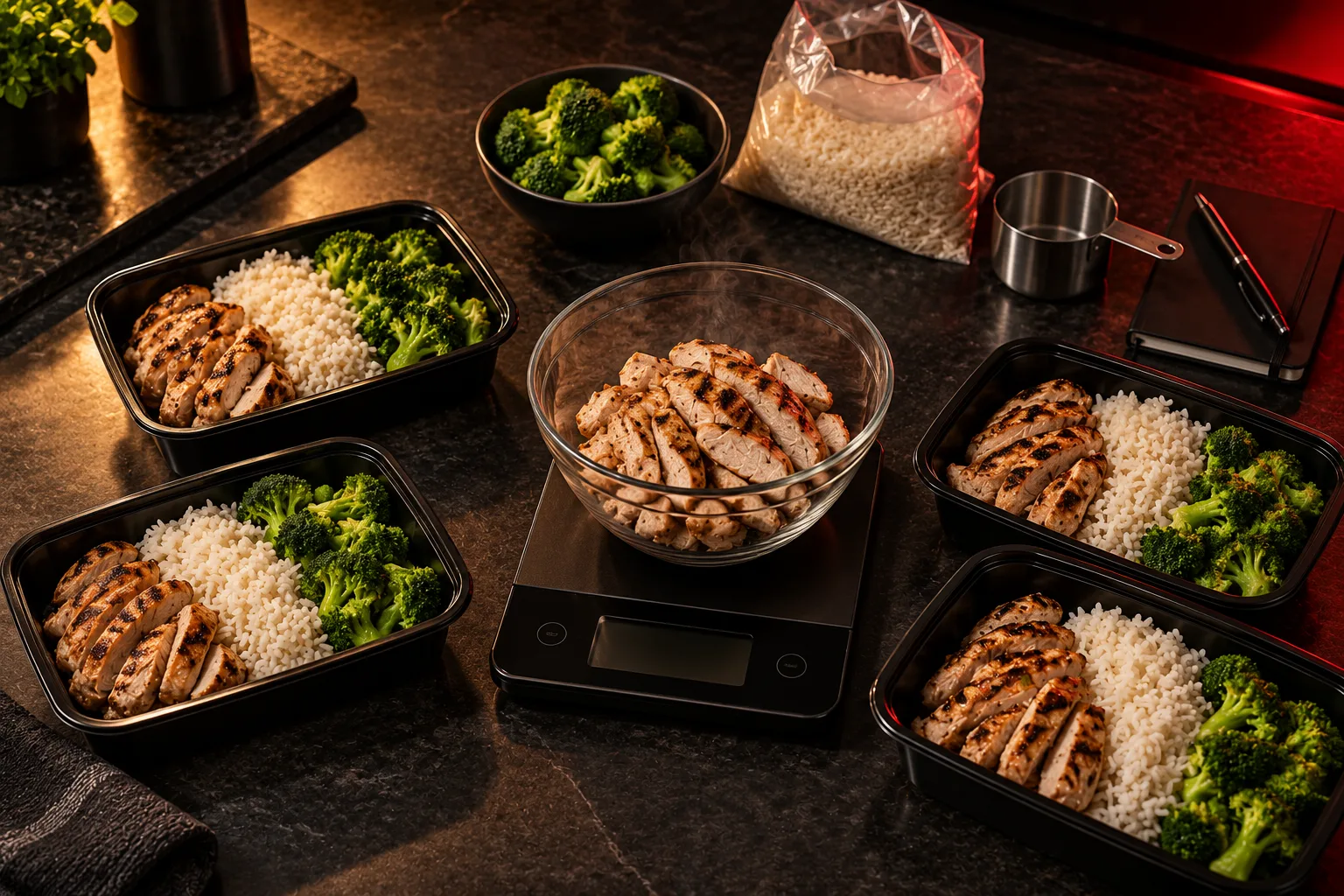
Body recomposition: can you bulk and cut at the same time?
Yes, for some people, some of the time. Recomposition means gaining muscle and losing fat in the same period while eating around maintenance. The trials where it happens have one of three things in common: the people are new to lifting, they carry a lot of fat, or they eat a lot of protein. The 4 week deficit trial above is the clearest case. New, hard training and 2.4 g of protein per kg produced 1.2 kg of lean mass and 4.8 kg of fat loss at the same time (PMID 26817506).
It also happens in trained people when protein is very high. Forty eight trained men and women ate either about 2.3 or about 3.4 g of protein per kg a day for 8 weeks on a heavy split routine. The high protein group ate more calories in total, yet lost 1.7 kg of fat and 2.4 points of body fat percentage. The normal protein group gained 1.3 kg of body weight and lost 0.3 kg of fat (PMID 26500462). More protein, more total food, less fat.
The catch is speed. Recomposition is slow in both directions. A trained lifter at maintenance might gain 1 kg of muscle and lose 1 kg of fat in three months, and the scale will not move, which is hard to live with. A bulk followed by a cut covers more ground in the same time. Recomp is the right call for beginners, for anyone coming back after a long break, and for people who cannot face the scale going up. For everyone else, phases are faster.
How long to bulk and cut, and when to switch
A bulk should be long and a cut should be short. That follows from the rates. At 0.25 to 0.5 percent a week, a useful bulk needs 16 weeks or more to gain a few kilos (PMID 31247944). At 0.7 percent a week, a cut removes the fat from that bulk in 6 to 10 weeks (PMID 21558571). Long cuts are where metabolic adaptation builds and muscle starts to go, so keep them under 12 weeks and take a break at maintenance if more fat needs to come off (PMID 24571926).
| Stage | Bulk | Hold | Cut | Cycle |
|---|---|---|---|---|
| First year | No formal bulk. Maintenance or small deficit, high protein | No formal cut | Recomp, review at 6 months | |
| Years 1 to 3, lean start | 16 to 24 weeks at plus 0.25 to 0.5 percent a week | 2 weeks | 6 to 10 weeks at minus 0.7 percent a week | About 6 to 9 months |
| Years 1 to 3, soft start | 6 to 8 week cut first, then 16 to 20 week bulk | 2 weeks | 6 to 8 weeks | About 8 months |
| Advanced | 20 to 30 weeks at plus 0.25 percent a week or less | 2 to 4 weeks | 8 to 12 weeks | About a year |
| Jordan, 80 kg, 15 percent | 16 weeks to about 84.6 kg | 2 weeks | 8 weeks back to about 80 kg | 26 weeks, see the chart |
When to stop bulking
Stop when one of three things happens. You reach the top of the Soft row in the body fat table, around 20 percent for men and 30 for women. Your weekly gain has been over 0.5 percent for three weeks and you cannot bring it down without feeling hungry. Or you have been bulking 24 weeks and want a change. The scale number itself does not matter. The rate and the mirror do.
When to stop cutting
Stop when you reach the body fat you wanted, when the cut has run 12 weeks, or when your lifts drop for two weeks in a row. The last one matters. Strength is usually protected in a moderate deficit (PMID 34623696), so losing it is a sign the deficit is too deep or has run too long. Spend two weeks at maintenance, then either start a bulk or, if more fat needs to go, cut again.
Bulk or cut calculator: your phase, calories and protein
Put in your weight, a rough body fat percentage, your maintenance calories and how long you have lifted. The calculator picks a phase using the body fat table, then gives the calorie range, the weekly rate to aim for and the protein range from the trials and reviews on this page. If you do not know your maintenance, the calorie calculator gives an estimate, and two weeks of a stable scale confirms it.
Bulk or cut calculator
Phase choice uses the body fat table above, which is a coaching rule of thumb. Bulk: maintenance plus 10 to 20 percent, gain 0.25 to 0.5 percent of body weight a week, protein 1.6 to 2.2 g per kg (PMID 31247944, PMID 28698222). Cut: maintenance minus 400 to 500 kcal, lose about 0.7 percent a week, protein 2.3 to 3.1 g per kg of lean mass (PMID 34623696, PMID 21558571, PMID 24092765). Get your maintenance from the calorie calculator. Educational only, not a meal plan.
Bulking vs cutting for women
The same rules apply, with two changes. First, the body fat thresholds are higher. Women carry more essential fat, so the rows in the table shift up by about 8 to 10 points. A lean woman is under 20 percent, a soft one over 27, and a cut is the usual call over 32. Second, the absolute numbers are smaller because body weight and maintenance calories are usually lower. A 10 to 20 percent surplus might be 200 to 350 kcal, and a 500 kcal deficit is a bigger share of the day. Many women do better with a 300 to 400 kcal deficit and a slightly longer cut.
The response to the training itself is not different. A review of 10 studies found no difference in muscle growth between men and women on the same lifting program, and women showed larger relative upper body strength gains (PMID 32218059). So the fear that bulking will make a woman bulky is not supported. At 0.25 to 0.5 percent a week, a 60 kg woman gains 150 to 300 g a week, and most of that, with the protein in place, is muscle.
Five bulking and cutting mistakes that waste a phase
1. Bulking at plus 1 000 calories
A big surplus gets the scale moving and feels like progress. The trials show the extra is fat. The planned surplus group in the elite athlete study gained no more lean mass than the group eating freely, and five times the fat (PMID 23679146). Keep it at 10 to 20 percent and let the scale rise slowly.
2. Cutting at minus 1 000 calories
A deficit over about 500 kcal a day stops muscle gain and starts to threaten the muscle you have (PMID 34623696). Faster weight loss also held lean mass flat where slower loss grew it (PMID 21558571). The fast cut saves four weeks and costs the thing you were cutting to show off.
3. Dropping protein on the cut
Protein needs go up when calories go down, to 2.3 to 3.1 g per kg of lean mass (PMID 24092765). Cutting protein along with everything else is the most common reason a cut ends with smaller arms and the same waist.
4. Switching phases every three weeks
At 0.25 to 0.5 percent a week, three weeks of bulking gains under a kilo, most of it water and glycogen. Then the cut removes it. Nothing was built. A bulk needs 16 weeks or more to be worth the cut that follows it.
5. Judging by the daily weigh in
Weight moves a kilo a day with water, salt and food in the gut. Weigh every morning, average the week, and compare weekly averages. The rate matters, not the number, and the rate only shows up in the average.
Verdict: cut if you can grab it, bulk if you cannot, and go slow either way
Bulk vs cut is a decision about where you are, not about which is better. Carrying visible fat: cut for 6 to 12 weeks at no more than 500 kcal below maintenance, with protein high, losing about 0.7 percent a week. Lean or normal: bulk for 16 to 24 weeks at 10 to 20 percent above maintenance, gaining 0.25 to 0.5 percent a week. New to lifting: do neither yet. Eat at maintenance with high protein and let the first year of training do both jobs.
How to train in each phase is on cutting vs bulking training. Setting the maintenance number the whole plan hangs on is on calories and energy balance and the calorie calculator.
Bulking vs cutting: frequently asked questions
Is it better to cut or bulk?
Neither is better. Bulk vs cut depends on where you start. If you can grab a layer of fat around your middle, a cut improves how you look faster and sets up a cleaner bulk. If you are lean, a bulk adds muscle you cannot build in a deficit. A deficit over about 500 kcal a day stops muscle gain (PMID 34623696), so people who want size should spend most of the year at maintenance or above.
Should I bulk or cut first?
Use body fat. Men under about 17 percent and women under about 27 percent usually bulk first. Men over about 22 percent and women over about 32 percent usually cut first. In between, a short 6 to 8 week cut followed by a long slow bulk is the common choice. Those thresholds are a coaching rule of thumb, not a trial result. Beginners should do neither and eat at maintenance with high protein for the first six months.
What is the 80/20 rule for bulking?
It is a food quality rule, not a research term. About 80 percent of your calories come from whole foods such as meat, fish, eggs, dairy, grains, fruit and vegetables, and up to 20 percent can come from whatever you like. It makes a 10 to 20 percent surplus easier to hit without forcing down plain chicken and rice all day. It does not change the calorie or protein targets.
Is 3 000 calories a day a bulk?
Only if your maintenance is under about 2 700. A bulk is maintenance plus 10 to 20 percent (PMID 31247944). So 3 000 kcal is a bulk for someone who maintains at 2 500 to 2 700 and a cut for someone who maintains at 3 500. The number on its own means nothing. Find your maintenance first, then add 10 to 20 percent.
If I am skinny fat, should I bulk or cut?
If you have under six months of lifting, neither. Eat at maintenance with 2 g or more of protein per kg and lift three or four days a week. New lifters build muscle and lose fat at the same time (PMID 26817506). After six months, most skinny fat lifters do best with a short cut of 6 to 8 weeks, then a long slow bulk at plus 10 to 15 percent.
How much protein when bulking vs cutting?
On a bulk, 1.6 to 2.2 g per kg of body weight. Above about 1.6 g per kg the 49 trial review found no further gain (PMID 28698222). On a cut, protein goes up: 2.3 to 3.1 g per kg of lean mass, higher the leaner you are and the harder the diet (PMID 24092765). For an 80 kg lifter that is roughly 130 to 175 g on a bulk and 155 to 210 g on a cut.
Is bulking and cutting healthy?
Moderate versions are. A 10 to 20 percent surplus and a cut of up to 500 kcal a day, each run for a few months with high protein and lifting, sit inside the sports nutrition recommendations (PMID 31247944, PMID 24864135). The unhealthy versions are the extremes. Large surpluses add a lot of fat. Long or deep cuts drive metabolic adaptation (PMID 24571926) and, in aesthetic sport, raise the risk of disordered eating, which the contest prep review flags directly (PMID 24864135).
How long should a bulk and cut cycle be?
A bulk of 16 to 24 weeks, two weeks at maintenance, then a cut of 6 to 12 weeks. That is about 6 to 9 months for a full cycle. The bulk is long because safe gain is slow, 0.25 to 0.5 percent of body weight a week. The cut is short because 0.7 percent a week removes the fat from that bulk quickly, and long cuts are where muscle loss and adaptation build up.
Sources and further reading
Every figure on this page about bulking vs cutting comes from one of the 14 papers below, each checked against its PubMed abstract on 24 October 2026. The body fat thresholds, phase lengths, meal examples and the 80/20 rule are coaching rules of thumb and are labelled as such in the text. Reference links are dofollow to support open science.
Verified
Verified
Verified
Verified
Verified
Verified
Verified
Verified
Verified
Verified
Verified
Verified
Verified
Verified
Keep reading
Four pages that finish the job: how to train in each phase, how to find your maintenance, how much protein and when, and the calculator that gives you the starting number.
Final Educational Note
This article is educational and is not medical or dietary advice. It reports what randomised trials, meta-analyses and sports nutrition reviews say about energy surplus, energy deficit and protein intake in people who lift weights, and shows how those findings can be applied to bulking and cutting. The worked example and the calculator are illustrations, not plans written for any individual. More guides sit on the nutrition hub.
Anyone with a medical condition, anyone under 18, anyone pregnant or breastfeeding, and anyone with a history of disordered eating should have calorie and protein targets set by a registered dietitian or physician. Rapid weight loss, very low calorie diets and extreme surpluses carry health risks that this page does not cover. Read more about how this site works on the about page and in the full disclaimer.