Do Steroids Affect Your Kidneys? 6 Facts & the Real Danger
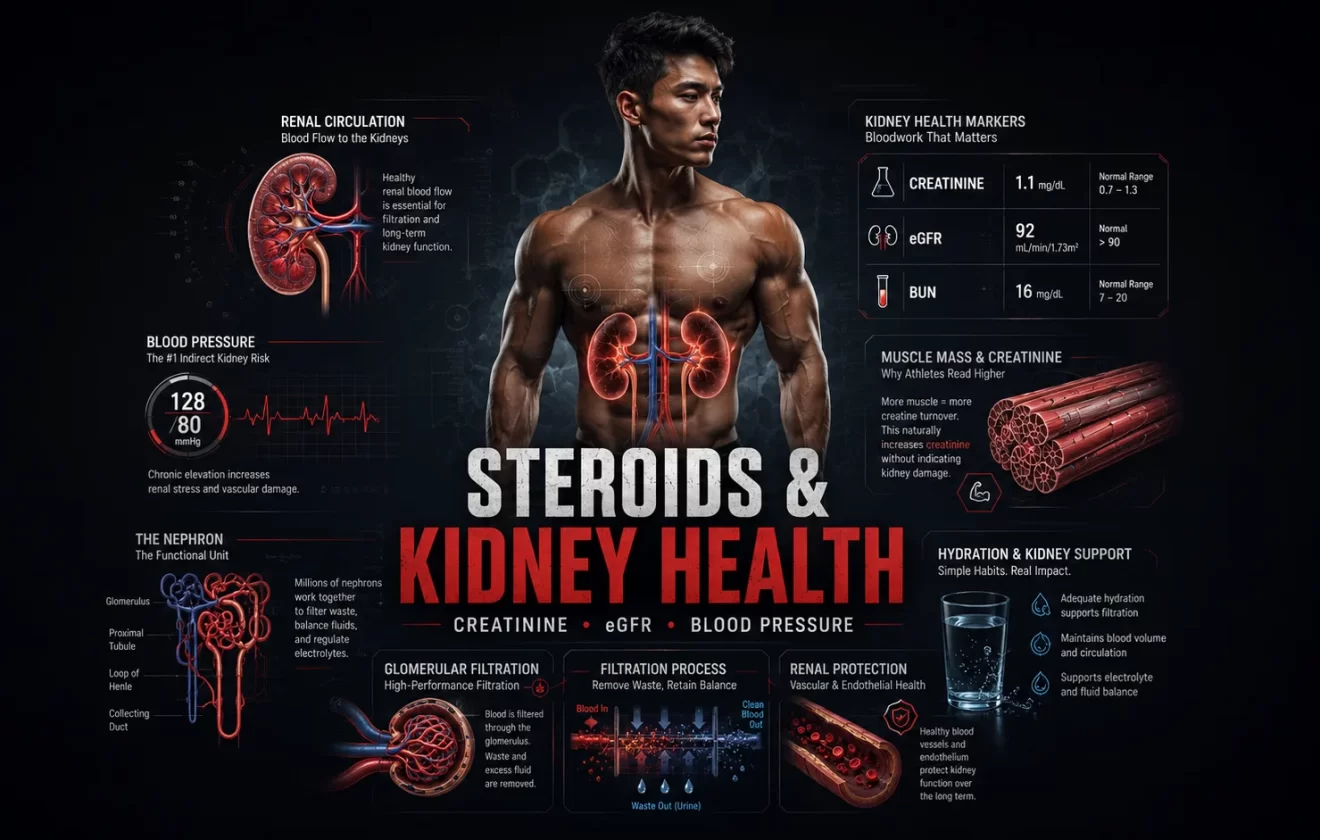
Short answer: yes, but the popular version of the story is half wrong. Steroids affect your kidneys through blood pressure, a raised workload and, in extreme cases, real structural damage - yet the "high creatinine" that scares most lifters is usually just muscle, not failing kidneys. Here is how steroids affect your kidneys, what creatinine actually means for you, and the one test that cuts through the confusion.
Do steroids affect your kidneys?
Yes - but mostly indirectly, and less often than the internet claims. The main ways steroids affect your kidneys are through the higher blood pressure they cause and the extra filtering workload that comes with carrying a lot of muscle. Direct, severe kidney damage does happen, but it is largely confined to heavy, long-term, high-dose users, often stacking other risks on top.
The bigger day-to-day issue is a false alarm. The standard kidney number - creatinine - rises simply because you have more muscle, whether or not your kidneys are struggling. So a lot of lifters are told steroids affect your kidneys when their actual kidney function is fine. Sorting the real risk from the artefact is what this guide is about.
High creatinine, or actual kidney damage?
Here is the piece almost everyone gets wrong. Creatinine is a breakdown product of creatine in muscle, so the more muscle you carry, the more creatinine you produce - completely independent of kidney health. A heavily muscled lifter can run a creatinine that would look alarming in a sedentary person while having perfectly normal kidneys.

It gets worse, because eGFR - the "kidney function" percentage - is calculated from creatinine. So a muscular body inflates creatinine, which then drags the estimated eGFR down (check your own number in the eGFR calculator (CKD-EPI 2021)), and suddenly a healthy lifter looks like an early-stage kidney patient. The fix is a different test: cystatin C, which the body produces regardless of muscle mass. If you want to know whether steroids affect your kidneys for real, cystatin C - not creatinine - is the marker that tells the truth.
How common is real kidney damage?
Put in perspective, serious kidney injury from steroids is uncommon relative to how often people worry about it. The dramatic cases in the medical literature - bodybuilders with biopsy-proven scarring and heavy protein leakage - involved extreme, years-long, high-dose use in very large individuals, frequently alongside other kidney stressors. That is a real warning, but it is not the typical recreational user's story.
Far more common is the everyday false alarm: a lifter sees a "high creatinine" or a "low eGFR" flag and assumes steroids affect your kidneys, when a cystatin C test would show normal function. So the honest picture is two-sided - genuine, sometimes severe damage exists at the extreme end, while most of the day-to-day panic about steroids affecting your kidneys is a measurement artefact from carrying muscle.
How steroids affect the kidneys
When the damage is real, several routes are in play - and most of them run through pressure and workload rather than the drug poisoning the kidney directly:
High blood pressure
Glomerular overload (FSGS)
The supplement stack
Higher hematocrit
Direct effects
What actually raises kidney risk?
Unlike the liver, kidney risk is less about the specific compound and more about the surrounding conditions. The pattern of who gets into trouble is fairly consistent:
| Factor | Kidney risk | Why it matters |
|---|---|---|
| Uncontrolled high blood pressure | High | The leading real-world route by which steroids affect your kidneys long term |
| Very high dose + long duration + big mass | High | The FSGS case pattern - extreme, sustained overload |
| NSAID abuse + dehydration | Moderate | Painkillers plus low fluids are directly hard on the kidney |
| Harsh supplement stacks | Moderate | Stimulants, mega-dose protein and diuretics add load |
| Sensible TRT, BP controlled | Lower | Modest, monitored use is far less likely to harm the kidney |
Read that table as a to-do list in reverse: the way you stop steroids affecting your kidneys is mostly by controlling blood pressure, keeping doses and duration sane, staying hydrated, and not stacking nephrotoxic extras on top.
Where does a creatinine reading land?
Set a creatinine value to see the rough band (illustrative male ranges, mg/dL) - but remember a muscular lifter sits naturally higher, so confirm with cystatin C before assuming steroids affect your kidneys:
Creatinine rises with muscle mass, not just kidney trouble. On cycle, track the trend against your baseline and pair it with cystatin C and a urine protein check.
Illustrative only, not a diagnosis. For what creatinine, eGFR and BUN really mean, see the kidney markers guide.
Do the kidneys recover after stopping?
It depends on what actually happened. If your "kidney problem" was really just muscle-driven creatinine, there is nothing to recover - the number drops a little as you lose mass, and cystatin C confirms function was fine all along. In that common scenario, steroids affect your kidneys mainly on the lab printout, not in reality.
Genuine damage is different. Pressure-related decline can stabilise or improve once blood pressure is controlled, but established scarring like FSGS does not simply reverse, and significant protein in the urine is a sign to stop and see a nephrologist. The reversible cases are the reason to monitor early; the irreversible ones are the reason not to ignore it.
What actually protects your kidneys
If you have decided to use, protecting kidney function is mostly about the surrounding conditions, not a magic supplement:
- Control blood pressure. This is the single biggest lever, because pressure is the main route by which steroids affect your kidneys over time. A cuff and a plan to keep BP down matter more than anything else here.
- Test cystatin C, not just creatinine. It is the muscle-proof measure of real kidney function. Add a urine test for protein (albumin) to catch early glomerular trouble.
- Stay hydrated and easy on NSAIDs. Painkillers plus dehydration are a classic cause of acute kidney injury in lifters - an avoidable one.
- Keep dose and mass sane. The structural damage cases cluster in extreme, long-term, high-dose use. Moderation genuinely lowers the odds that steroids affect your kidneys for real.
- Baseline first. A pre-cycle panel tells you your natural creatinine so a later reading is meaningful, not a fresh panic.
- Act on protein in the urine. Foamy urine or a positive albumin test is the real warning sign - that is a doctor conversation, not a forum one.
Do creatine, protein and pre-workouts hurt the kidneys?
This is where myth and reality get tangled. Creatine is one of the most researched supplements in existence and does not damage healthy kidneys; it does raise creatinine a little, purely because creatinine is made from creatine, which then looks alarming on a panel and gets blamed on the gear. Protein raises the kidney's workload but does not harm healthy kidneys at normal intakes. The genuine risks are elsewhere: NSAIDs taken for training pain, aggressive diuretics for contest prep, high-stimulant pre-workouts, and simple dehydration.
The reason this matters is that when steroids affect your kidneys in bodybuilders, it is usually the whole stack acting together, not the steroid alone. Someone running gear plus daily NSAIDs plus a hard cut plus low fluids has stacked four insults on one organ. Strip those away and the odds that steroids affect your kidneys in isolation drop sharply - which is exactly why sensible supplementation is part of kidney protection.
How to read a kidney panel
A standard kidney panel gives creatinine, eGFR and BUN. In a muscular person, read creatinine and its eGFR with heavy skepticism - both are distorted by muscle mass, which is exactly why so many lifters wrongly believe steroids affect your kidneys. The markers that actually tell you something are cystatin C (function, muscle-independent) and urine albumin/protein (early glomerular damage). BUN adds context but is swayed by protein intake and hydration.
Compare against your own pre-cycle baseline, not the generic range, and if creatinine looks high, get cystatin C before doing anything drastic. For a full breakdown of each marker, read our creatinine, eGFR & BUN guide, and track kidneys alongside the rest on a baseline panel.
Why silent kidney decline is worth watching
Like blood pressure, the kidneys fail quietly. You can lose a large share of function before any symptom appears, because the remaining nephrons compensate until they cannot. That is what makes the pressure-driven route by which steroids affect your kidneys so insidious - there is no pain, no obvious sign, just a number drifting on a test you might not be running. By the time swelling, foamy urine or fatigue show up, meaningful damage may already be done.
The reassuring flip side is that the early markers are cheap and easy. A urine albumin test costs very little and flags glomerular trouble long before symptoms, and cystatin C gives you a clean read on function. Taking the risk that steroids affect your kidneys seriously does not mean fear - it means running two inexpensive tests so a slow decline cannot sneak up on you.
Common questions
Is high creatinine from steroids dangerous?
Does creatine supplement hurt your kidneys?
What is the biggest kidney risk on a cycle?
Can steroids cause kidney failure?
Should I get a cystatin C test?
Does more protein damage the kidneys?
Does TRT affect your kidneys?
What blood tests actually show real kidney damage?
Is foamy urine a sign of kidney damage?
How often should I check kidney markers on a cycle?
Do orals or injectables affect the kidneys more?
- Herlitz LC et al. Development of focal segmental glomerulosclerosis after anabolic steroid abuse - Journal of the American Society of Nephrology.
- Creatinine and cystatin C as measures of renal function in men with testosterone-induced muscle hypertrophy - why cystatin C is muscle-independent.
- Acute kidney injury associated with androgenic steroids and nutritional supplements in bodybuilders - Clinical Kidney Journal.
The takeaway
Do steroids affect your kidneys? Yes, mainly through blood pressure and, in extreme cases, structural overload like FSGS - but most of the "kidney damage" lifters panic over is just creatinine inflated by muscle. Control your blood pressure, keep dose and duration sane, stay hydrated, go easy on NSAIDs, and measure cystatin C plus urine protein instead of trusting a creatinine number your muscle distorted. That is how you tell a real problem from a phantom one.
Educational information only, written for harm reduction - not medical advice and not an encouragement to use anabolic steroids, which carry serious health and legal risks. Kidney and cardiovascular decisions should be made with a qualified clinician.