Gynecomastia Risk on Steroids: 5 Warning Signs
Why gyno starts, and how to catch it
Gynecomastia risk on steroids matters because breast-tissue changes are one of the side effects lifters often fear, misunderstand, or try to manage too late. The real issue is not only “high estrogen.” It is the full context: estrogen-androgen balance, tissue sensitivity, body fat, compound exposure, symptoms, bloodwork, and when medical review is needed.
Gynecomastia Risk on Steroids in Plain Language
Gynecomastia means growth of male breast glandular tissue. That detail matters. It is not the same thing as chest fat, temporary puffiness, water retention, or a soft look from higher body fat. Those things can look similar from the outside, but they are not the same issue.
In steroid and PED conversations, gynecomastia is usually connected with estrogen activity, testosterone conversion, and the balance between estrogen and androgens in breast tissue. That is a real part of the discussion, but it gets oversimplified fast. Not every nipple sensation is gynecomastia. Not every puffy chest is gland growth. Not every estrogen-related symptom means the same thing.
The practical goal is to understand the risk pattern before it becomes a panic decision. A lifter should know what gynecomastia is, what can mimic it, what symptoms deserve attention, why baseline hormones matter, and why persistent tissue changes should be reviewed properly instead of handled with random forum advice.
True gynecomastia involves glandular breast tissue, not just fat, water, or temporary chest puffiness.
Risk is strongly connected to estrogen-androgen balance, individual sensitivity, and hormone context.
Persistent lumps, tenderness, asymmetry, discharge, or unclear changes deserve medical evaluation.
What This Gynecomastia Guide Covers
This guide covers gynecomastia risk in a PED context: what true glandular tissue means, why estrogen-androgen balance matters, how steroid use can change the hormone environment, what symptoms people usually notice, and where lifters often make bad assumptions.
It does not provide treatment instructions, aromatase-inhibitor protocols, SERM protocols, drug dosing, surgery advice, or personal medical decision-making. Gynecomastia can overlap with cosmetic concerns, endocrine issues, medication effects, breast masses, and other conditions. If the issue is persistent, painful, asymmetric, or unclear, the answer is not a comment thread.
- Covered: true gynecomastia, pseudogynecomastia, estrogen-androgen balance, nipple sensitivity, glandular tissue, steroid context, hormone testing, and common mistakes.
- Not covered: drug protocols, personal treatment plans, AI/SERM dosing, surgical recommendations, or diagnosis from appearance alone.
- Best use: read this after the Estradiol guide so the E2 discussion connects with real breast-tissue risk context.
What Gynecomastia Actually Means
Gynecomastia is an increase in male breast glandular tissue. That is the key phrase: glandular tissue. The word gets thrown around online any time a lifter dislikes how his chest looks, but a soft chest is not automatically gynecomastia.
A person can have fat accumulation on the chest without true glandular growth. That is often called pseudogynecomastia. It can happen with higher body fat and can look similar in a shirt or photo. But the mechanism is different, and the practical conversation is different.
True gynecomastia is more about breast tissue responding to hormonal signals. It can affect one side or both sides, sometimes unevenly. It may involve tenderness, swelling, a rubbery or firm disc-like area under the nipple, or visible tissue change. But appearance alone is not enough to be certain.
Glandular Tissue vs Chest Fat
This distinction matters because lifters often panic over the wrong thing. If the issue is mostly chest fat, the problem may be body composition, not glandular growth. If the issue is true glandular tissue, then the hormone and medical conversation becomes more relevant.
Puffiness Is Not Always Gyno
Temporary nipple puffiness can happen from water retention, heat, irritation, body fat, inflammation, or hormone fluctuation. It can be annoying, but it is not automatically permanent glandular tissue. The problem is that panic makes people treat every visual change like an emergency.
Why Estrogen-Androgen Balance Matters
Male breast tissue is influenced by the balance between estrogenic and androgenic signaling. Estrogen can stimulate breast tissue growth, while androgens generally oppose that effect in adult male tissue. When the balance shifts toward estrogenic activity, gynecomastia risk can rise.
This does not mean estrogen is “bad.” Men need estradiol for normal physiology. The problem is not the existence of E2. The problem is the context: how much estrogenic activity exists relative to androgenic activity, how sensitive the tissue is, how quickly the environment changes, and what other factors are present.
Steroid use can complicate this because some compounds aromatize, meaning they can convert into estrogenic hormones. Higher testosterone exposure may create more substrate for aromatization. Some people convert more than others. Some people appear more sensitive at the tissue level. That is why two lifters can react differently to similar-looking situations.
How Steroid Use Can Change the Risk Picture
Steroid use can change the hormone environment quickly. Testosterone levels may rise far beyond normal physiology. Some compounds can aromatize. Water retention, bodyweight, blood pressure, mood, libido, and skin can shift at the same time. That makes it harder to isolate one symptom and say exactly what is happening.
In the real world, a lifter might notice nipple sensitivity during a phase where bodyweight is climbing, sodium intake is high, training stress is high, sleep is poor, and hormones are unstable. It is tempting to blame one thing. But side effects often stack.
A more useful approach is to ask: What changed? When did it change? Was there baseline bloodwork? Is estradiol elevated relative to testosterone context? Is prolactin relevant? Is there a persistent lump or just temporary puffiness? Is one side changing more than the other? Is there discharge, pain, or a firm mass?
Those questions are not as exciting as a quick answer, but they are safer. Gynecomastia risk on steroids is exactly the kind of topic where guessing can make people either ignore a real issue or overreact to a temporary symptom.
Signs Lifters Usually Notice First
The first thing many lifters notice is nipple sensitivity. It might feel like tenderness, tingling, irritation, soreness under the nipple, or a strange awareness of the area during training or when clothing rubs against it.
Sensitivity alone does not prove gynecomastia. It can happen for different reasons. But it is still worth tracking because persistent sensitivity plus swelling, a firm area, visible asymmetry, or progressive tissue change becomes more important.
Another common sign is puffiness around the nipple. Again, puffiness can be misleading. It may be water retention, fat distribution, local irritation, or early tissue change. The question is whether it persists, progresses, becomes tender, or forms a more distinct lump-like area under the nipple.
- Nipple sensitivity: a common early complaint, but not proof of true glandular growth by itself.
- Puffiness: can come from fat, water, tissue response, irritation, or hormone fluctuation.
- Firm area under the nipple: more concerning when persistent, tender, growing, or asymmetric.
- Asymmetry: one side changing more than the other deserves closer attention.
- Discharge or unusual mass: should be evaluated medically rather than managed online.
What Can Mimic Gynecomastia
One of the biggest mistakes in bodybuilding circles is calling every chest change gyno. A lifter gains body fat, holds water, trains chest heavily, eats more sodium, gets inflamed skin, and then assumes glandular tissue is growing. Sometimes the concern is real. Sometimes it is not.
Pseudogynecomastia is chest enlargement from fat rather than glandular tissue. A higher body-fat percentage can make the nipple area look softer, rounder, or more prominent. That can look similar in pictures, especially under bad lighting or after weight gain.
Water retention can also change the look of the chest. During a mass phase or hormone change, the skin can look thicker, the nipple area can look puffier, and the whole torso can look less sharp. That visual change can create anxiety, but it is not automatically breast gland growth.
The only honest answer is that visual self-diagnosis has limits. A person can track symptoms and appearance, but persistent, painful, asymmetric, or unclear tissue changes should be evaluated by a qualified clinician.
Which Bloodwork Can Add Context
Bloodwork does not diagnose gynecomastia from a screen, but it can help explain the hormone environment. For PED-related concerns, the useful context often includes estradiol, total testosterone, free testosterone, SHBG, prolactin, LH, FSH, and sometimes broader health markers.
Estradiol matters because E2 is central to the estrogen side of the conversation. But E2 should not be read alone. A number that looks high in one context may mean something different when testosterone is also high, SHBG is low, symptoms are absent, or the timing of the test is unusual.
Prolactin is another marker lifters often mention, especially when sexual-function symptoms, nipple issues, or certain compound contexts are being discussed. But prolactin can be affected by many things, including stress, sleep, medications, and lab timing. It should not become another number people panic over without context.
For a deeper foundation, read the Estradiol (E2) Before Steroids guide and the Blood Tests Before Steroids guide.
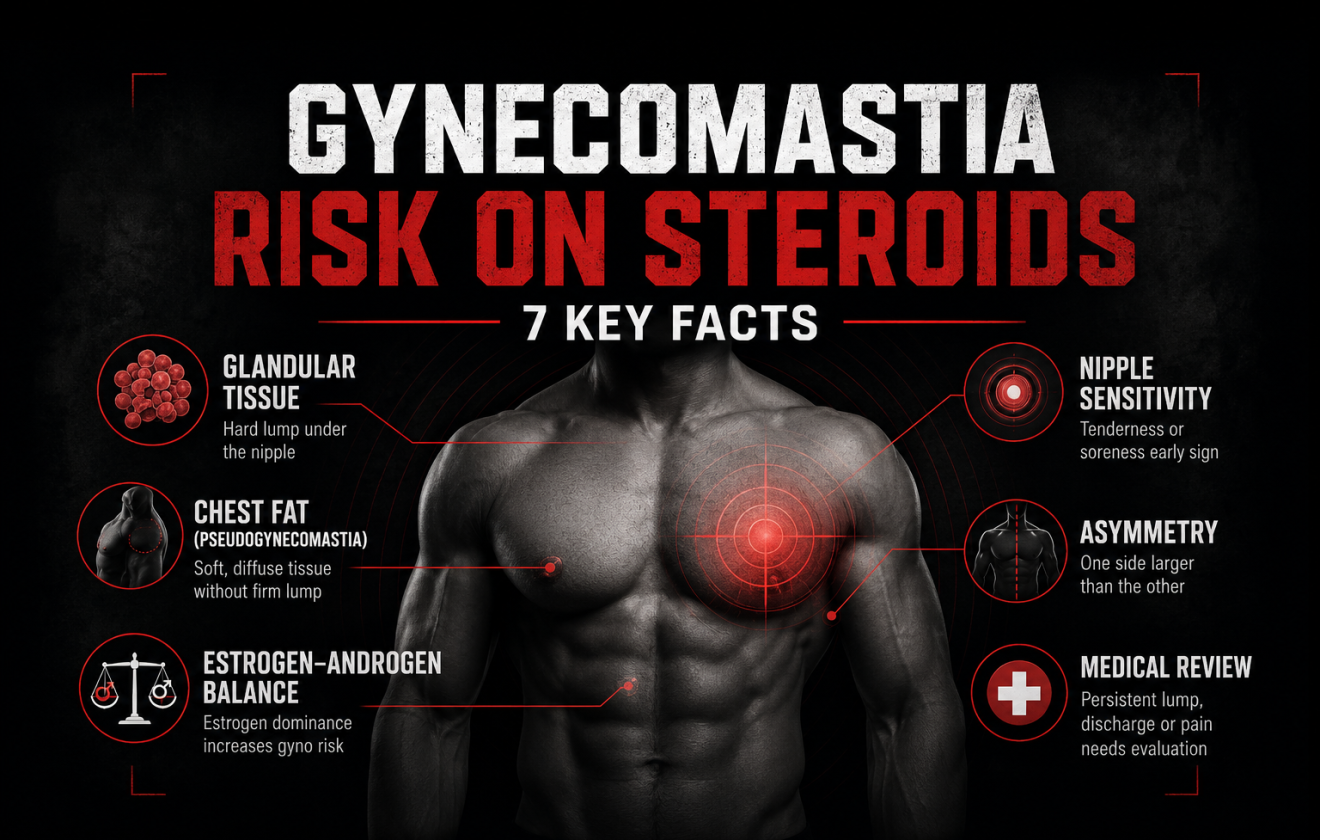
7 Key Facts About Gynecomastia Risk on Steroids
These seven points are the practical framework. They are not a treatment plan. They are the basic logic a serious lifter should understand before turning nipple sensitivity into a panic protocol.
- 1. True gyno is glandular: chest fat, water retention, and puffiness can look similar but are not the same thing.
- 2. Balance matters: risk is strongly tied to estrogen-androgen balance, not estrogen alone.
- 3. Sensitivity is a clue: nipple tenderness deserves attention, but it does not confirm gynecomastia by itself.
- 4. Baseline labs help: without pre-use hormone data, later interpretation becomes weaker.
- 5. Prolactin can add context: it may matter in some cases, but it should not be interpreted blindly.
- 6. Timing matters: new symptoms, persistent changes, and progressive tissue growth are not the same scenario.
- 7. Medical review matters: persistent lumps, discharge, asymmetry, or unclear changes should not be handled through forum advice.
Why Panic Management Can Backfire
The most common online reaction to gyno fear is panic management. A lifter feels nipple sensitivity and immediately assumes estrogen is out of control. Then the conversation turns into aggressive self-management before the person even knows what is happening.
That can backfire. If the issue is not true gynecomastia, the response may be unnecessary. If the issue is estrogen-related but the person overshoots, low estradiol can create its own problems. If the issue involves a mass, discharge, medication effect, or another condition, self-treatment can delay proper evaluation.
This is why the responsible conversation is slower. Track the symptom. Compare with baseline if you have it. Look at hormone context. Pay attention to whether the tissue is changing. Watch for red flags. Use medical review when the issue is persistent, progressive, asymmetric, or unclear.
Why Compound Choice Can Change the Conversation
Different compounds can create different side-effect profiles. Some hormone environments are more estrogenic. Some are more androgenic. Some may involve prolactin discussions. Some add water retention or blood pressure strain that makes symptoms harder to interpret.
That does not mean this article should turn into a compound ranking list. The more important point is that gynecomastia risk is not independent from the larger PED context. What someone is using, how long the exposure has been present, what their baseline looked like, and how their body responds all matter.
Two lifters can run into different outcomes from similar-looking decisions. One may develop nipple sensitivity quickly. Another may never notice breast tissue changes but may have worse blood pressure or lipid issues. Side effects are not evenly distributed.
That is why serious PED education starts with monitoring, not assumptions. If breast-tissue risk is a concern, the conversation should include estradiol, testosterone context, prolactin where relevant, body-fat level, symptom timeline, and medical evaluation when needed.
Body Fat, Aromatase, and Visual Confusion
Body fat can influence the conversation in two ways. First, higher body fat can make the chest look softer and more breast-like even without true glandular enlargement. Second, adipose tissue can be part of the aromatase discussion because aromatase activity exists in fat tissue.
This does not mean body fat explains everything. Lean lifters can still develop breast-tissue issues. Heavier lifters may have visual chest softness without true gland growth. The point is that body composition changes the way the chest looks and can also change the hormone context.
During a fast bulk, the problem becomes even more confusing. A person may gain fat, hold more water, increase sodium, sleep worse, use stimulants, and change hormones at the same time. The mirror becomes a poor diagnostic tool.
A calmer approach is better: track bodyweight, take consistent photos if needed, record symptoms, monitor hormones where appropriate, and avoid treating every visual change as permanent gynecomastia.
When Medical Review Matters
A temporary sensation is one thing. A persistent lump, progressive swelling, one-sided change, discharge, skin changes, pain, or a firm irregular mass is a different conversation. Those situations should be evaluated by a qualified healthcare professional.
Medical evaluation may include history, physical exam, medication review, hormone testing, and sometimes imaging if the clinician thinks it is necessary. The goal is not to scare the reader. The goal is to separate cosmetic anxiety from a real tissue issue and to rule out other causes when the presentation is not straightforward.
Male breast cancer is uncommon, but unusual breast findings should not be dismissed just because the person lifts weights or uses hormones. A firm lump, nipple discharge, skin dimpling, or one-sided progressive change should not be reduced to “probably estrogen.”
- Persistent lump: especially if firm, growing, or one-sided, should be evaluated.
- Nipple discharge: not a normal bodybuilding side effect to ignore.
- Skin changes: dimpling, ulceration, or unusual changes need medical review.
- Progressive asymmetry: one side changing over time deserves closer attention.
- Unclear symptoms: when the issue is not obvious, guessing is weaker than evaluation.
Where Tamoxifen Fits in the Gyno and Man Boobs Conversation
Tamoxifen, often known by the brand name Nolvadex, comes up constantly in discussions about gynecomastia and so-called man boobs. It is a selective estrogen receptor modulator, which means it blocks estrogen’s effect specifically in breast tissue. That mechanism is exactly why it gets mentioned in the context of glandular gyno rather than simple chest fat.
In legitimate medicine, tamoxifen is a prescription drug used under supervision, including for certain cases of gynecomastia, and there is real clinical literature behind that use. That is very different from buying it online and self-treating a lump. Man boobs caused by body fat will not respond to tamoxifen at all, because that is not a glandular-tissue problem - which is precisely why guessing without an assessment wastes time and money.
The educational takeaway here is not a dosing protocol. It is that tamoxifen is a real medication with real effects and real side effects, that it only makes sense for genuine glandular gynecomastia confirmed by a professional, and that timing matters because established, fibrotic gyno responds far less to any medication than early, tender tissue does. Anyone weighing tamoxifen for gyno or man boobs is better served by a doctor’s assessment than by forum advice.
Where Lifters Usually Get Gynecomastia Wrong
The first mistake is assuming every nipple sensation is gynecomastia. Sensitivity can be real and still not prove gland growth. It is a signal to pay attention, not a diagnosis.
The second mistake is assuming every chest-fat issue is hormone-related. If body fat rises, the chest can look worse. That is frustrating, but it is not automatically a breast-tissue disorder.
The third mistake is waiting too long when the issue is clearly progressing. Some lifters panic too early; others ignore obvious changes because they do not want to stop what they are doing or admit something is wrong. Both extremes are common.
The fourth mistake is treating estrogen management like a badge of experience. A person can be aggressive with estrogen control and still misunderstand the issue completely. More intervention does not automatically mean smarter monitoring.
- Panic at first sensitivity: symptoms need context, not instant assumptions.
- Ignoring actual tissue change: progressive lumps or swelling should not be dismissed.
- Confusing fat with gland: pseudogynecomastia and gynecomastia are not the same thing.
- Reading E2 alone: estradiol should be interpreted with testosterone, SHBG, prolactin, timing, and symptoms.
- Using forum protocols: copy-paste advice can create new hormone problems or delay medical review.
How to Think About Gynecomastia Risk Without Guesswork
Gynecomastia risk on steroids is not something to ignore, but it is also not something to manage by panic. The useful middle ground is clear: understand the tissue difference, know your hormone context, track symptoms honestly, and take persistent changes seriously.
Before deeper PED decisions, baseline bloodwork helps. Estradiol, testosterone context, SHBG, prolactin where relevant, body composition, and symptom history all make the interpretation stronger. Without that, people end up arguing from feelings, photos, and random advice.
If a breast-tissue concern becomes persistent, progressive, asymmetric, painful, or unusual, the responsible next step is medical review. The goal is not to overreact. The goal is to avoid guessing when the issue may involve real glandular tissue or another condition that needs evaluation.
For the next step, read the Estradiol (E2) Before Steroids guide, the Blood Tests Before Steroids guide, the Blood Pressure Before Steroids guide, and explore more articles in the PED Side Effects section.
For external reference, review male breast enlargement basics from MedlinePlus, gynecomastia symptom and cause context from Mayo Clinic, diagnostic context from Mayo Clinic, gynecomastia physiology from NCBI Endotext, and estrogen biology in men from NCBI Endotext.
Final Educational Note
Muscle Science is an educational resource. This article is for general information only and does not replace medical advice, diagnosis, treatment, hormone management, emergency care, or care from a qualified healthcare professional.