Hair Loss and DHT on Steroids: Can You Prevent It?
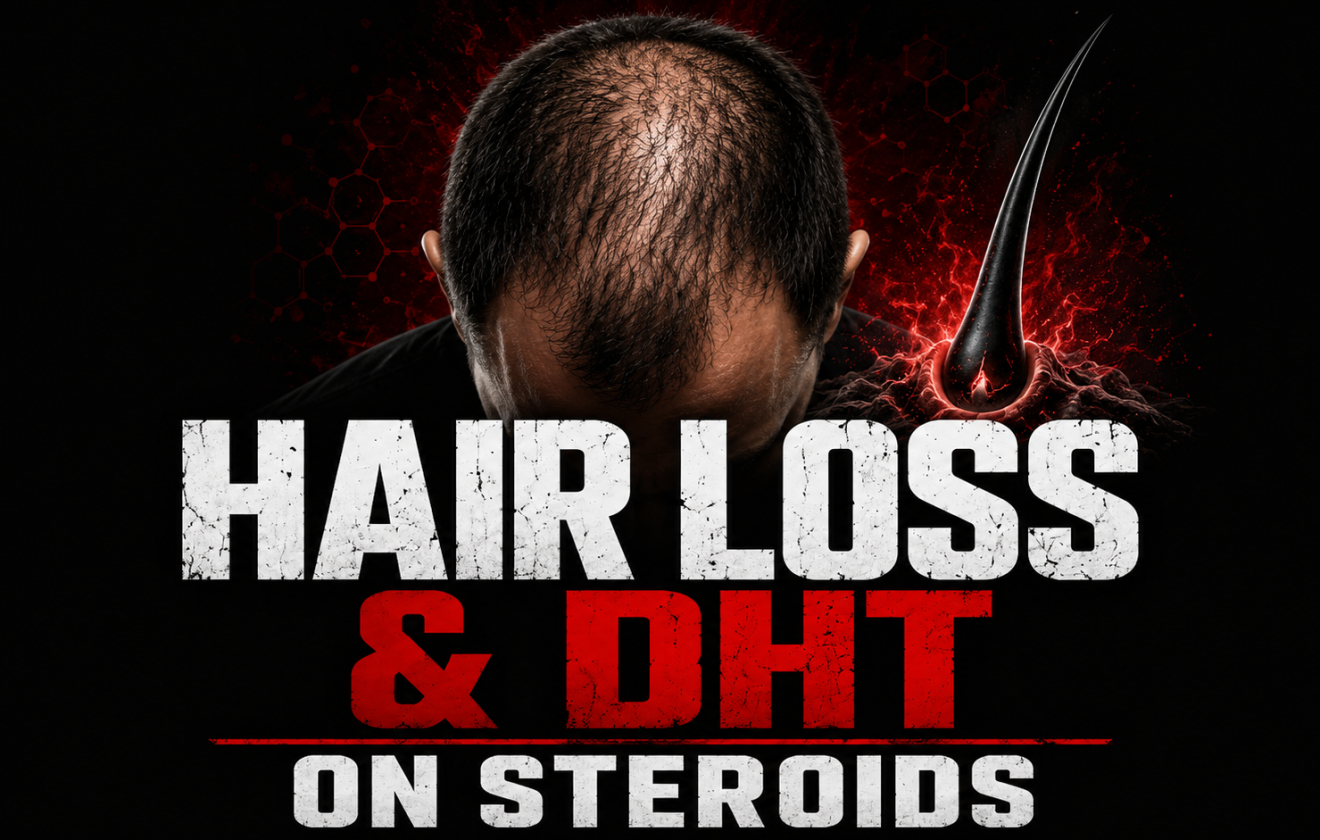
How DHT drives shedding on cycle
Hair loss and DHT on steroids matter because androgen-related shedding can feel sudden, personal, and hard to reverse once a hairline starts changing. The real issue is not simply "DHT is bad." It is the full picture: genetics, scalp sensitivity, androgen exposure, compound choice, hair-follicle miniaturization, and whether a lifter already had male-pattern hair loss beginning quietly in the background.
Hair Loss and DHT on Steroids in Plain Language
Male-pattern hair loss is usually not random. It follows a recognizable pattern because certain scalp follicles are genetically sensitive to androgen signaling. The classic areas are the temples, frontal hairline, and crown. Some men notice slow recession over years. Others feel like everything changed during one aggressive PED phase.
DHT - short for dihydrotestosterone - is one of the main androgens discussed in male-pattern hair loss. It is made from testosterone through the 5-alpha-reductase enzyme. In genetically sensitive follicles, androgen signaling can contribute to miniaturization, where thick terminal hairs gradually become thinner, shorter, and weaker over time.
Steroid use can make this conversation more intense because androgen exposure may rise sharply above normal physiology. But PEDs do not create the same hair outcome in every lifter. Some men keep a strong hairline despite years of use. Others start shedding early because the genetics were already there. That difference is why realistic risk awareness matters more than forum confidence in either direction.
Hair loss risk depends heavily on inherited follicle sensitivity - not just the compound someone uses.
DHT is a key androgen in male-pattern hair loss, but scalp sensitivity is what determines the actual outcome.
Hairline recession, temple thinning, and crown loss suggest androgenetic alopecia rather than temporary shedding.
What This Hair Loss Guide Covers
This guide explains how DHT fits into steroid-related hair-loss risk, why genetics matter, what follicle miniaturization means, how shedding differs from pattern progression, and why some lifters should take hair risk seriously before experimenting with stronger androgen exposure.
It does not provide hair-loss treatment protocols, medication instructions, finasteride guidance, minoxidil routines, transplant advice, or personal medical decisions. Hair loss can involve androgenetic alopecia, stress shedding, scalp disease, thyroid issues, nutritional problems, medication effects, autoimmune conditions, and other causes. A dermatologist is the right professional when the pattern is unclear or progressing.
- Covered: DHT, androgen sensitivity, male-pattern hair loss, follicle miniaturization, shedding, genetics, compound context, and when dermatology review matters.
- Not covered: drug protocols, treatment dosing, hair-transplant advice, personal diagnosis, or promises about preventing steroid-related hair loss.
- Best use: read this as part of the PED Side Effects education series before assuming your hairline will respond the same way as someone else's under similar androgen exposure.
What DHT Is and Why Lifters Talk About It
DHT is a potent androgen produced from testosterone by the enzyme 5-alpha-reductase. It has important roles in male biology, especially during development, but it is also heavily discussed in hair-loss contexts because of its relationship with androgenetic alopecia in susceptible men.
In hair-loss conversations, DHT is not just a blood number. The scalp response matters as much as the DHT level itself. Two men can have different hair outcomes with similar hormone environments because their follicles do not have the same sensitivity. That is why one lifter runs into hairline changes early while another seems untouched by comparable androgen exposure. The same variation applies to estradiol balance - shifts in the testosterone-to-estradiol ratio during a cycle can also affect the broader hormonal picture, as covered in the Estradiol Before Steroids guide.
The scalp follicles most involved in male-pattern hair loss are not spread evenly across the head. The back and sides are usually more androgen-resistant. The frontal hairline, temples, and crown are more commonly affected. This is why male-pattern hair loss has a recognizable geometric shape rather than thinning every area equally.
DHT Is Not the Whole Story
It is tempting to reduce everything to "DHT causes hair loss." The more accurate version is more specific: in genetically susceptible people, androgen signaling can drive progressive miniaturization in sensitive scalp follicles. DHT is important, but genetics and follicle response decide how much that biological reality actually matters for a given individual.
Serum DHT Is Not the Same as Scalp Sensitivity
A normal-looking blood test does not guarantee a safe hairline. Local tissue activity, receptor sensitivity, enzyme expression, genetics, inflammation, and cumulative time under androgen exposure can all matter independently. Hair loss is not always explained cleanly by one lab value on a panel.
Male-Pattern Hair Loss Is Usually Genetic
The most important point is also the one many lifters dislike hearing: male-pattern hair loss is strongly genetic. PEDs may accelerate the visible process in someone who is already susceptible, but they do not affect every person equally regardless of what they use.
A man with strong family history, early temple recession, crown thinning, or fine miniaturized hairs at the hairline should not treat hair risk as theoretical. He may already be in the early phase before PEDs ever enter the picture. Higher androgen exposure can make a quiet existing pattern significantly more obvious and faster-moving.
A man with no visible recession and low family history is not guaranteed protection either, but his risk picture may be genuinely different. Genetics are not always obvious. Sometimes the pattern appears later than expected. Sometimes family members shaved early or never discussed hair loss, making the history harder to read accurately.
Miniaturization Is Different From Normal Shedding
Everyone sheds hair. Seeing hair in the shower, on a pillow, or in a brush does not automatically mean permanent balding. Normal shedding happens as part of the hair growth cycle. Stress, illness, aggressive dieting, poor sleep, thyroid issues, nutrient problems, and major physiological changes can all increase shedding temporarily.
Miniaturization is different. In androgenetic alopecia, affected follicles gradually produce thinner and shorter hairs over repeated growth cycles. The hairline becomes less dense, the temples become weaker, and the crown can start looking transparent under direct light. That slow process is far more meaningful than a bad week of shedding after a stressful training block.
The difference matters because lifters often panic over shedding while ignoring miniaturization. A shower drain photo may look alarming, but the real question is whether hair density, hair diameter, and pattern are changing over time. That requires consistent observation under consistent lighting - not daily emotional checking in different bathroom mirrors.
- Shedding: more hairs falling than usual, sometimes temporary and related to stress, illness, dieting, or hormonal shifts.
- Miniaturization: progressive thinning of affected hairs in the hairline, temples, or crown - the more important long-term signal.
- Pattern change: recession or crown thinning over time suggests androgenetic alopecia more reliably than random shedding alone.
- Density loss: scalp becoming more visible under consistent lighting is often a more useful signal than counting individual hairs.
How Steroids Can Change the Hair-Loss Conversation
Steroid use can raise androgen exposure beyond normal physiology. For hair-sensitive men, that can make an existing genetic tendency show up faster and more visibly. The issue is not just "will this compound make me bald?" It is "how sensitive are my follicles, what is my baseline, and how much androgenic pressure am I adding on top of what was already there?"
Some compounds are discussed as more hairline-unfriendly because of their androgenic character or because of how they interact with DHT conversion pathways. But ranking compounds in a simple list can mislead. Dose exposure, duration, stacking, individual conversion rates, baseline hair status, and genetics all interact to change the outcome - which is why the same compound affects different men differently. Understanding the baseline marker picture before any cycle starts is the relevant starting point; the Blood Tests Before Steroids guide covers that foundation.
The same user may also confuse other problems with steroid-related androgenic loss. A harsh calorie cut, poor sleep, illness, thyroid dysfunction, iron issues, stress, or scalp inflammation can also cause shedding independent of androgens. That does not mean androgens are irrelevant. It means the full situation needs to be examined honestly, not blamed on the most obvious variable.
Serious risk awareness starts before the cycle. Look at the temples. Look at the crown. Ask what happened to close male relatives. Take consistent photos under the same lighting. If recession has already started, do not pretend the risk is still abstract.
Do Anavar and Winstrol Cause Hair Loss?
Anavar (oxandrolone) and Winstrol (stanozolol) come up more than almost any other compounds in hair-loss questions, and for a specific reason: both are DHT-derived oral steroids. Because male-pattern hair loss is driven largely by DHT’s effect on genetically sensitive follicles, DHT-based compounds like anavar and winstrol are widely reported to speed up shedding in people who are already prone to it.
The important nuance is that neither anavar nor winstrol creates hair loss out of nothing. Someone with no genetic predisposition can often run them with little or no change to their hair, while someone already miniaturizing can see a noticeable acceleration. Their reputation is less about being uniquely toxic to hair and more about being androgenic orals that push an existing, genetic process along faster. Winstrol in particular carries a strong anecdotal reputation for shedding, though individual response varies widely.
If your hair matters to you, the practical framing is honest risk assessment rather than compound superstition. Knowing your family history, watching the hairline and crown for early miniaturization, and understanding that DHT-derived compounds like anavar and winstrol tend to be higher-risk for sensitive individuals is far more useful than assuming any single drug is safe or catastrophic. As always, this is educational context, not a recommendation to use these compounds - and a dermatologist can assess real hair-loss risk far better than a label on a bottle.
7 Key Facts About Hair Loss and DHT on Steroids
These seven points summarize the practical framework. They are not treatment instructions. They are the basic logic a lifter should understand before assuming hair loss is either guaranteed or impossible based on compound choice alone.
- 1. Genetics lead the risk: inherited follicle sensitivity is the biggest reason some men lose hair faster than others under the same exposure.
- 2. DHT matters: DHT is strongly involved in male-pattern hair loss, especially in scalp follicles that are already genetically sensitive.
- 3. Androgen exposure matters: steroid use can increase the pressure on already vulnerable follicles, accelerating a process that was already present.
- 4. Shedding is not always balding: temporary shedding and long-term follicle miniaturization are fundamentally different problems with different implications.
- 5. Pattern tells a story: temples, frontal hairline, and crown changes deserve more attention than random shedding alone.
- 6. Compounds do not affect everyone equally: two lifters can use similar compounds and have very different hair outcomes based on genetics.
- 7. Early review matters: if preserving hair is important, a dermatologist should be involved before major progression - not after the damage is done.
Signs a Lifter May Be More Hair-Sensitive
The clearest signal is family history. If close male relatives developed early recession, crown thinning, or obvious male-pattern baldness, the risk deserves respect. Family history is not a perfect prediction, but ignoring it is wishful thinking rather than risk management.
The second signal is the personal baseline. If the temples are already moving back, the frontal line is becoming uneven, or the crown looks thinner in harsh overhead light, the process may already be active. Higher androgen exposure from PED use may make a change that was already in motion significantly more noticeable.
The third signal is hair miniaturization. Short, fine, weak hairs around the hairline can suggest that follicles are already producing thinner hairs - a different situation from simply having a mature hairline at the same frontal position. A dermatologist can evaluate this more accurately than bathroom lighting and amateur self-assessment.
- Family history: early balding in close male relatives raises meaningful concern worth taking seriously.
- Temple recession: progressive change over time is more important than the exact hairline position on any one day.
- Crown thinning: overhead photos under consistent lighting can reveal density changes early before they become obvious.
- Miniaturized hairs: finer, shorter hairs near the hairline can signal follicle sensitivity even before dramatic recession.
- Rapid change after exposure: sudden visible loss during high androgen stress deserves prompt attention rather than dismissal.
Why Compound Choice Is Not the Only Factor
Lifters often ask which steroid is safest for the hairline. That question sounds simple, but real physiology is not simple. A compound's androgenic profile matters, but the user's scalp sensitivity matters equally. So do duration, total exposure, stacking decisions, and whether the person already had active pattern loss at the time of use.
Some users get into trouble because they think "hair safe" means "hair risk impossible." Others assume one compound's bad reputation means every user will lose hair immediately. Both views are too binary. The hairline response is individual and not fully predictable from compound reputation alone.
Another issue is stacking. A lifter may blame one compound while ignoring the total androgen load from the full protocol. Hair follicles do not care which forum label was attached to the plan. They respond to the biological environment they are exposed to - the total androgenic pressure, not the name of the bottle.
This is why the responsible educational position is not to promise a hair-safe pathway. It is to explain that hair risk should be judged from baseline, family history, scalp sensitivity, and realistic exposure assessment rather than wishful thinking about specific compounds.
Why Hair Loss Feels Sudden Even When It Is Not
Many men notice hair loss only after it becomes clearly visible in photos or mirrors they have not paid attention to before. That can make the change feel sudden and shocking. In reality, miniaturization may have been progressing quietly for months or years before the person started watching closely.
PED use often becomes the moment a lifter starts watching closely. He checks the mirror more often, takes more progress photos, changes the lighting, wears different hairstyles, and becomes acutely aware of every hair in the sink. That heightened attention can make old gradual changes feel like they appeared overnight.
At the same time, steroids can genuinely accelerate visible loss in susceptible people. Both things can be true simultaneously: a pattern may have already existed quietly, and stronger androgen exposure may make it progress faster. The point is not to blame everything on PEDs or to ignore their role. The point is to think clearly and honestly about both possibilities.
Other Causes Can Make Hair Loss Look Worse
Not all hair loss during a PED phase is purely DHT-driven androgenetic alopecia. Aggressive dieting, illness, stress, poor sleep, thyroid problems, low iron status, medication changes, scalp inflammation, and rapid weight changes can all affect shedding independently.
This matters because lifters sometimes misread every hair change through a single androgenic lens. If the timing overlaps with a harsh calorie cut, high training stress, poor recovery, or new medication, the picture may involve more than androgenetic alopecia. Understanding what was happening in overall health around the time of shedding is part of honest self-assessment. The habit of tracking health markers - as in the approach covered by the Bloodwork & Health hub - creates a baseline that makes it easier to separate causes later.
Scalp health also matters on its own. Itching, scaling, redness, inflammation, or patchy loss should not be dismissed as normal male-pattern hair loss. Those signs may point toward dermatologic issues - folliculitis, seborrheic dermatitis, alopecia areata, or other conditions - that need proper evaluation rather than assumptions.
- Diet stress: aggressive calorie cuts can increase shedding in some people through nutritional and hormonal stress.
- Illness or acute stress: major physiological stress can push hair follicles into a shedding phase temporarily.
- Thyroid or nutrient issues: medical causes can contribute to hair changes independent of androgens.
- Scalp inflammation: redness, scaling, or irritation needs proper dermatology context, not a guess.
- Patchy or unusual patterns: non-androgenetic patterns should be reviewed medically rather than self-diagnosed.
When a Dermatologist Makes Sense
If hair preservation matters, waiting until the hairline is heavily changed is a poor strategy. Dermatologists can evaluate pattern, miniaturization, scalp condition, and whether the issue looks like androgenetic alopecia or something else entirely - and earlier evaluation tends to leave more options available.
A dermatologist may use history, physical exam, scalp evaluation, photos, or sometimes lab work depending on the case. The point is not that every lifter needs a medical appointment for one bad hair day. The point is that progressive or unclear hair loss is significantly easier to address early than after months of visible change.
This is especially true for men who already see recession, crown thinning, or family-history risk before PED exposure ever begins. If someone knows hair preservation is important to them, the responsible move is to get proper context before making decisions that could accelerate a pattern they cannot emotionally accept.
Where Lifters Usually Get Hair Loss Wrong
The first mistake is thinking hair loss is only about the compound. Compound choice matters, but genetics and scalp sensitivity often matter more. A person with high follicle sensitivity can run into problems quickly even on compounds with a milder androgenic reputation. A person with low sensitivity may tolerate much more before seeing visible changes.
The second mistake is waiting too long while pretending the hairline is fine. Men often notice early recession but delay taking it seriously because they do not want to confront the possibility. By the time the change becomes obvious and undeniable, the process may be much harder and more expensive to address.
The third mistake is panic-checking. Checking the mirror every hour under different lights makes anxiety worse and does not create better data. Consistent photos, objective comparison over weeks and months, and professional evaluation are far more useful than daily emotional checking.
The fourth mistake is confusing temporary shedding with permanent pattern loss. Shedding can be dramatic but not always permanent. Miniaturization is the bigger long-term concern. A dermatologist can help separate these patterns when the answer is not obvious from self-assessment.
- Blaming one compound only: total androgen exposure and individual genetic sensitivity matter at least as much as compound reputation.
- Ignoring family history: close relatives with early balding are a real warning sign, not background noise.
- Watching too late: hairline and crown changes are significantly easier to address in early stages than late ones.
- Panic-checking daily: inconsistent lighting and daily anxiety create poor judgment and poor data.
- Skipping dermatology review: unclear or progressive hair loss deserves professional evaluation, not forum advice.
Dermatology and Research Resources on Hair Loss
The following sources provide additional clinical background on male-pattern baldness, androgenetic alopecia genetics, DHT pathways, and hair-loss treatment context for readers who want to go deeper into the evidence base.
How to Think About Hair Risk Without Guesswork
Hair loss and DHT on steroids should be viewed as a risk-awareness topic - not a guarantee and not a myth. Some lifters are highly vulnerable. Some are not. The difference usually comes down to genetics, follicle sensitivity, baseline pattern, and cumulative androgen exposure over time.
Before deeper PED decisions, a lifter who cares about hair should check his baseline honestly. Look at the temples, frontal line, and crown. Review family history. Take consistent photos under the same lighting. If there is already recession or crown thinning, the risk is not abstract - it is already in motion.
If hair loss is progressing, patchy, inflamed, sudden, or emotionally distressing, medical review is the smarter path than forum research. The goal is not to panic. The goal is to stop guessing and understand whether the issue is androgenetic alopecia, temporary shedding, scalp disease, or another health-related cause.
Continue with the PED Side Effects hub for all side-effect education articles. Review the Gynecomastia Risk on Steroids guide for another androgen-driven side effect to understand before PED exposure. Read the Estradiol Before Steroids guide for the hormonal context around androgen cycles. Use the Blood Tests Before Steroids guide for baseline monitoring. Use the Start Here page to find the right reading path.
Final Educational Note
Muscle Science is an educational resource. This article is for general information only and does not replace dermatology care, medical advice, diagnosis, treatment, hormone management, emergency care, or care from a qualified healthcare professional.