Estradiol on TRT: 6 Facts on Your E2 Sweet Spot
Estradiol on TRT
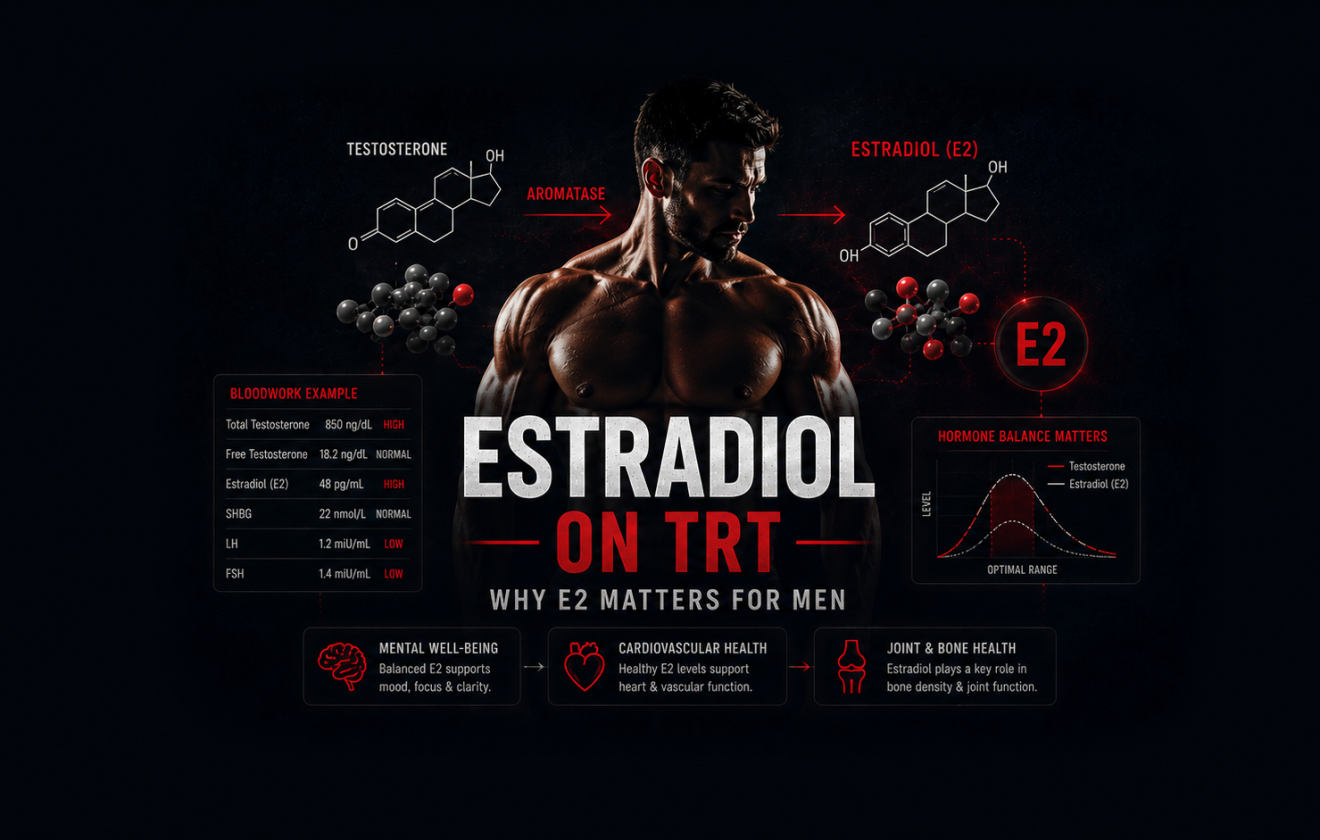
Estradiol on TRT is the estrogen your body makes by converting some of your testosterone, and it matters far more than most men realise. When you inject testosterone, an enzyme called aromatase turns a share of it into estradiol (E2). That estradiol is not a bug to be eliminated - it is essential for libido, erections, mood, bone strength and healthy joints. The goal on TRT is not zero estrogen; it is estradiol in a comfortable middle range.
The trap most men fall into is treating estradiol as the enemy and crashing it with an aromatase inhibitor. Crashed E2 feels just as bad as high E2 - often worse. This guide shows the sweet spot with real numbers, explains high and low symptoms, includes a tool to interpret your own labs, and covers the assay detail that trips up half the men reading their results wrong.
What estradiol is and why it rises on TRT
Estradiol is the main form of estrogen in the male body. Men need it, just in smaller amounts than women. It is produced when the enzyme aromatase converts testosterone into estradiol, mostly in fat tissue. So the more testosterone you have circulating, the more raw material there is to aromatise - which is exactly why estradiol on TRT tends to climb once you start injecting.
How much it rises depends on your dose, your body fat and your genetics. Higher testosterone doses give aromatase more to work with, more body fat means more aromatase activity, and some men simply aromatise more than others. The chart below shows the general trend: as the weekly testosterone dose goes up, estradiol tends to follow.
This is normal and expected. A rise in estradiol on TRT is not automatically a problem - it only becomes one if it climbs high enough to cause symptoms, or if someone panics and crashes it. The skill is reading the level against how you actually feel.

The estradiol sweet spot on TRT
There is no single perfect number, but there is a range where most men feel best. On a sensitive estradiol assay, that sweet spot is roughly 20 to 40 pg/mL. Inside this band, estradiol supports strong libido, stable mood, good erections and healthy bones and joints, while staying low enough to avoid the bloat and moodiness of high E2.
The key idea is the inverted-U shown in the chart: drive and well-being are low when estradiol is crashed, climb to a peak in the middle, and fall again when it runs too high. Both ends of the curve feel bad. Your personal sweet spot may sit a little higher or lower than the next man's, which is why symptoms matter more than chasing an exact figure.
Crucially, if you feel great and your estradiol reads 45 or 50, that is usually fine - you do not treat a number you cannot feel. The range is a guide, not a target to force with drugs.

High estradiol symptoms on TRT
When estradiol climbs too high on TRT, the classic signs are water retention and a puffy, smooth look, emotional volatility or moodiness, softer or less reliable erections, and sometimes sensitive or itchy nipples. Blood pressure can nudge up with the extra fluid. Many men first notice it as feeling bloated and a bit off despite testosterone being right where they want it.
High estradiol is usually driven by a higher dose, higher body fat, or simply strong personal aromatisation. The best first moves are often the least dramatic: trim the dose, lose some body fat, and re-test. Reaching straight for an aromatase inhibitor is how men over-correct into a crash, which is a worse place to be.
It is also worth knowing that plenty of men feel perfectly fine at estradiol levels a textbook would call high. If you have no symptoms, a high-ish number on its own is rarely a reason to intervene.
There is one genuine exception worth respecting: a small number of men are prone to gynecomastia, and persistent high estradiol with breast tenderness or a growing lump under the nipple is a real reason to act rather than wait. Even then, the response is a considered, blood-test-confirmed reduction in estradiol, not a panic dose of aromatase inhibitor. Knowing your own history - whether you have ever reacted badly to high estrogen before - helps you judge how closely to watch it.
Low estradiol on TRT can feel just as bad
This is the half of the story the clinics obsessed with high estrogen leave out. Crashed estradiol on TRT is genuinely miserable and, in many ways, worse than running a little high. Below roughly 20 pg/mL men report aching, dry, cracking joints, a completely dead libido, weak erections, a flat and joyless mood, dry skin and poor recovery.
On TRT, low estradiol is almost always self-inflicted - the result of an aromatase inhibitor taken when it was not needed or dosed too heavily. The cruel part is that these symptoms mimic low testosterone, so men often respond by raising their dose, which does nothing because the real problem is that they have crushed their estrogen.
The fix is simple once the cause is clear: stop or sharply reduce the aromatase inhibitor and let estradiol climb back into range, which usually restores how you feel within one to two weeks. Estrogen is not the enemy; crashing it is.
Interpret your own estradiol
Enter your numbers below. The tool classifies your estradiol as low, optimal or high for a man on TRT and shows your testosterone-to-estradiol ratio, so you can read your labs against how you feel.
Estradiol Interpreter
Drag the sliders (or type) to set your sensitive-assay estradiol and total testosterone, and see where your E2 sits plus your testosterone-to-estradiol ratio. Educational only, not a dosing tool.
Use it as a starting point for a conversation with your prescriber, not a reason to self-medicate. And remember the golden rule of estradiol on TRT: treat symptoms, not the number alone.
The testosterone-to-estradiol ratio
Some men and clinicians look beyond estradiol alone to the testosterone-to-estradiol ratio - total testosterone in ng/dL divided by estradiol in pg/mL. The thinking is that estradiol should scale with testosterone, so a very high testosterone with a modest estradiol can feel different from a normal testosterone with the same estradiol.
As a rough orientation, ratios in the low tens (for example a total testosterone of 700 and an estradiol of 30 gives about 23) are common in men who feel well, while a much lower ratio can accompany relatively high estrogen. The interpreter above calculates this for you.
Treat the ratio as a supplementary clue, not gospel. It is not a validated clinical target, the numbers shift with the assay used, and symptoms still outrank any ratio. But it is a useful extra lens that most estradiol-on-TRT guides never mention.
High vs low estradiol on TRT at a glance
High and low estradiol pull you in opposite directions and come from different causes. The zones chart and table below lay it out:

| On TRT | Low estradiol | High estradiol |
|---|---|---|
| Testosterone reads | Often normal or high | Often normal or high |
| Libido | Low, dead drive, weak erections | Can dip; erections may soften |
| Mood | Flat, joyless, irritable | Emotional, weepy, moody |
| Body | Aching, dry, cracking joints; dry skin | Water retention, puffiness, bloat |
| Common cause | Too much aromatase inhibitor | High dose, high body fat, no management |
| The fix | Stop/cut the AI; let E2 recover | Lower dose or body fat; small AI only if confirmed |
Notice how many symptoms overlap with each other and with low testosterone - which is exactly why you test estradiol rather than guess from feel alone.
How and when to test estradiol on TRT
An estradiol result is only useful if it is measured and timed correctly. Follow this sequence:
- 1
Use the sensitive assay
Always order the sensitive or ultrasensitive (LC-MS/MS) estradiol test, not the standard immunoassay. On the male range the standard test can read falsely high and send you chasing estrogen that was never elevated.
- 2
Test at trough, consistently
Draw your bloodwork at trough - just before your next injection - and keep the timing consistent between tests. Estradiol tracks your testosterone, so the same protocol sampled at peak versus trough gives very different numbers.
- 3
Pair it with total testosterone
Order estradiol alongside total testosterone so you can read the two together and see your testosterone-to-estradiol ratio. Estradiol in isolation tells you less than estradiol next to the testosterone that produced it.
- 4
Change one thing, then re-test
If you adjust your dose, body fat or an aromatase inhibitor, give it several weeks and re-test before adjusting again. Estradiol on TRT moves slowly, and stacking changes hides what actually worked.
Do that and your estradiol numbers become genuinely useful instead of a source of needless panic.
Why the wrong estradiol test misleads men
Here is the detail that sends countless men down the wrong path. There are two common ways to measure estradiol: the standard immunoassay and the sensitive (LC-MS/MS) assay. The standard test was designed for the higher estradiol ranges seen in women and is widely regarded as unreliable at the low male range, where it can read falsely high.
A man who gets a standard estradiol test, sees an alarming-looking number, and reaches for an aromatase inhibitor may be crashing a perfectly normal estrogen based on a bad measurement. On TRT you want the sensitive or ultrasensitive estradiol assay every time, and you should compare results only against sensitive-assay ranges.
If your report just says “estradiol” with no method noted, ask which assay was used before you act on it. This single detail separates a useful panel from a misleading one, and almost none of the mainstream estradiol-on-TRT explainers stress it.
When an aromatase inhibitor actually makes sense
Aromatase inhibitors such as anastrozole do have a place, but a much smaller one than the internet suggests. They make sense when a sensitive estradiol test confirms a genuinely high level and you have real symptoms of high estrogen that have not responded to lowering the dose or body fat. They do not make sense as a routine, just-in-case add-on to every TRT protocol.
If an AI is genuinely warranted, the guiding principle is to use as little as possible. Tiny doses, taken infrequently, adjusted slowly and re-checked with bloodwork, are far safer than a standing dose that quietly crashes estradiol over weeks. Many men who think they need an AI simply need a slightly lower testosterone dose.
The bottom line for estradiol on TRT is balance, not elimination. Dose and interpret to how you feel, confirm with the right blood test, and remember that a man with crashed estrogen is worse off than one whose estradiol sits a little high.
Frequently asked questions
What is a good estradiol level on TRT?
For most men, roughly 20 to 40 pg/mL on a sensitive assay is the sweet spot for libido, mood and joints. It is a guide, not a hard target - if you feel great slightly outside it, that is usually fine.
Why does estradiol rise on TRT?
Because the enzyme aromatase converts some of your injected testosterone into estradiol, mainly in fat tissue. Higher doses, higher body fat and personal genetics all push estradiol on TRT higher.
Do I need an aromatase inhibitor on TRT?
Usually not. An AI only makes sense when a sensitive estradiol test confirms a high level and you have real high-E2 symptoms that did not improve with a lower dose or less body fat. Routine AI use is the most common way men crash their estrogen.
What does crashed (low) estradiol feel like?
Aching, dry, cracking joints, a dead libido, weak erections, a flat mood and poor recovery - often worse than high estradiol. On TRT it is almost always caused by too much aromatase inhibitor.
Which estradiol test should I use on TRT?
The sensitive (LC-MS/MS) or ultrasensitive assay. The standard immunoassay is unreliable at the male range and can read falsely high, leading men to treat estrogen that was never actually elevated.
Should I treat the number or my symptoms?
Your symptoms. Estradiol on TRT is best judged by how you feel, using the lab number and the sweet-spot range as context. Many men feel great at a level a chart calls high, and treating a symptom-free number usually causes harm.
References
- Finkelstein JS et al. Gonadal steroids and body composition, strength, and sexual function in men. N Engl J Med, 2013 - shows estradiol, not just testosterone, drives libido and body fat in men.
- Schulster M et al. The role of estradiol in male reproductive function. Asian J Androl, 2016 - estradiol's role in libido and erectile function.
- Rosner W et al. Utility, limitations, and pitfalls in measuring testosterone: an Endocrine Society position statement. J Clin Endocrinol Metab, 2007 - why immunoassays are unreliable at low ranges (assay accuracy).
- Vandenput L, Ohlsson C. Estrogens as regulators of bone health in men. Nat Rev Endocrinol, 2009 - estradiol and male bone density.
- Bhasin S et al. Testosterone therapy in men with hypogonadism: an Endocrine Society clinical practice guideline. J Clin Endocrinol Metab, 2018 - monitoring and interpretation on TRT.
On TRT, aim estradiol at a sweet spot, not at zero
Estradiol on TRT is essential, not the enemy: it drives libido, mood, erections and bone and joint health. Most men feel best around 20 to 40 pg/mL on a sensitive assay, with both crashed and very high estradiol feeling poor. Use the sensitive test, judge by symptoms rather than the number alone, and reach for an aromatase inhibitor only when a confirmed high level and real symptoms justify it - because crashed estrogen is worse than estrogen that sits a little high.